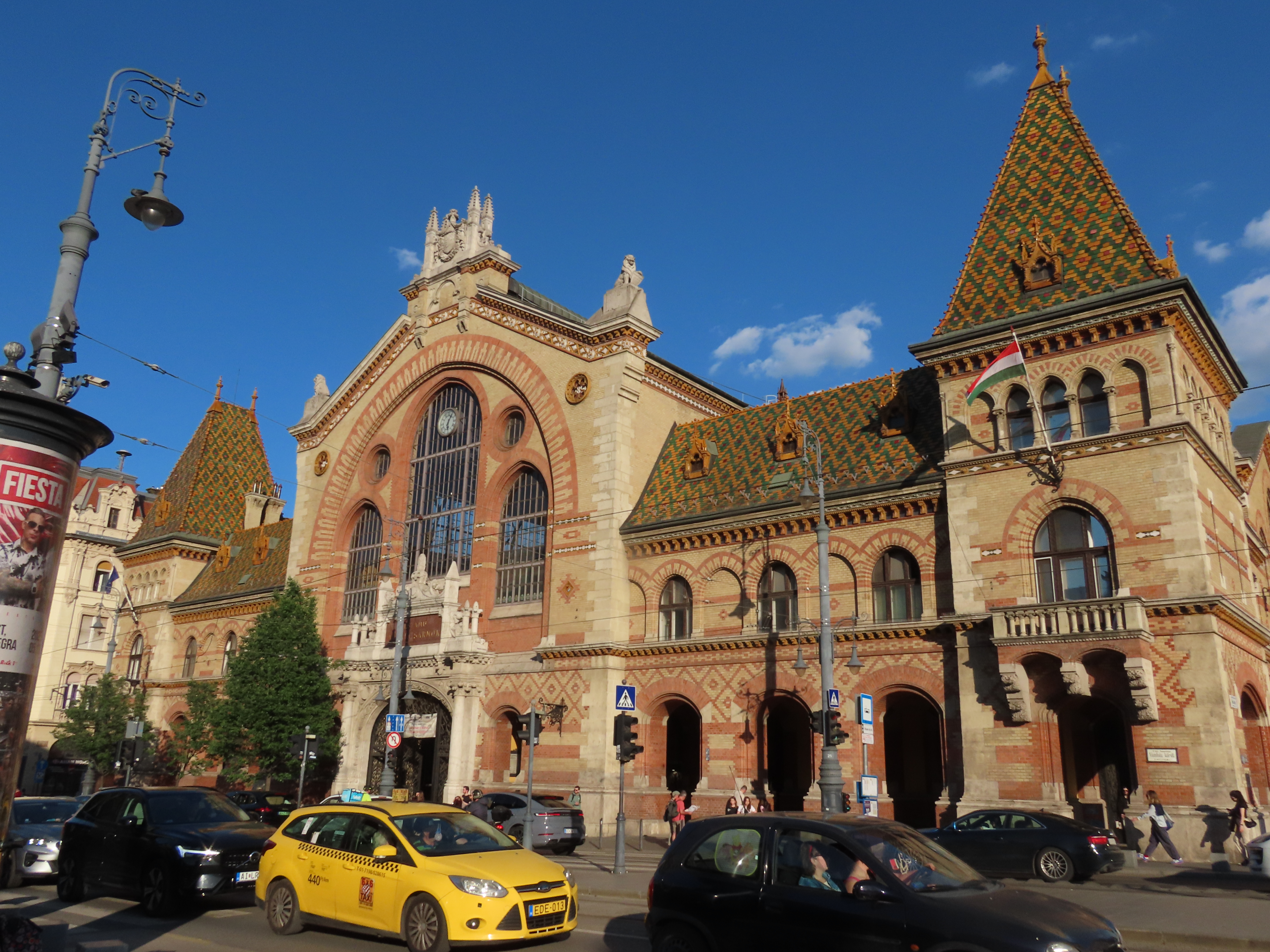
I could not believe the main item on my shopping list in Budapest was paprika and here we were in the iconic Central Market Hall buying it by the bushels. (What have I come to?!) The smiling sales lady did not seem surprised, guiding us adeptly through the different varieties and with a surreptitious look around I realised I was not the only Indian around. Have we lost taste for our homegrown fiery chillies? Sacrilege!! But, traditional Hungarian goulash would be just another stew without that smoked paprika…
For me, in Europe the number one destination had always been Budapest and then Prague but when the man suggested adding it, as rather an appendage to a packed itinerary, I was reluctant but in the spirit of carpe diem I agreed. Budapest was a blur of 24 hours and we made the most of them, planning smartly. Sprinkled with a liberal dose of serendipity, like the paprika in the goulash, it turned out be a special sampling!
By the Danube
The hilly Buda and the flat Pest, conjoined names with distinct entities came together as one entity only as late as the 18th century to form one of Europe’s biggest capitals. Imagine the sprawl of the city which houses almost one third of Hungary, which once, along with Vienna was the co-capital of the Austro-Hungarian empire. The Turks also ruled here, their legacy the famous hammams or baths that channelize the natural springs spouting healing waters here.
With absolute paucity of time, walking was unfortunately the first to take a leap out of the window. Budapest, like all European cities has a plethora of good walking tours to choose from but none matched our time there. What we took instead, was a 24 hour pass that gave us seamless access to the metro and trams and buses.
Got a ticket for a ride
The afternoon we arrived we spent in Buda side and the following morning we explored the Pest Castle Quarter, not wasting time in doing to and fro.
Szia Budapest
We reach Budapest at noon, willing to get into the expensive cab ride from the railway station to our stay but no one is willing to take us. So, back we go into the station and down to the metro underneath it. A tram ride and a short walk follows, bringing us to our accommodation in District V. Quickly settling into the spacious apartment where a very thoughtful personal note for the man has been kept, we head out.
Pitter-Patter Pattern
Minarets and Markets
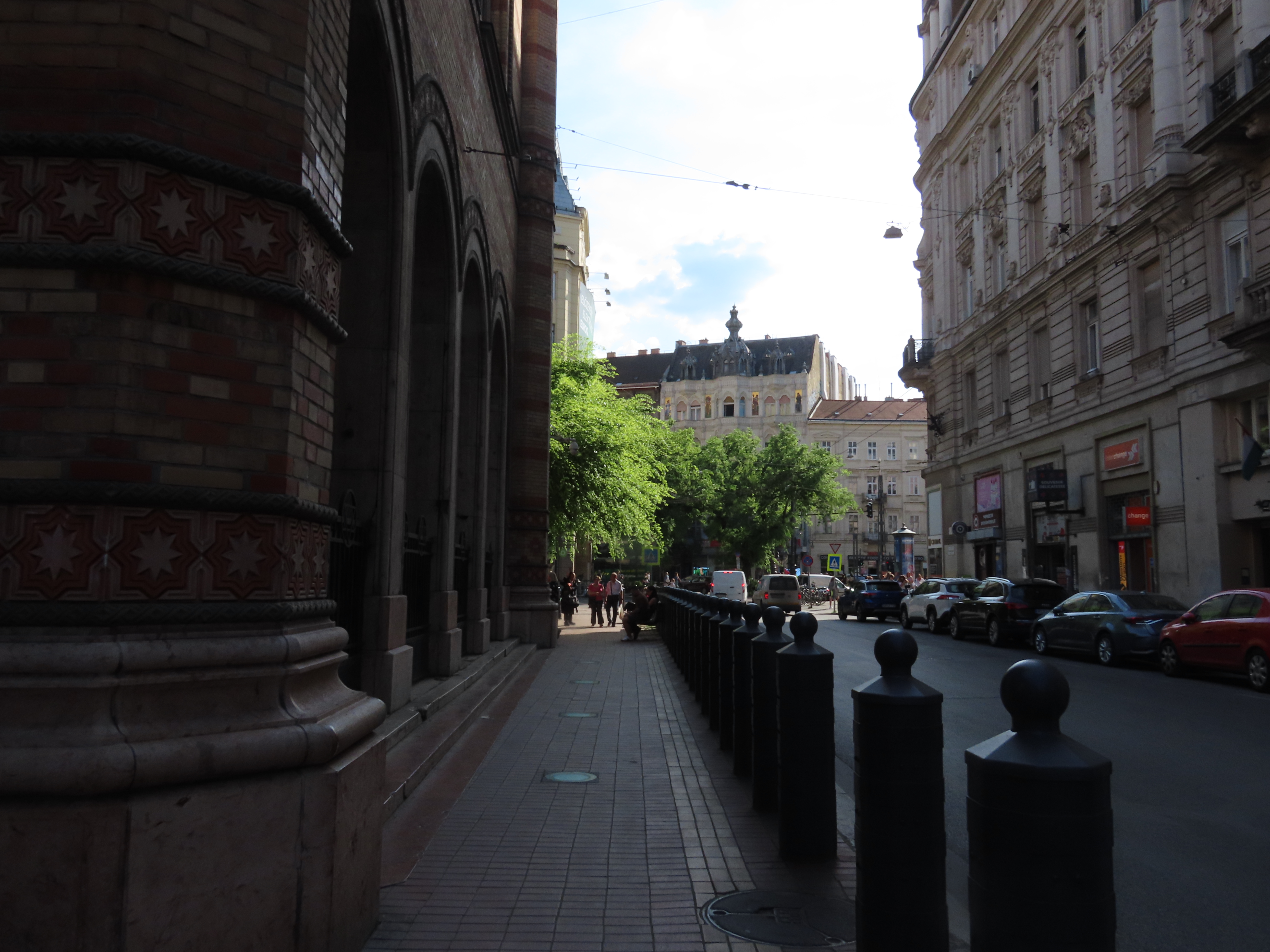
In the bustling streets of District V we discover there are enough restaurants and grocers catering for familiar, closer-to-home palate. At a crowded square we find thronging groups being taken inside a distinctly Moorish brick building. We stop to admire at the Dohany Street Synagogue, the biggest in Europe. With its onion domed minarets and exposed brick finish, it is unlike anything around. Made in the last century, it served the huge local Jew population and in the Second World War it marked the edge of the Jewish ghetto. Today it feels like a pilgrimage place with the complex housing a functional synagogue, a museum, a holocaust memorial amongst other parts.
Ghetto Lines
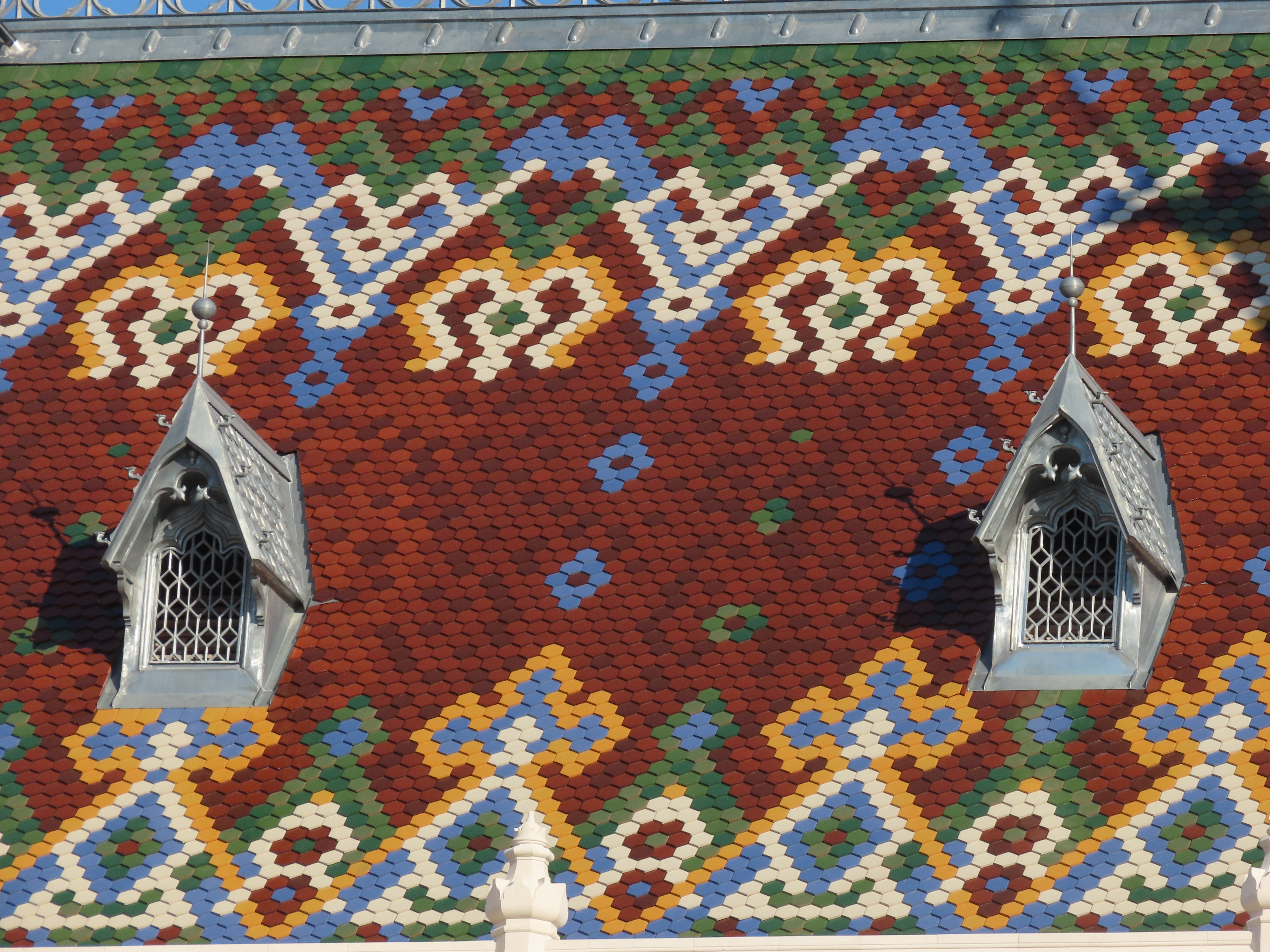
Then we make a beeline to the Central Market or Great Market Hall. This brick, iron and glass structure topped with a colourfully tiled roof is the largest and oldest market place in the city. The green and yellow Zsolnay tiles look warm in the evening light. In the vaulted interiors we find groceries (paprika!!), fresh produce, souvenirs, local handicrafts et al. Closing time is upon us so there is no time to linger and sample the street food available here.
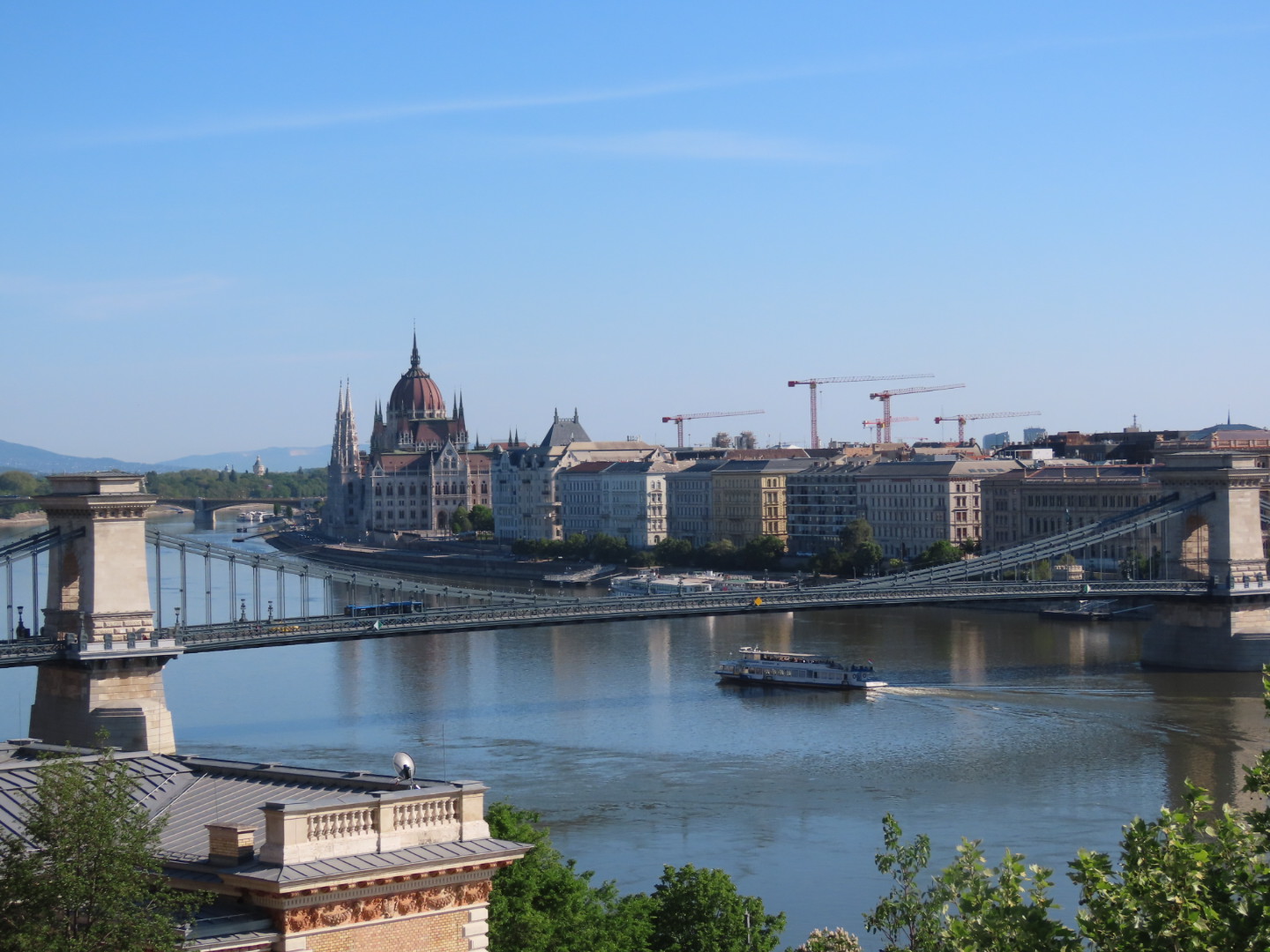
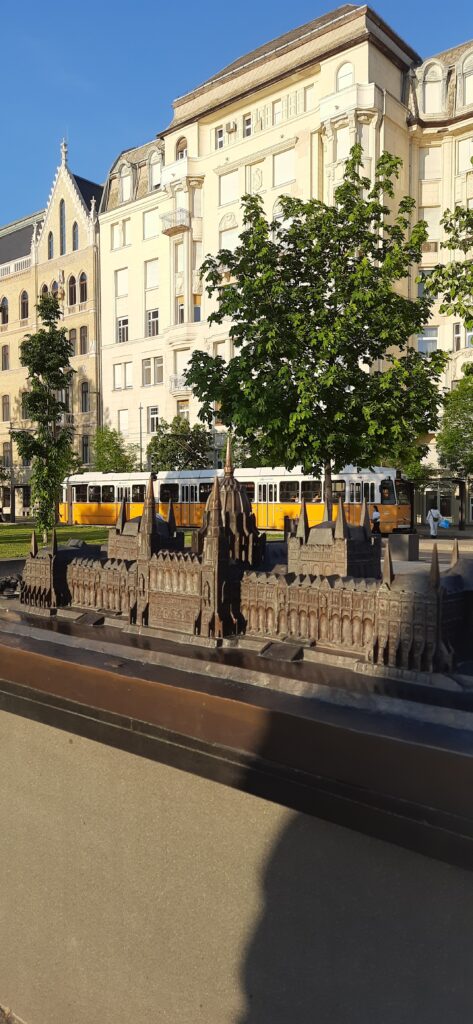
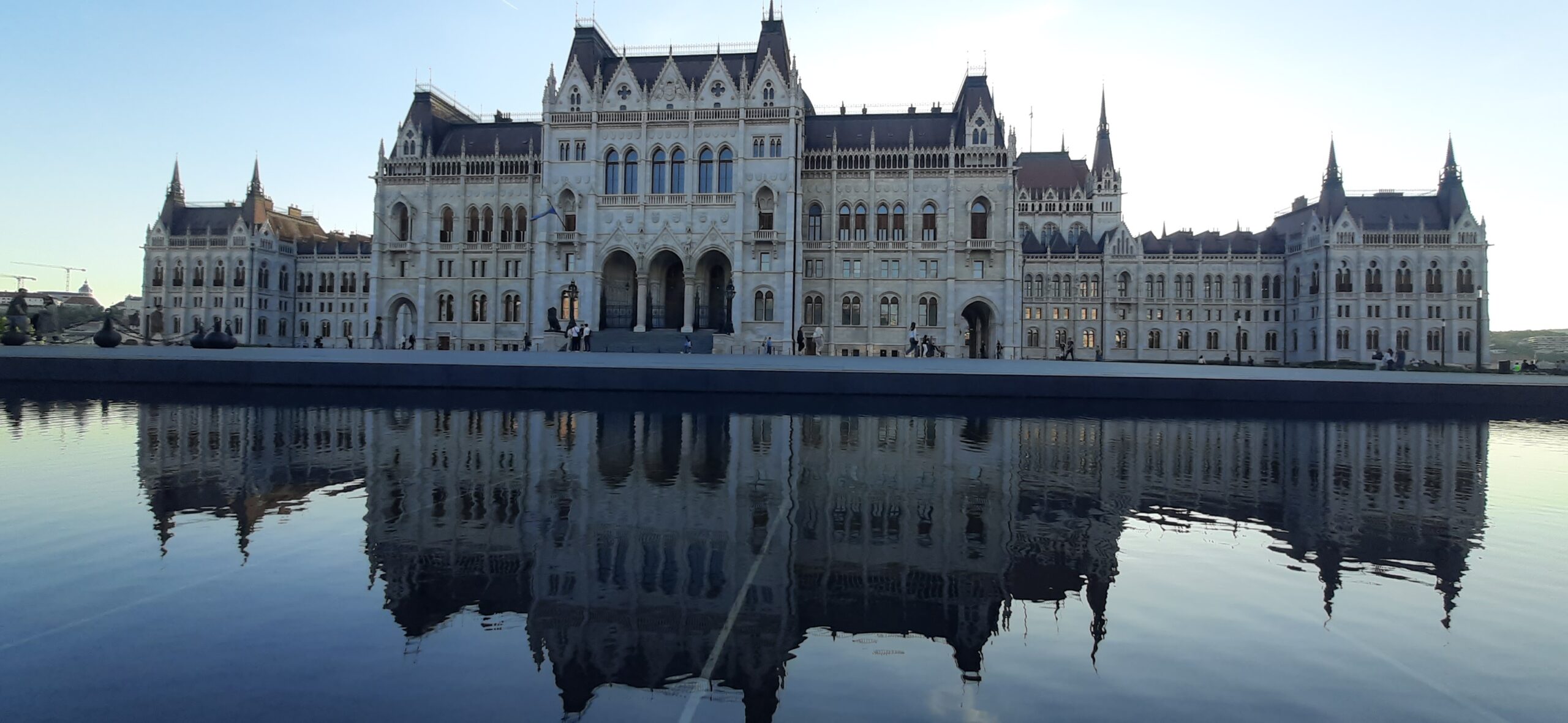
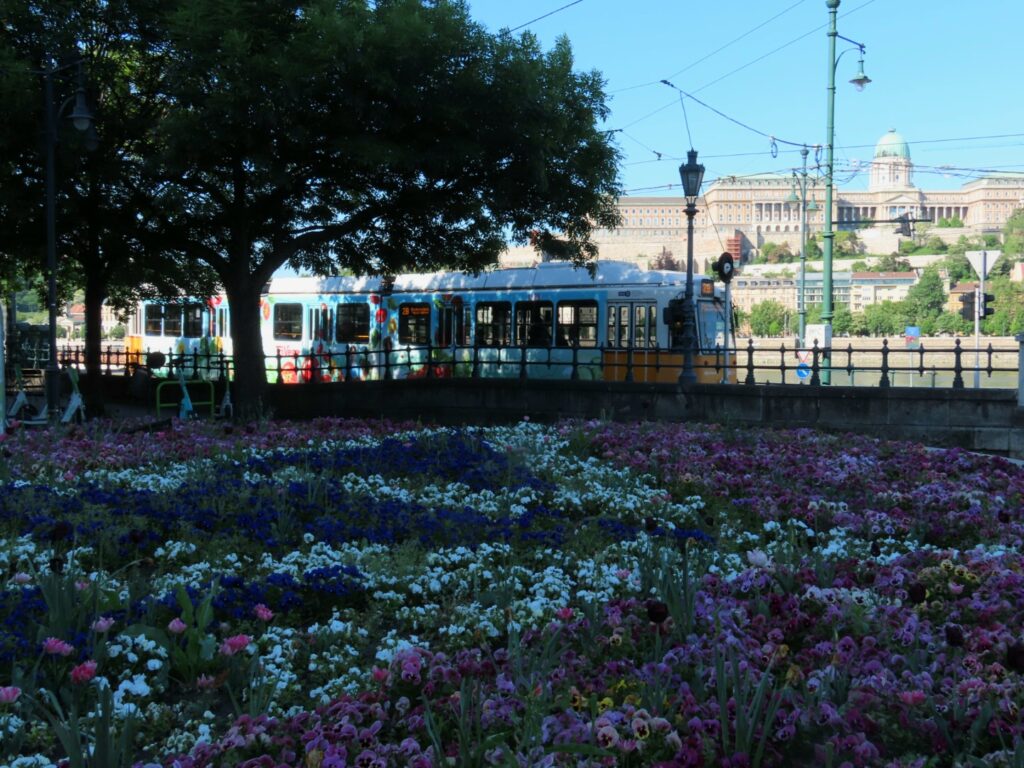
We catch tram number two from the intersection nearby for some spectacular sightseeing along the river front. The Danube, barely blue here, still has all the important monuments facing it. We alight at the parliament building to take in the humongous neo-gothic structure with perfectly symmetrical wings spreading on either side of a central cupola reminiscent of an Italian renaissance church.
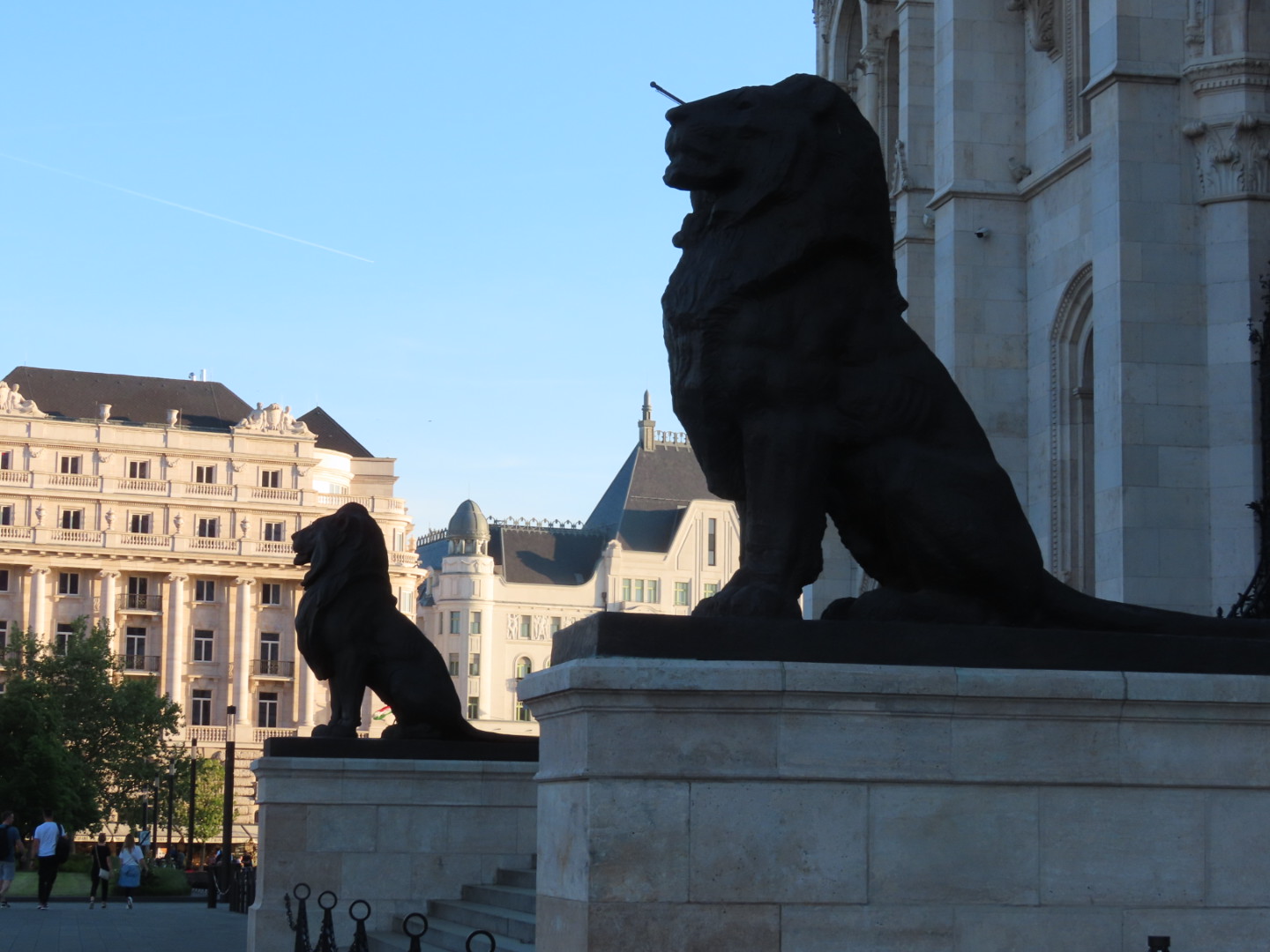
Lionize
Two regal lions with their noses in the air and coiffed manes guard the entrance. Sadly it is not possible to take a tour of the interiors or waltz down the waters of the river to see it all lit up in the night. A lot of renovation work is going on around the expansive square but it is artfully camouflaged behind screens draped on the building with the purported final design printed on it. One can see the eventual façade long before it materialises.
Portrait of Power
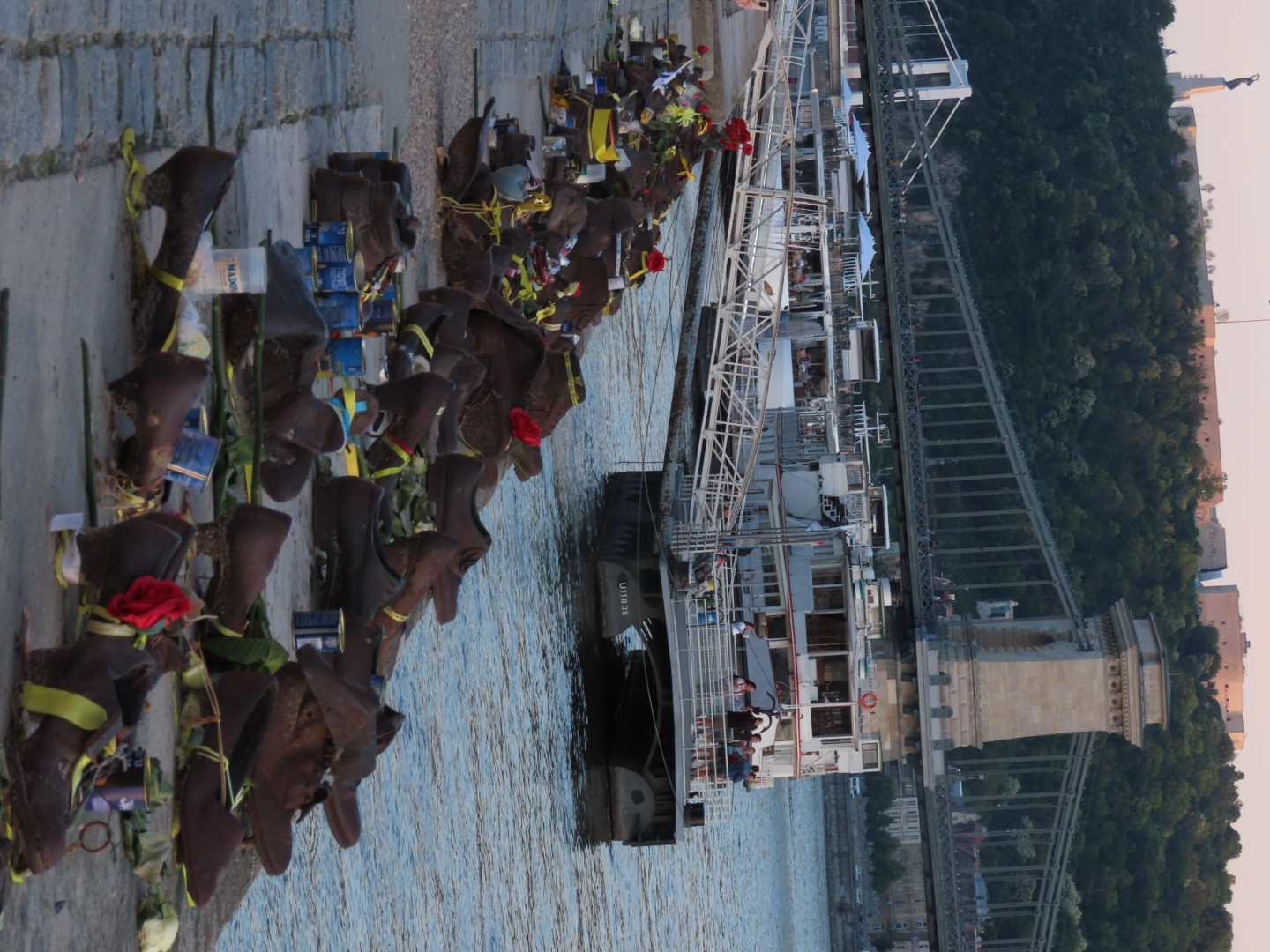
We stroll to the promenade by the river where the holocaust memorial- Shoes on the Danube Bank is. The brilliance of this poignant memorial lies in its simplicity. Cast iron shoes, of men, women and children point, a little accusingly perhaps, at the river which swallowed the Jews shot here after being made to take off their shoes. They are a moving reminder of the horrors meted out during the Second World War. The sun sets in a fiery orb, radiating light like the star it is, between the spires of a church across the river.
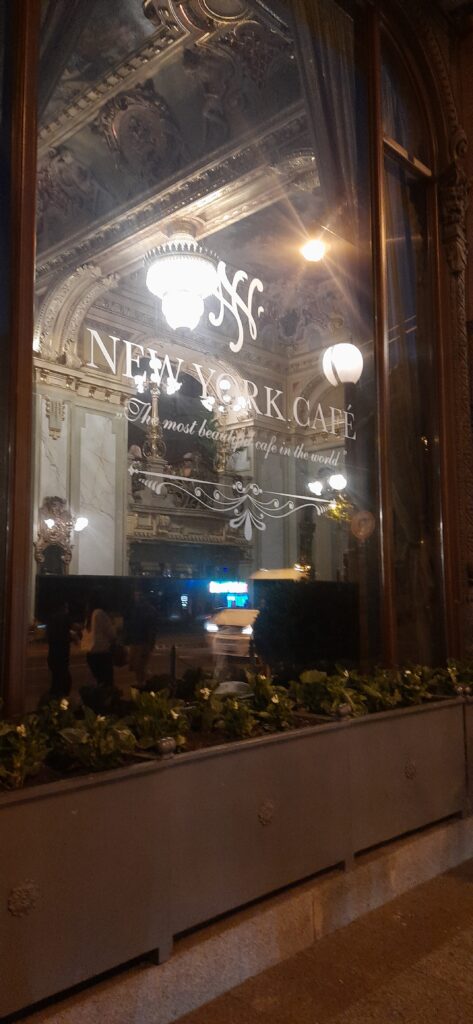
We retrace our rides and cross the iconic New York Café, rated as the most beautiful café in the world, with its opulent interiors brightly lit. It looks cozily inviting to us pedestrians.
Coffee and Charm
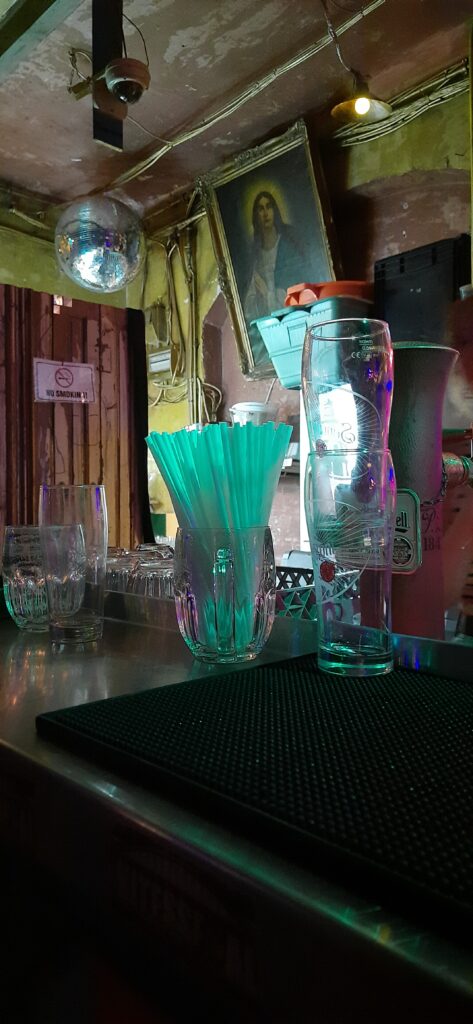
Later we head to sample the night life of Budapest and discover the bar that set the bar, and the trend, is within ambling distance. The crowd is still building up outside the ruins of Szimpla Kert, the original Ruin Bar. The music is pulsating, the setting eclectic and the drinks flow as do people, through the maze of rooms of the dilapidated industrial building living a rocking second life as a party hub. The evening ends on a sweet note with traditional trdelnik, freshly done. The layered pastry dusted with sugar and cinnamon, wrapped around a wooden roller being turned a toasty brown over fire, is demolished as soon as it is warmly served.
Resurrections
Phoenix Fairytale
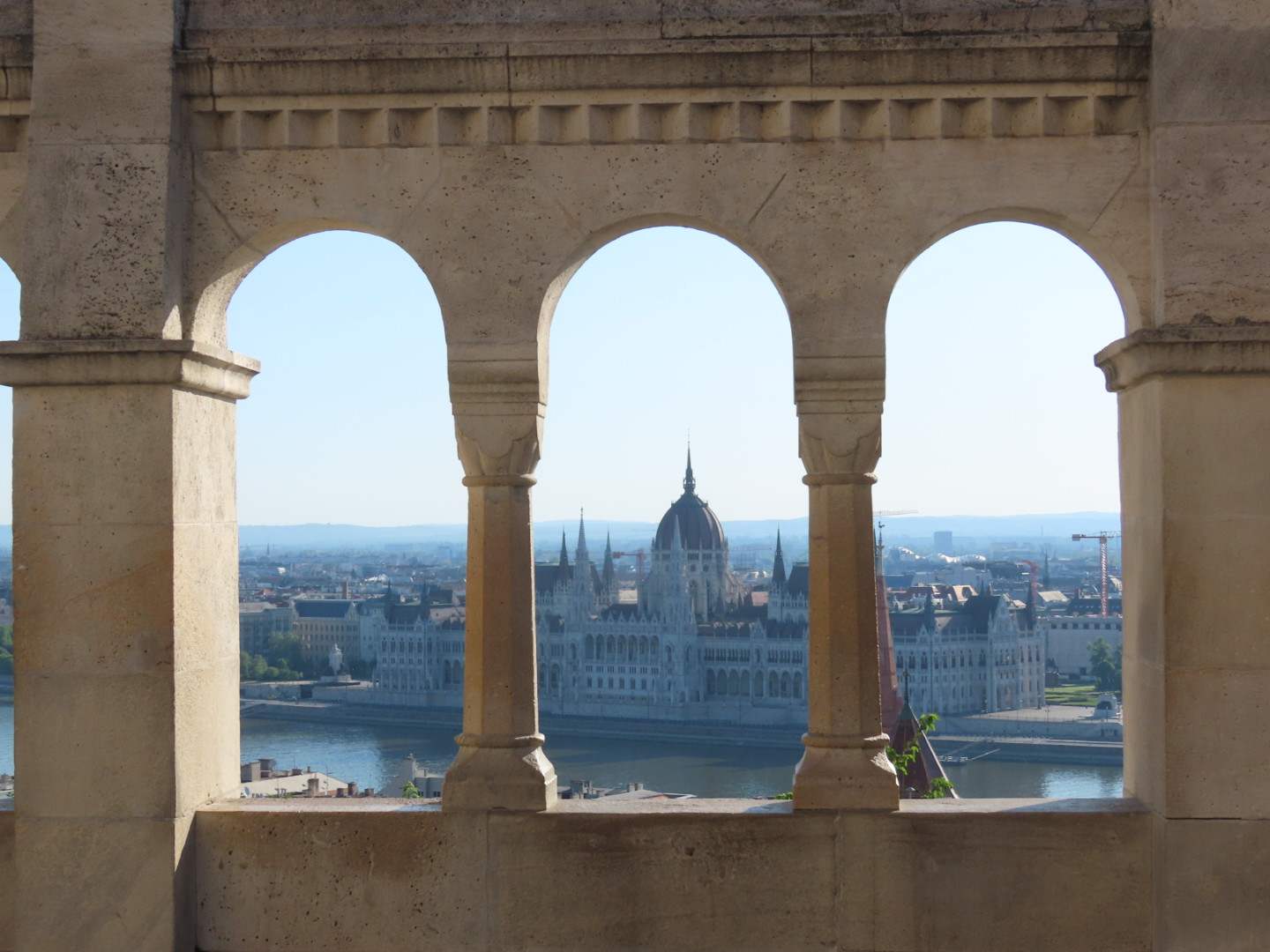
Early next morning we catch a bus to the base of the Buda Castle quarter. This historic hill, seat of the powers that be, has been reduced to near rubble, rebuilt and redesigned innumerable times since the 10th century. It has survived the Mongol hordes, the Turks, World Wars and the rise and ebb of numerous dynasties. We make short work of the long climb through deserted streets. There are just a handful of people at Fisherman’s bastion, a wall with beautiful arches which make perfect frames for the view- the deep Danube, a natural moat below and the vast expanse of Pest beyond the Parliament. Buda and Pest are bound together by many bridges apart from the famous Chain Bridge.
Buda’s Bastion
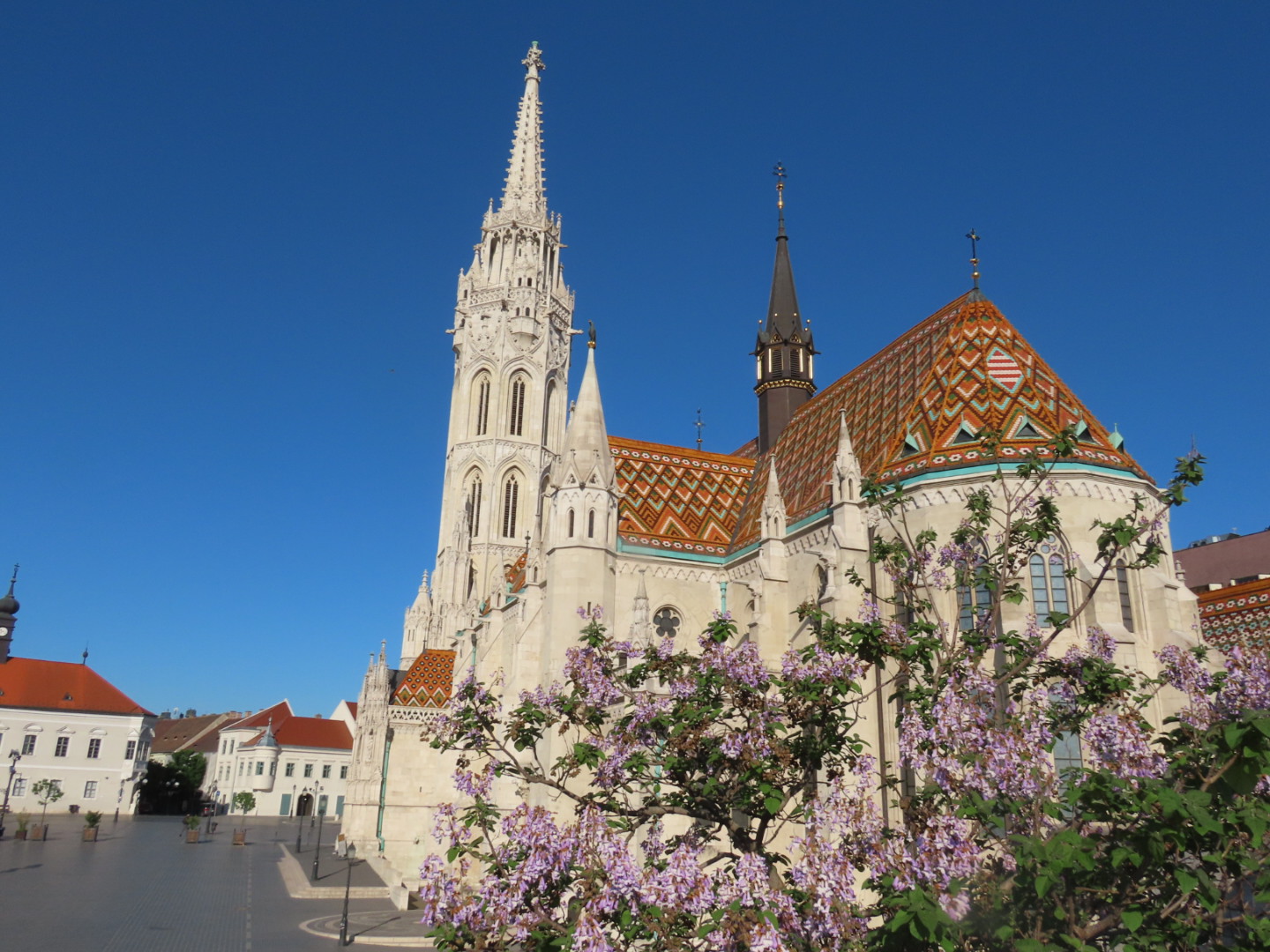
Chinese couples with their personal paps, make the most of the fairy tale turrets and arches in the morning light. (They know good lighting!) The massive neo-gothic Matthias church towers up and dwarfs everything around. The colourfully tiled roof adds an eclectic element to the pristine white exterior. The slender bell tower soars above even the church.
Majestic Matthias
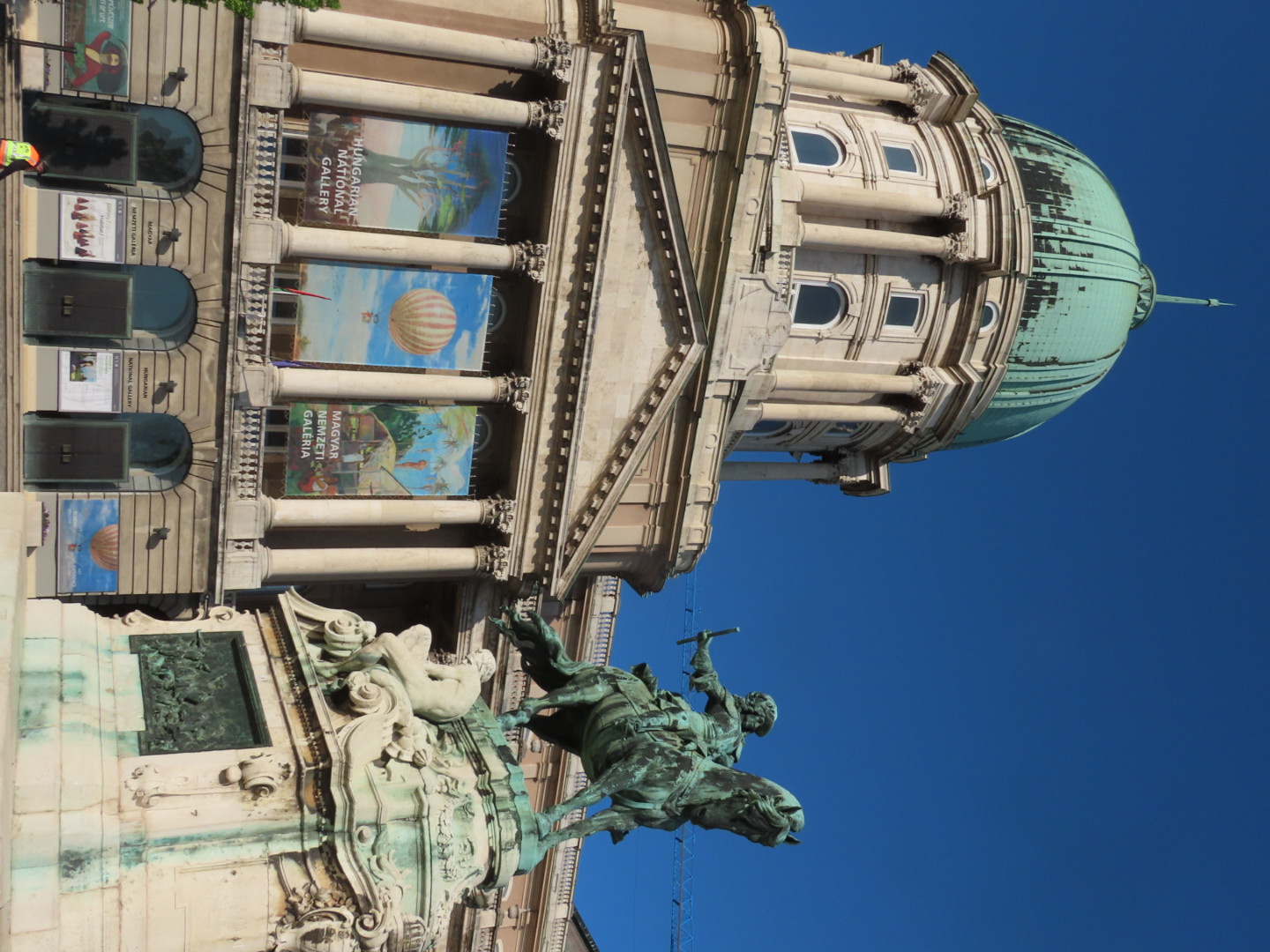
From the Holy Trinity Square we walk through a lane lined with quaint buildings, one which has a labyrinth underneath where Count Dracula was once held, crossing the Sandor Palace, home to the President, to the Buda Castle which now houses the national library, the historical museum and national gallery but it has not opened yet. Just the impressive statue of the Duke of Savoy is all the company we have.
High Art
The clock is ticking and we manage to find steep steps going down the outer wall and from the Chain Bridge we catch a bus and an underground ride back to the flat. It is difficult to rush when Budapest’s blooms beckon a lingering look and last picture. It has been a whirlwind trip to a city that has risen resiliently time and time again. Someday perhaps we will walk into what a peek is all we had time for from the outside.
Beguiling Blooms
Fact File–
Getting Around- The Budapest Basic Travel Card(BKK) offers unlimited rides on buses, trams and the metro for different durations. They are available at all transport hubs.
Staying- In the Buda side stay near the Castle area or District I and in Pest in District V or VII. Another option is staying close to the Deak Ferenc ter, a hub where a lot of the metro lines and trams intersect.
It all started with a spittoon that caught my eye in the Salar Jung museum and so here we were in a narrow lane in the labyrinth around Charminar in a junk shop, between a poultry shop (with quails, pigeons, rabbits and… crows ?!) and a grocery shop, (where I had just been educated in the difference between Sulaimani and Irani tea) getting a gorgeous paandan wrapped up in a newspaper. (The spittoon will follow another day.) It will be a decoration piece, the shopkeeper surmised. ‘No, now I will use it.’ I replied. ‘You haven’t used one till now and now you will?’ the shopkeeper said with a hint of a smile and shake of his head. I reiterated the claim, now with lesser surety. A Ganapati whizzed past, in a rickshaw seated on a man’s lap. A teaseller pouring a cup of cutting chai for the shopkeeper offered us a cup too. The half-hearted pitter-patter made the offer enticing….but there were other gems waiting.
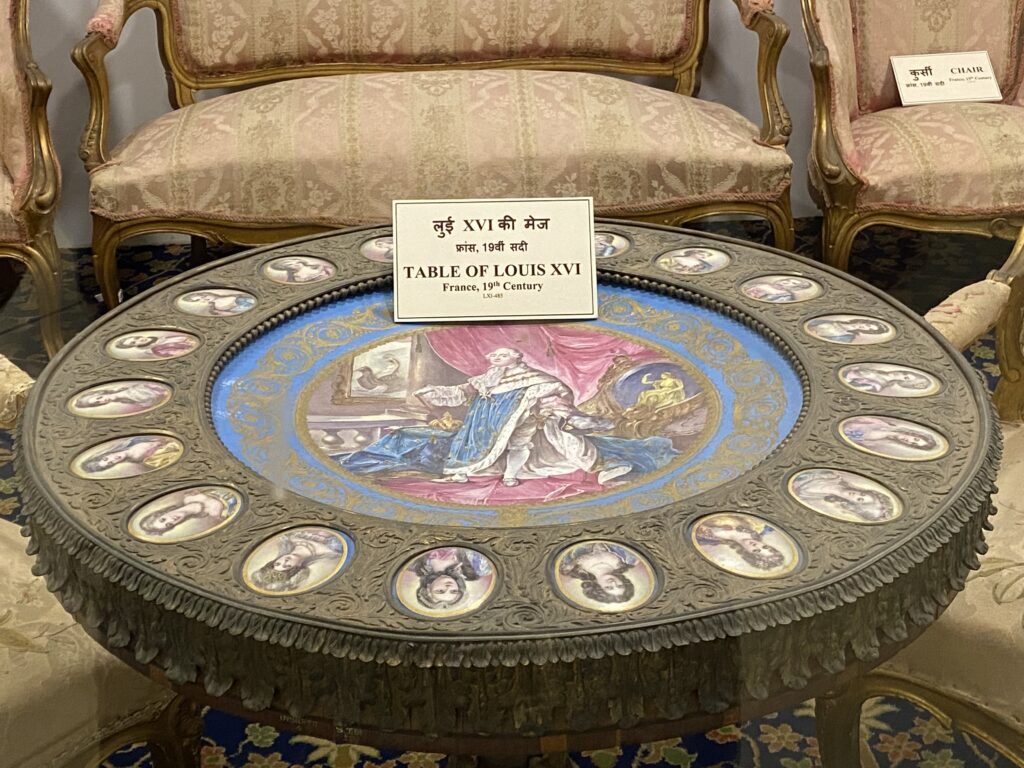
High Table
Landing in Hyderabad and heading from the airport on an elevated road gave the most expansive view of an undulating urban sprawl interspersed with rocky outcrops. Modernity’s towering edifices dwarf the Bala Hissar on top of Golconda Fort. We speed down the flyover, to land in the tight embrace of traffic, that is also the hallmark of the tri-city. Whether it is main Hyderabad, alternating between bustling markets or the more open area near the Hussain Sagar Lake, green and spacious Secunderabad or space age Cyberabad aka Hi-Tech City’s (still don’t know for sure its name) high-rises soaring on the fast-disappearing hillocks, maddening traffic is a thread that runs through them all. For once I had left the planning to the man since he had stayed there earlier, albeit ages back. Charminar was the only definite on my itinerary. We end up going there many times! The historical part of Hyderabad is all truly its own.
Hyderabad tends to be hyperbolic! The massive secretariat building overlooks the Husain Sagar Lake and a gigantic metallic lamp that reflects the traffic faithfully. The world’s largest monolithic Buddha stands serenely in the lake, oblivious to the chaos swirling around him. Repurposed old palaces with delicate onion domes peek over rows of palms to look at the Musi River.
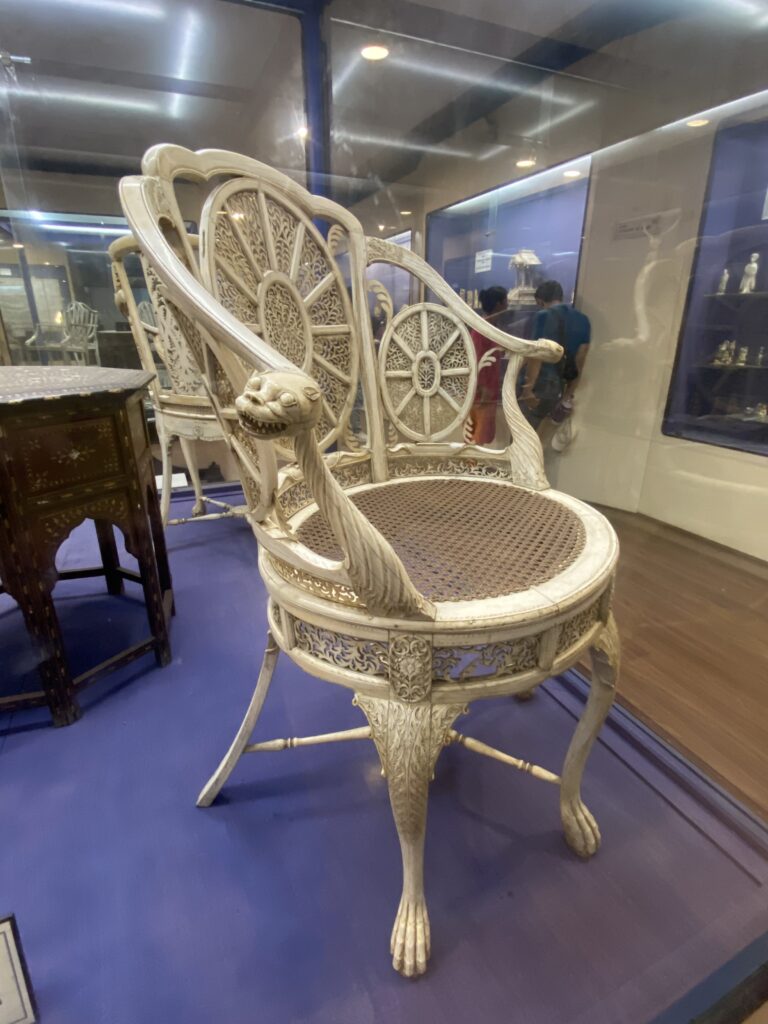
Have a seat.
The Salar Jung museum is a revelation! I was under the misconception it housed the Nizam’s belongings, but the Salar Jung family were the diwans or prime ministers for three generations to the Nizams and the museum holds their personal collection. The last one resigned from his post to pursue his passion project- collecting art from across the world. He died without an heir and his collection, one of the largest private ones ever, was given to the government. Sadly, his palace, the Diwan Devdi, which originally housed the museum, was parcelled off piecemeal.
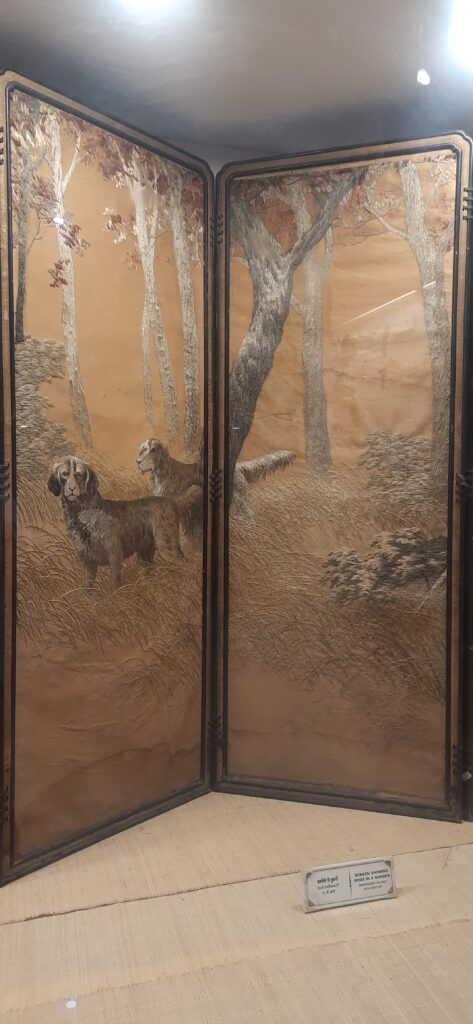
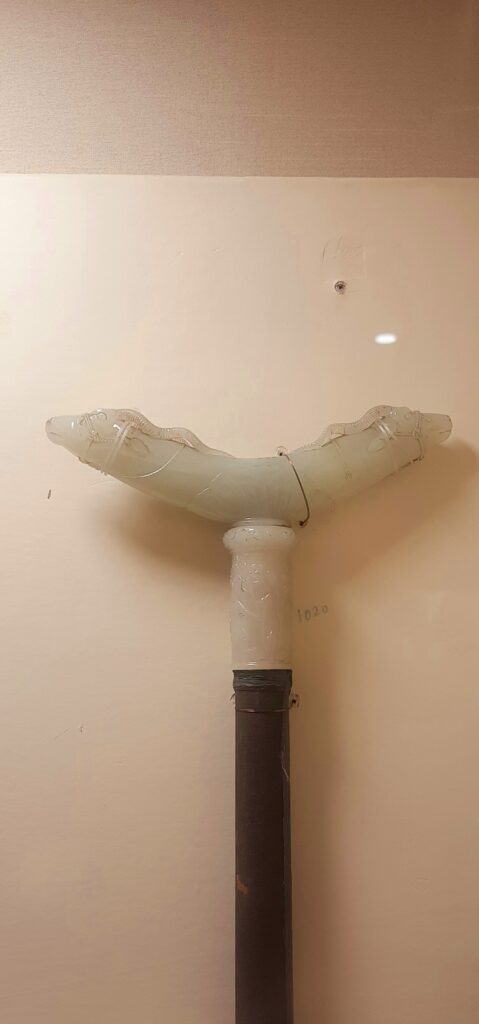
From Chinese ceramics and enamelware, exquisite tapestry from Japan, European furniture, bric-a brac, the treasure trove throws up gems but the piece de resistance is the Veiled Rebecca. It lives up to the hype even under the most abysmal lighting. Nothing dims the beauty of the sublime marble sculpture. The jade and ivory collections, including a mat woven from strands of ivory (How??) and a stunning collection of bejewelled daggers with finely carved jade hilts (my favourites) fare better. There are personal items of Aurangzeb, Tipu Sultan, Noor Jehan and Jahangir. Another attraction, a functional clock acquired from Cooke and Kelvey Co reminds me of Prague’s astronomical clock.
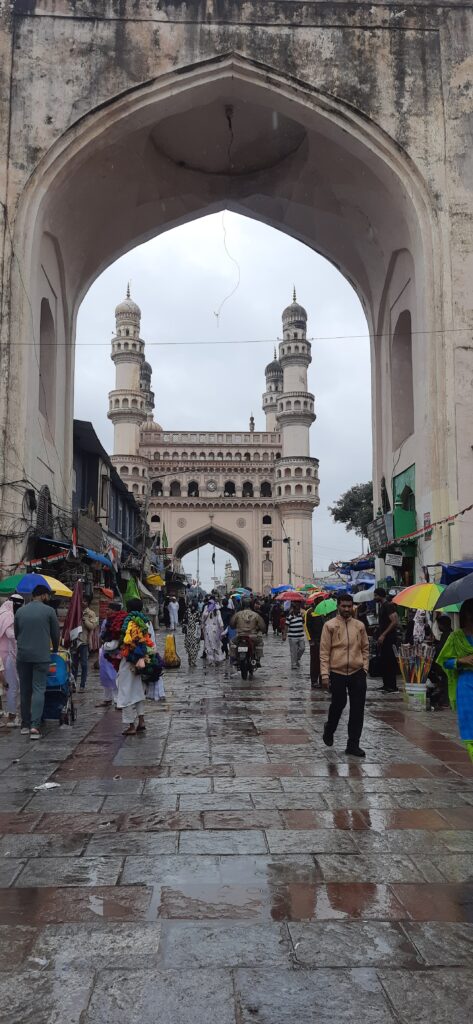
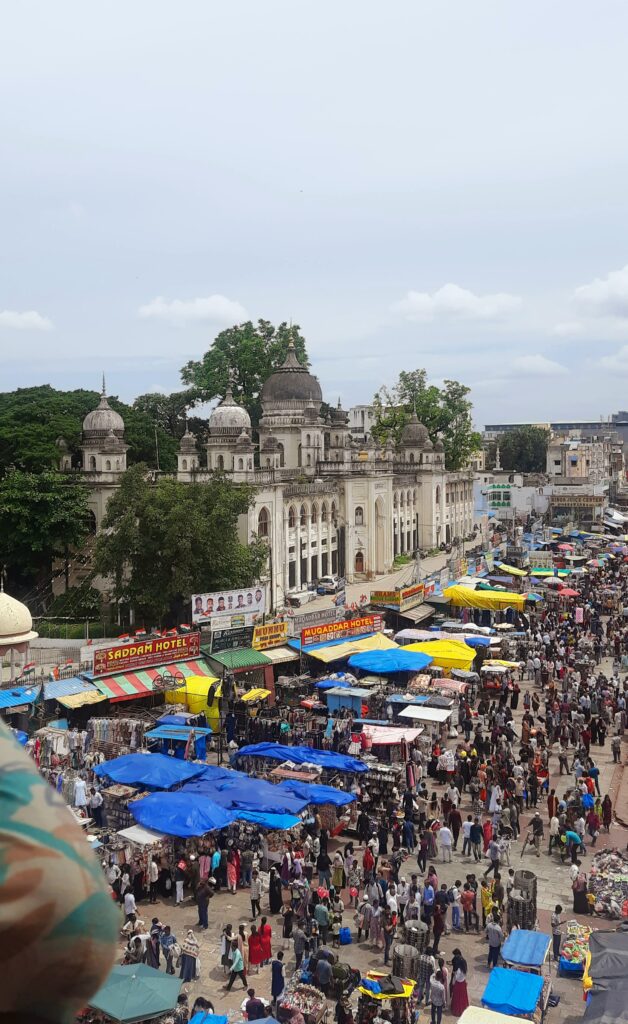
Our first visit to Charminar is early by local standard I suppose. The wares of Laad bazaar, glittering bangles and rolls of beautiful borders, are still being put out. “Madam, madam” the shopkeepers call out. Madam is not a bangle person. My arms do not appreciate the delicate fetters that demand graceful caution. The life expectancy of a bangle is not more than a few hours on my wrists!
Four Minarets
Charminar at the end of the lane looks bigger and prettier in person. It is getting a facelift and it’s stucco work, while not very detailed, is being scrubbed. We climb up a narrow winding staircase in one of the minars. The stone work Makkah Masjid and the haveli-like Nizamia General hospital with onion dome minarets, adjoining Charminar, are the only worthwhile view.
Eye Tonic
We walk towards Gulzar Houz through a massive gate. This lane is lined with pearl shops. Like the pearl craftsmen who came to Hyderabad and were patronized by the Nizams, the only organic gem comes here not only from freshwater ponds but from seas across the world – naturally black ones from Tahiti, Akoya’s from Japan, luminescent golden baubles from South Sea or the priceless Basra ones. Like their gems, the Mangatrais came two hundred years back from Haryana and have been here for 5 generations in this business. As we are leaving their shop the octogenarian head of the family graciously offers lunch and gifts me a small Ganesha. Our appetites just need a cup of tea and we head for the famous Nimrah Bakery for Irani chai and bun maska. The soft bun slathered with mildly sweetened cream in between, melts in the mouth and the milky tea is a perfect perk me up.
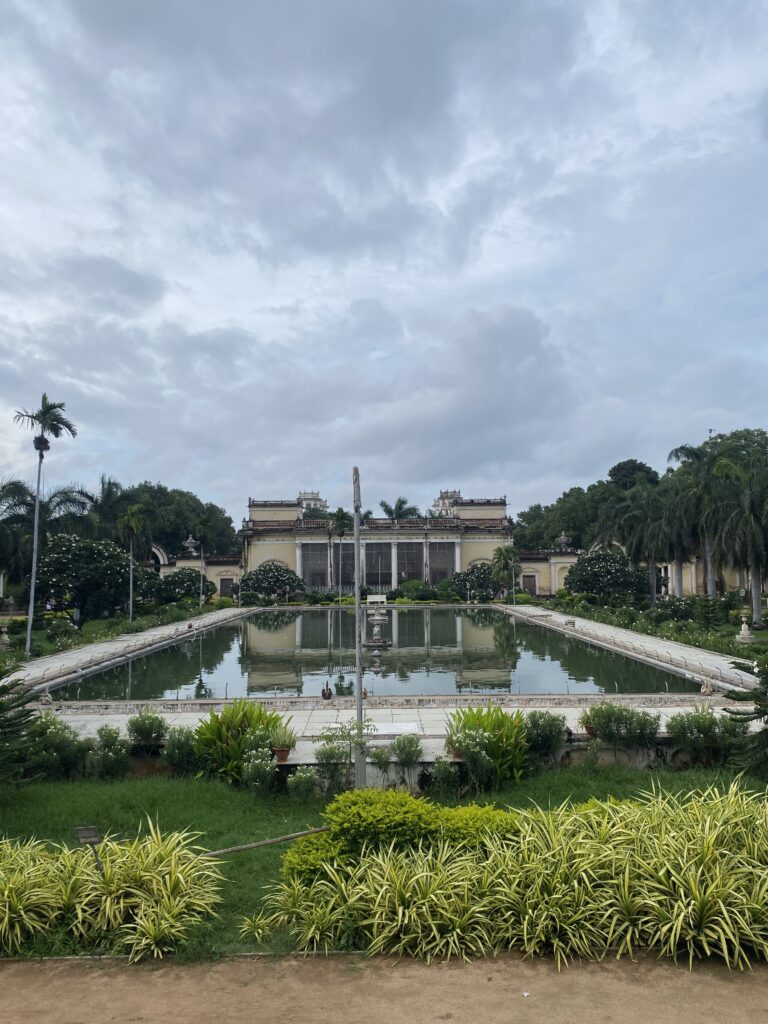
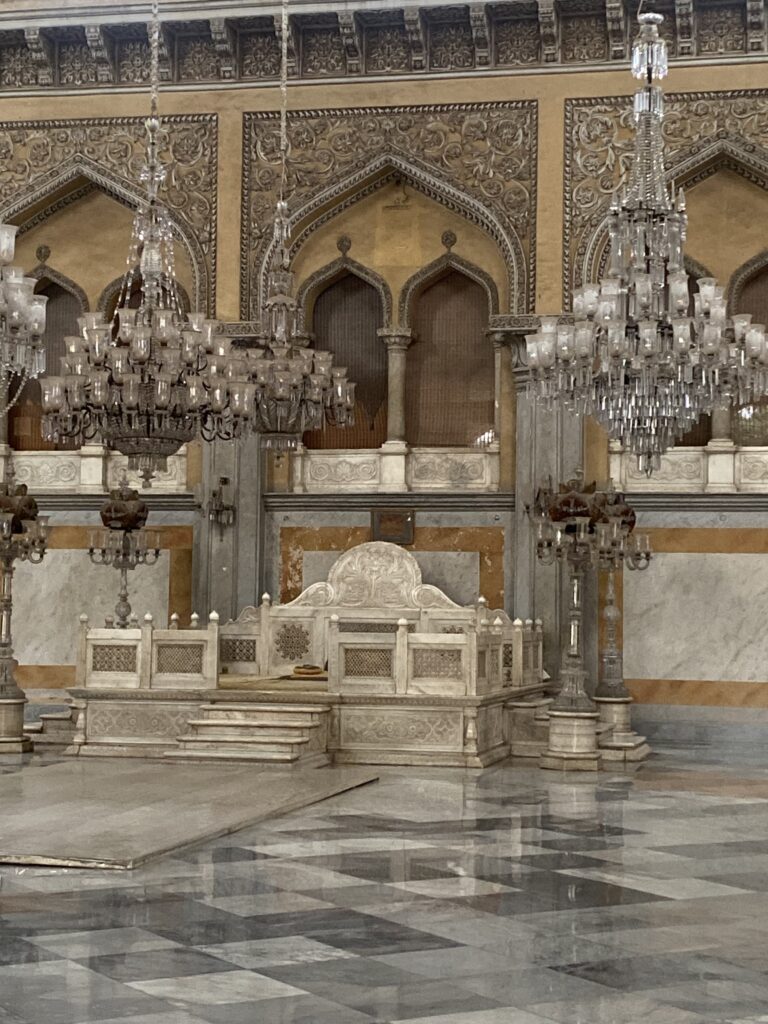
Chowmahalla Palace, close to Charminar, was the seat of the Asaf Jahi dynasty. It is an oasis of peace with a slightly neglected air, like an old dowager wrapped up in nostalgia, harking to heydays. It too is getting a makeover. Inside the main gate a rectangular pond stretches towards the Khilwat Mubarak or the Darbar Hall. A quadrangle with scalloped arches and rooms surrounds the pond. The Darbar hall is behind purdah. It hides beautiful stucco work, low chandeliers, and a marble throne.
Waiting to give audience
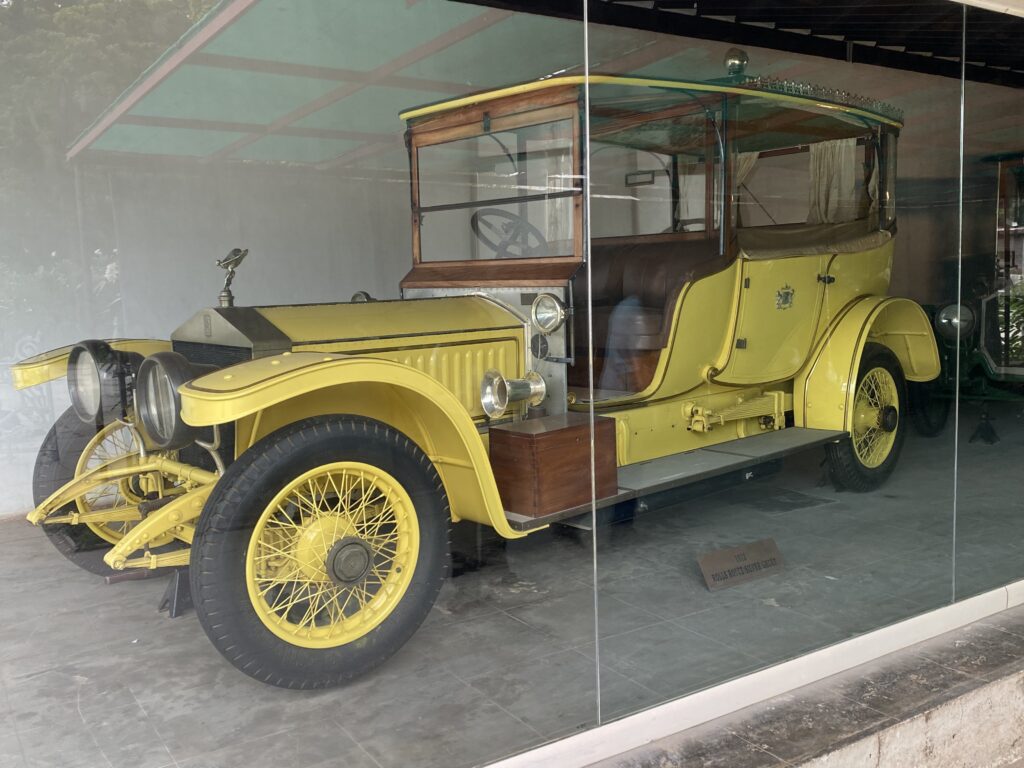
The side rooms with massive arched wooden windows give a brief history of the Nizam’s family tree, starting from Asaf Jah I who was given the title of Nizam-ul-Mulk, as the viceroy of the Deccan sultanate by the Mughals. The viewing rooms upstairs now display crockery and clothes. Further inside, behind an arched gate, lie four older palaces around a fountained pond, which give the palace it’s name. Aftab Mahal has wide steps leading up to a tiled platform and inside, an elegant parlour room is on display….waiting for guests who can never come. The garages at the back hold a parade of stately vehicles and buggies led by an eye-catching canary yellow Rolls Royce.
Royalce Ride
Rich Man’s World
The Purani Haveli was the official residence of the Nizams. The estate has been parcelled between different schools. The entrance is through a narrow lane adjoining the Princess Durru Shehvar hospital, named after the regal looking princess of the Ottoman empire who married the last Nizam, Asaf Jah VII’s, elder son. One portion of the rather decrepit haveli with an European façade houses the Nizam’s Museum, dedicated mostly to the Silver Jubilee of the last Nizam’s coronation.
No tardy trowel this.
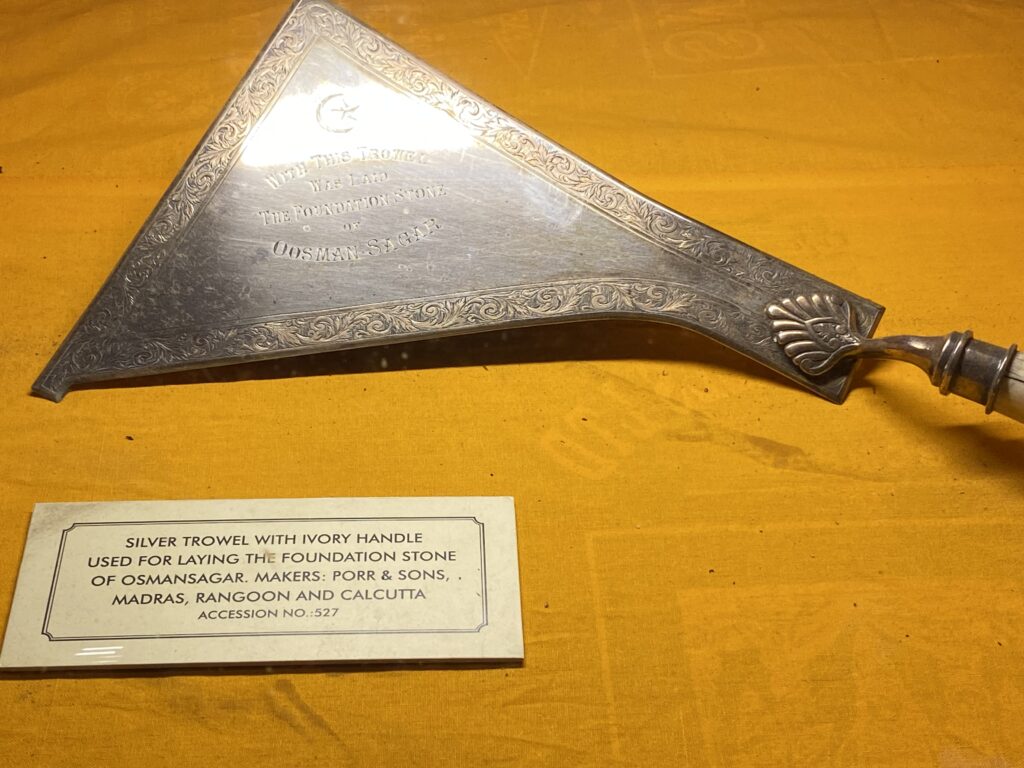
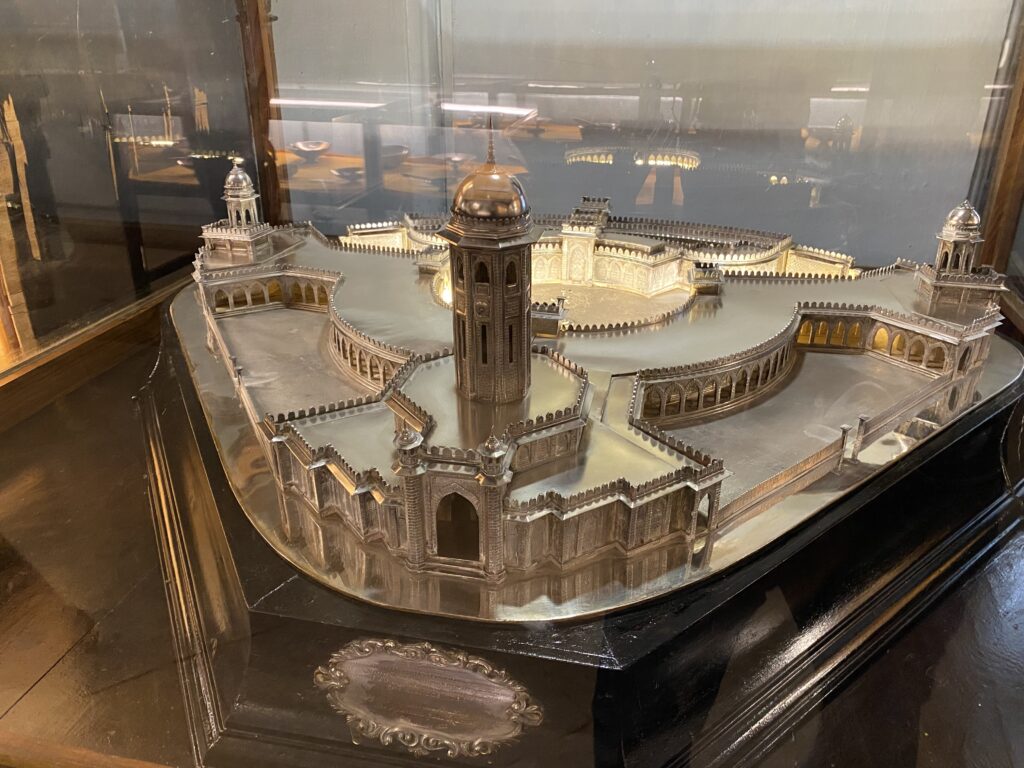
There is a gilded chair under a brocaded canopy, gifts, souvenirs, silver replicas of Hyderabad’s landmarks, silver plates and trowels from foundation ceremonies. In another room the history of Hyderabad is catalogued briefly and the last hall, and it is a long hall, is the Nizam’s walk-in closet. With teakwood almirahs and small changing cubicles lining the wall, and on top, rows of glass cupboards displaying footwear, it is any fashionista’s closet dream. It is said that he never repeated his clothes. Well, the last Nizam was the richest man on earth in his time. Rich enough to gift fourteen thousand acres of land to the Bhoodan movement and pledge five tonnes of gold to the Defence Fund during the China conflict. (Do the math!)
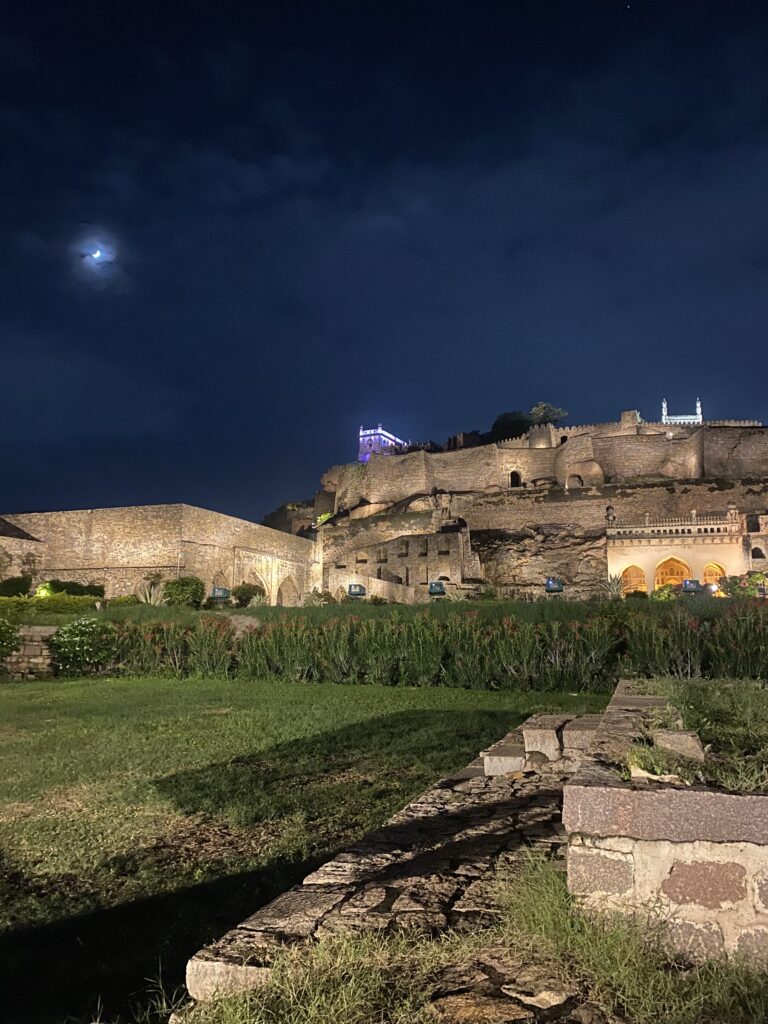
The narrative changes across the Musi River. We attend the sound and light show at the Golconda Fort. The script is bland and the colours loud, although the perspective is interesting. The Nizam’s are portrayed as the interlopers here, having being installed by the Mughals who defeated Golconda’s ruling Qutb Shahi dynasty. After the show, lights illuminate the massive boulders and tiered granite fortifications of the fort, once home to the Koh-i-Noor.
Golconda- Deccan’s Diamond
The dynasties might be dust now but a crescent moon, pearl white between the silver-lined clouds seems to harks back to the halcyon history of Hyderabad.
Fact File-
Entry fee–
Salar Jung Museum-Rs 50.
Charminar- Rs 25 by cash and Rs 20 by UPI.
Chowmahalla Palace- Rs 100. Tickets sales shuts at 4:30 pm and monument closes at 5 pm.
Old Haveli- RS 80.
Golconda Fort Sound and Light Show- Rs 80 – Rs 140. Timings-7 & 8.15 pm (March – Oct) & 6.30 & 7.45 pm (Nov – Feb). The first show is usually in English and the second in Hindi / regional language.
Photography– All places charge extra for mobile photography.
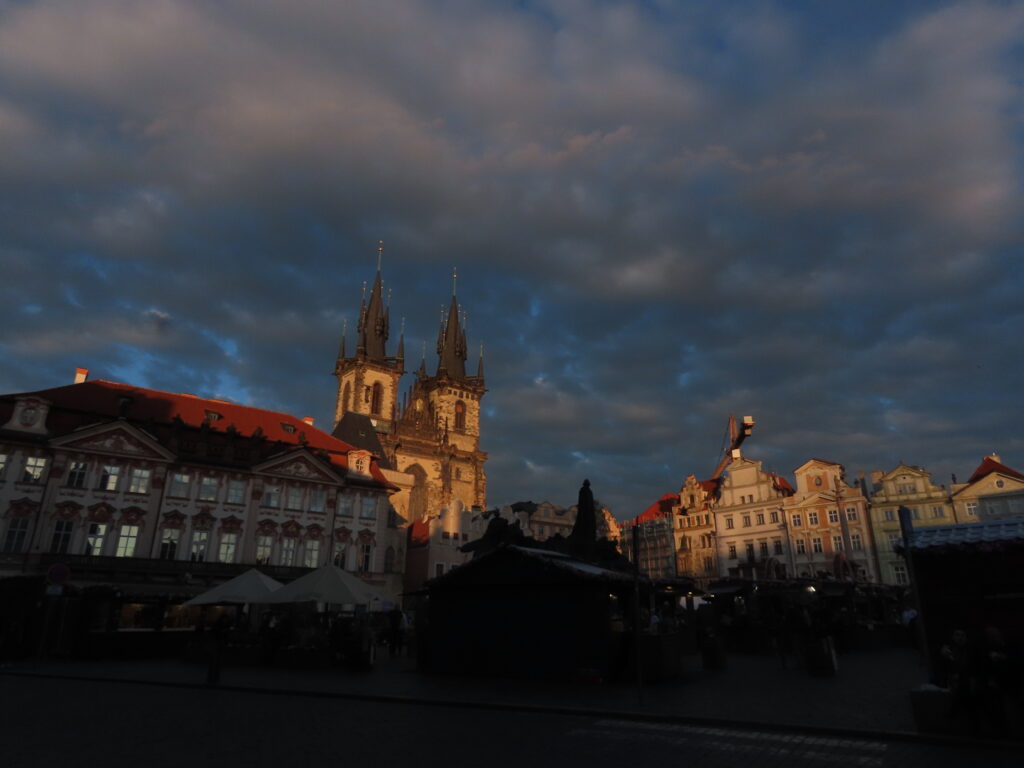
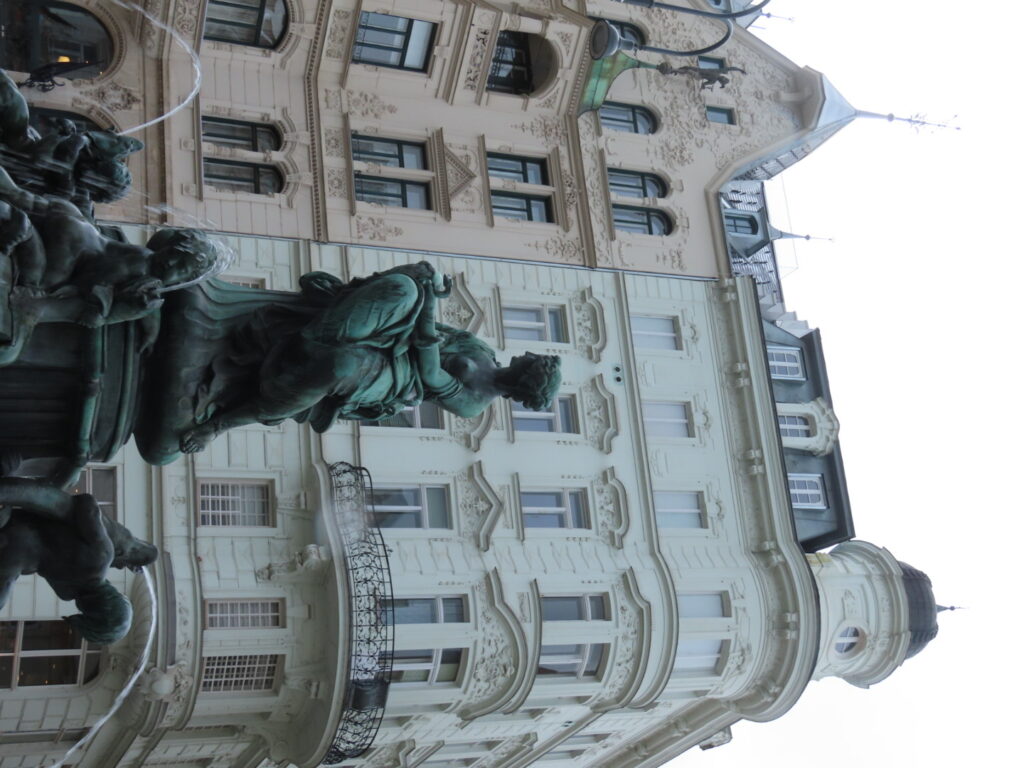
The Czech had a tradition of throwing people out of the window. So popular was this, of not dirtying hands and hoping the cobbled streets of Prague would finish the job, that they actually have a word for it- defenestration. Sometimes it did not work! In the third Defenestration of Prague in 1618, the nobles survived the fall. That led to murderous reprisals, war and the Austrian’s ruling over the erstwhile kingdom of Bohemia. Austrian influence shows up in the pastel-coloured pastry facades that stand cheek by jowl all over Old Town, looked down by tall gothic dark spires of the churches that belong to an older era.
Sometimes smokey, sometimes sparkling, Prague has a bohemian air… with gothic edging! She seems slightly mysterious, wise and definitely dances to her own tune. Lose yourself in her labyrinthine lanes or settle yourself in one of the many cobbled stone squares to watch the world go by. The people might have a slightly wary air but they know how to do a perfect roast not to mention a good tank of beer, apart from defenestrating people!
A Ride to Remember
Atleast three days are needed to explore the old parts of Prague- Prazsky Hrad or the Prague Castle on a hill, Mala Strana or Lesser Town at its feet and Stare Mesto, or Old Town across the sinuous Vltava River. How should one plan them in this ‘city of a hundred spires’, where tall tales and taller spires, legends and history blur like fine shaded bohemian crystal?
Day1-
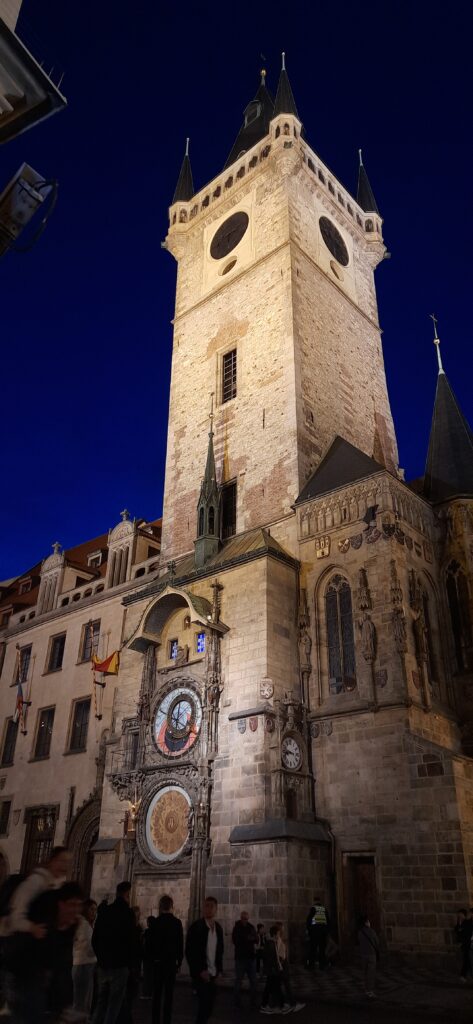
Walk to Old Town Square, the centre of gravity in Old Prague. Dominated by the twin albeit not identical towers of the Church of Our Lady before Tyn which date back to the 14th century, with the Jan Hus Memorial in the middle of the square. Prague’s iconic astronomical clock on the Old Townhall building marks the other side of the square but the clock faces a side like it wants all the attention to itself, and it gets it in hordes with crowds waiting for the hourly show of the apostles and a skeleton parading through the tiny windows. So, there is ample opportunity to see them. But the real beauty is the 14th century intricate three-piece clock.
Apostle Hour
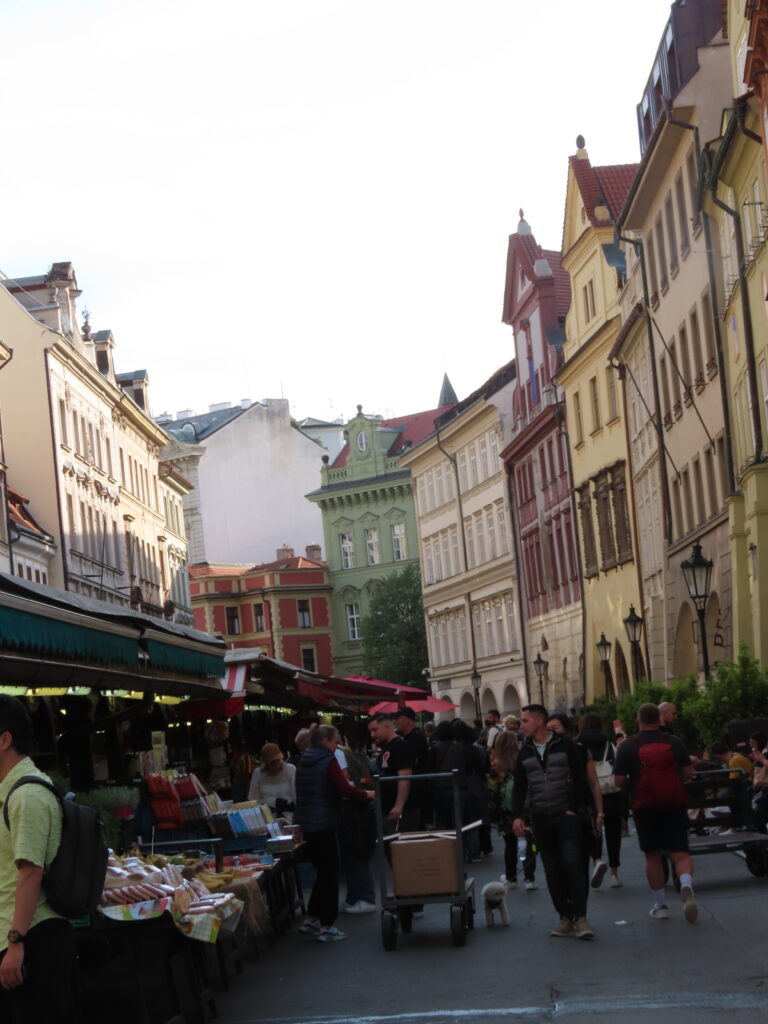
Then, through a narrow alley with a sex machine museum, (Haha, there are museums galore here, for things you can and cannot imagine) souvenir shops, eateries etc, head to Wenceslas Square. More like a wide promenade, it has been the stage for many seminal events in Czech history. It ends at the foot of a hill with the National Museum on top.
A lane to lose yourself in.
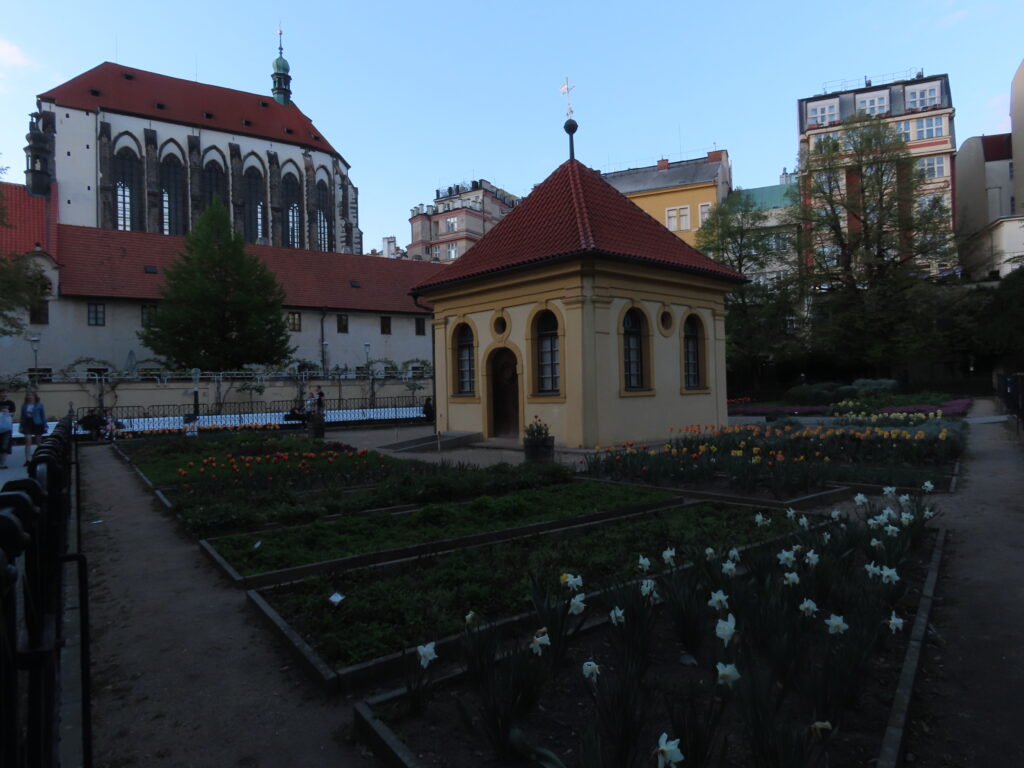
Grab lunch at one of the many cafes lining the squares. Spend the rest of the afternoon discovering the bylanes of Old Town, chancing upon hidden treasures like the Franciscan Garden.
A garden grows silently.
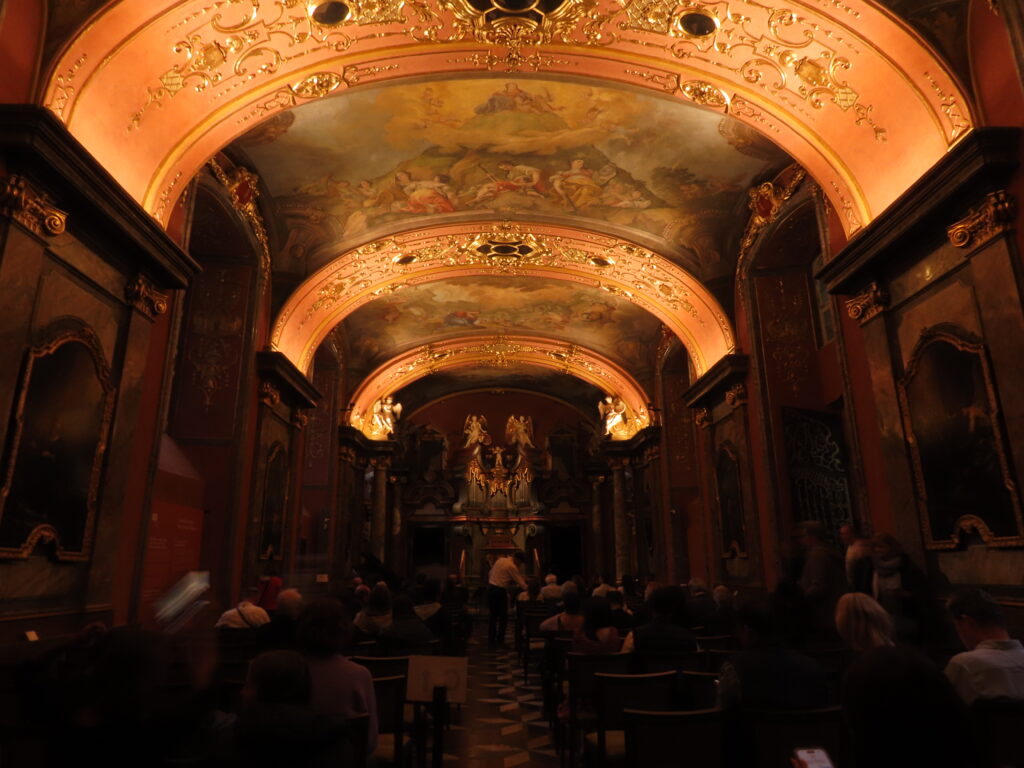
In the evening head through one of these lanes to treat yourself to a classical concert in a tiny chapel. The Mirror Chapel with its baroque interiors of gilded stucco, frescoes, mirrors and old organs is part of the Klementium, an old Jesuits’ College. An underrated place worth a visit as well. The experience of listening to soloists from the Royal Czech Orchestra is something even the cherubs on the roof seem to delight in.
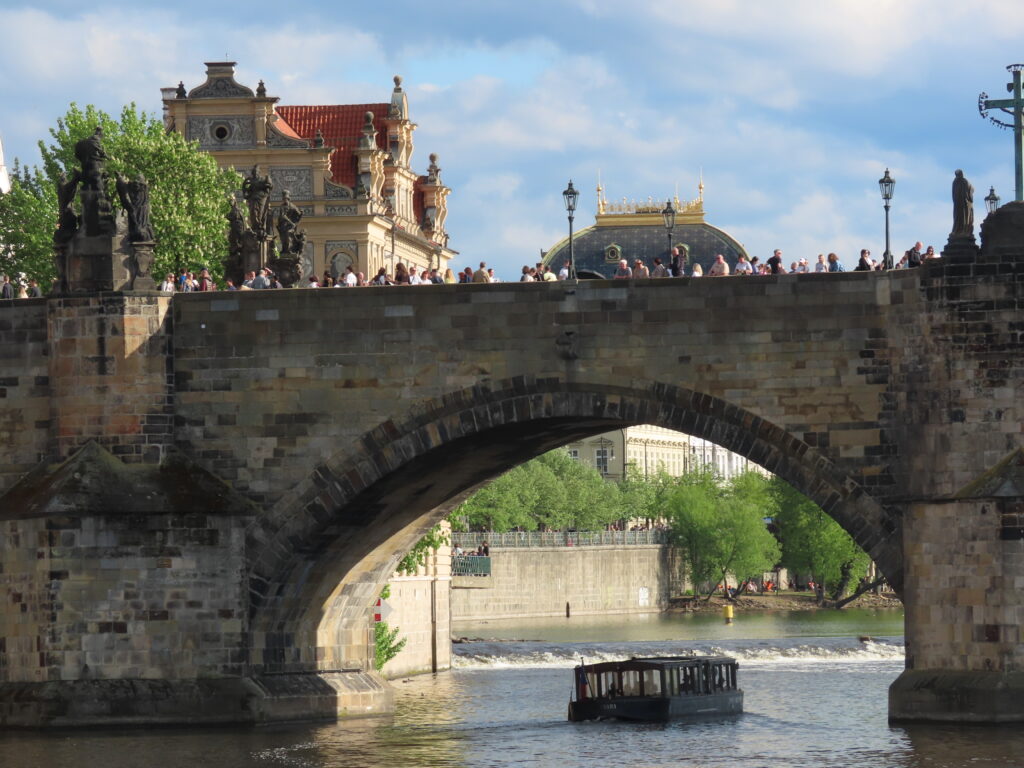
Join a guided tour. Walk from the one of the oldest medieval relics- the sooty black, Powder Gate, past Charles university, the oldest university in Eastern Europe, through the Jewish Quarter with its Spanish Synagogue and a sculpture Kafka would approve of. Once one of the largest Jew ghetto it is now a tony commercial area. Cross a raised cemetery and reach the famous Charles Bridge over the Vltava. There are buskers and tourists, and statues that never leave the place lining the parapets.
Life Line
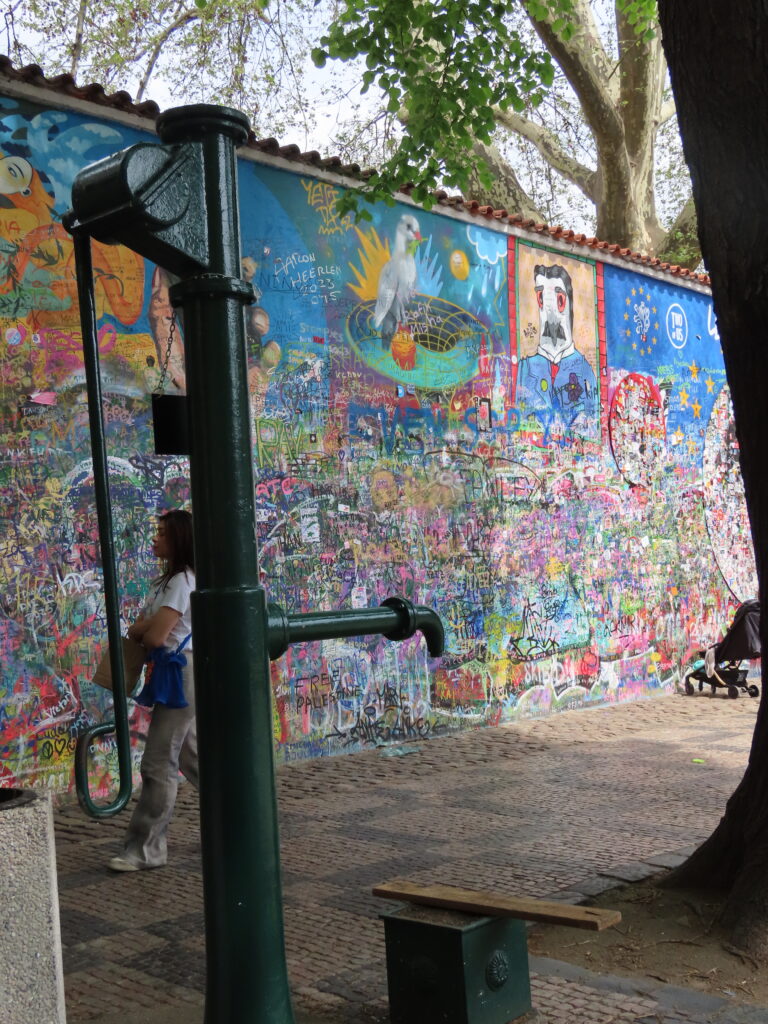
Walk across to Mala Strana, all the while listening to tales which add vivid colour to the dull sepia tones of history. Discover Lennon Wall, the chaotic layers of graffiti telling a story of peaceful defiance in the shaded alleys of a district which now has staid embassies.
The wheel of time slows for a cup.
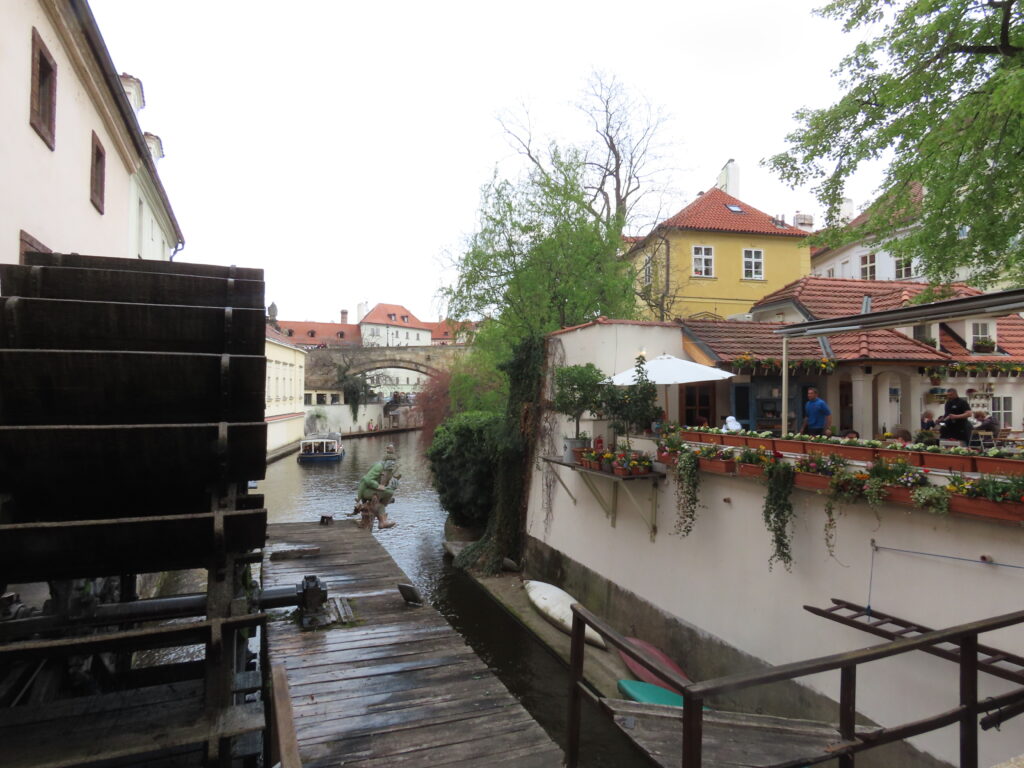
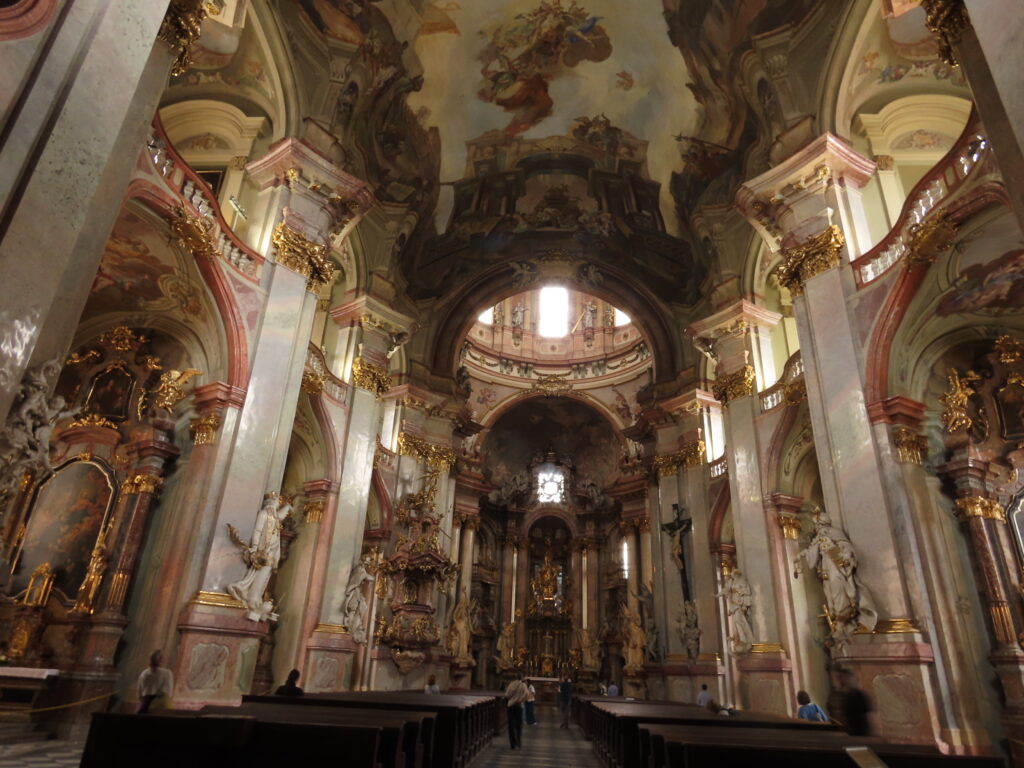
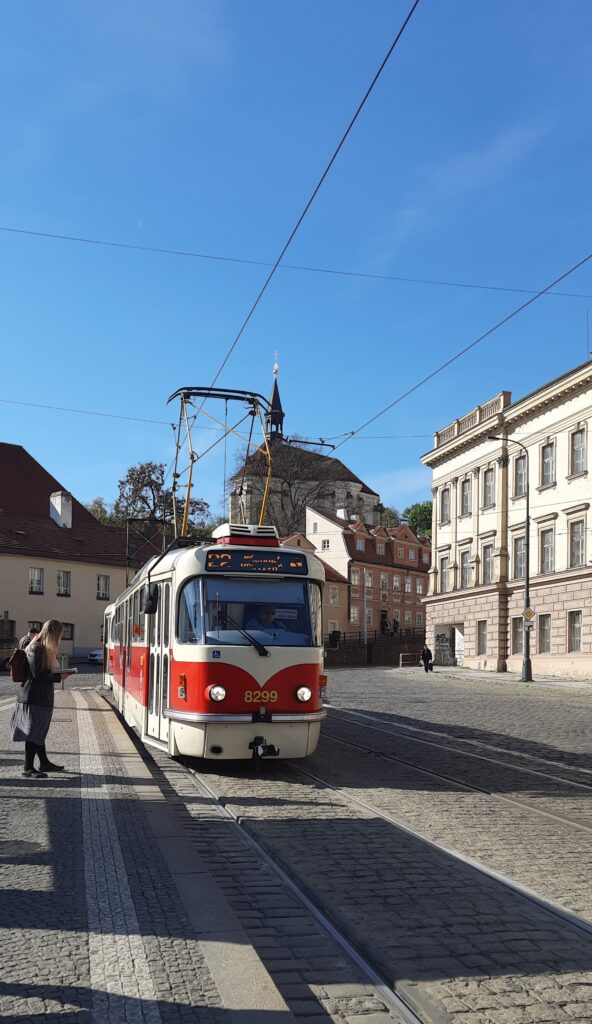
After a perk me up cuppa at the quaint café adjoining a giant waterwheel next to Lennon Wall head to St. Nicholas Church. It’s dome an oddity in a city of spires. Sit in one of the pews of the massive baroque church and take in the opulent interiors (and rest those tired feet.) Have chilled beer and lunch at one of the taverns. Board tram 22 from in front of St Nicholas Church and take a ride to get a glimpse the best of old Prague.
Heavenly abode
Spend the evening sipping champagne as you watch an abridged version of Swan Lake at the underground Broadway Theatre. It’s utilitarian interiors a complete contrast to the show on the stage. I felt I was in the communist era watching something subversive!
Subversive Art
Day3-
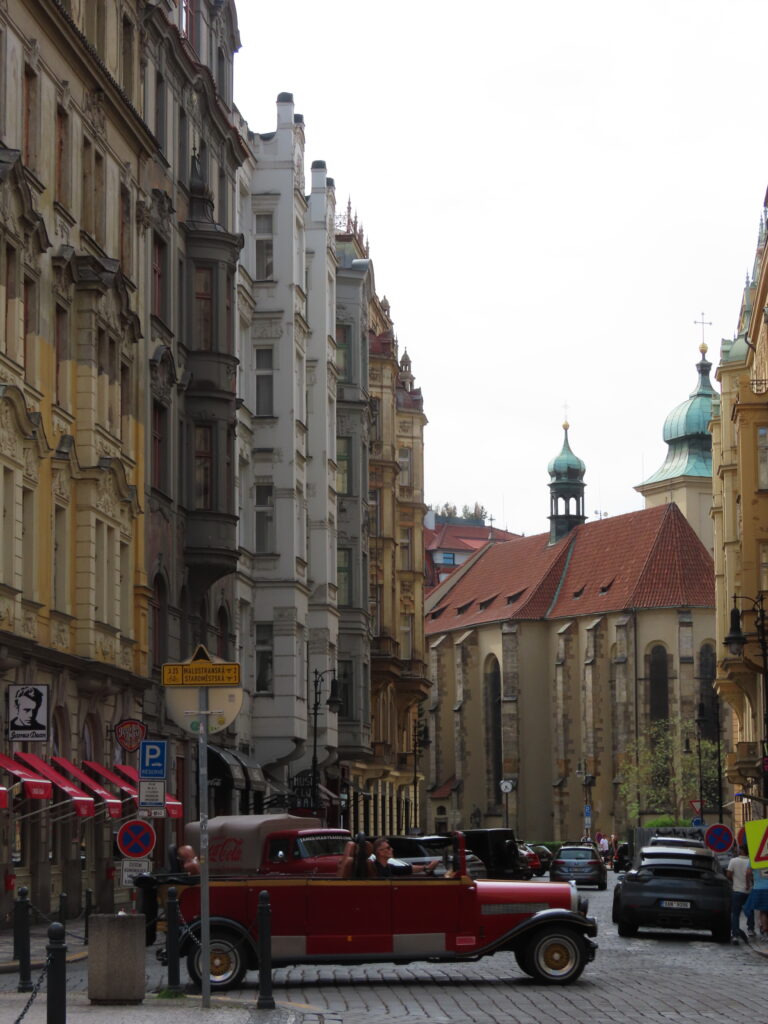
Walk or take a tram to Mala Strana early. (In the same line you could end up with a vintage or an ultra modern carriage) Walk up to the ship-shaped Prague castle complex with the towering, dark St Vitus Cathedral in it’s centre. From the bastions get a bird’s eye view of the gardens and hidden courtyards of Mala Strana.
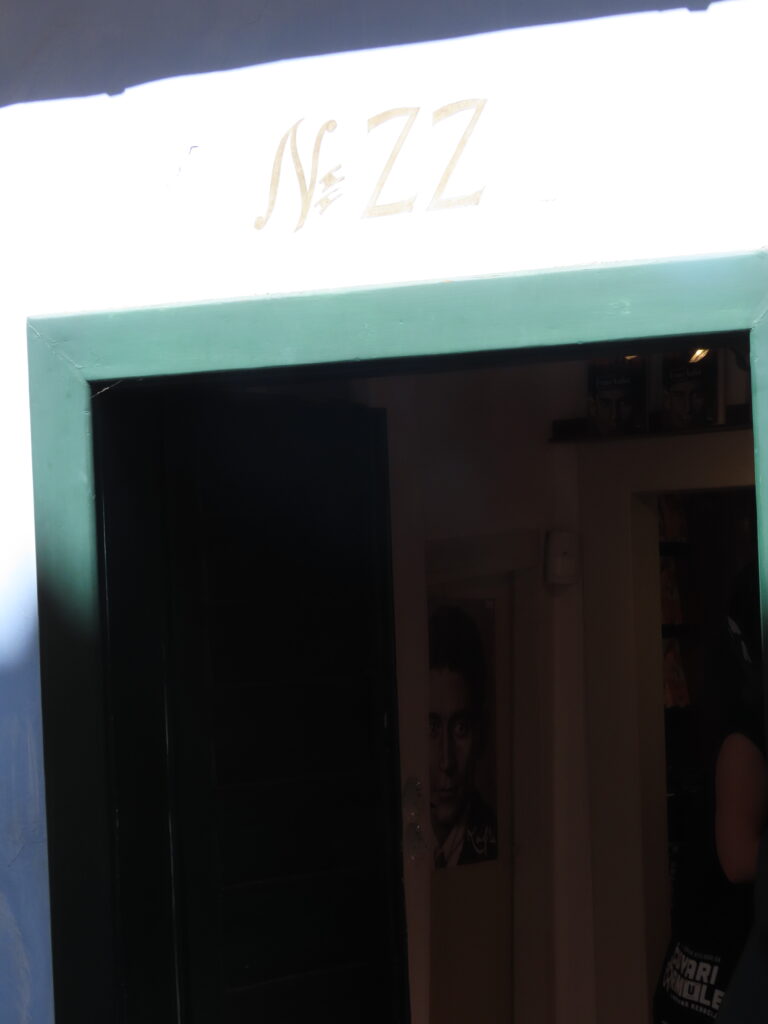
The palace interiors are plain per se save the gorgeous giant tiled heaters. Explore the narrow Golden Lane with its cubby houses in a row, including number 22 where Frank Kafka once lived. Each one has been restored to give a visual feel of different people’s lives back in the day. The upper storey runs across many houses and holds soldier’s armoury.
Kafka’s direct gaze.
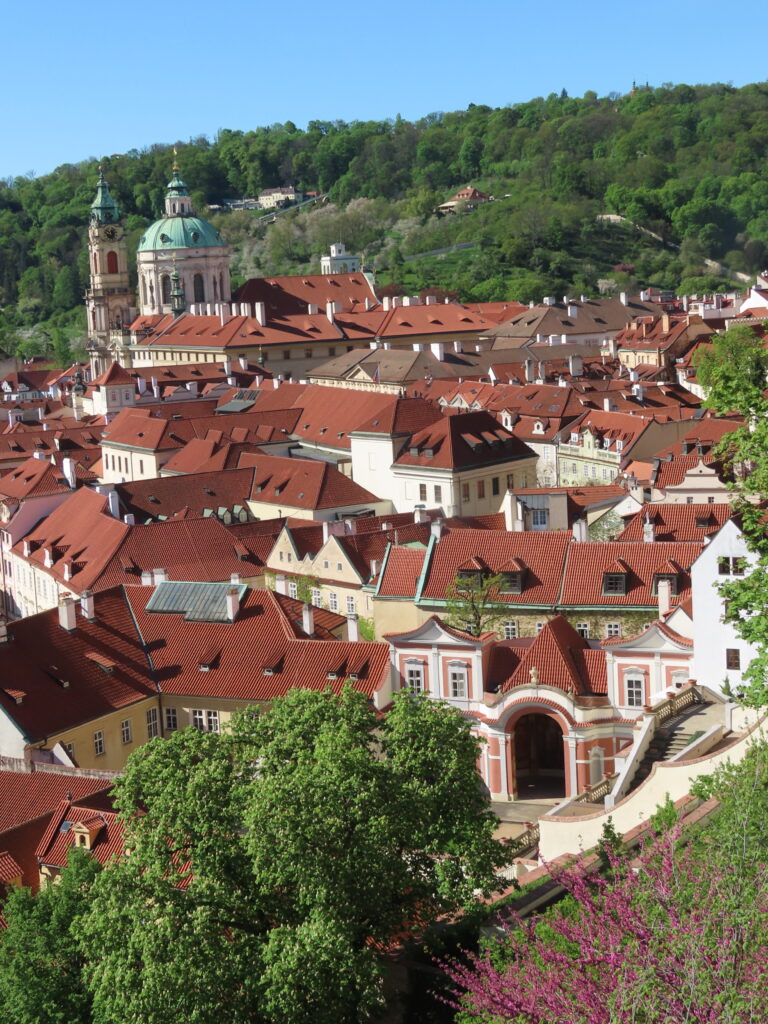
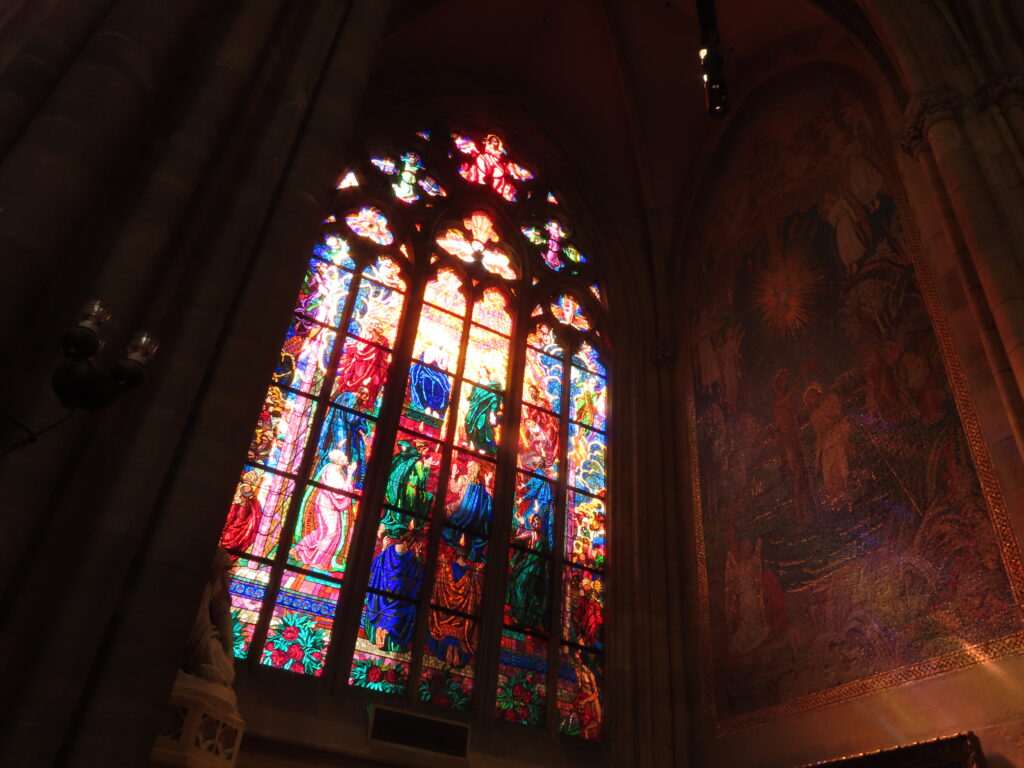
The cathedral has the most stunning, literally and figuratively, high art! The full-length painted glass panes, some done by Mucha, are divinely beautiful with different hues through the day. Head to see the changing of the guard which happens at noon every day at the Mathais Gate. The expansive square in front is encircled by various palaces of noblemen. Have lunch at Kuchyn restaurant with a lovely view of green Petrin Hill and the terracotta roofed city before walking down to Mala Strana to lose yourself in its charming cobbled alleys.
A dome in a city of spires
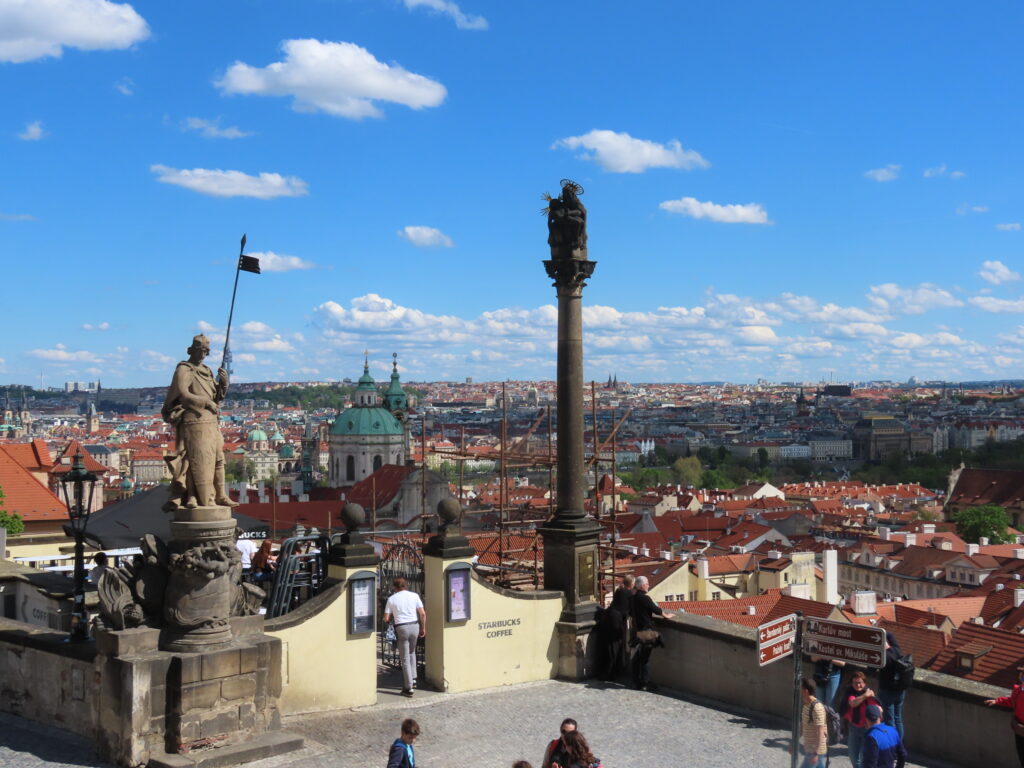
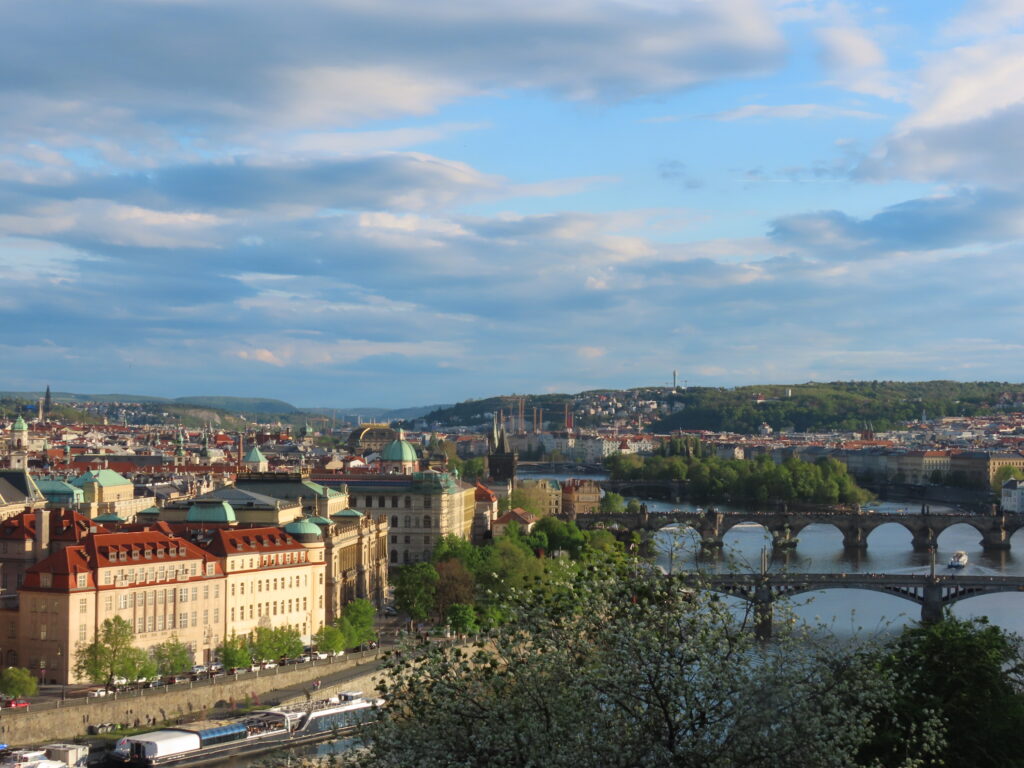
Head to the Vltava River for a boat ride in the evening. Gently glide on a small shallow stretch to get a ringside view of both banks. End the evening at Letna Park to see, in the mellow golden hour, the many bridges spanning the curves of the Vltava between the slopes of old Praha.
A picture postcard from Praha
Looking into the bewitching Bohemian Crystal that is Praha casts a spell. It will have anyone who visits it once coming back for an encore.
Fact File
Accommodation-
Old Town has many good options. Mala Strana has a few.
Getting around-
The trams are a great way to get not only a feel of the city, but to get around as well. Walking is inevitable in the cobbled streets.
Money Wise-
Though the Euro works well, the local Kroner is preferred.
Miscellaneous-
Tram 22 offers some of the most worthwhile views of the city.
Vintage views
Kuchyn and Lokal in Mala Strana are must trys for local cuisine. Book an outside table in advance at Kuchyn.
GuruWalk has some good ‘free walking tours’.
Book your event tickets through GetYourGuide which has good options.
The castle ticket can be booked online and has different variants.
Billy Joel’s ‘Vienna’, without intending to, sums up the spirit of the metropolis. Vienna conjures up images of a grand old dame who savours her age. With coiffed silver hair, uber elegant, witty, no nonsense with a taste for the finer things in life who would probably say, ‘I go to Sacher Café for the ambience but my goodness, I wouldn’t wait in a line for the torte!’
Mistress of all she surveys..
Visiting any part of Central Europe is like getting a crash course on the Holy Roman Empire and its successor, the Austrian Empire. With Vienna as their capital, the empire’s finest, be it art, architecture or music- all is to be found in this sprawling city. The monarchs played their bit role but here, the queens are the ones still being eulogized.
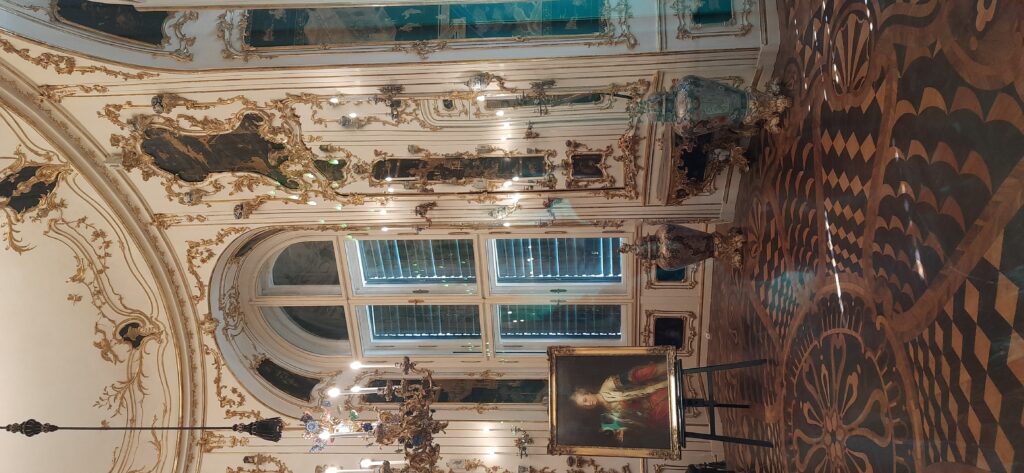
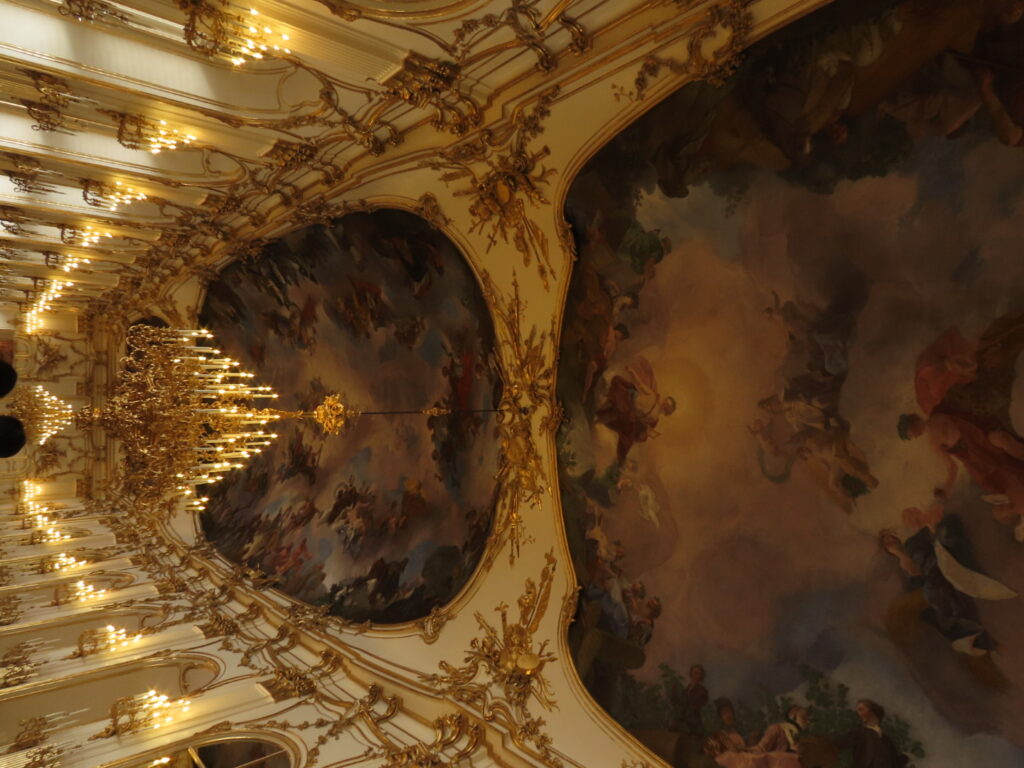
A portrait of plenty. (Schonbrunn State Apartments)
Three days is just enough to explore the Inner town and some of the palaces around. If you want to thoroughly explore the architecture and dive into the art scene you might need to shift there!
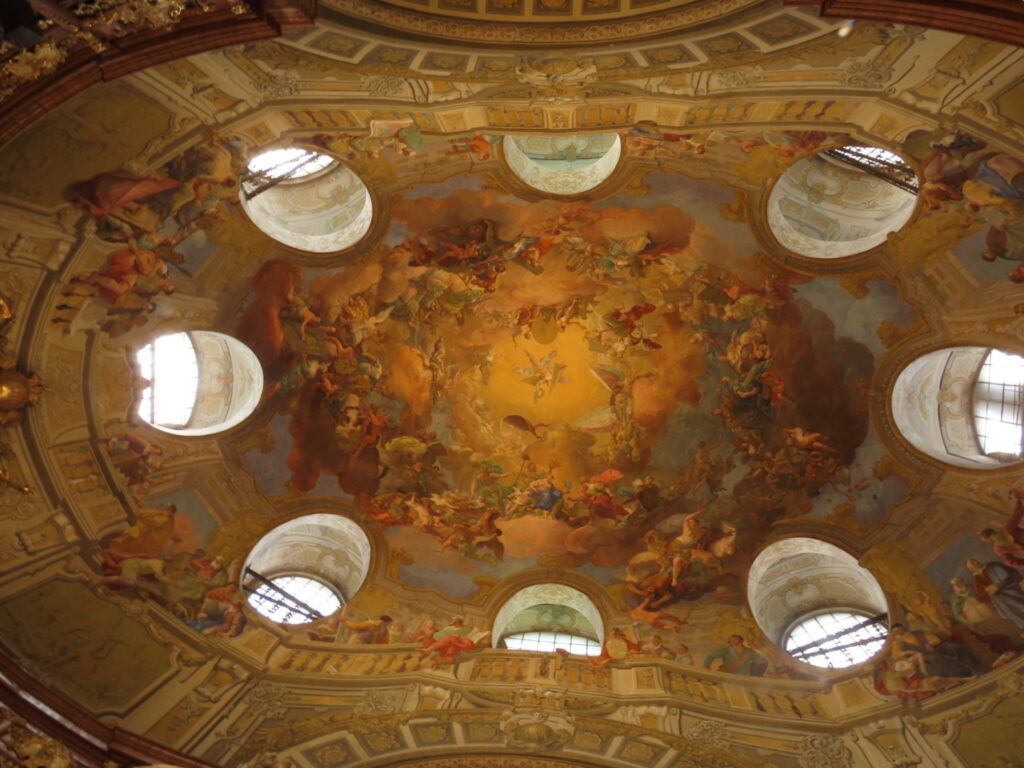
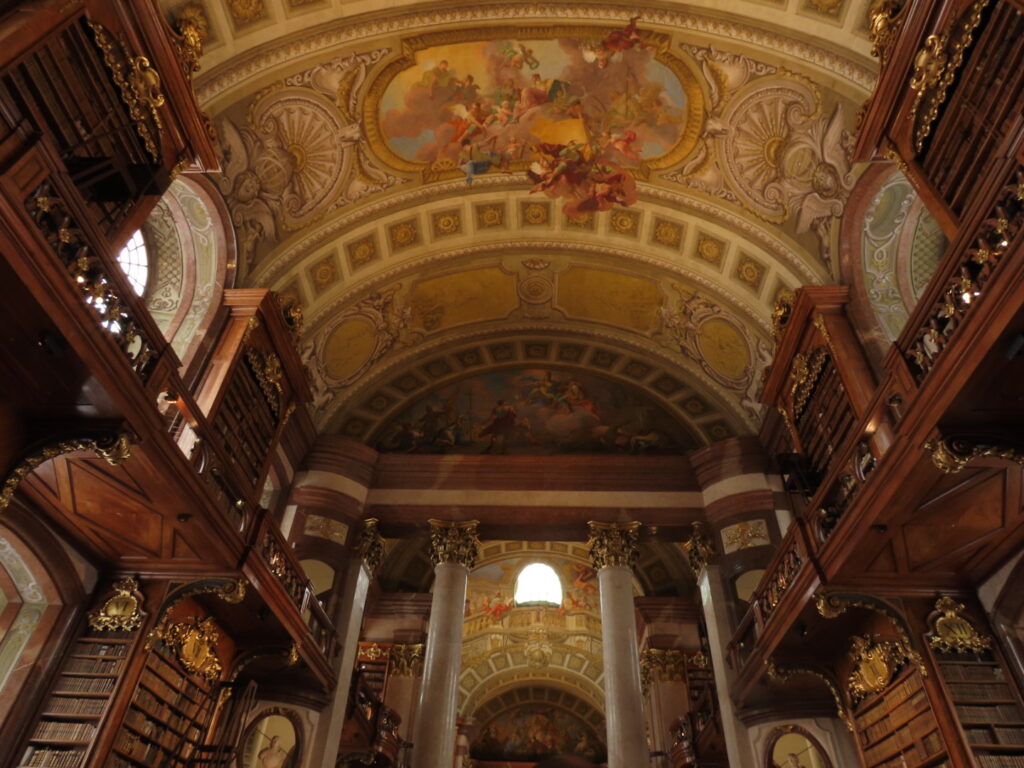
Above us, only heaven..(National Library)
Where-
There is no dearth of places to stay in Vienna and in 150-200 euro per night you will get good accommodation. Stay as close to Innere Stadt as possible, if not in it, with quick access to the metro, trams and, if possible, the HOHO buses.
Pro tip- A good area with lots of options is the adjoining Neubau area. The Westbahnhof station has the metro, trams, HOHO and the airport buses plying from it.
How-
1. Vienna has an excellent metro and tram network. The HOHO buses can be a good option to get around as well.
2.Out of the 3 lines of the HOHO buses, the Yellow Line has the maximum sightseeing places. The buses run approximately every half an hour starting 9:30 am onwards.
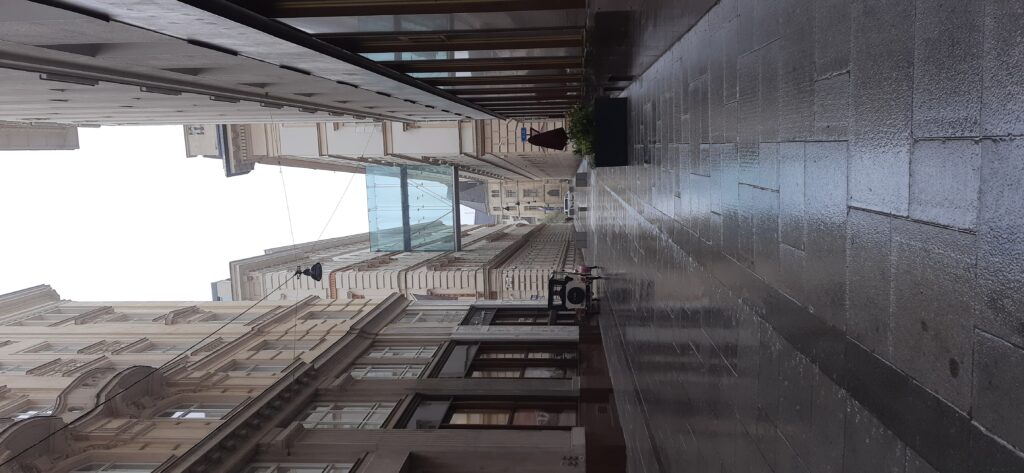
A streetcar named Desire
3.The metro is fast and each ticket costs 2 euro no matter what the destination. You need to validate your tickets on your own in the tram and at the metro station. Generally, no one checks but if you get caught without a validated ticket the fines are hefty. About 100 euros. Ulp-gulp!
Pro Tips-Time your visits to a place so that you don’t waste time waiting for the next ride while using the HOHO buses.
The HOHO buses start and finish at the State Opera House and the last bus on the yellow line finishes it’s circuit at 5:30 pm.
Passes and Tickets-
There is an entry ticket for everything. There are tickets for different portions and time slots for parts of Schonbrunn and Hofburg Palaces. The churches are mostly free.
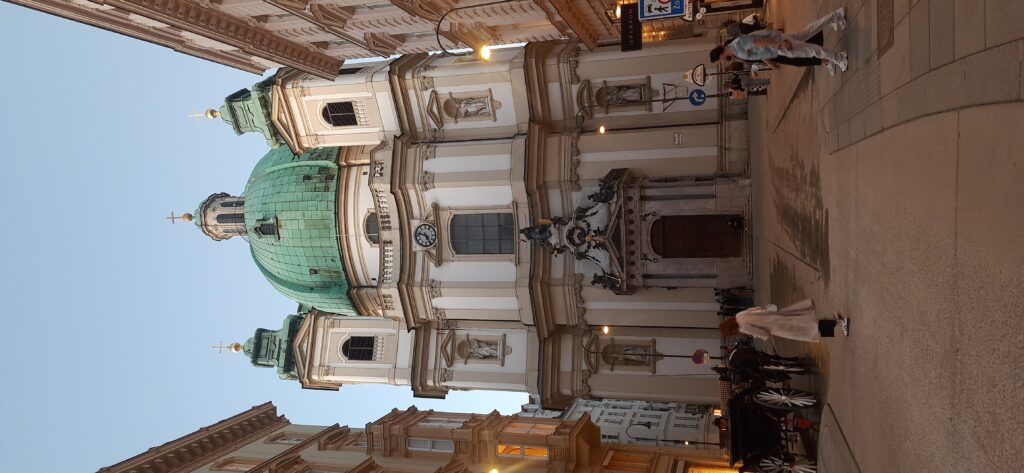
Peterskirche
There are two passes available in Vienna. The Vienna Pass gives you entrance to upto ninety attractions, fast track entry to many and includes the HOHO bus ticket. The Pass also includes a cruise on the Danube and a walking tour of the Innere Stadt area. It has options for 1,2,3 or 6 days.
The Vienna City Card is a transport card with three validity options- 24, 48 and 72 hours and includes all modes of transport in the city but not the HOHO bus which can be an add on. It gives discounted entry to many places apart from discounts at some restaurants, hotels etc.
Pro Tip-Buy a pass or card online. Unfortunately, there seems to be no system to book time slots online in advance.
Packing it in-
Vienna tests your walking shoes with its cobbled streets and pavements. Carry a pair of good walking shoes and an umbrella. Dragging a loaded suitcases on cobbled stones test’s your muscles and patience, so pack smart!
What-
Get a glimpse of the lives of the Habsburgs in their palaces with their baroque facades and opulent interiors. Soak in the silence in the interiors of the churches once you are done admiring their gothic spires or baroque domes.
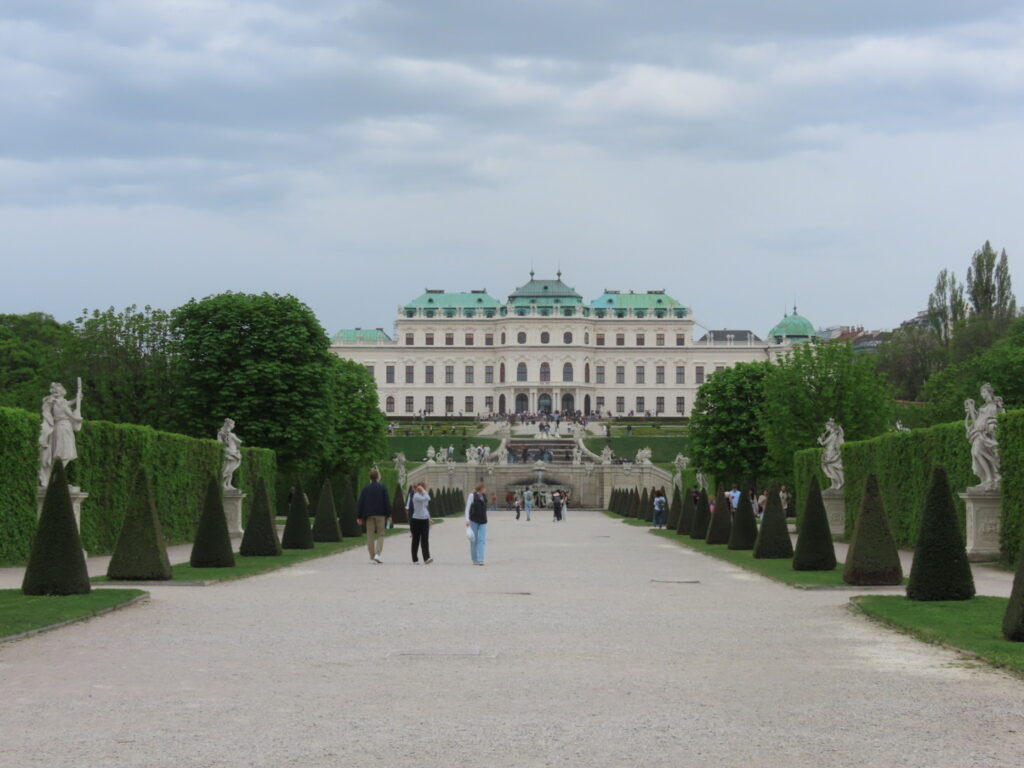
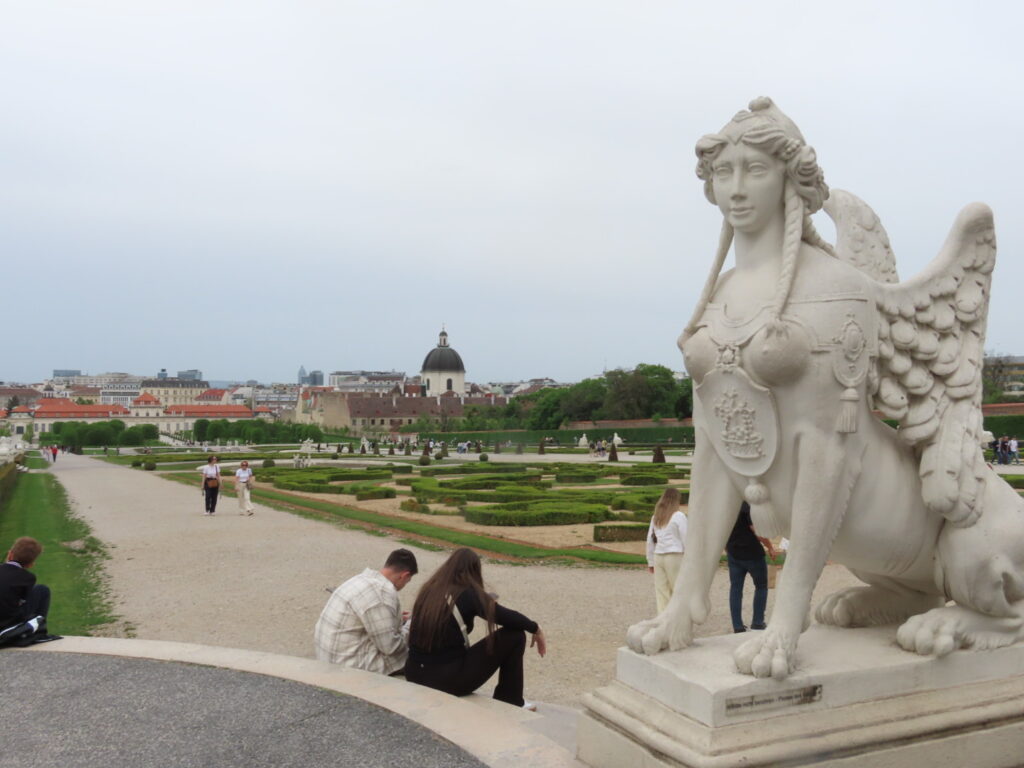
Up the Garden Path (Upper Belvedere)
Take a cruise down ‘Blue Danube’, indulge your inner art aficionado in the plethora of museums, catch performances in beautiful settings or simply lose yourself in the alleys of the Innere Stadt only to discover charming squares and buildings which seem covered with artisanal royal icing! How apt! Vienna wows whoever visits it. How to do it all in 3 days?
1.Head early to Schonbrunn Palace, the summer residence of the imperial Habsburg family. Book your slot for the palace tour. If it is not available immediately, explore the garden behind the palace. It is a sprawl, with a zoo and a maze amongst other portions, so keep ample time.
Arches of Triumph (Gloriette)
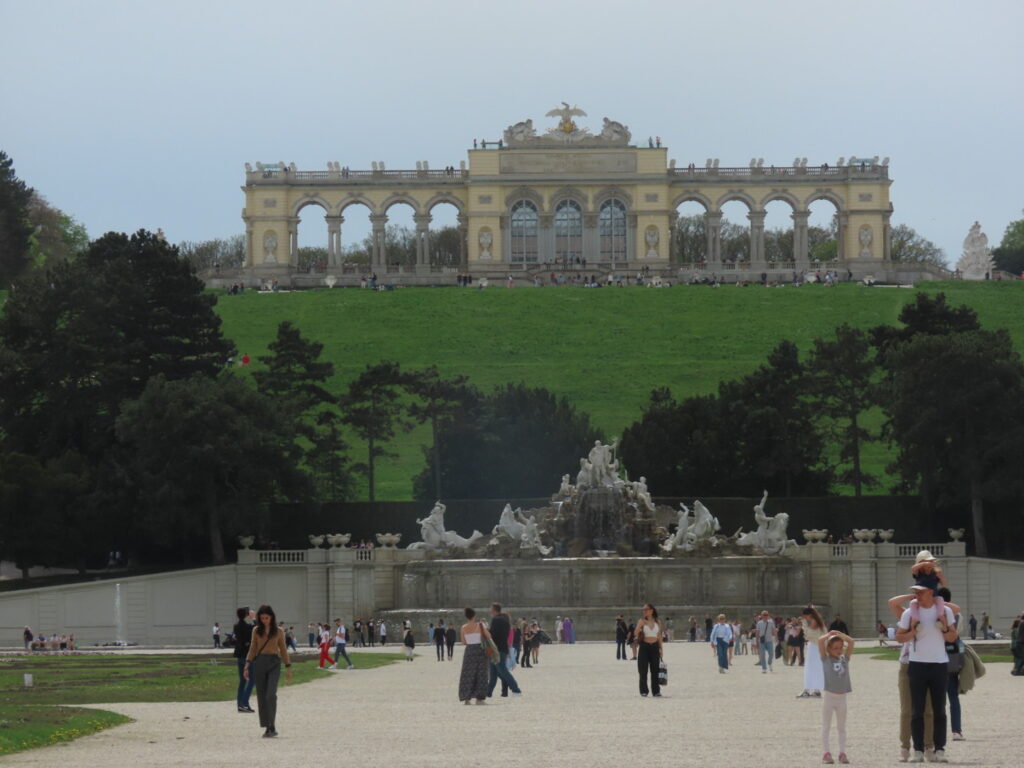
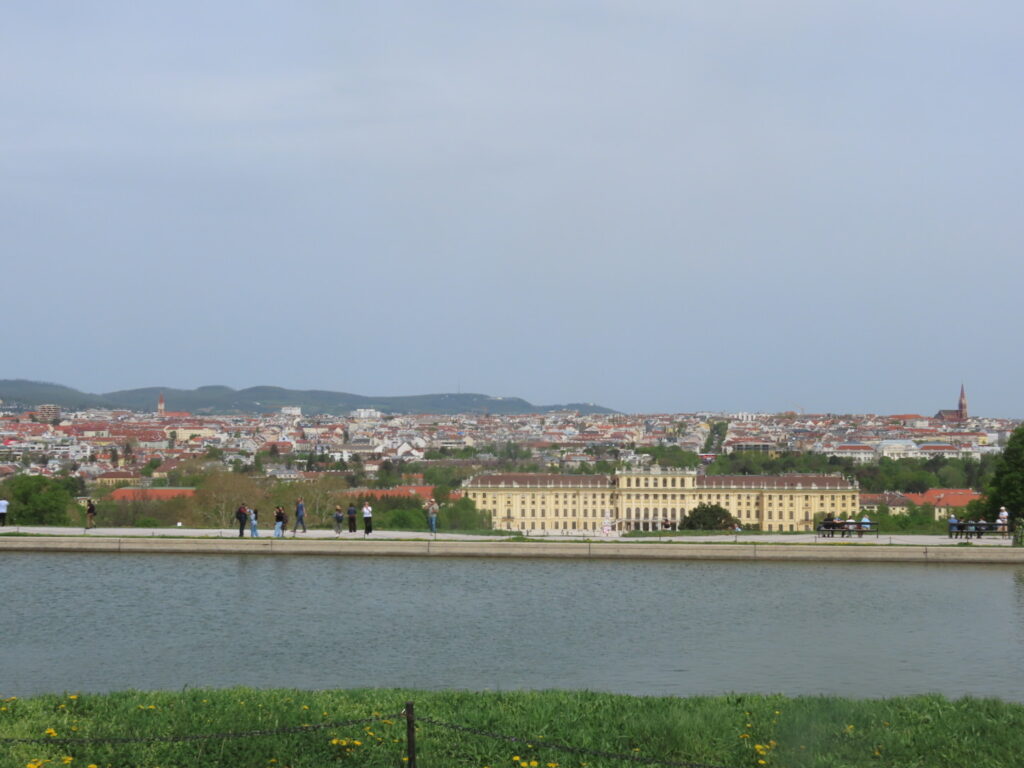
It is a climb to the arches of the Gloriette Viewing Terrace beyond the garden, above the fountain of Neptune, but the view of Vienna is worth it. If you do not want to walk, hop onto a mini ‘train’ that does the rounds of the grounds which starts from in front of the Privy Garden.
What a Gloriette View! (Schonbrunn Palace)
Inside the palace enjoy the stunning virtual reality show as you walk through the frescoed interiors. Ooh aah over the opulent state apartments and ceremonial halls.
The hanging gardens (Schonbrunn Palace)
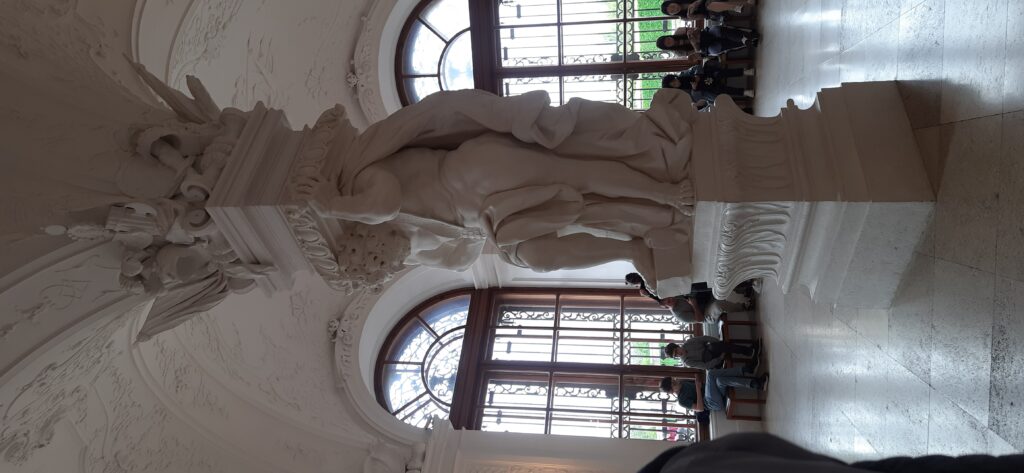
2.Move to Upper Belvedere built by Prince Eugene of Savoy. Maria Teresa turned it into Austria’s first public museum. Admire the pillars in the foyer before moving to the first floor to gaze at Gustav Klimt’s ethereal rendition of women.
Sit on the stairs outside that lead to the rolling garden and savour the view. Lower Belvedere holds temporary exhibitions.
Guardians of the Garden
3.In the evening catch a concert at the Orangerie at Schonbrunn or at one of the churches.
Pro Tip-Viator and Get Your Guide have tickets for the performances. Book in time since the good ones get sold out much in advance.
Schonbrunn opens at 8:30am.
Day 2-
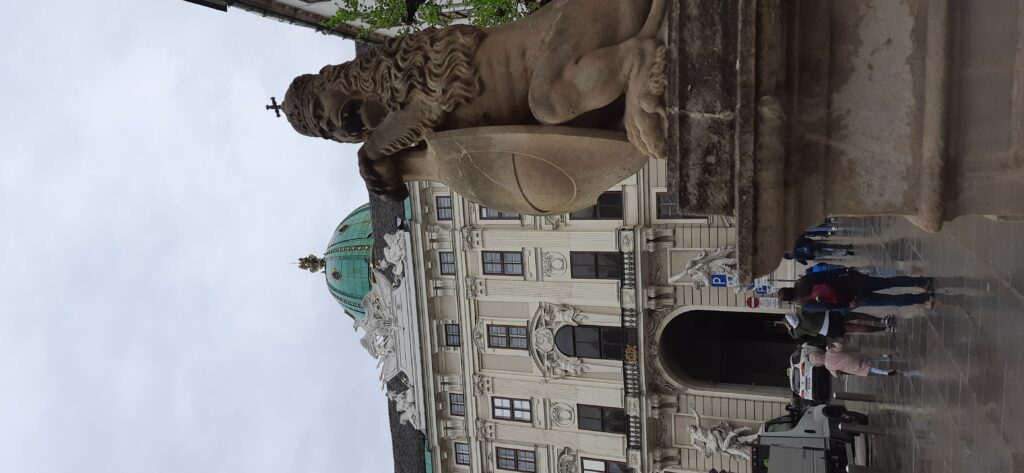
Reach the Hofburg Palace early. Book a slot for the Sisi Museum and State Apartments tour. In the 13th century the last of the ruling Babenberg’s started construction of the oldest parts of the palace. If Schonbrunn was all about Empress Maria Teresa, this winter palace is about the romanticized Queen Sisi. The palatial complex of extended wings, numerous royal apartments and courtyards demands time.
King-sized (Hofburg Palace)
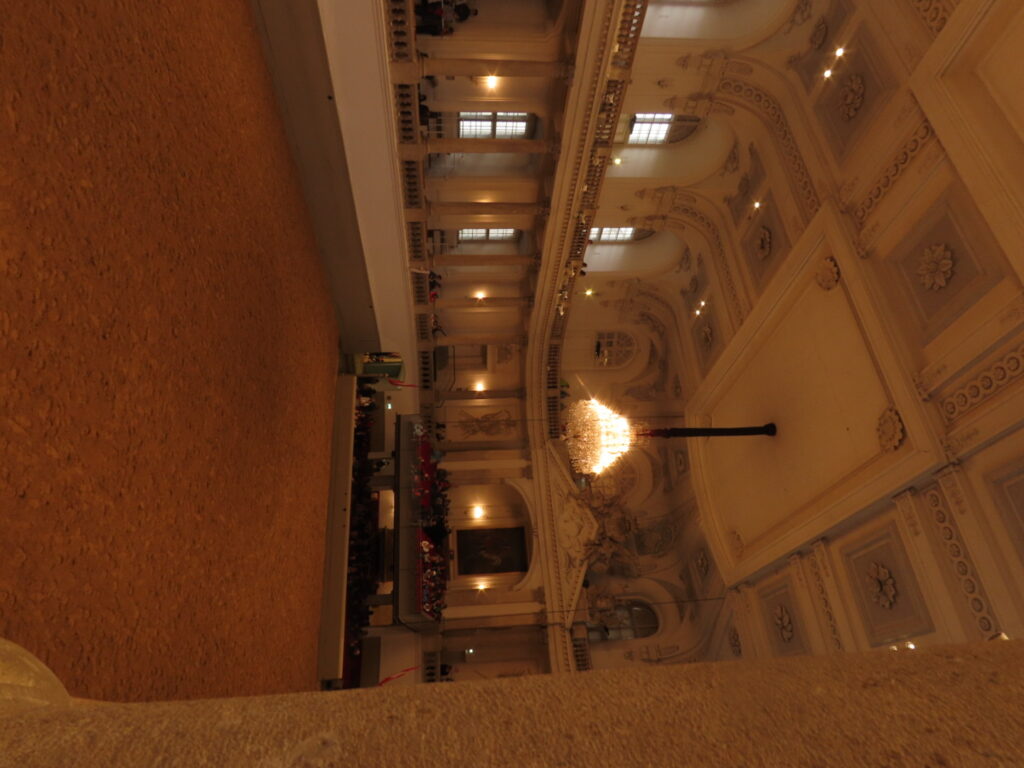
Watch a performance of the Lipizzaner horses at the Spanish Riding School. Pure-bred stallions perform dressage to classical music in a chandeliered arena. If you are short on time, catch their morning exercise which starts at 10am.
Pegasus (Spanish Riding School)
Go for a guided walk to soak in the stories of the surrounding Innere Stadt area.
Admire the crown jewels of the Habsburgs in the Imperial Treasury.
Gape in wonder at the interiors of the National Library. I wonder if anyone ever got any reading done under those frescoes!
Read the Painting on the Wall
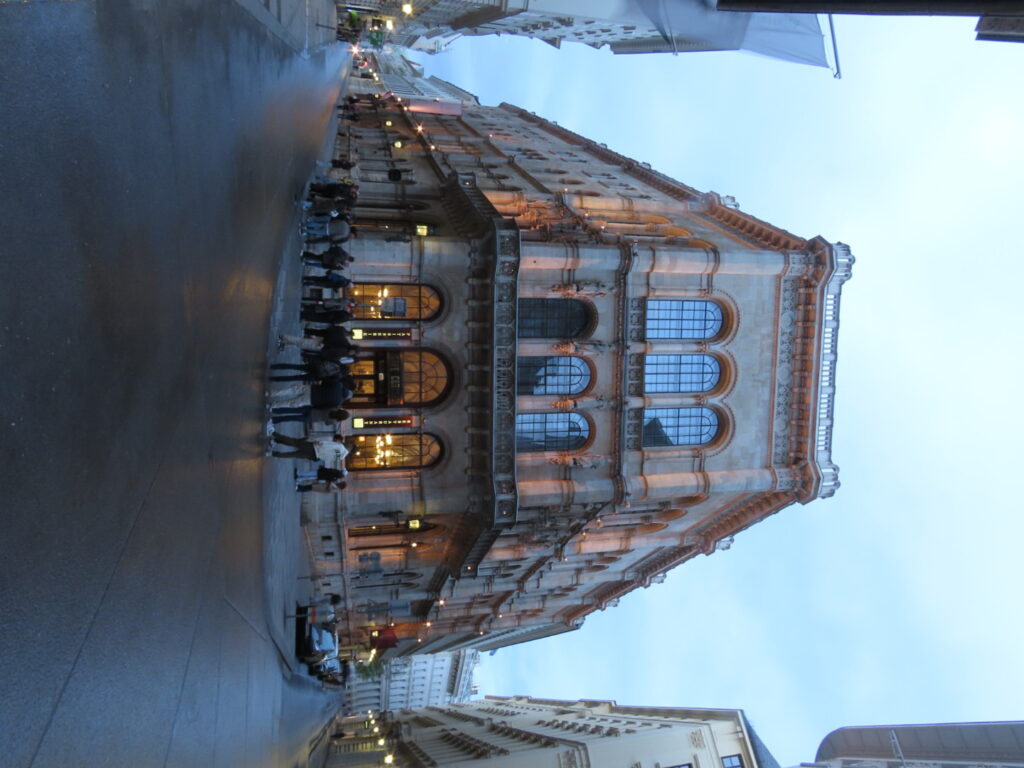
You have probably earned a leisurely coffee break by now. Head to Sacher Café for the famed Sacher torte or for a side of history (and there is enough to pass around in Vienna) with your coffee try the iconic Café Central, which counts, apart from a catalogue of writers, Hitler, Tito, Freud and Stalin amongst it’s patrons. (Book a table in advance to skip the inevitable line.)
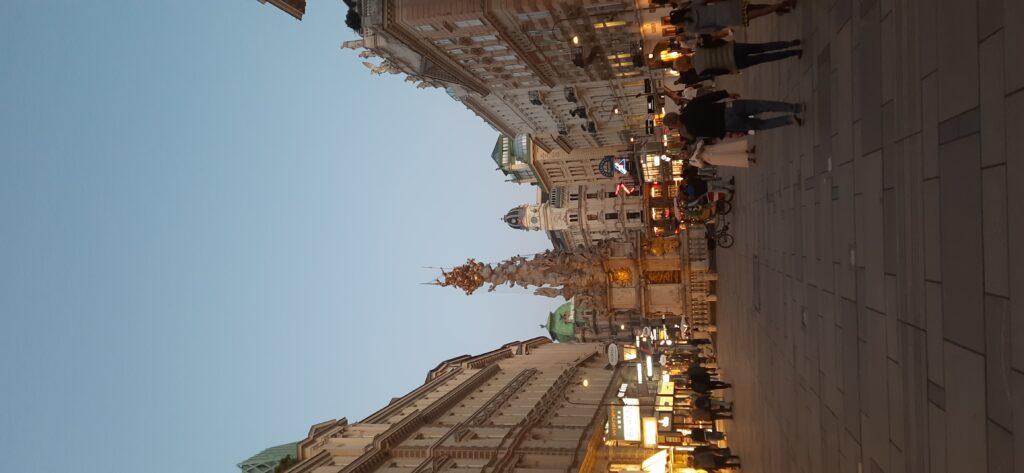
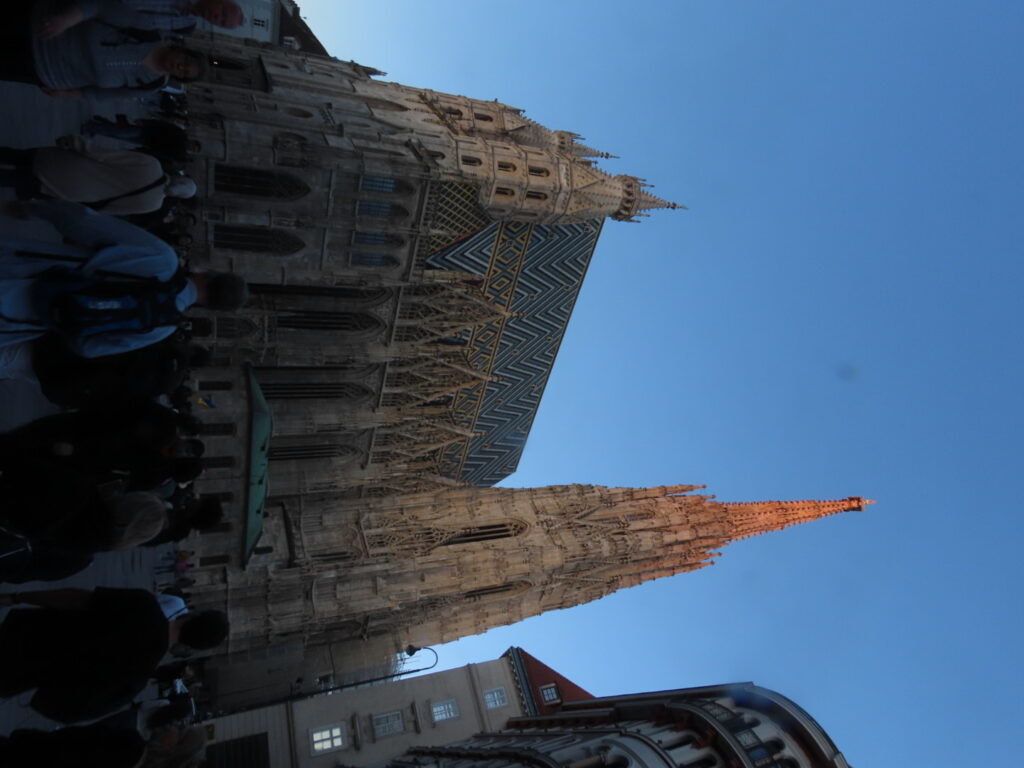
Stroll through the cobbled streets to the gothic St Stephans Church. It’s mosaic tiled roof and towering spire blazing like a beacon in the setting sun makes a magnificent sight!
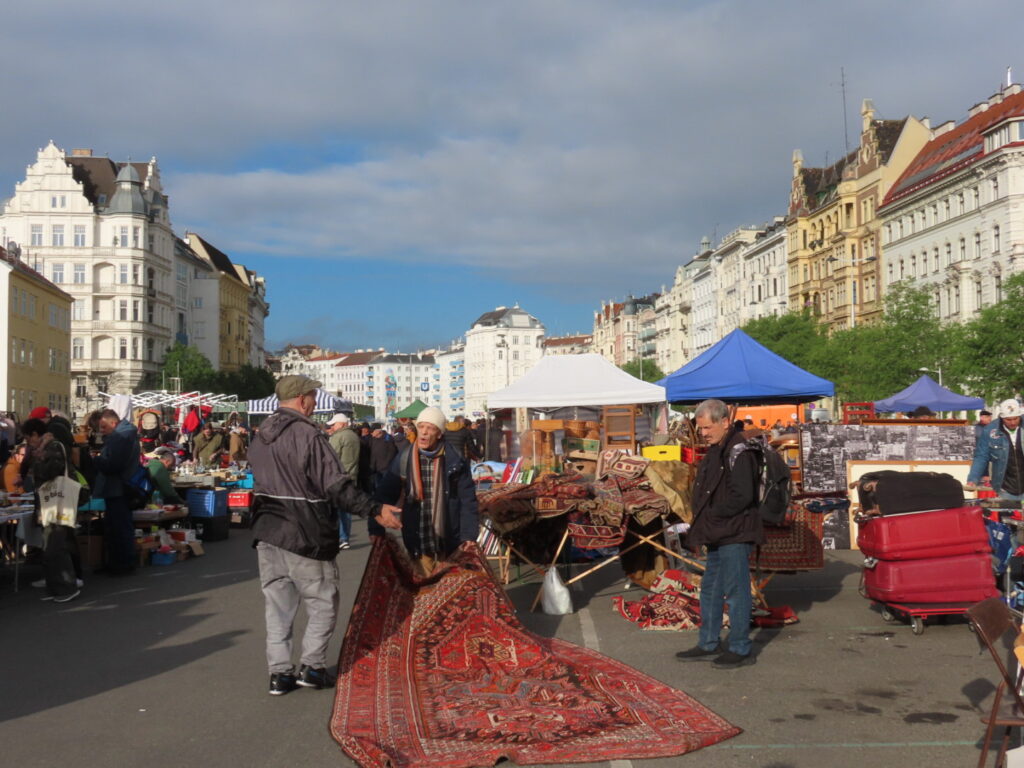
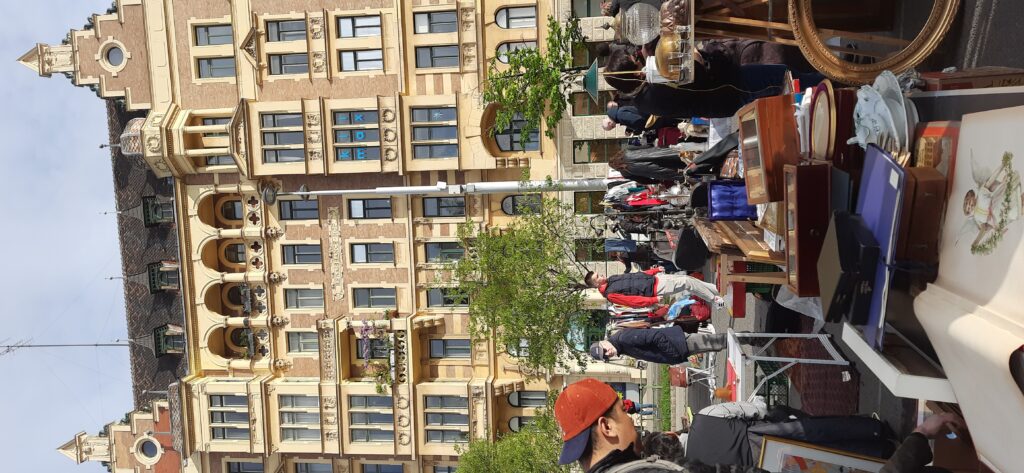
Pro tip- On Saturday, head for some treasure hunting to the Flea market at one end of Naschmarkt. Timing- 6:30 am onwards.
Treasure Hunt
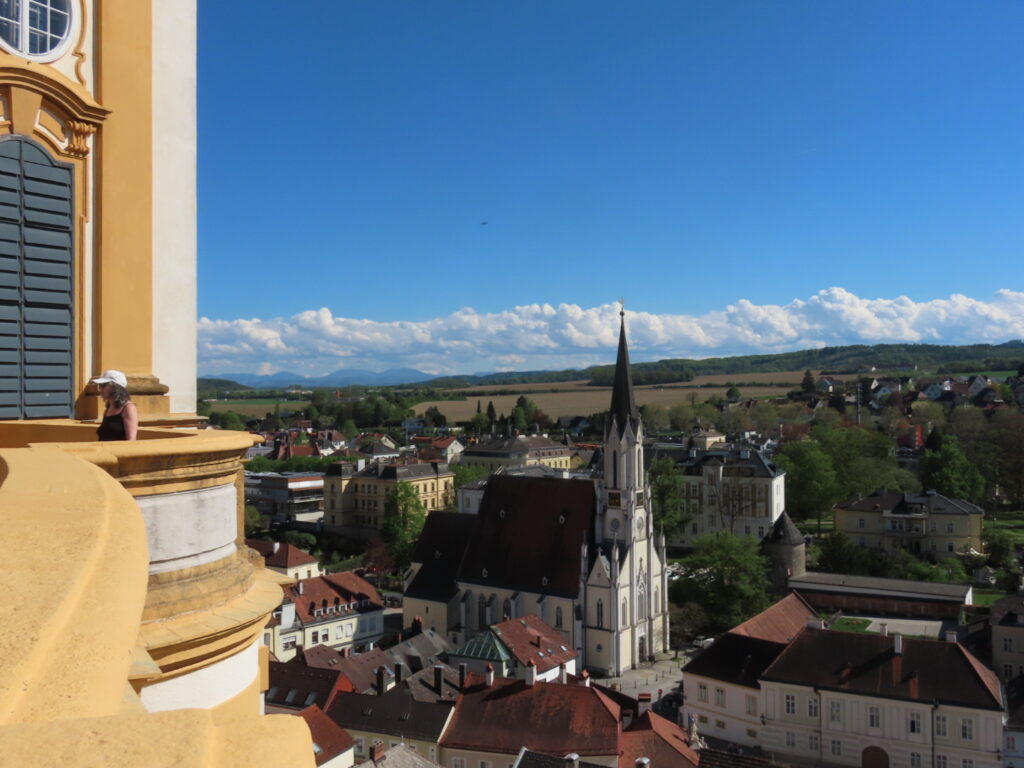
Be ready to be charmed by this cultural connoisseur’s city. It’s fabled savoir-vivre can leisurely be soaked in with a bit of planning. If you have time, a daytrip to Melk Abbey via Durnstein will be like a daydream!
The stage was set. The accompanying cast played their part, only the main lead did not get the brief to, well, just show up! Pench is the land of Mowgli and his tribe of wolves, with Bagheera the black panther, Baloo the bear, Kaa the python and ofcourse, Shere Khan the tiger, all to be found in the jungles around Seoni, a place close to Pench. From here the tale with kernels rooted in reality originated. It inspired Rudyard Kipling to write a collection of stories succinctly named the Jungle Book.
An Open Jungle Book
Uncaged Jungles
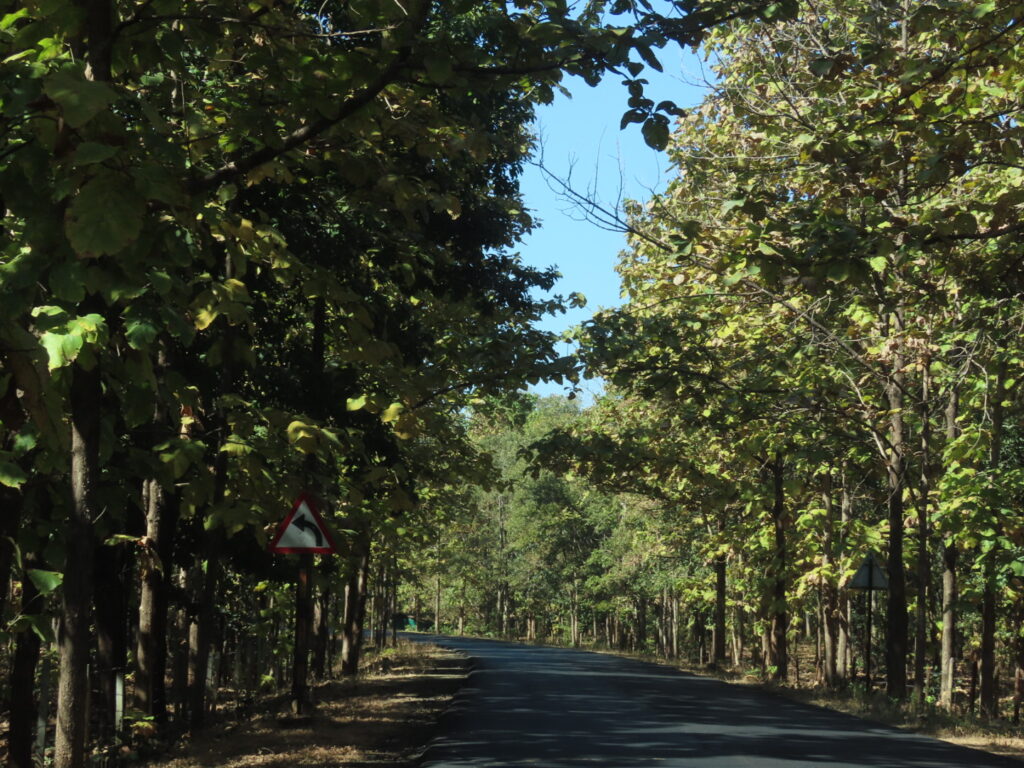
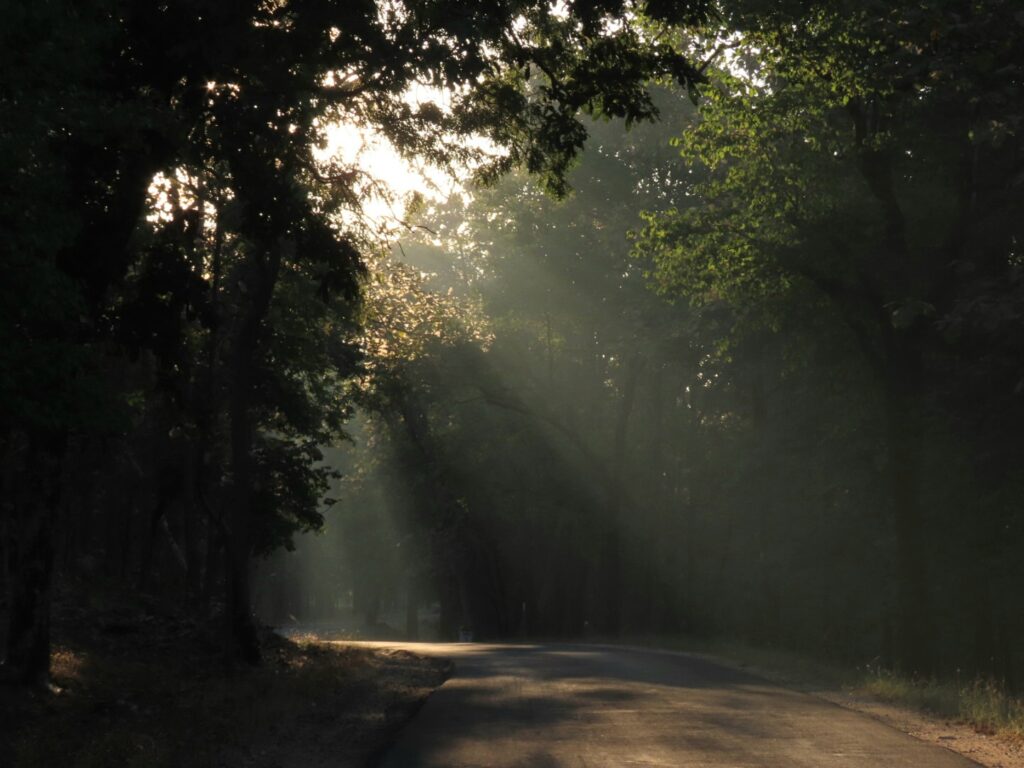
The drive to Pench is beautiful through Madhya Pradesh. We get down from the Malwa plateau on a highway being remade. Ironically all the work through the teak forest to make the new alignment and the tunnelling has made the wildlife move to the neighbouring urban areas it seems. We cross the Narmada where a smattering of Brahminy ducks with their bright orange backs and black beaks bob around like beacons in the water.
Highway through heaven.
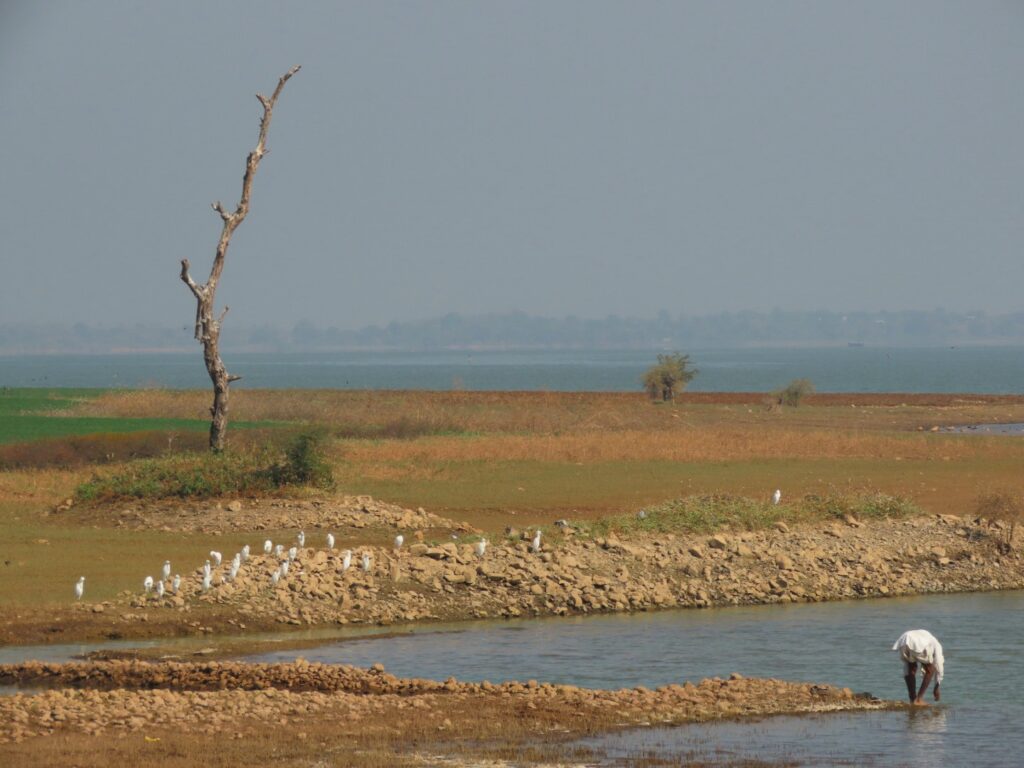
The road winds through fertile valleys with hamlets surrounded by hills covered with thick teak forests. It feels like a tiger could saunter across the road at any time. Dried rivulets run helter-skelter promising to be full in season. In winter, only fractured pools hold wishy washy memories of monsoon. A massive reservoir is the perfect place for a break to have the coffee we are carrying. A man tilling his fields by the shore and a flock of white herons give us company.
Whites
A high-volume highway connecting Jabalpur to Nagpur passes through the buffer zone as we approach Pench with flyovers at animal crossing. I wonder about the traffic sense of the animals. Must be better than ours. In India we all are jay walkers. Then often bruised and blue jay walkers.
Peaceful Pench
We turn off the highway and cross the Khawasa buffer zone on a narrow road lined with forest which makes way for resorts, fields and hamlets with bright blue and green walled houses. A deflated hot air balloon is an incongruous sight in a field. We reach our hotel near Turia gate and call it an early night.
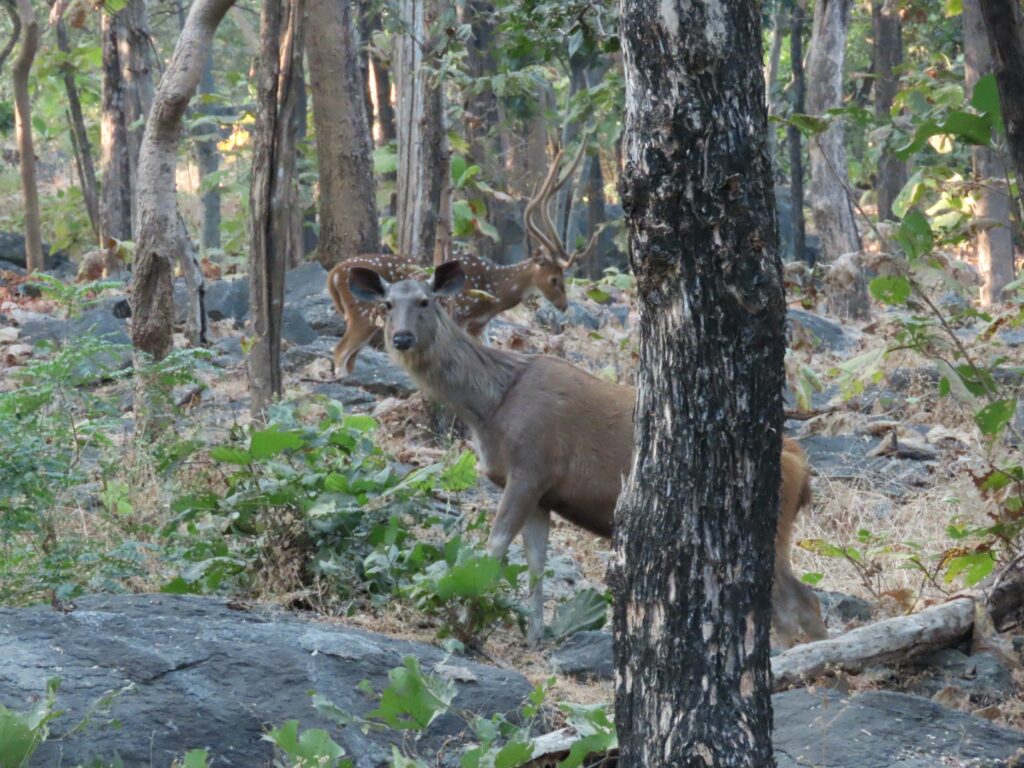
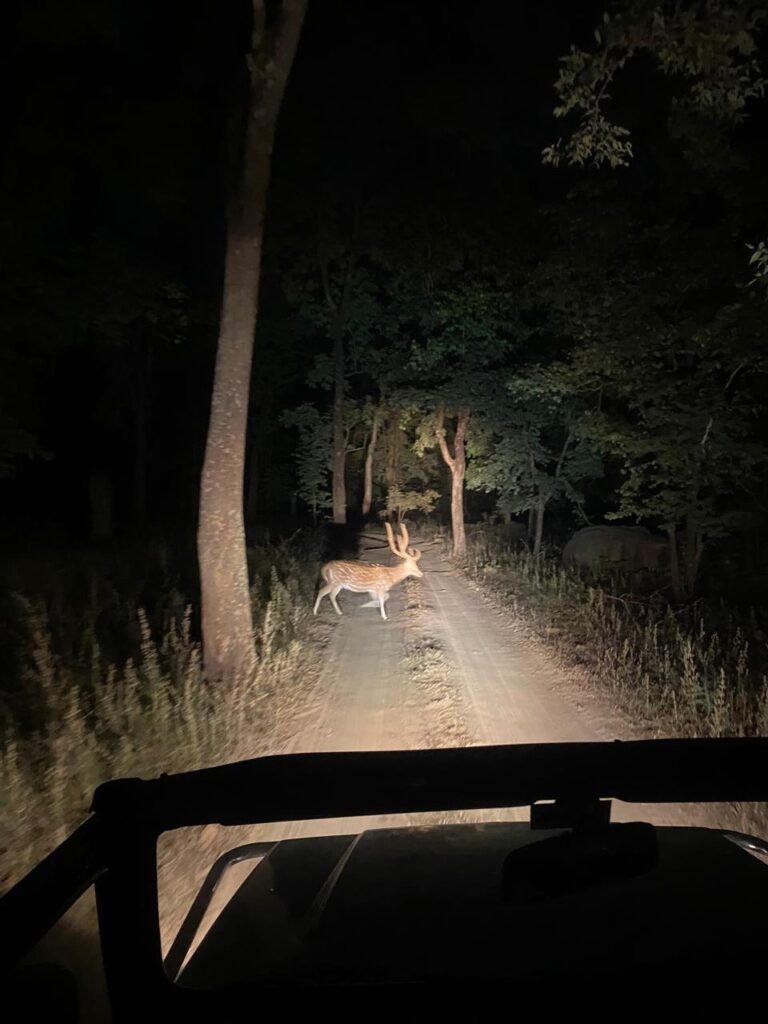
The next morning, we rise before the sun to get into a high Canter with our breakfast basket. The gypsies have already lined up at Turia gate. Inside there are no zones but designated routes and all routes eventually circle to the breakfast point near the Totladoh reservoir. Our guide is an enthusiastic fellow for whom, thankfully, it not all about the tiger. We stop to admire herds of curious spotted deer. The males have velveteen antlers.
Oh Deer! Two is company, three…
A noisy group of massive wild boars cross our path. The full grown, assured ones don’t scamper into the undergrowth. We are near a dry gulley when we hear the call! We go back and forth a little bit but the tiger seems to settle down somewhere and the call dies out. This part of the forest is more undulating and rockier. Perfect leopard country we are told. But Bagheera, and there is a solitary black panther in Pench, remains elusive.
The woods are deep…
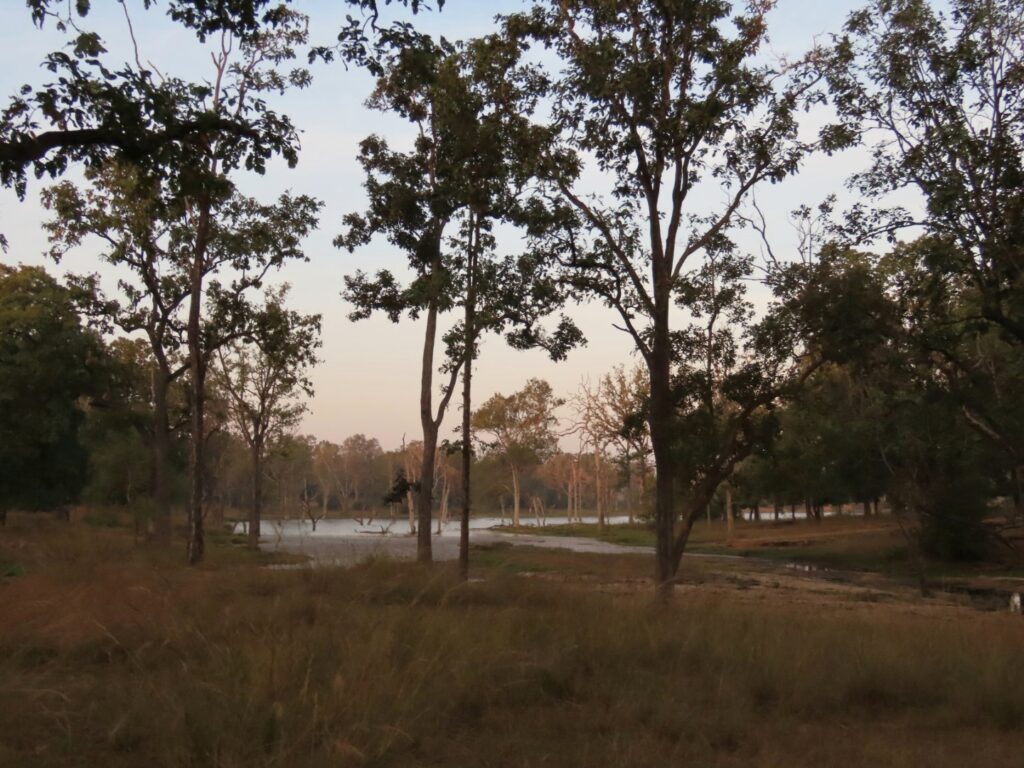
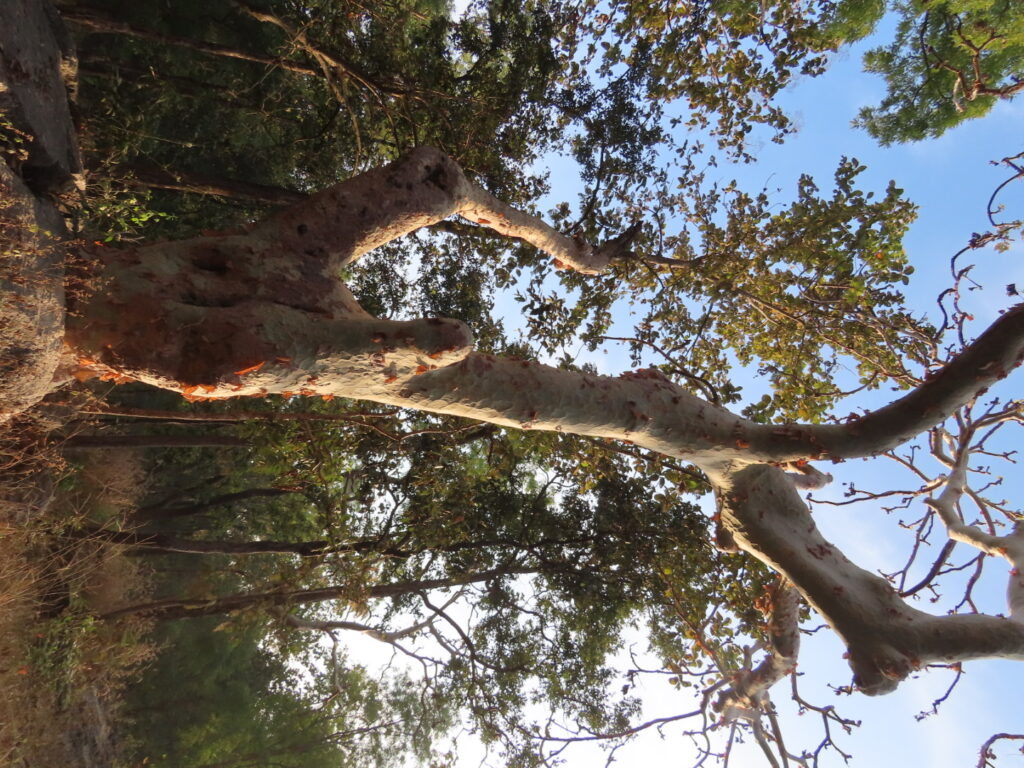
The grass catches the light filtering through the treed canopy and burns a honey amber as it grows between the massive black rocks. We stop near a dried pool and an Arjun tree is pointed out to us. Then a moulting Ghost tree on a mound of boulders. The massive skeletal white tree so aptly named is peeling an onion pink. Apparently, the peel changes colour depending on the season.
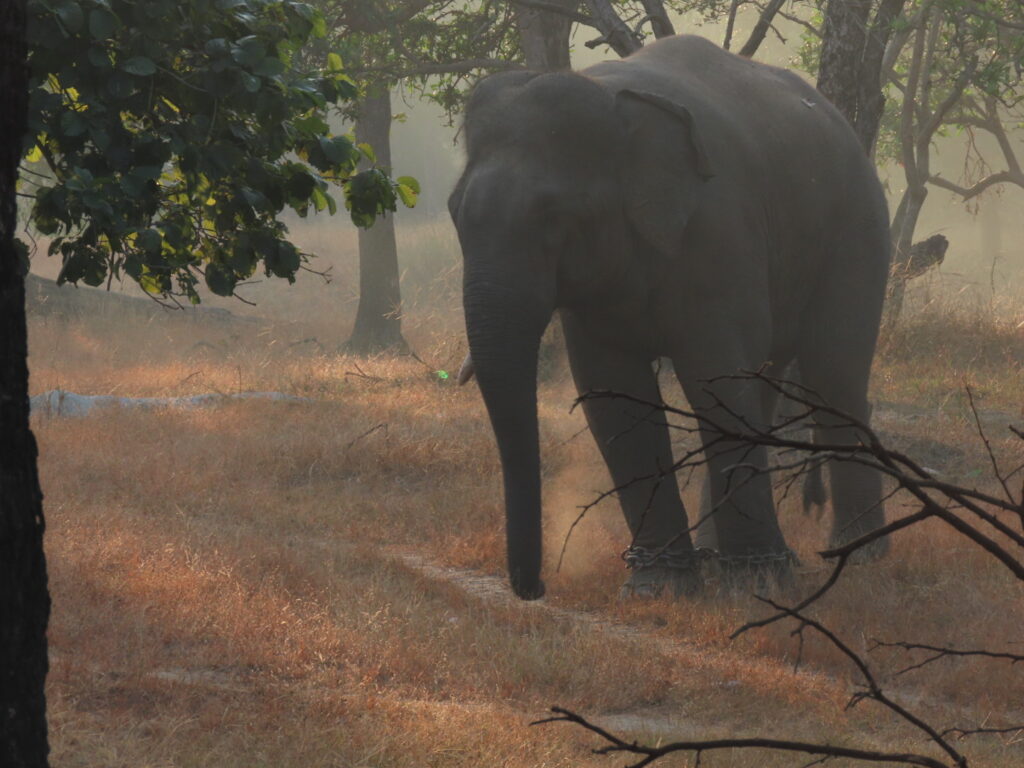
Though the Arjun and the ghost tree look similar at a glance, the former needs moisture rich ground and the latter prefers dry rocky land. We cross a forest guard camp and an elephant is tethered to a tree. He seems to do a jig when someone with perhaps his breakfast approaches him. This is not elephant country since the deciduous forest cannot feed herds through the year.
Far from home.
Massive gaurs ruminate and snooze in the cool morning as we approach the breakfast place. All the vehicles congregate at this mound. There is excited chatter on who caught a glimpse of the elusive cat. Someone says they saw a tigress with cubs and a tiger! In the jungles the ‘have seen’ have a certain mein.
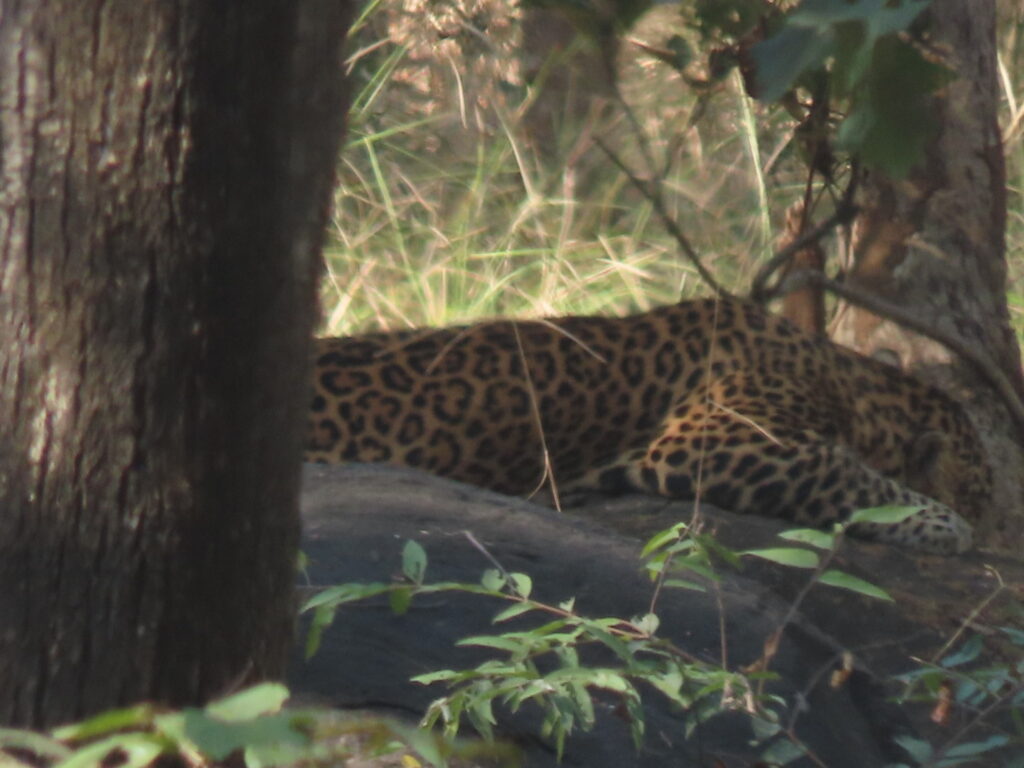
We are heading back when we are told of a leopard sighting ahead. Only a trained eye would have spotted the sleeping beauty away off the road. He does not even twitch an ear, oblivious to the commotion he has caused, in a shaded grove on a black boulder. His rich spotted coat spread on the rock does not need the sun to glow golden!
An elusive cat spotted!
Met by Moonlight
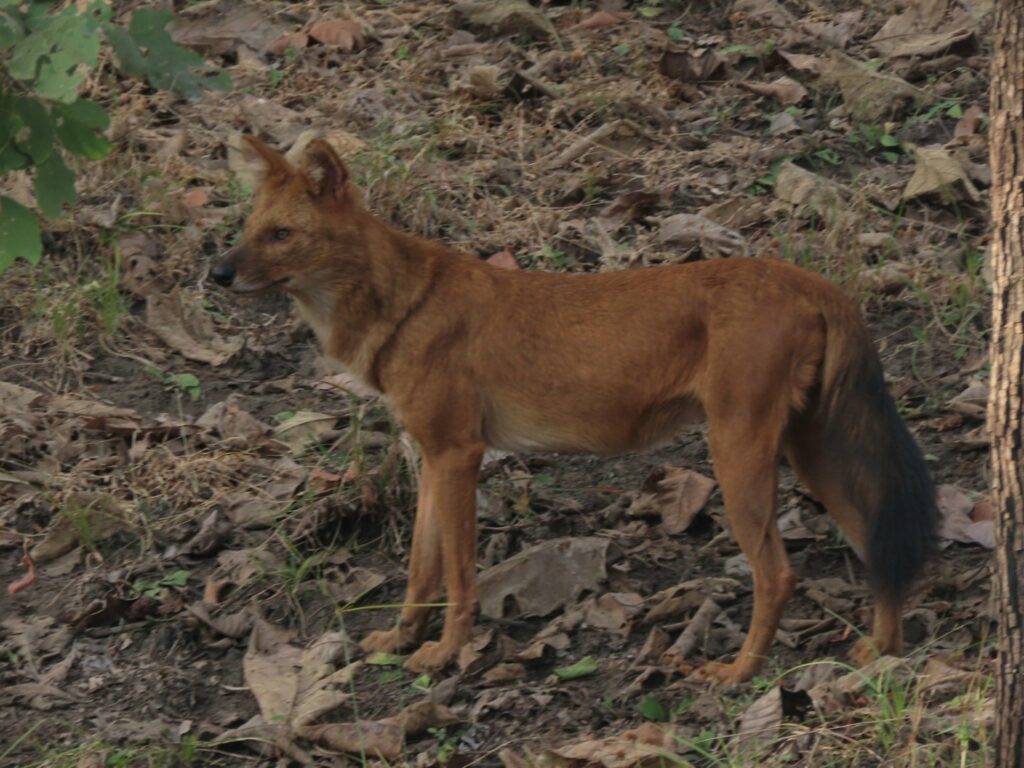
I know of no other place that offers the night safari, supposedly a good chance to see the Indian wolf. But surprisingly the wolf is the rarest animal to be spotted here. Mowgli’s tribes’ numbers have dwindled drastically. The night safari is in the Khawasa buffer zone. We enter as the sun sets and the trees close in and soon there is nothing to be seen beyond the headlights. Even though the sound of traffic from the highway never completes abates, it is a little unsettling. The moon throws shadows and when we stop near a towering mound of rocks made pitch black by the canopy of trees, I feel unseen eyes on me though I would not be able to spot a thing until it was at touching distance. We see fresh tiger pugmarks along the track and there is anticipation in the air suddenly, but all we chance upon are placid bluebulls and deer.
Spotlight
The forest is peacefully asleep. A tigress had been seen near a village adjoining the zone but it has clearly called it a night and so should we.
Dancing Drongos and Dhols
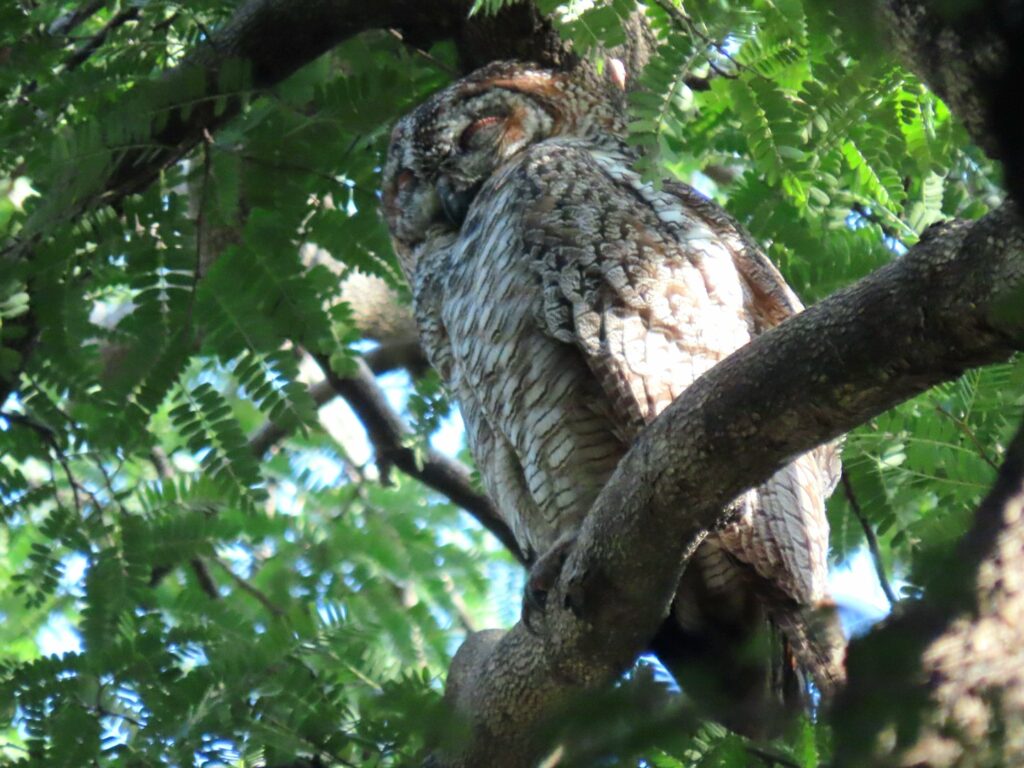
We are in a gypsy for the morning safari next day. I miss the height of the Canter. I spy racket-tailed drongo do a quick dance and disappearing before I can focus my camera. The massive ghost tree of yesterday looks like a familiar friend. A tendu tree’s bark is cinder black in contrast. I love this zone with its rocky countryside! We see a sleeping mottled wood owl. Perched on his tree house is by the road, he resolutely ignores all the oohing and aahing. We are not even worth a death stare!
A portrait of disdain.
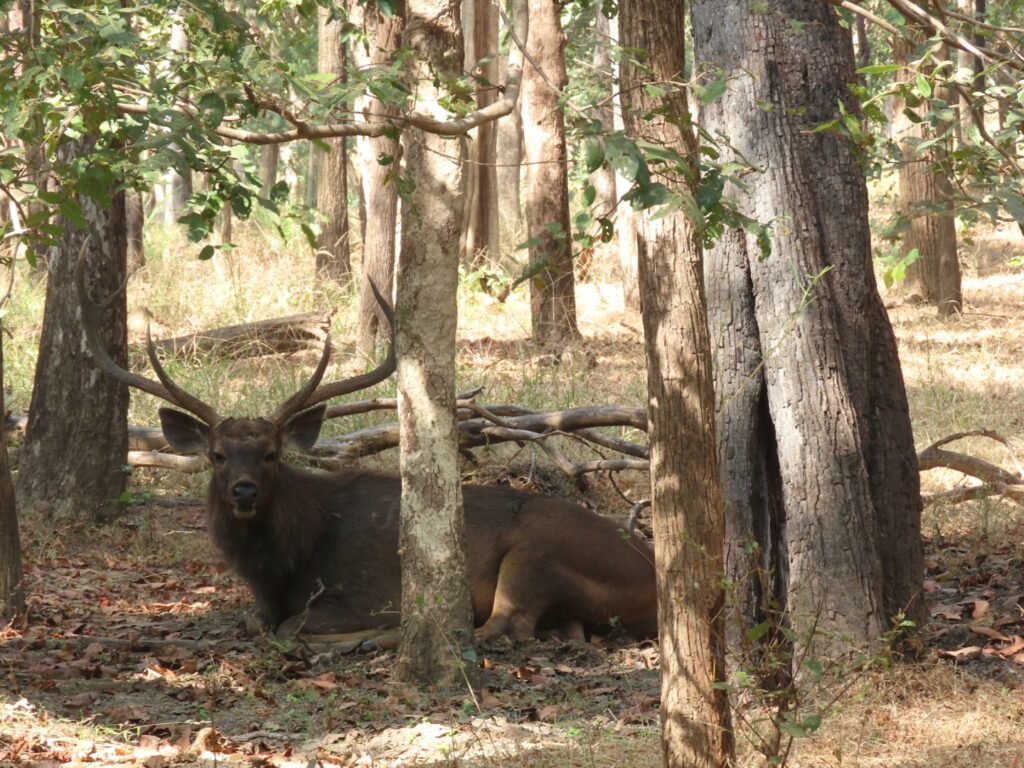
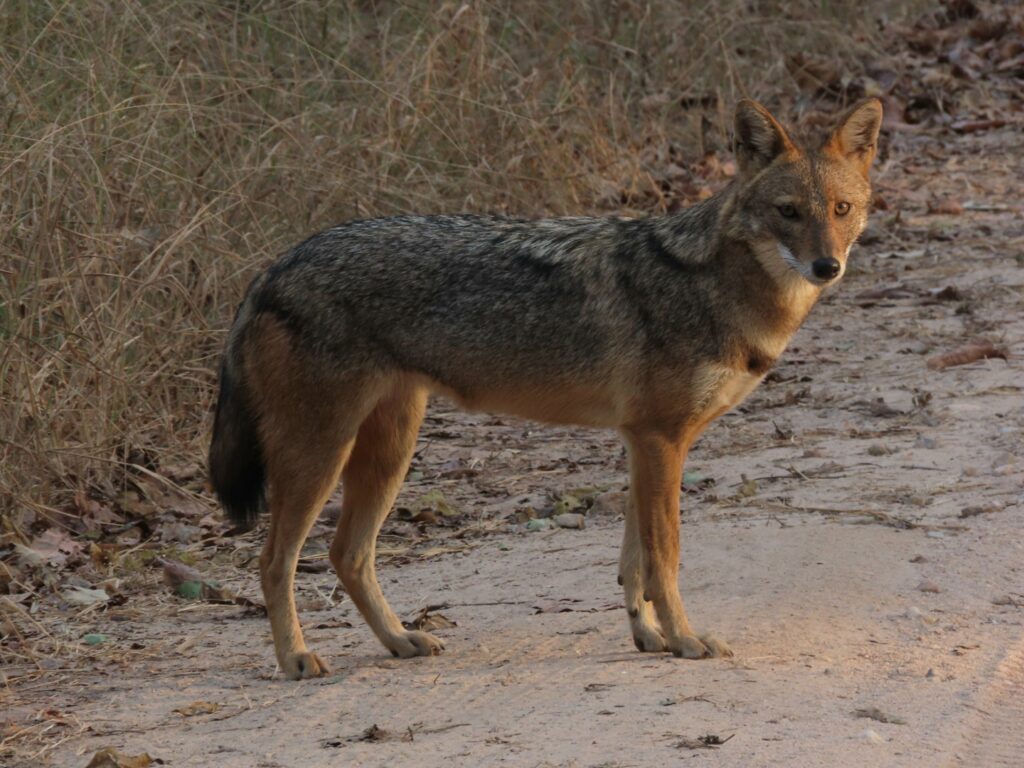
Near the breakfast zone there is absolute excitement and the vehicles go back and forth. A tiger has been seen! But not by us… There is such a smug look, like a cat who has got the cream, on the faces of people who have seen it. We spot a fish eagle and gaurs near the lake. A jackal runs along our vehicle without a care in the world. As we head out in the end we see the one who has got away.. a massive sambar sitting with his head crowned by impressive antlers.
Uneasy lies the head that wears the crown.
Our last safari in the evening our guide tries his best to ensure we see something striped. But neither stripes nor spots are sighted. What we are treated to is a dhol along the road in a merry mood. At first wary of the attention, he then warms to the gallery, trots along the road, rubs his bums on the grass, prances around and puts up an enthralling show. Has us totally spellbound!
Merry dhol.
A little later a jackal indulges us with perfect profile shots. We are again treated to the owl. Still sleeping! All is peaceful in the jungle in Pench. The ensemble cast’s performance has been par excellence, as if to make up for the main leads no-show. But perhaps Shere Khan only shows up for Mowgli.
Jackal on a jaunt.
Fact File
Getting There-
Nagpur is the closest airport. (Approx 78kms)
Staying-
We stayed at the Madhya Pradesh Tourism Hotel and Pench Jungle Camp.
Safaris-
1. Can be booked online and at the gate counter, subject to availability.
The Central Asian Republics itinerary started with Kyrgyzstan, but quickly shifted to Uzbekistan and Kazakhstan. The man and daughter enjoy the mountains but climb them only under duress. She and I had just done Amarnath and she would have been an unmoving stone had I suggested another trek. ‘Want to do a trek in Kyrgyzstan?’, I threw the question to the best friend who is constantly climbing mountains or diving into the depths of the seas, my only beacon of hope and company. The conversation ended with a ‘why not’. Ten days later she called asking if I would be interested in a trek to the Alay mountains AKA ‘Asia Patagonia’ in Kyrgyzstan. Yes, yes, I replied before even reading the details. So began the adventure…
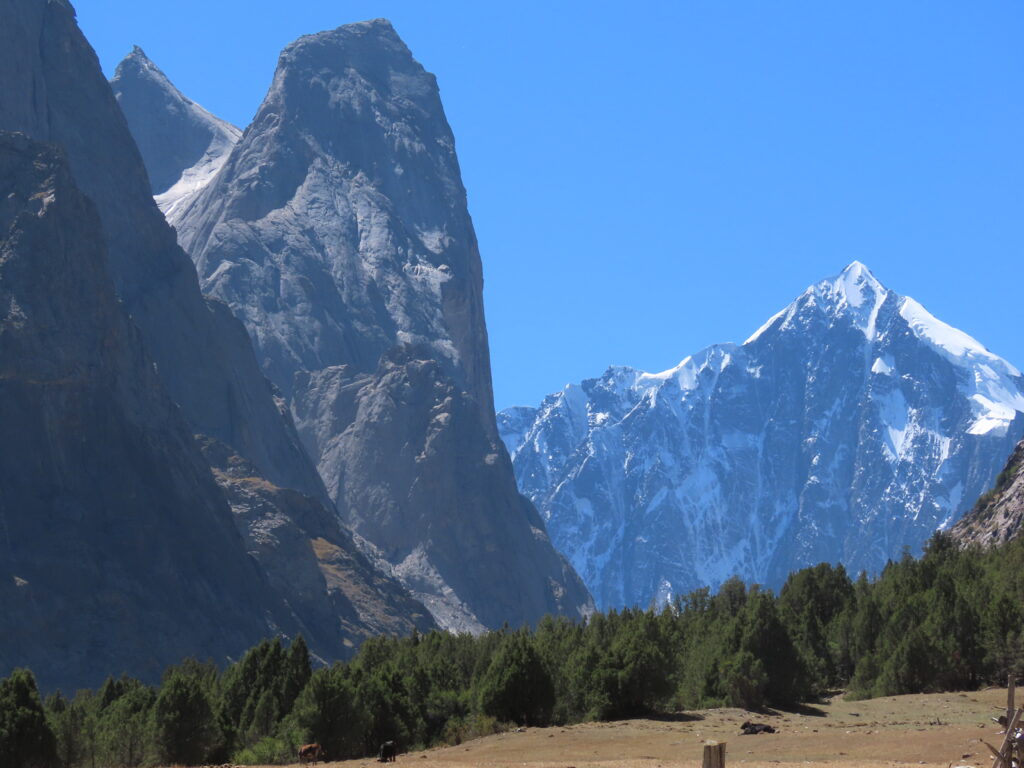
Rock Climber’s Dream (Asan and Usan Rockfaces)
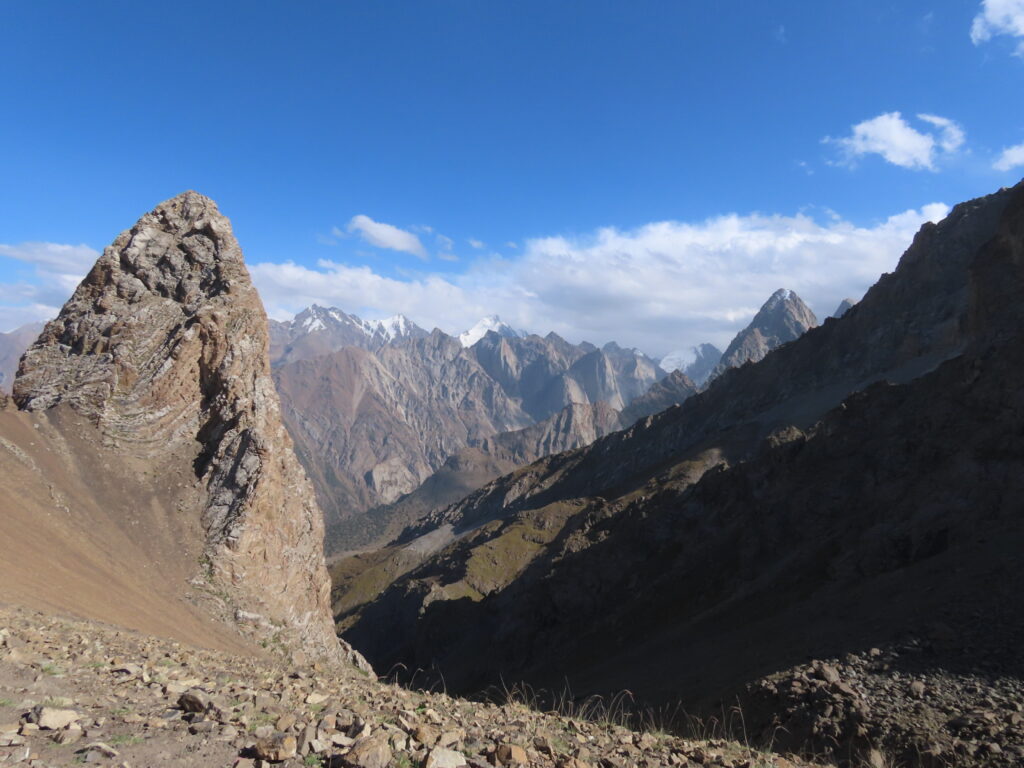
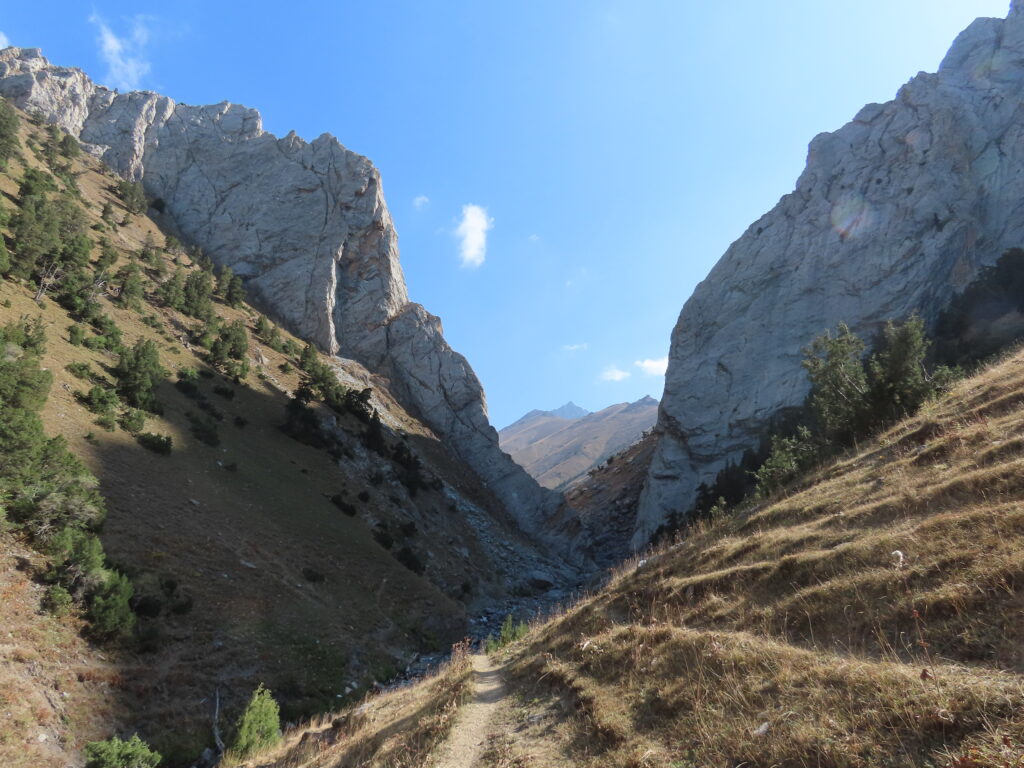
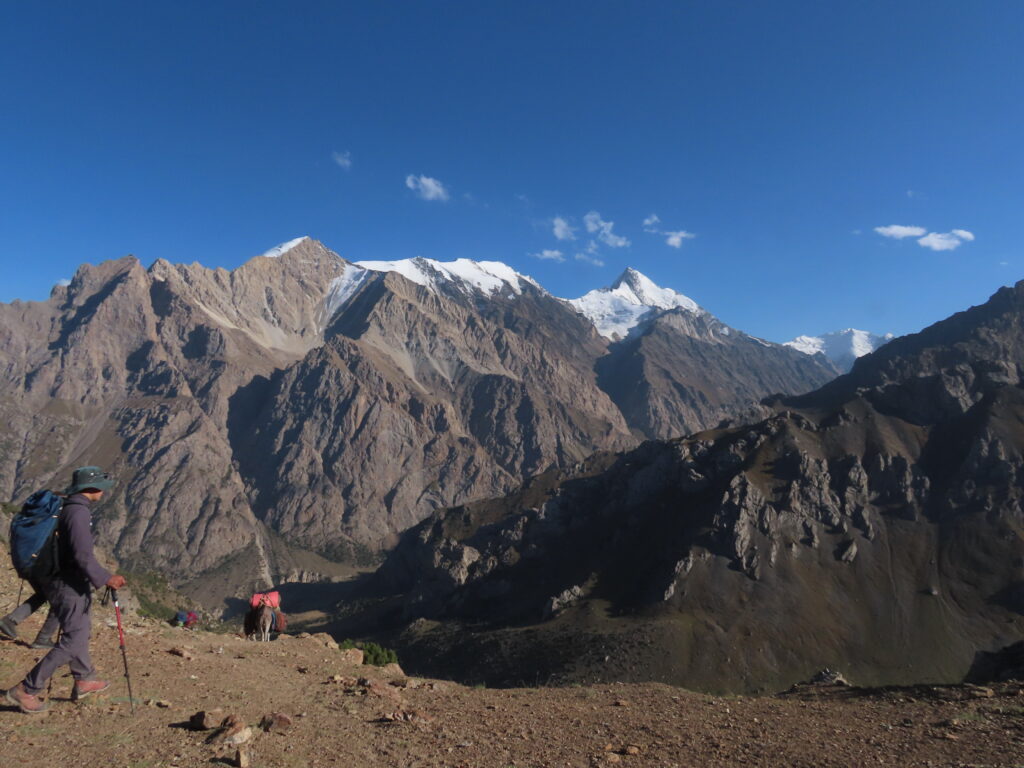
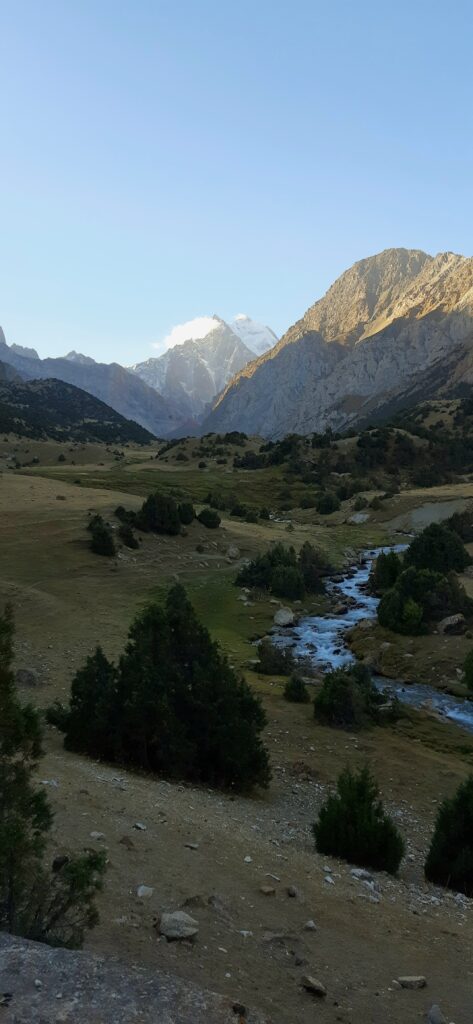
Kyrgyzstan is a land of extremes with mountains running through the country’s geographical tapestry. Mountains woven a gentle moulded green in the north and crazily craggy brown in the south. Most people trek in the northern Tian Shan mountains, climbers head for Lenin Peak. (The Russians are still missed) The southern part bordering Tajikistan (No love lost here surprisingly) has the more unexplored Pamir Alay ranges which form a claw in the Turkestan area in the southern part of Kyrgyzstan.
Alay Mountains or Asia’s Patagonia (Ak Suu Pass)
My trekking partners, all experienced hands or rather feet, joined me at Tashkent. After a day of exploring the capital, we drove out in great style in a spacious van, past tapchans being sold on it’s outskirts, through the fertile Fergana Valley with the Syr Darya draining it, along cotton fields and skirting Andijan which Babur called home till he lost it and found Hindustan, never to return, till we reached the border. Where all the style evaporated!
Entre
We are told by the guy organizing our trip that someone will assist in crossing into Kyrgyzstan but it does not materialise. We are dropped at the border and walk laden with our backpacks and exit Uzbekistan easily only to get stuck in no-man’s land with a whole lot of Kyrgyz returning home. It is a little chaotic involving a dash to a gate at a covered cattle run. (Comforting to know we are not the only ones with no sense of lines) In the melee when the gate is opened, the guys nearly don’t make it through with their loaded luggage till a guard hears their ‘tourist tourist’ and yanks them in before slamming the gate shut behind them. We are stuck in that pen for what feels like an eternity. A woman next to me is carrying interesting looking chicks in a box. They have a fancy hairdo and socks. Suddenly there is a surge and a quick stamping of passports and we are in Kyrgyzstan hunting for our driver who turns out to be a chatty animated fellow and our guide for the duration- young, smiling Kuba. Settled in a comfortable hotel at Osh we have dinner at Navat, where they give blankets to warm us outdoors. I like! The meat platter has slivers of horsemeat and ox’s tongue apart from other meats but although I taste, I don’t relish it… a beautiful black horse keeps prancing around my mind. (Not an image to make it more palatable)
Next morning we meet Azi, the owner of the trekking outfit whose first question is, ‘how did you discover this trek?’ After a quick briefing and the obligatory picture we head out of Osh on a long drive.
The Tapestry of Kyrgyzstan
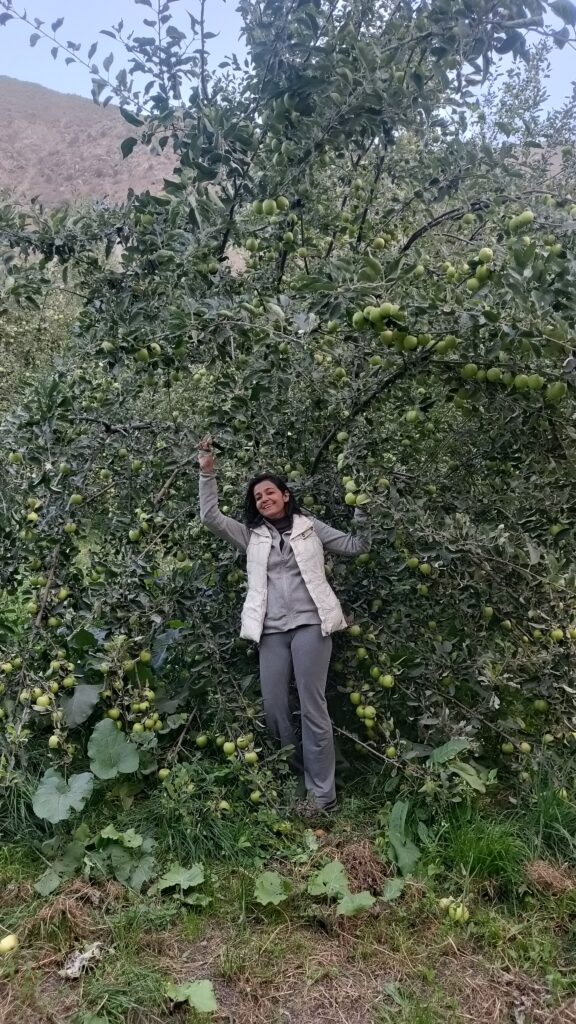
Skirting bare mountains, journeying past rolling fields and weathered hills, we turn off the highway onto a dirt track and finally reach Uzgurush, in a narrow valley with poplars, orchards, a gushing stream, and the homestay of our local guide- bright eyed, warm, superbly knowledgeable, and capable Sulaiman. After tea we take a walk around the village accompanied by his nieces, a pretty, shy teenager and a chirpy social younger one for whom language is no barrier to have a full-on conversation. We find cherry, pear and apple trees laden with ripe fruit. It is a piece of paradise! And we raid some of it. I think the raiding or something does not agree with me and I am sick in the night.
Uzgurush is a garden of Eden.(Picture Credits- Vohra)
Moving through the Maw
In the morning the entire family sees us off and we follow a track out of the village and into the scrubby mountains, follow a stream under some lovely shady trees and then suddenly up a winding path. The donkeys, minded by two brothers- Zainidin and Kurban, carrying our packs overtake us as we trudge up a fairly forgettable hill till we reach a skeleton of a hut. Lunch here is a spread-cold cuts, cheese, fruits, naan, tea, coffee and dry fruits. With Sulaiman every meal is a treat. An army marches on its stomach is a saying he takes a notch up. We might not be conquering land but something more, intangible and profound.
‘Ak Tash’ or the White Rock River
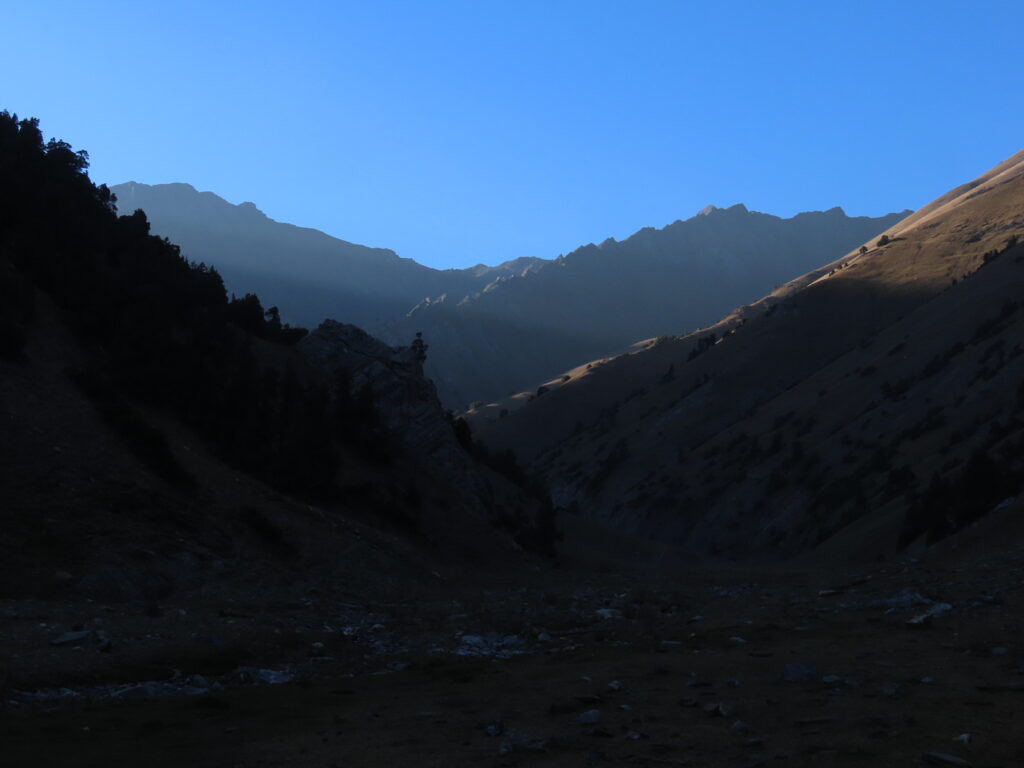
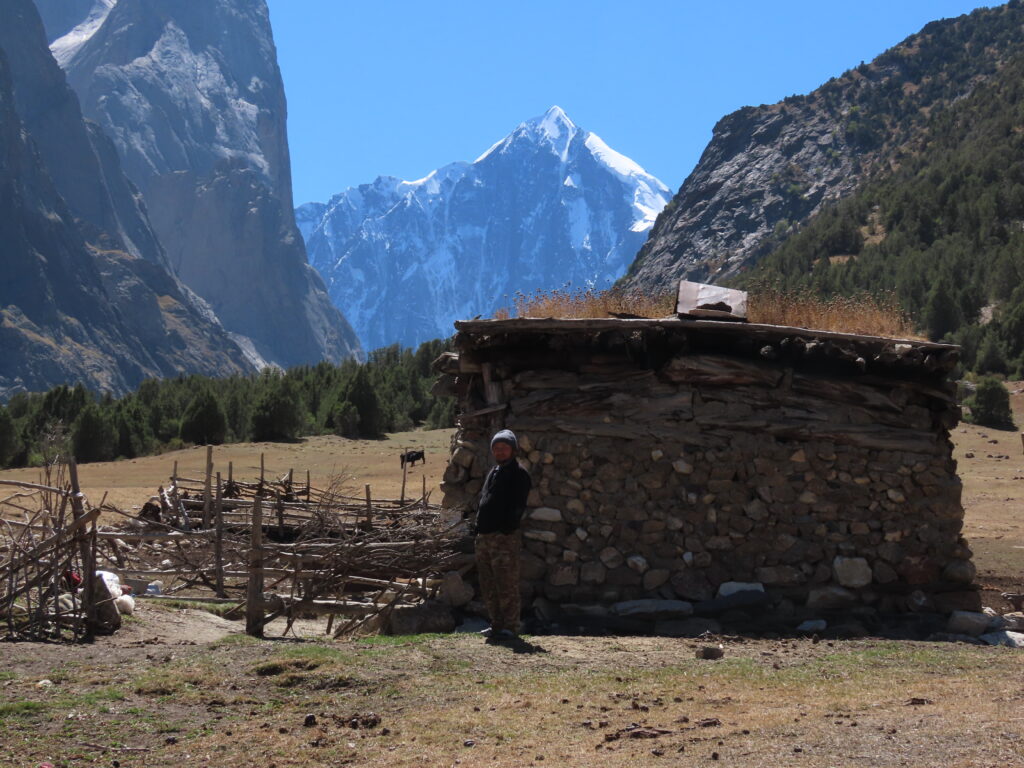
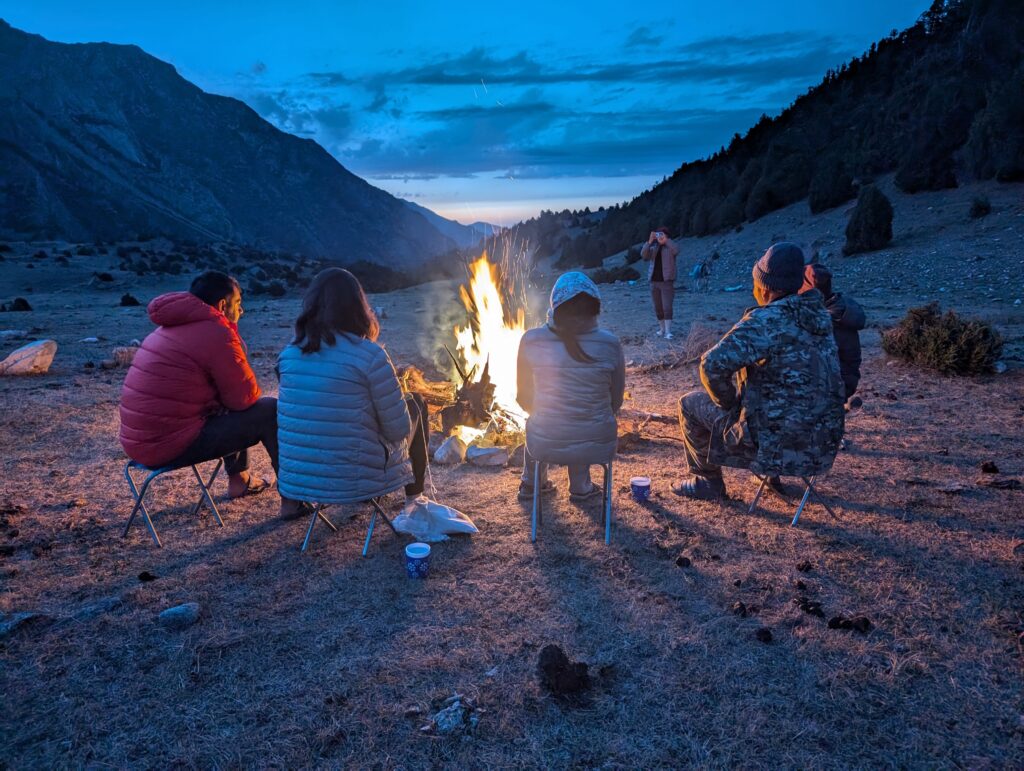
We walk through spruce trees till a crest. On the other side is a small alpine meadow with ruminating cows by the Ak-Tash River. It is still a stream here, coming through a ravine and we follow it to where it emerges though the open mouth between two converging slopes topped with jagged rocky white teeth. A pair of bearded vultures waltz above us close to the craggy top. We pass through the mouth and come to our first campsite. The sun disappears quickly and the breeze rushes through the gap. We soon have a blazing fire going.
The sun throws light.
Two Trying Tops
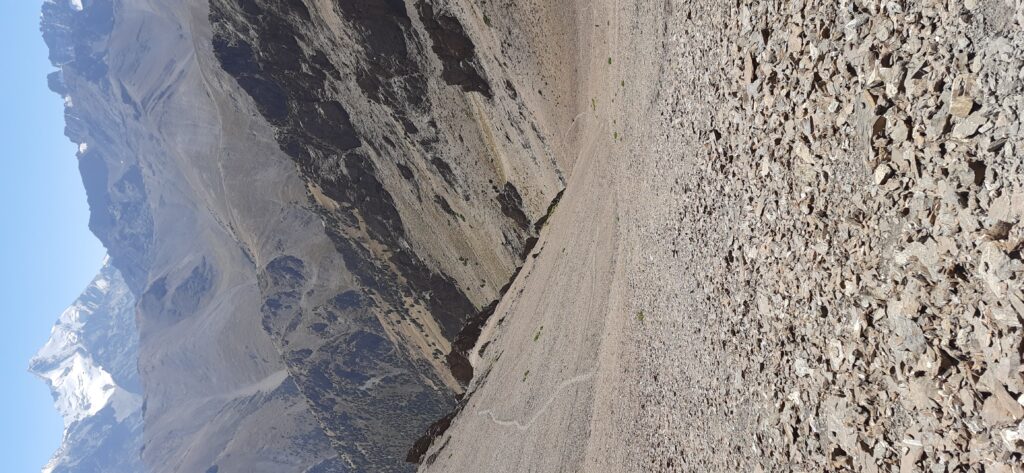
Next morning as sunshine makes its way down the dark slopes, we make our way up. Each valley and meadow seems to have one shepherd with his flock and dogs. The first pass of the day, Dzhalgychy, is a slow laborious climb on a barren mountain of scree. I spot a griffon looking like an extension of the rocky outcrop it is perched on. The best bit about trekking is the view from the top and the worst is the descent that awaits on the other side and thus begins the saga of holding Kuba’s hand.
Vohra, Satish and Yadav disappear quickly down the slope. With a sad sense of balancing, I seem to have two left feet. After the initial steepest portion I let go of Kuba. I slip twice or thrice landing on my backside and I walk into the group having lunch with nothing more than a scraped hand and bruised ego. I am not hungry but Sulaiman deftly cuts a musk melon and places it in front of me with a ‘eat’ that brooks no argument. It is the sweetest melon I have ever eaten! We get out of this steep, nondescript gully and cross a sloping boggy meadow and start climbing the steep far side. It is a winding, mindless climb. Kuba tries to make it more palatable by pointing to a rocky feature on top. We have to go there he says. ‘There’ resolutely stays there for the longest time! But ‘there’ is not it!! There is more…a little more gently near the crest.
Nameless Pass
The donkeys are resting before the traverse and Kuba points to a towering peak across the valley. We will cross that tomorrow. I think he is pulling my leg. Suddenly I find he has ambled on, the two brothers with their donkeys are also off and I am alone. The traverse is narrow and the slope disappears into nothingness below. I call out to the brothers and Kurban leads me on a trot till the pass and Kuba. When we hit the treeline below Kuba runs off. Yadav relievedly hugs me as I straggle into the camp and Sulaiman asks all good? All good!.. Chai please.
There
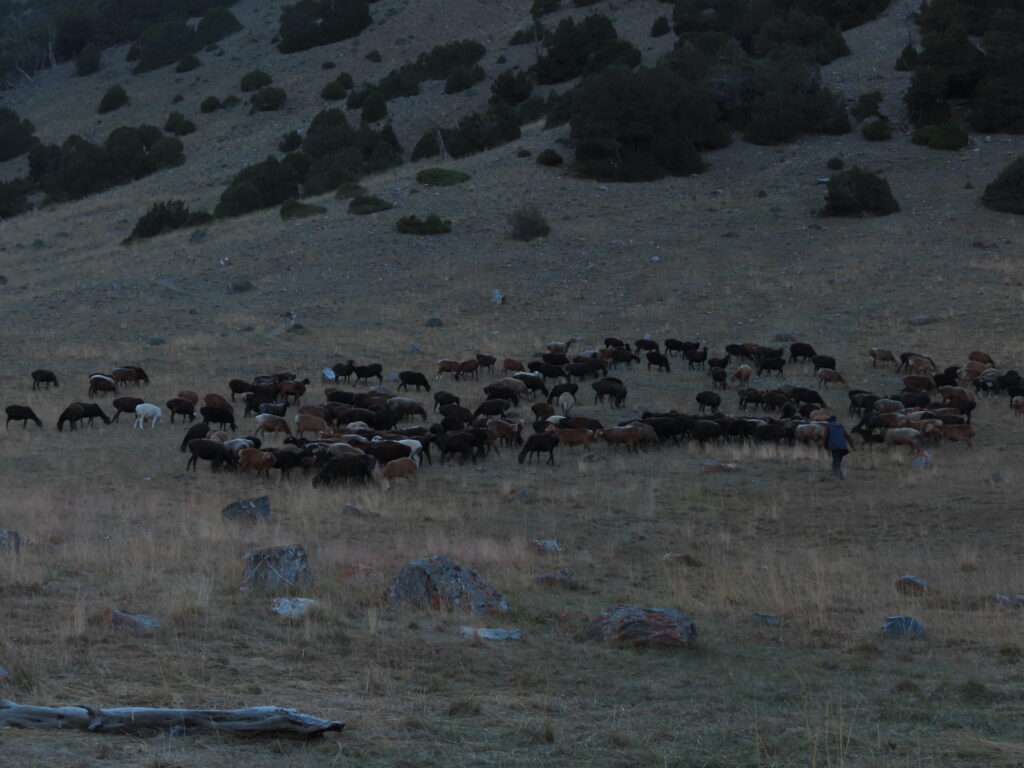
A shepherd with his gorgeous dogs and herd sweeps down from the mountain in the fading light while Kuba drags an entire tree down the slope to light up. Sulaiman decides we will have bar-be-que for dinner since there is plenty of meat on hooves available. The others have disappeared into their tents and the shepherd drags a sheep for my approval and I try to smile yes, yes and quickly look away. A bit much for me but not for Vohra who wants to see the entire process.
MOH
Ak Suu is the Acme
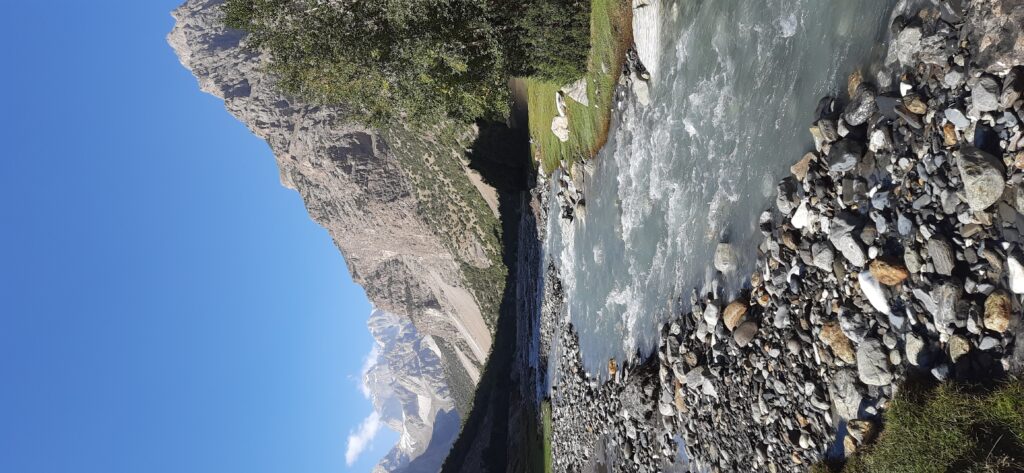
As we set off the next morning, we realise we had camped high up in a branch of the Orto Chashma Valley. It is beautifully lush with an arctic blue river coming down from the snow bound knot of peaks at its head. We are supposed to return and head there in two days to the Ak-Tubek Pass. The climb on the other side begins immediately after the stream, gradually at first, then more windingly through juniper trees.
Two Germans coming over Ak Tubek, doing the circuit in reverse, catch up with us. The first pass, Kosh Moinok, is more of a crest giving an incredible view of this valley bound by numerous passes. Somewhere below is a downed helicopter but we miss it. The path ahead is fairly level but narrows into a goat path of soft soil and an endless fall. I focus on Kuba’s feet, hold his hand and follow his lead to our lunch site- A shepherd’s hut with a pen on a sloping patch in the crook of the mountain’s towering arms. Within minutes of starting for the pass we cross a large group of Russians coming down. One is astounded as to why we are here when we have the Himalayas in our country! I am bringing up the rear again soon and the clouds that have been gathering seem to darken couple of shades in a heartbeat. Uh oh! But they kindly hold on. We reach a saddle between vertical peaks of rocks and snow. Beyond the bare traverse the view is stunning from a windy Kara Suu- just a sea of jagged snow bound peaks. A knotted cone rises on one end of the ridge and on the other side, below the peaks, I spot two horses grazing peacefully in the distance looking tiny.
Yadav has started descending. The others have already disappeared but from where? Kuba has taken a stroll while I catch my breath. I ask where is the path and he points to an indention barely there on the scree, curving into thin air. I balk…I can’t do this! But that is not an option and it is getting late. I take a deep breath and we start…. At one point Kuba thinks he should carry me down. The valley is still not visible and the sun is ready to disappear behind the mountains. Not an option either. I will walk all the way to the camp!
Kuba contemplating Ak Suu’s Cone
Soon the slope eases up and turns grassy and the path begins to loop. I lose my patience and ask Kuba if we can go straight. We jog, skip, skid down and it is such fun! We spot a large hare on some rocks. The light is fading and the camp remains elusive. Is it up or down the valley? Kuba spots it a little up the valley through the trees. We reach the meadow to find a beautiful black horse grazing and cows ruminating on whatever they ruminate over in a secluded valley like this. That night sitting inside the shepherd’s stone hut we decide not to trace our steps back over Kara Suu. Instead, we’ll head over to another valley and walk to a roadhead and hopefully find a ride back to Uzgurush. Kara Suu has tested everyone’s spirit and given us a day to remember forever.
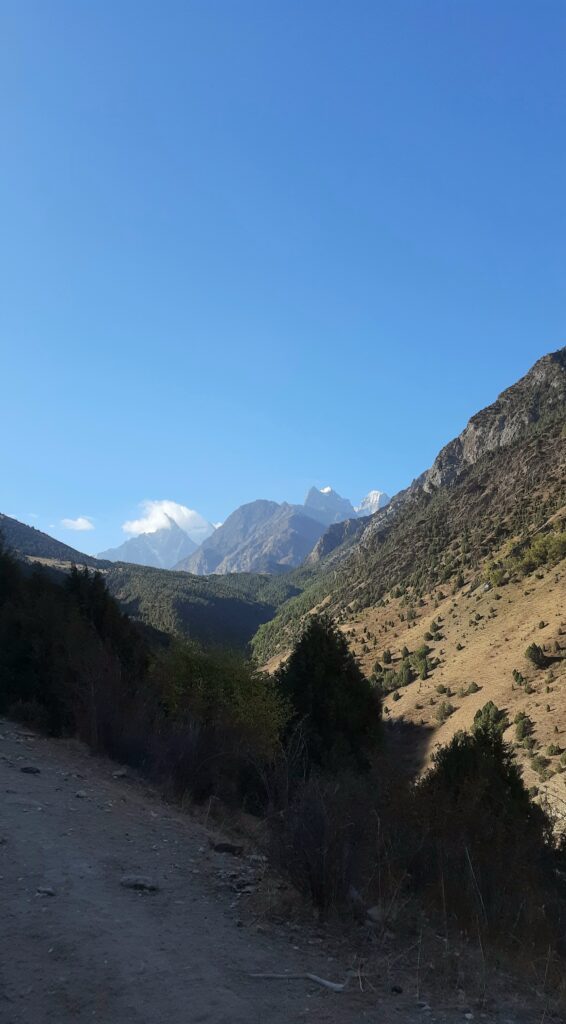
After a night’s rest the spirits feel better and the surroundings look stunning. The deep U Karavshin Valley is hemmed between a towering range of near vertical granite rockfaces, including the twin-Asan-Usen on one side, and a forested range on the other.
Karavshin Campsite
A hike to the glacier at the foot of Piramidalnyi peak is the plan, but glaciers are more moraine than ice and dry and drab in my mind. I join the others but at the first hint of an incline, I head back. A shepherd with a rifle slung on his back, accompanies the others as he takes his flock out. Bears we suppose. It is a beautiful blue day and apart from the griffons gliding the thermals and alpine birds twittering in the thickets there is not a soul for a mile or so. Suddenly I realise oh bears and I am all alone! I sing tunelessly all the way back! Sulaiman hands me a mug of coffee. The sheep he is preparing for dinner smells tantalizing!
Sulaiman
The rest of the afternoon is spent sprawled on the grass. A munching donkey comes to check if I am still alive. I rotate with the sun and leave an indention by the time the others come back from their day’s walk. The rifle was for the wolves trying to get a good last meal before the season ends and the shepherd has been sleeping with his flock in the pen.
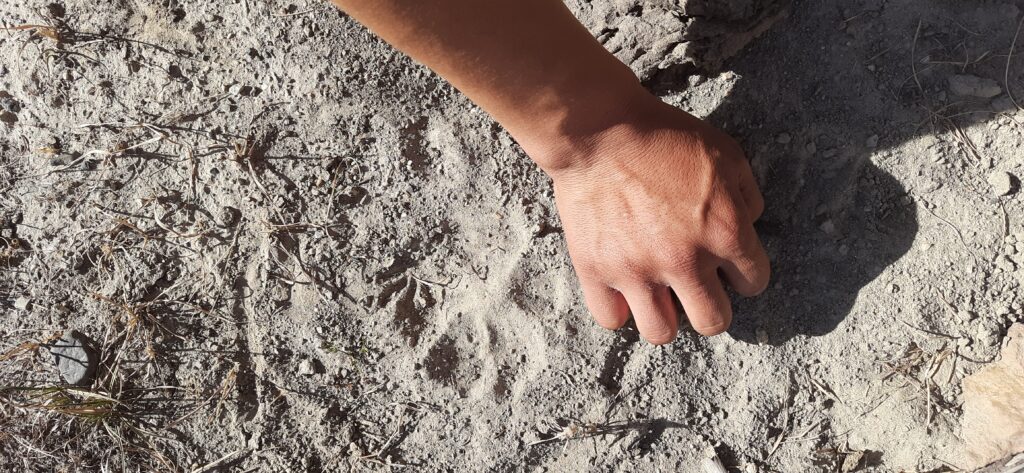
Next day Sulaiman has promised a fifteen kilometer downhill walk. I gear up mentally for five more. At the stream below the camp we think the boys are chivalrously waiting for us at the wooden bridge. They are, also because the low bridge is wet and horribly slippery. We sit and slither across. After crossing the low range and sighting wolf tracks, we come to a raging stream where there is supposed to be a bridge but it isn’t.
Paws and Prints
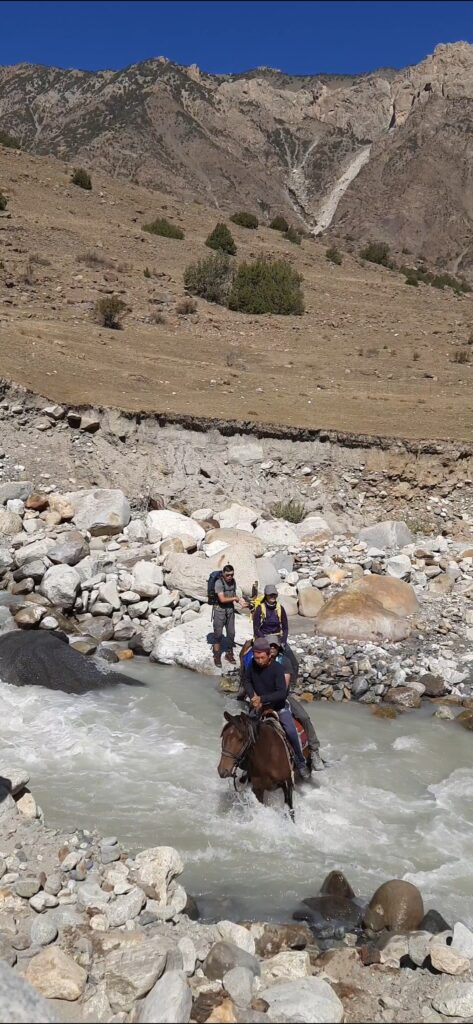
Kuba thinks it has been washed away and scouts around for the next hour trying to find a way to get cross. We park ourselves in the shade above a deserted village. Suddenly we spy Sulaiman walking on the other side. The bridge was upstream. To save time he sends his horses across with Zainidin. Sulaiman’s horse is skittish and I do not fancy being alone on him lest he decides to buck me off mid-stream. So I sit on his rump and hang on to Zainidin and the saddle for my dear life as we navigate the stream in a trice. Satish does the same, while Yadav and Vohra manage like pros by themselves on the second horse.
Reluctant Riders, Exultant Riders
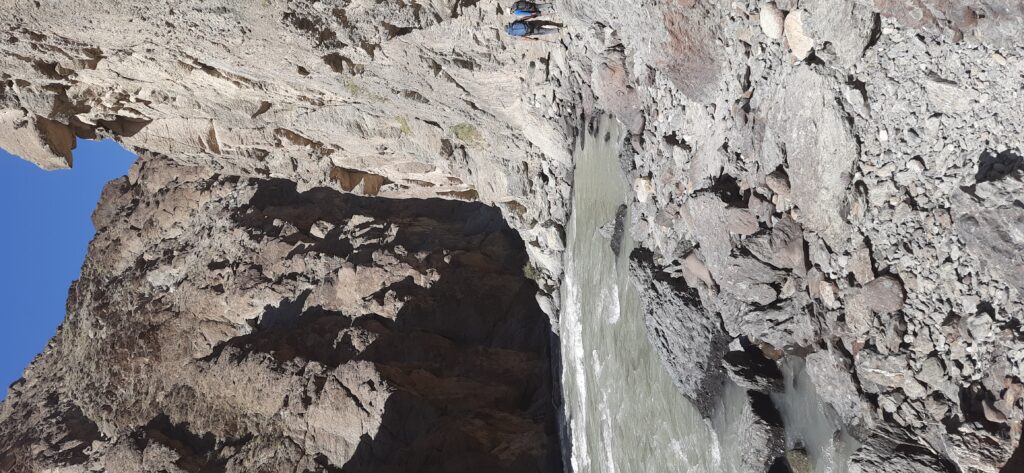
Initially it is a staid walk through a dry, deserted and desolate valley. Two nervous horses across the river and a dead goat wedged between rocks when we are walk through the bottom of a rocky canyon is all the life we see. In between there are couple of vertigo inducing portions high up on the slopes meant only for mountain goats. At one point I nearly want to cry. I am not dying here even though I had joked about it! We come to the remnants of a hamlet and run into a group of soldiers. Our papers are checked and we are searched for narcotics. This used to be the route taken by the Taliban from Tajikistan and here they and the Kyrgyz forces had a bloody skirmish. They even kidnapped a trekker once.
Show me the way to the next whisky bar…
After a walk of nearly twenty-two kilometers we hit the roadhead and a mining camp. Sulaiman retraces his steps to the soldiers to make a call to ask for a vehicle. Zainidin will walk back to Uzgurush with the pack animals through a valley. We make ourselves comfortable on a wooden platform under a tree next to the stream and spend the night under the stars.
Idyllic End
War Horse
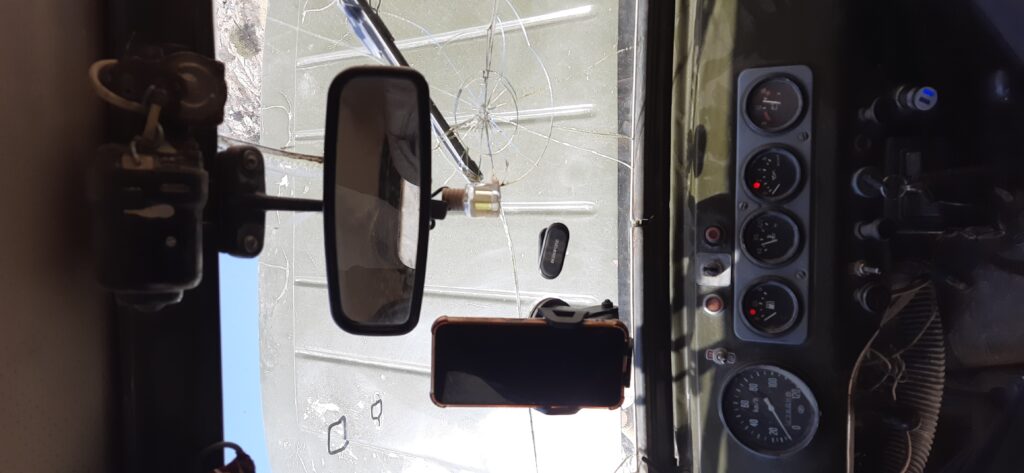
Next morning a vintage Russian jeep which looks like it has been shot at fetches up. We are stuffed like sardines in it. The first halt happens within minutes to fill all the available cans and bottles which are packed around the engine, in the doors, with water. A few more stops follow as we wind up the mountain and the cans are emptied to cool the radiator. All the drivers here seem to be from the same mould. We leave the mountains, hit the highway and transfer to a larger vehicle to reach Uzgurush. It feels like a sweet homecoming.
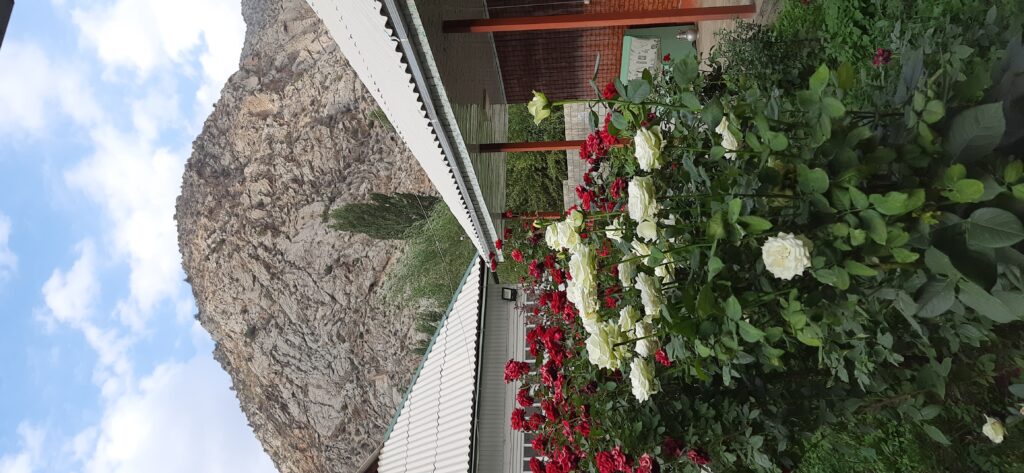
Sulaiman’s home was a bed of roses.
Next day we are off to Ak Suu valley where we were to exit from originally. The entrance to the valley is narrow and then it widens with a gradual incline. I see a meadow on the ridge ahead and tell myself I am sure we are not going there and then, now that I have thought it, I am sure we are! We do, but it is a leisurely walk up towards Ak Suu peak, hidden by clouds, on a path as wide as a road.
Far Far the Mountain Peaks (Ak Suu and Iskandar Peaks)
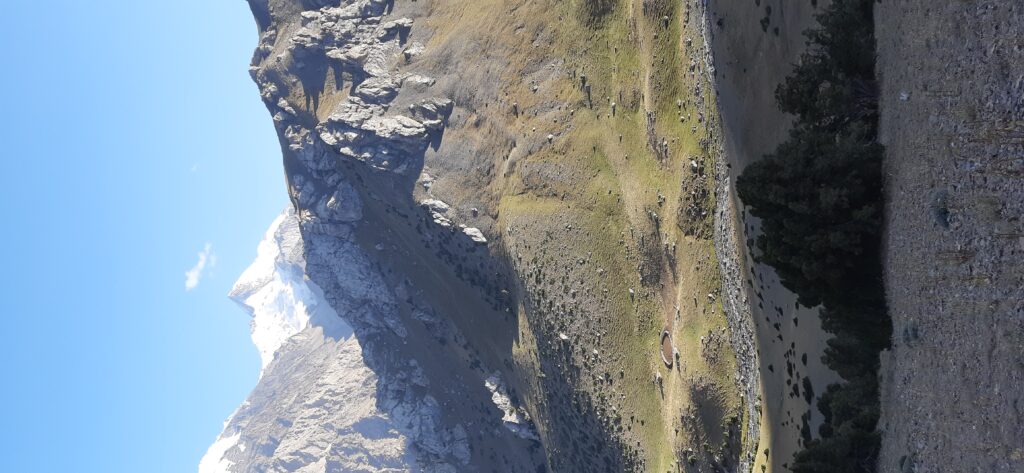
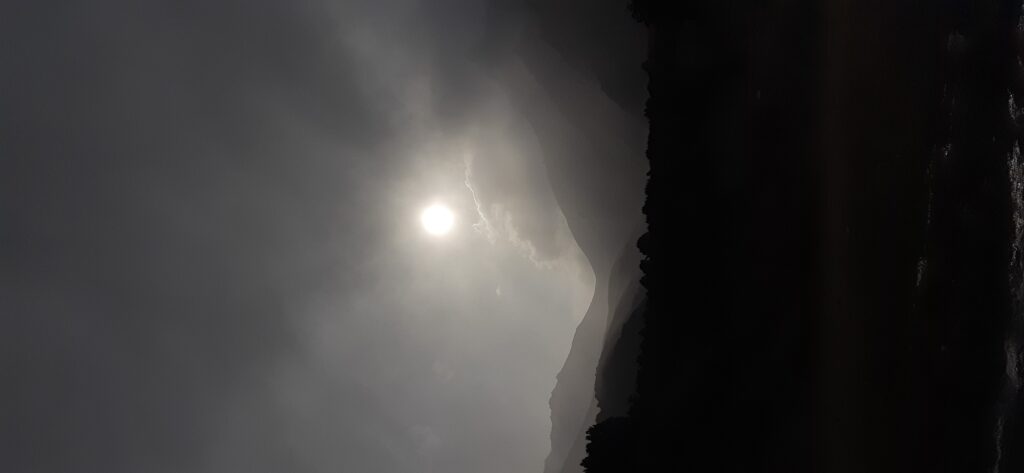
On the low ridge each meadow looks good enough to halt but Sulaiman preaches patience. The best is yet to come, and it does. We walk through scattered junipers to a sloping bowl with a green and boggy center. An embankment that looks like it has been breached by the stream rims it. Two valleys fork out beyond it. One ends at Ak Suu. The tents are pitched just as the weather calls it a day and the rain comes down whipped by the wind.
Fiercely Fickle
The next morning dawns clear and Ak Suu is clearly visible in all its straight angular snowy glory. The guys walk to the glacier near Ak Suu. Yadav and I explore the stream. The water is glacier fresh, crystal clear and crispy cold.
Ak Suu in a Dreamscape
We find picture perfect spots to read, soak up the sun, down coffee, watch lammergeiers skim the tree tops and brown dippers dive in the stream, and just be! It is an idyllic and ultimate way and place to end an epic adventure that was as memorable as it was challenging.
Life’s purpose is crystal clear. ( Picture Credit – Satish)
Fact File
Our trek was organised by Visit Alay Adventure Tours and Travels.
The border crossing from Uzbekistan to Kyrgyzstan can be done by vehicle also.
Two unconnected sources planted the seed of the Silk Route in my mind. (Which then took forever to germinate!) One was a picture of perfectly moulded mountains providing a backdrop to a lake and the yellowest mustard fields I had ever seen (which was all probably Kazakhstan!). The second was a story on Facebook (if you please) by an intrepid traveller and writer par excellence- James Joyce, who painted such a vivid and exotic picture of blue monuments in Samarkand that it became my ‘have to see places’. Bukhara materialised by and by and along my favourite dal named after it but with probably no culinary connection, has my heart.
Blue Eye Candy
Bukhara- Of Bazaars and Beacons of Light
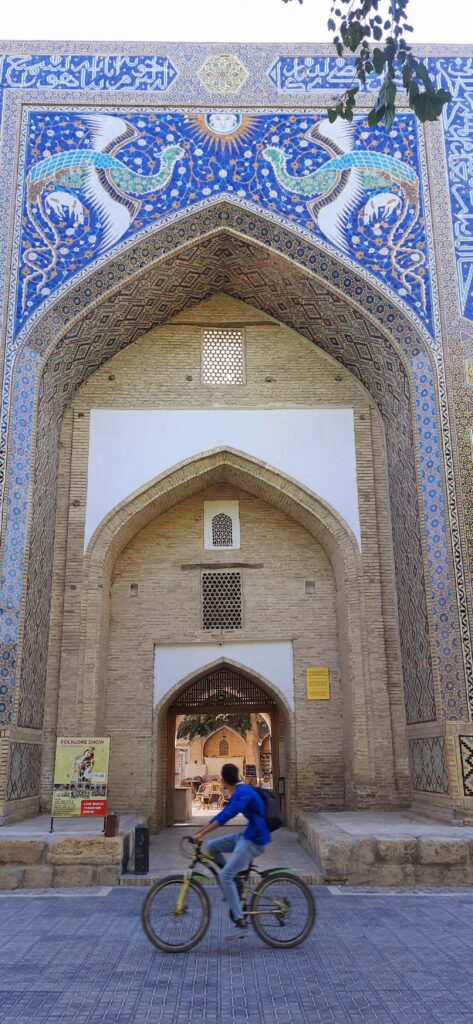
Done exploring Itchan Kala in the oasis that is Khiva we catch the train to Bukhara. After dozing in the afternoon heat thanks to the bogey’s defunct airconditioning I stand in the passageway as we chug past fields and canals and in the fading light of the evening, I spy a minaret and blue domes on the horizon. From the station we speed past non-descript blocks and the newer parts of Bukhara straight to our accommodation in old Bukhara. The hotel is off the road, behind a park and canal with the Nadir Divan Begi Madrassa enroute with the most brilliant phoenix like birds on it’s façade.
Rich as Imagination (Nadir Divan Begi Madrassa)
They are striking not only because of the vivid colouring but also since it is such a departure from the permitted geometric designs. (Islam does not permit depiction of living beings which is ironic since in India Mughal miniature art was all about people.)
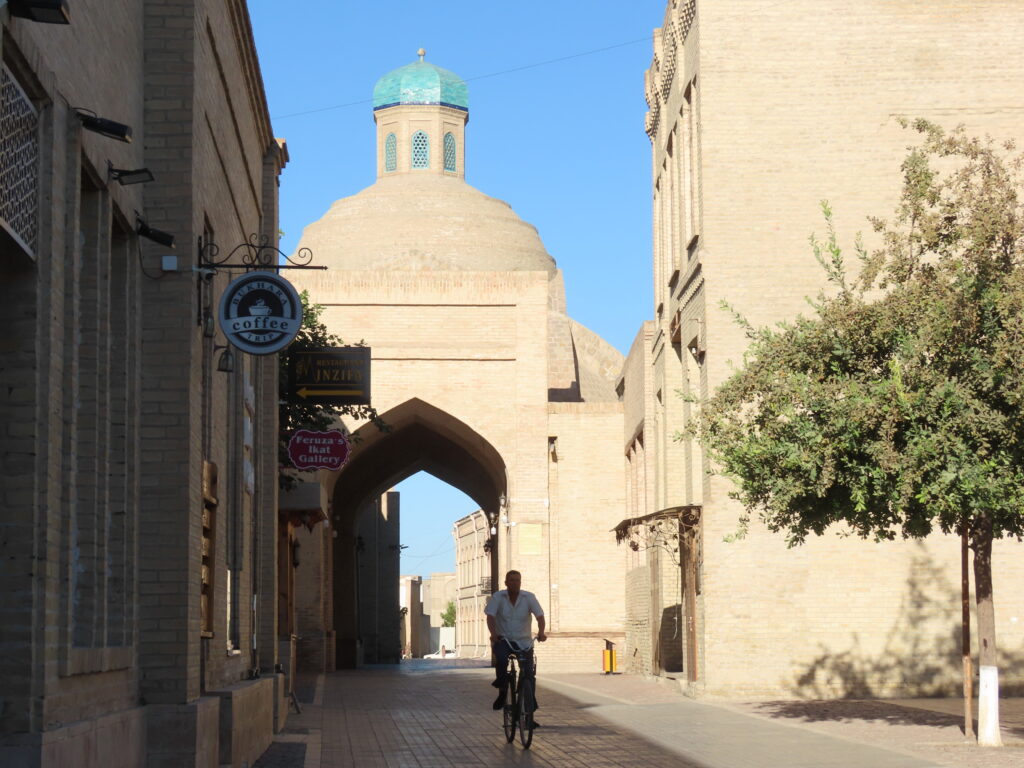
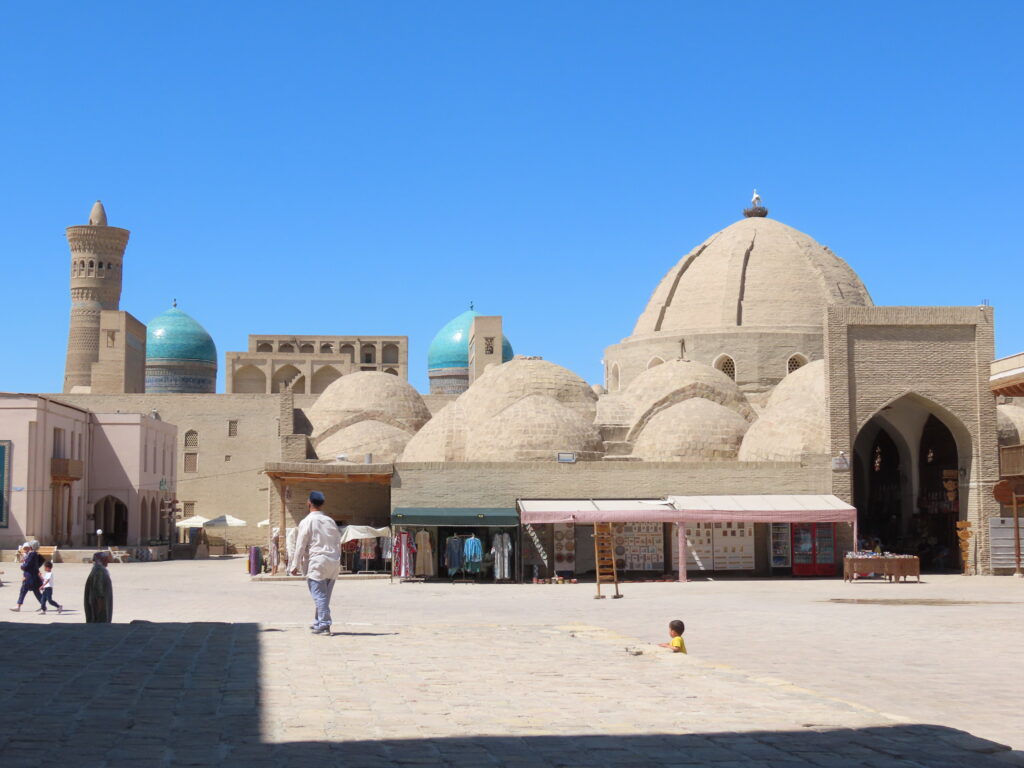
This ancient trading town with many lives and masters is still alive and thriving with well-preserved traditional domed bazaars in plain brickwork. It was once one of the biggest markets for slave trading though when Ibn Battuta passed through, he found it a little more than a wreck. We walk the same alleys late in the evening, past the domed Toki Zargaron and Telpakfurushon with shops selling carpets, knives and spices and through lively paved streets to the Poyi Kalon complex.
Old Market New Shops (Toki Sarrofon)
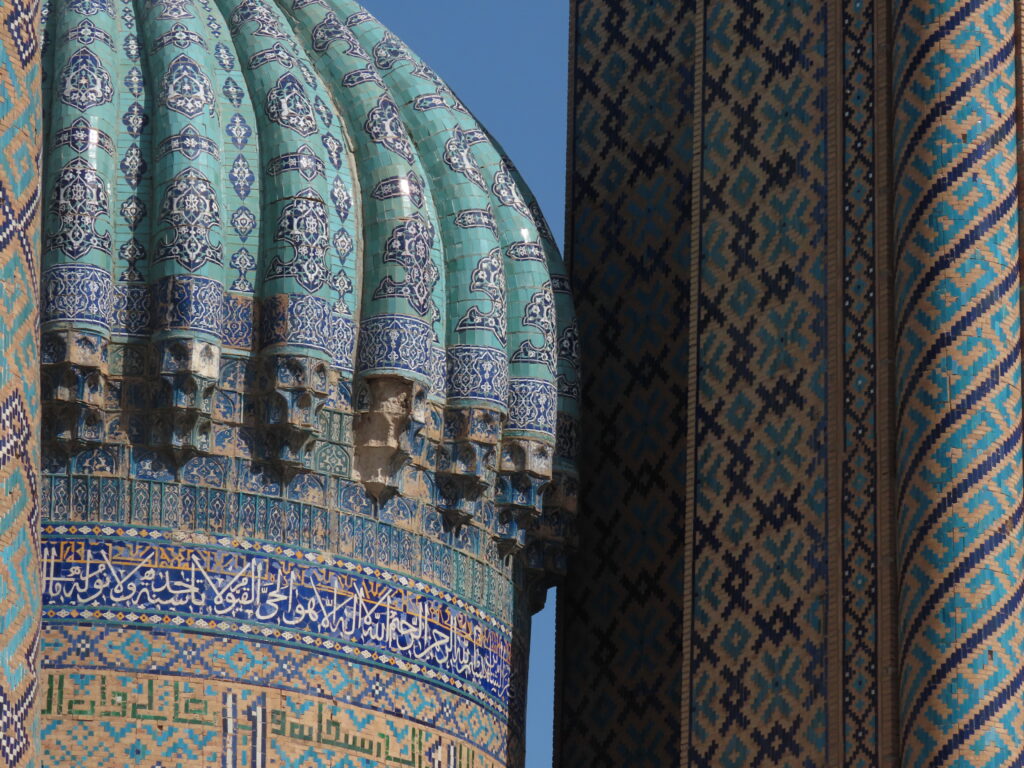
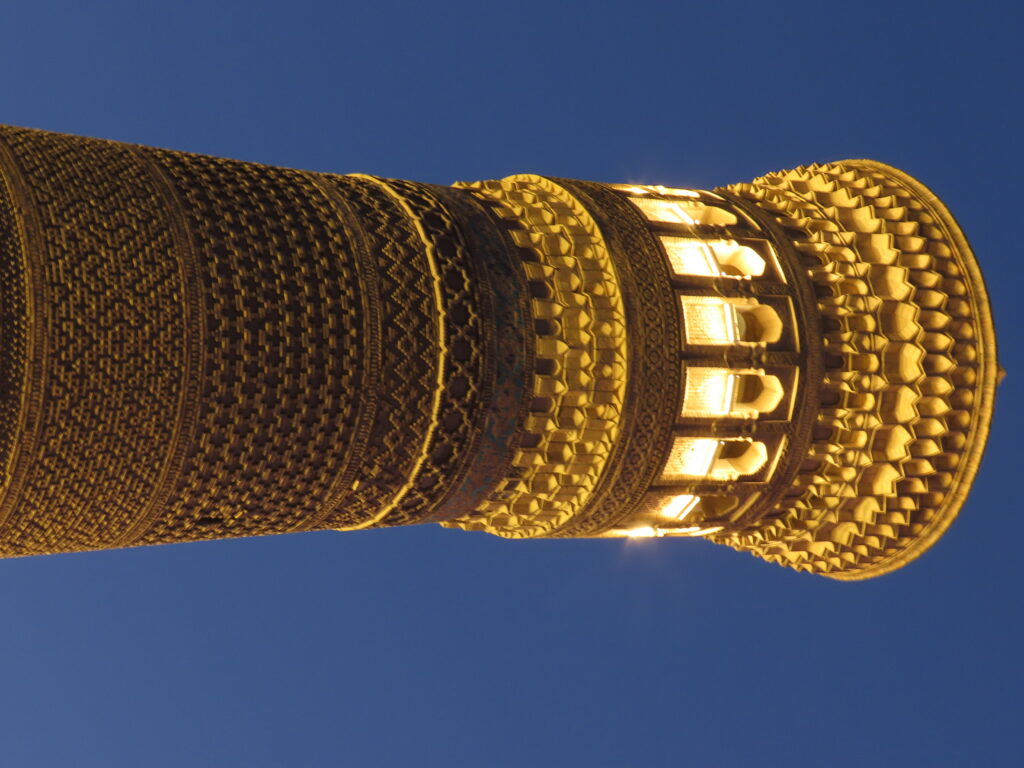
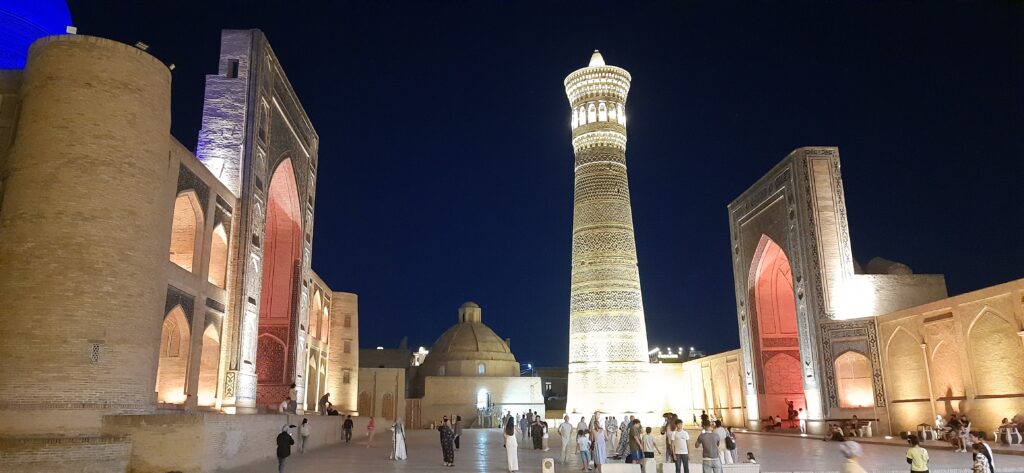
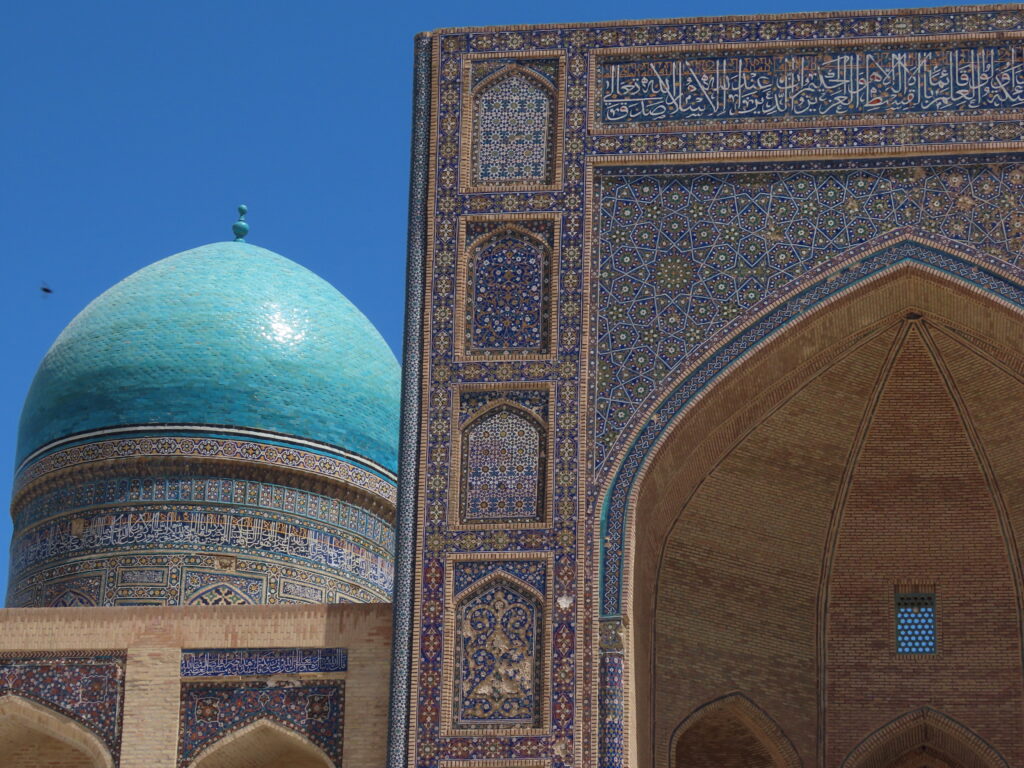
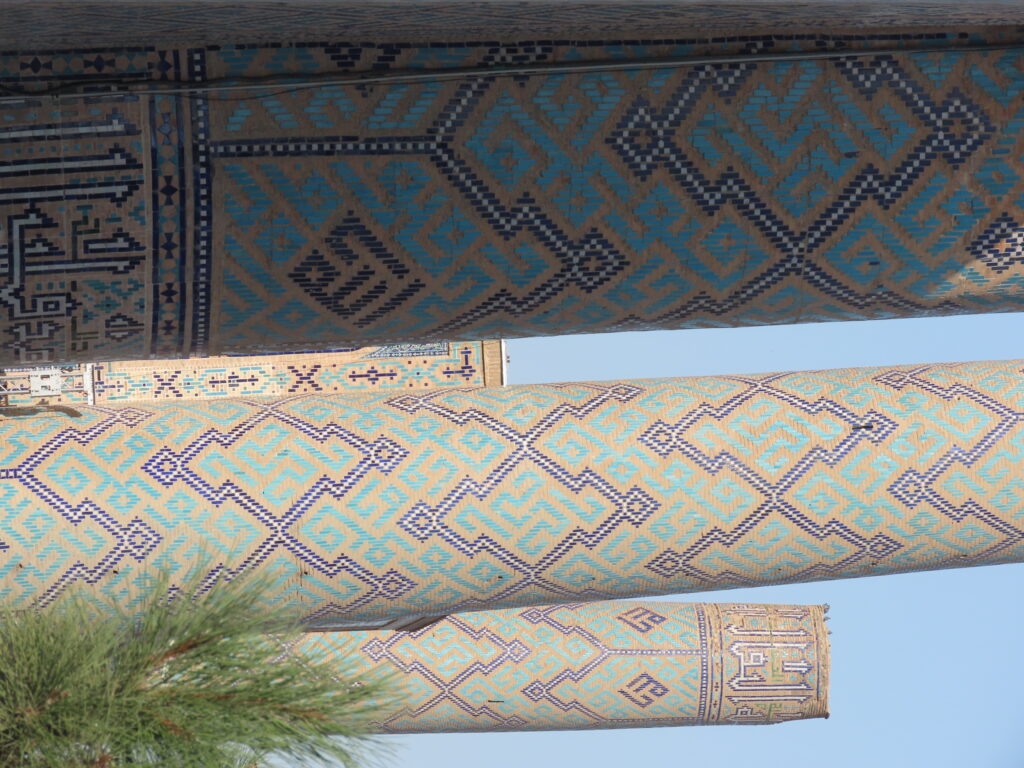
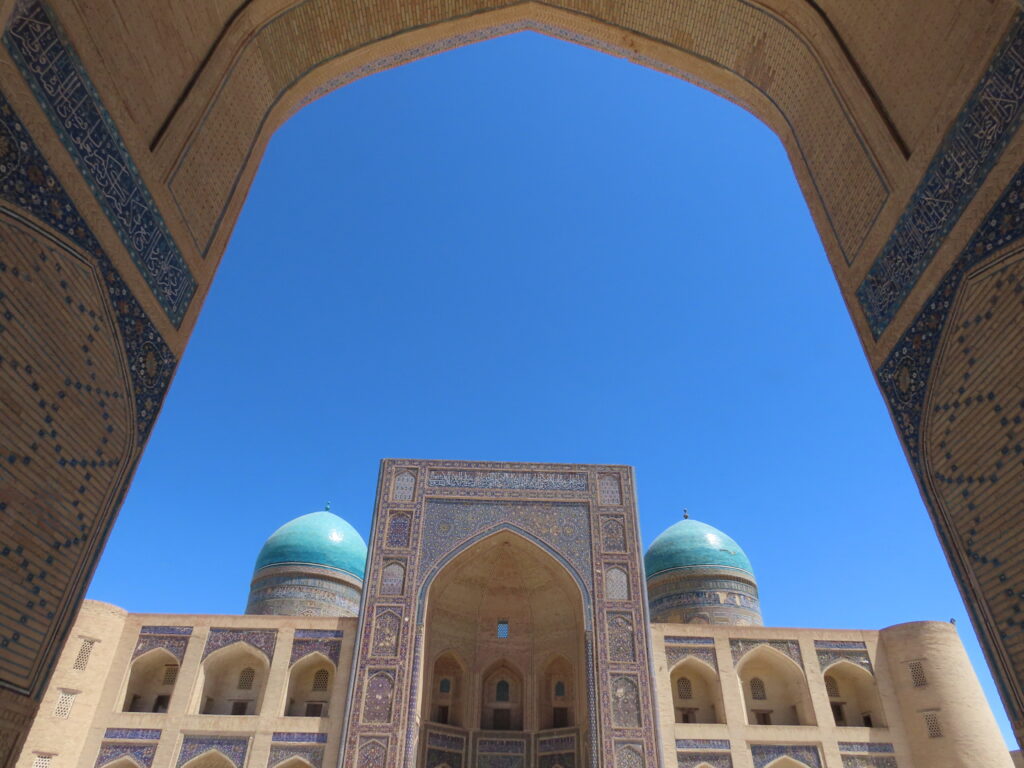
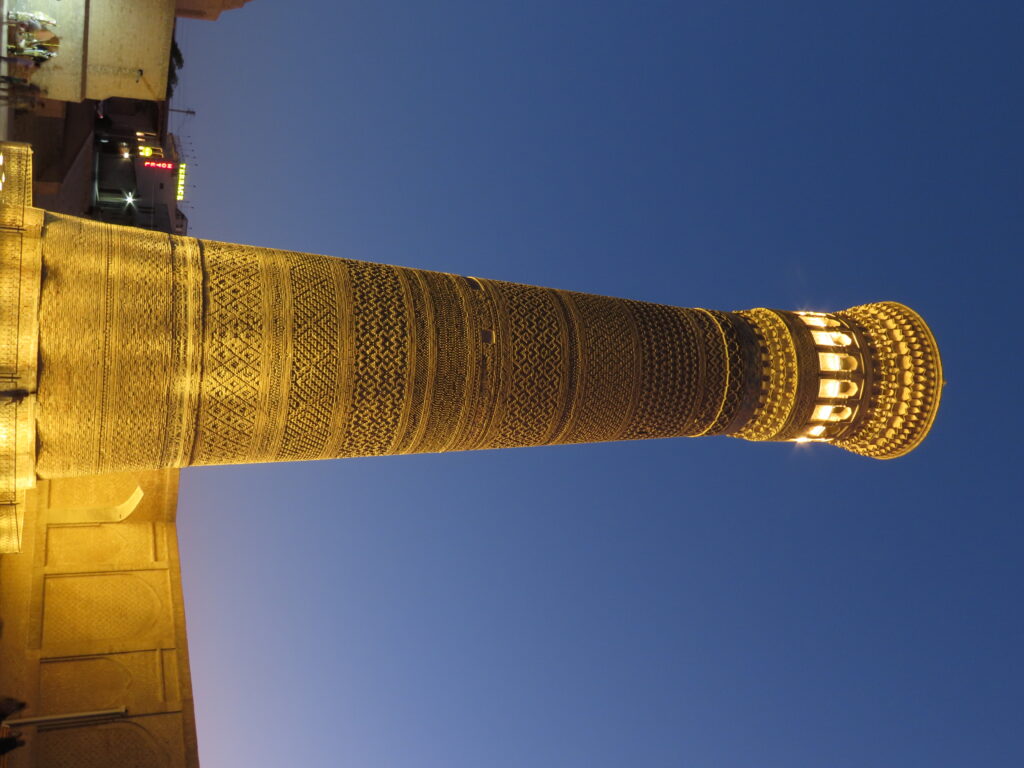
The Kalon tower, the tallest minaret in central Asia when it was constructed in the 11th century, is a beacon of light and in the quadrangle, is flanked by a namesake mosque and the only functional madrassa here- the Mir-i-Arab Madrassa, with giant blue domes on either sides of a towering façade in fabulous blue patterns.
Brickwork in the Spotlight (Kalon Tower)
The ensemble is all lit up in blue and pink and as garish as it sounds, it carries it off with panache. There is nothing better than to sit on the steps under lofty arches and soak in the atmosphere.
‘The Light Rises from Bukhara’
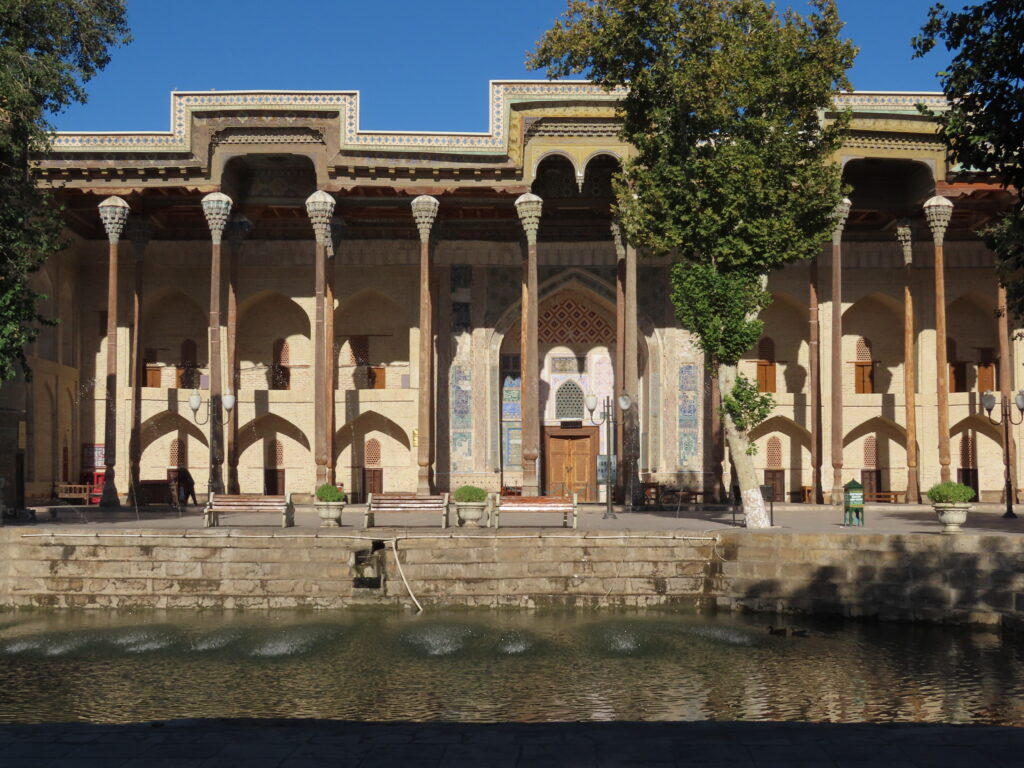
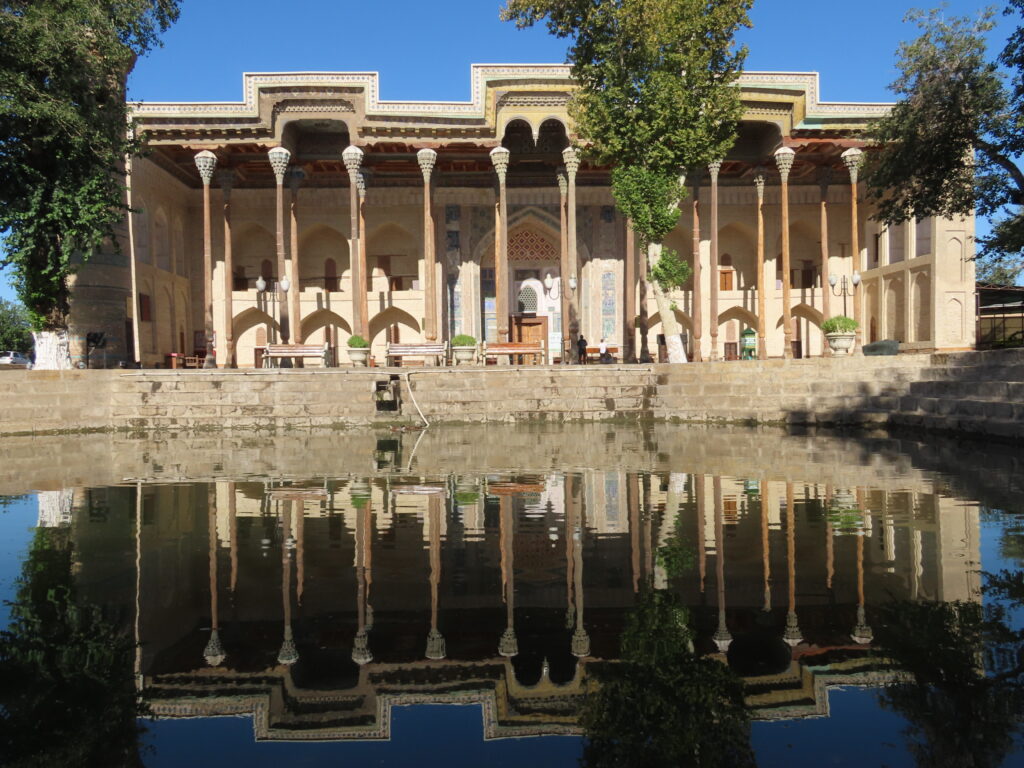
The next morning before breakfast we retrace our steps to the Poyi complex and beyond to the Ark or the citadel which is the oldest part of Bukhara. The ramparts rise high on the flat land curving a little like at Itchan Kala. We cross the road and sit on a bench at the hauz or pond in front of the Bolo Hauz mosque.
Pretty Peaceful Prayer hall (Bolo Hauz Mosque)
It is unlike any we have seen here. Slender wooden pillars uphold a wooden roof painted in warm colours and the light from the hauz paints patterns on it. Grandparents babysitting little ones feed the ducks.
Monument in Miniature
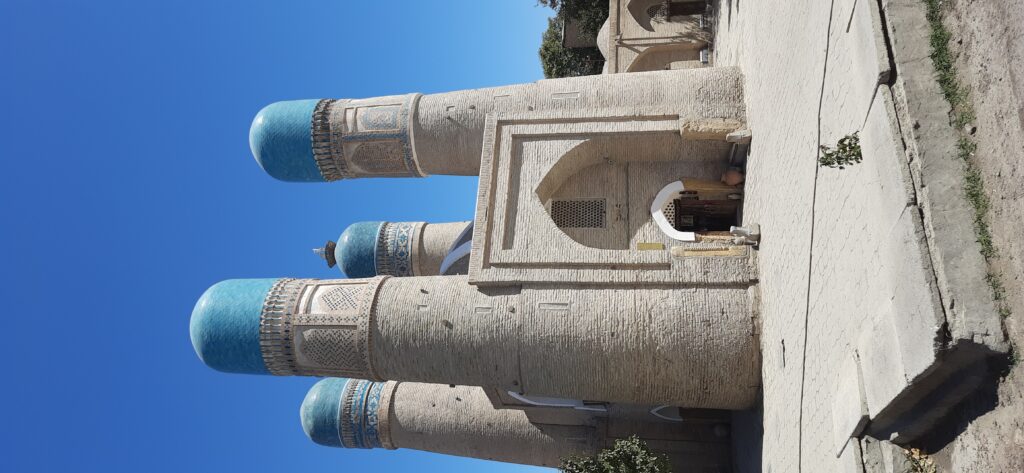
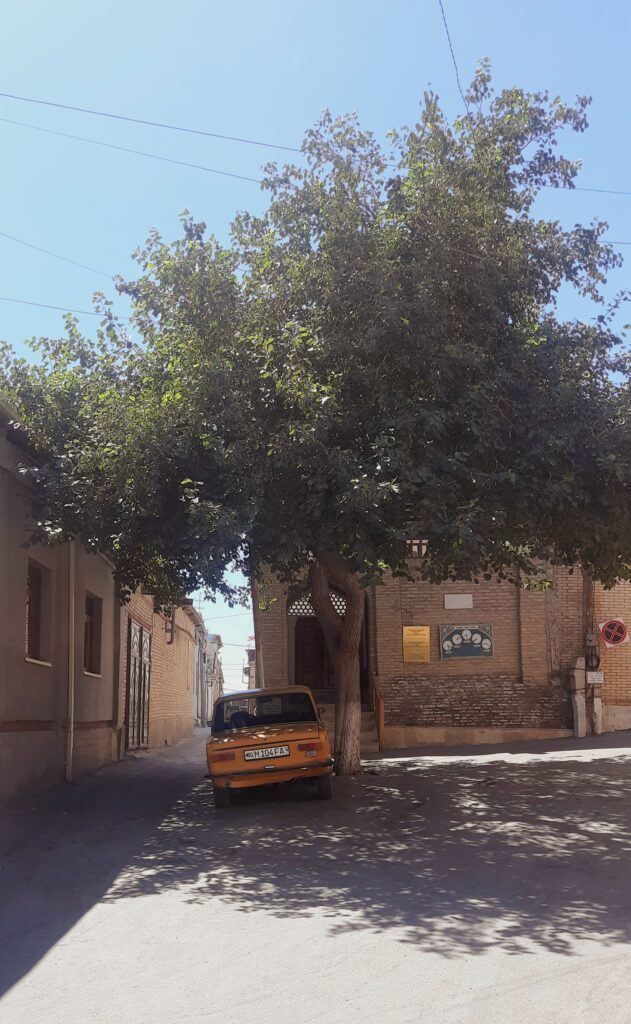
Later we amble to the tiny Char Minor tucked into the bylanes of a residential area. With plain blue minarets it has no architectural beauty yet the miniature structure retains a certain charm thanks to its size. We wander through the labyrinthine lanes of residences with ancient ladas, relics of another time, parked in front, to the two madrassas, Ulug’bek and Abdulaziz Khan, facing each other. The madrassas have been repurposed as shopping arcades with curios, art and clothes. In the heat of the day the tourists take refuge in the shops.
A streetcar named mango
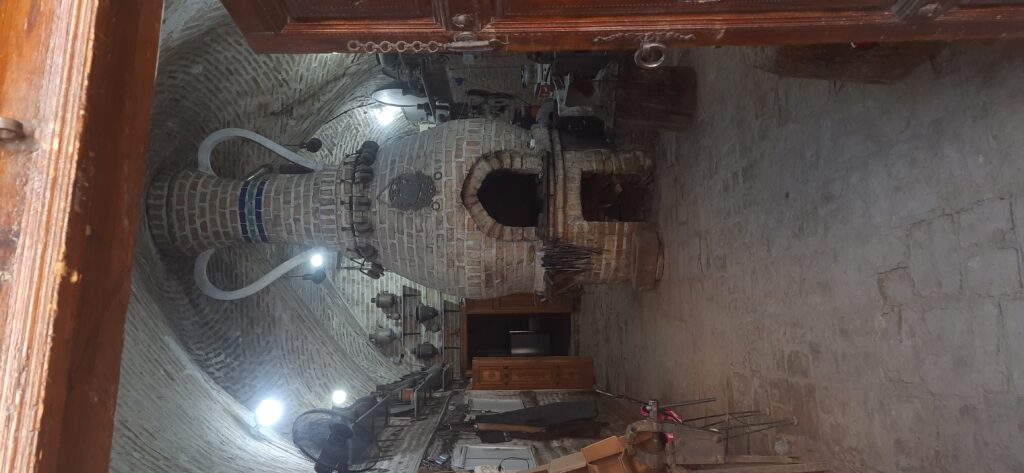
We discover a hamam and I try to persuade the man to try it. He balks seeing the images displayed. Says it looks too contorting to give any joy or relief. Across is a pichokchi’s(master who creates knives) foundry with a furnace shaped like a fluted jug. He is busy sharpening one out.
The means matter
A larger-than-life bronze statue of a legendry folk hero Khoja Nasreddin near Lyabi Hauz is beleaguered by mothers trying to cajole their kids to sit with him on his donkey. It supposedly portends luck, we are told by the man selling curios across the road at Kukaldosh madrassa. We end the evening again at the steps of a fairly deserted Miri Mosque and as the lights come on under an inky sky it is the perfect place to be.
An Artist’s Canvas. (Miri Mosque)
On the Golden Road to Samarkand
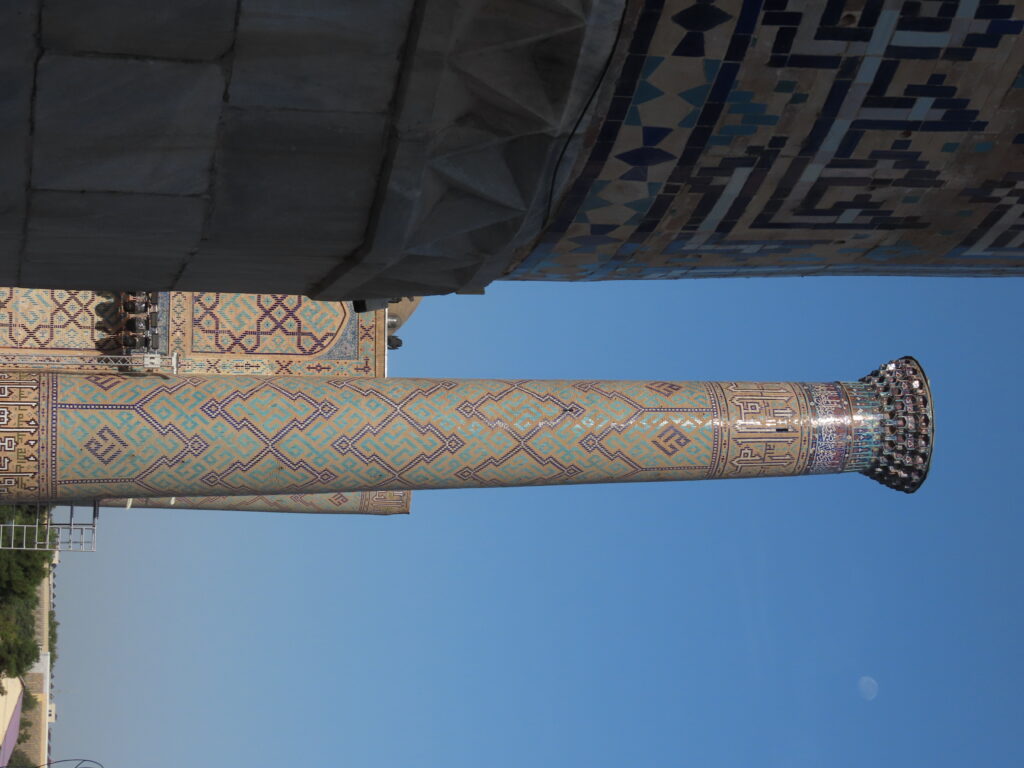
The Sharq rushes past the expansive rolling countryside to put us in Samarkand as it is waking up the next day. After a sumptuous breakfast we walk to Registan Square which Google guide says is a two minute walk from our guesthouse. For a change it is accurate as we see the geometric patterned towers of Ulug Beg’s madrassa peep out from above the thick trees.
Three is a charm.
There is music in the air. But the initial excitement of finally seeing the most famous ensemble of the route turns to disappointment when we discover the reason for the festive air. There is going to be a mega music show to coincide with Uzbekistan’s national day at the Registan but unfortunately for security reasons and the practice session the Square is cordoned off. So near yet so far! We watch the dancers twirl around and flag bearers practice from behind the barricades before recalibrating our programme.
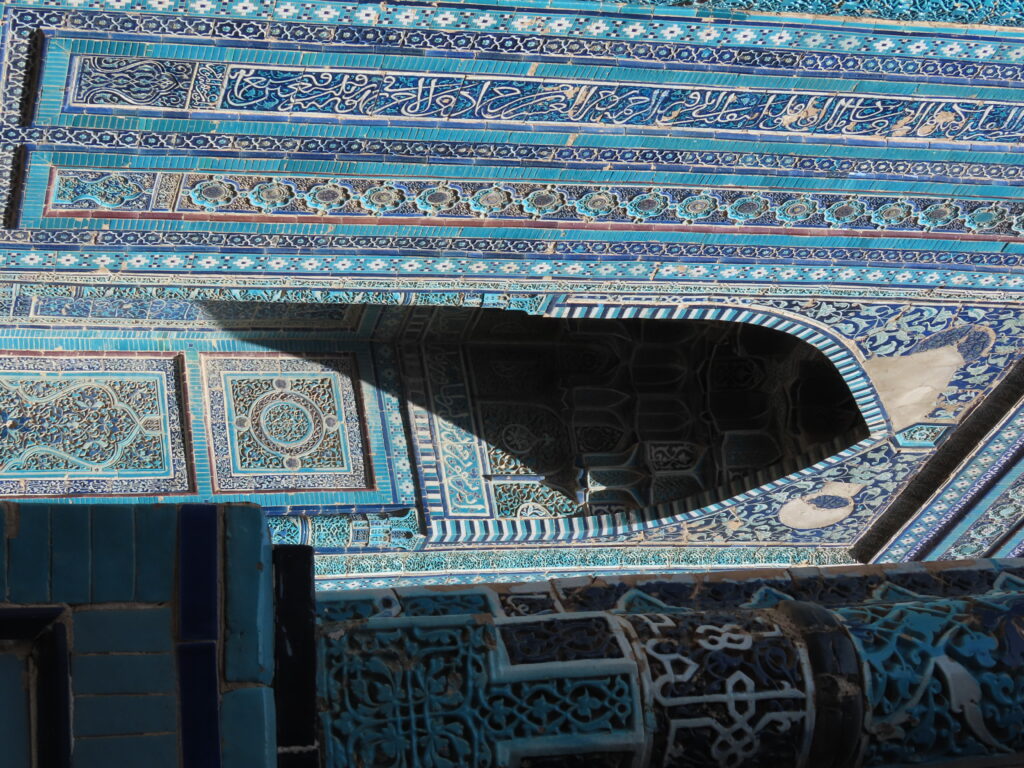
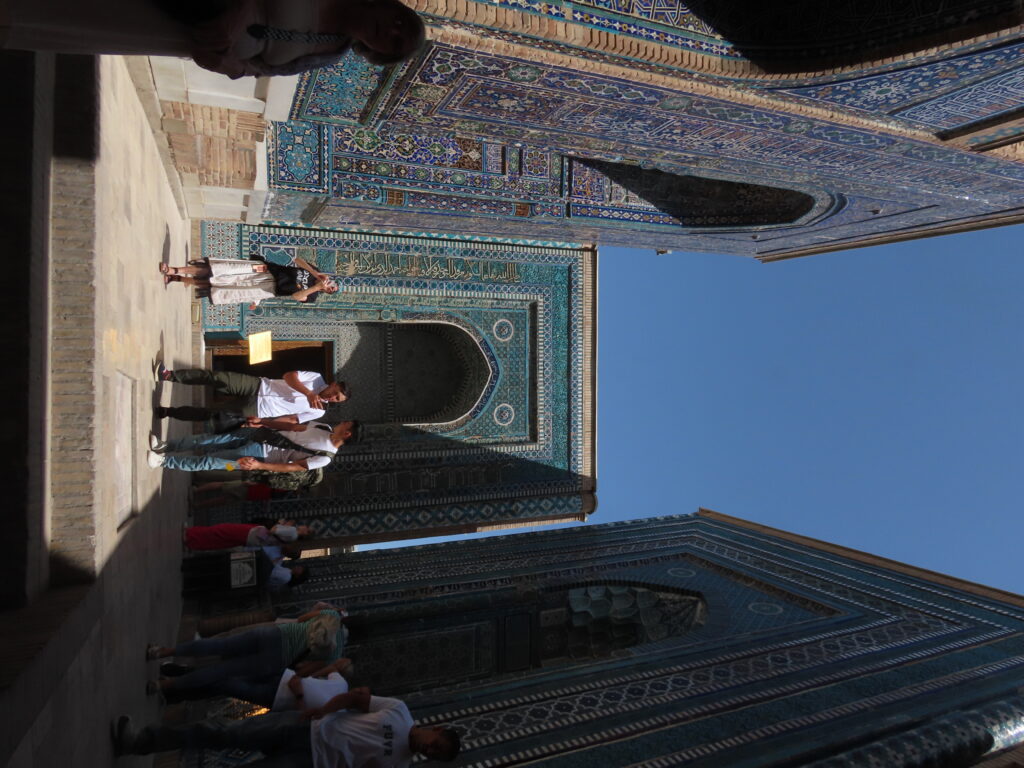
We head to Shah-i-Zinda, which by the time we reach is completely overrun by bus loads of tourist. But, once we climb up through a bland archway in a line stand Uzbekistan’s finest buildings. This necropolis is the final resting place of many a royal family member and court dignitary of yore. The tiled facades go from an indigo to midnight blue and every shade in between.
With calligraphy, floral motifs and geometric patterns, still retaining all their glossy finish they are just beautiful! The interiors of most are a rich bottle green and the roofs have patterns in orange. A man sells paintings in one and at the end of a maze of rooms near the end we find an imam singing prayers once the handful of seats are full.
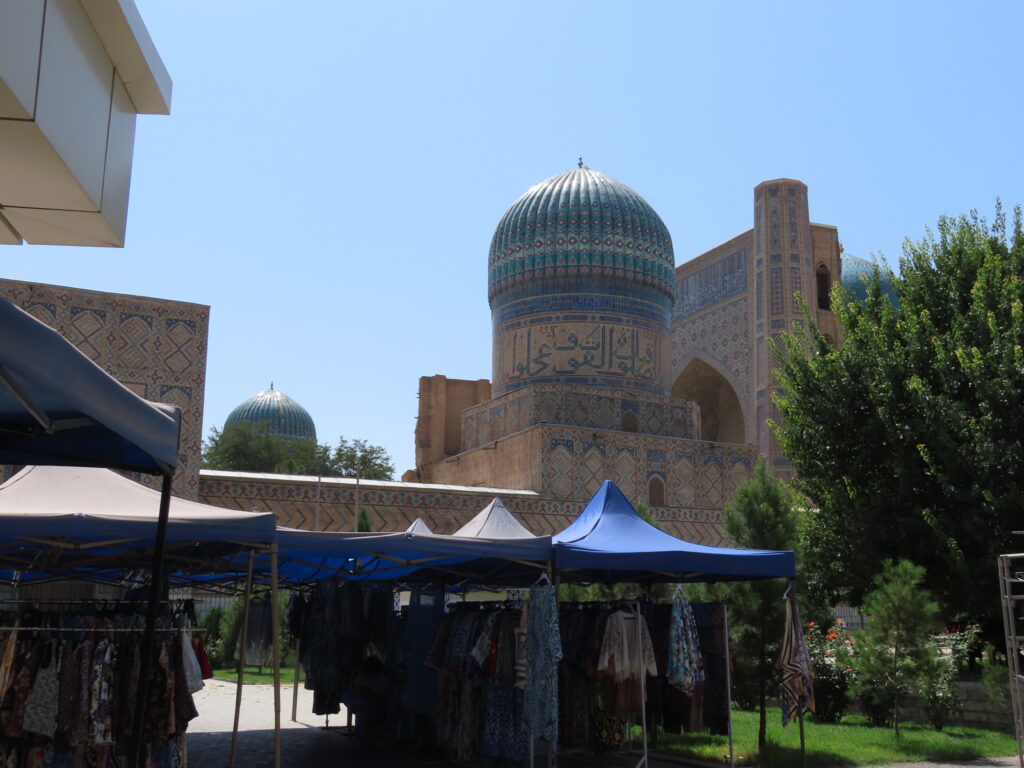
We walk to Bibi Khaynum’s mosque. Timur’s queen’s mosque has been resurrected from a ruin and inside the spacious quadrangle shaded by trees stands a massive marble quran. In the Siyob bazaar adjoining it where apart from the mounds of dry fruits, spices and candied sugar, the riot of colours comes in the shape of porcelain souvenirs.
All a Woman May Need (Siyob Bazaar and Bibi Khaynum’s Mosque)
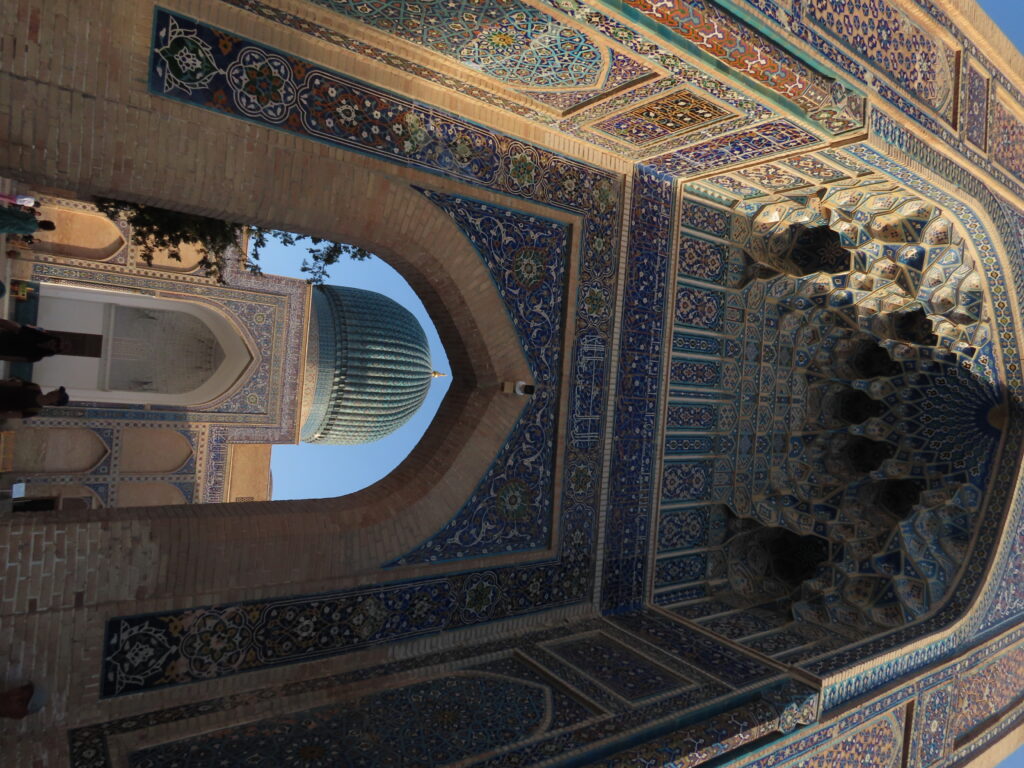
In the evening we walk down to Gur-i-Amir, Timur’s mausoleum. The fluted turquoise dome is massive but that apart it is a modest structure.
Legends and Legacies (Gur-i-Amir)
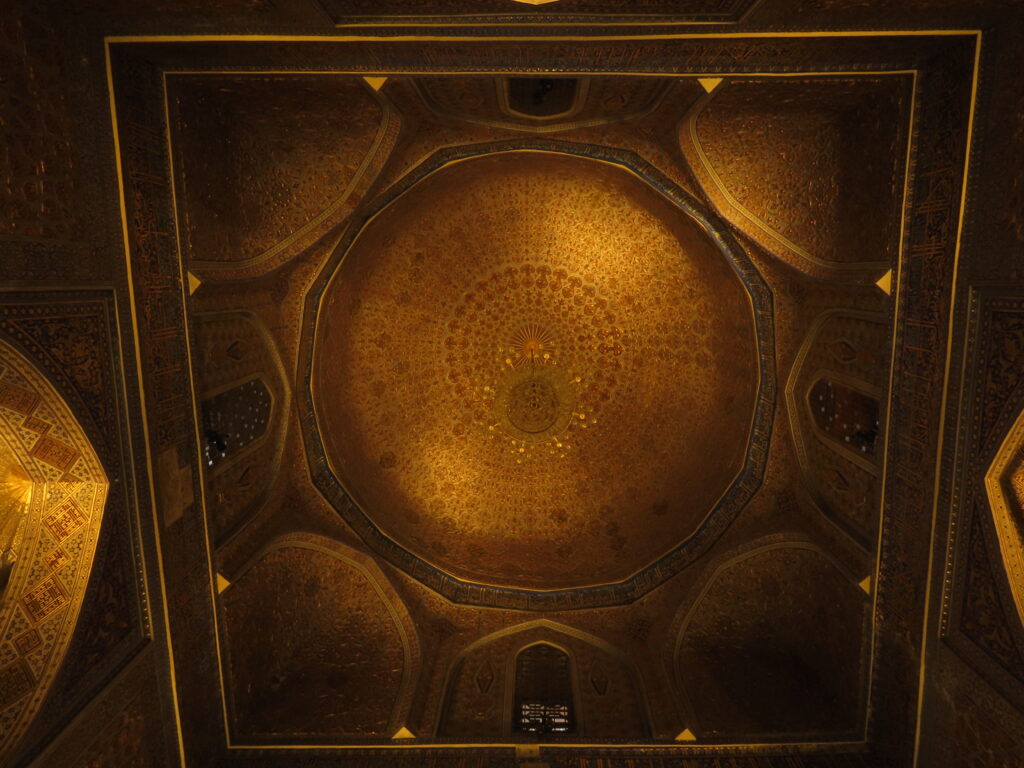
Inside, the famed ruler has the company of his sons, Ulug Beg, his grandson and one of his revered teachers. The plundering Nadir Shah made off with Timur’s jade marker but returned it after a spate of bad luck followed along with it. The restored interiors are a rich blue and the gilded gold cupola with lighting on point makes it glow.
We get lucky the next day in the afternoon since the barricades are opened for visitors at the Registan Square in between the practices. All the minarets seem to be leaning just a little at different angles.
Not a straightforward affair.
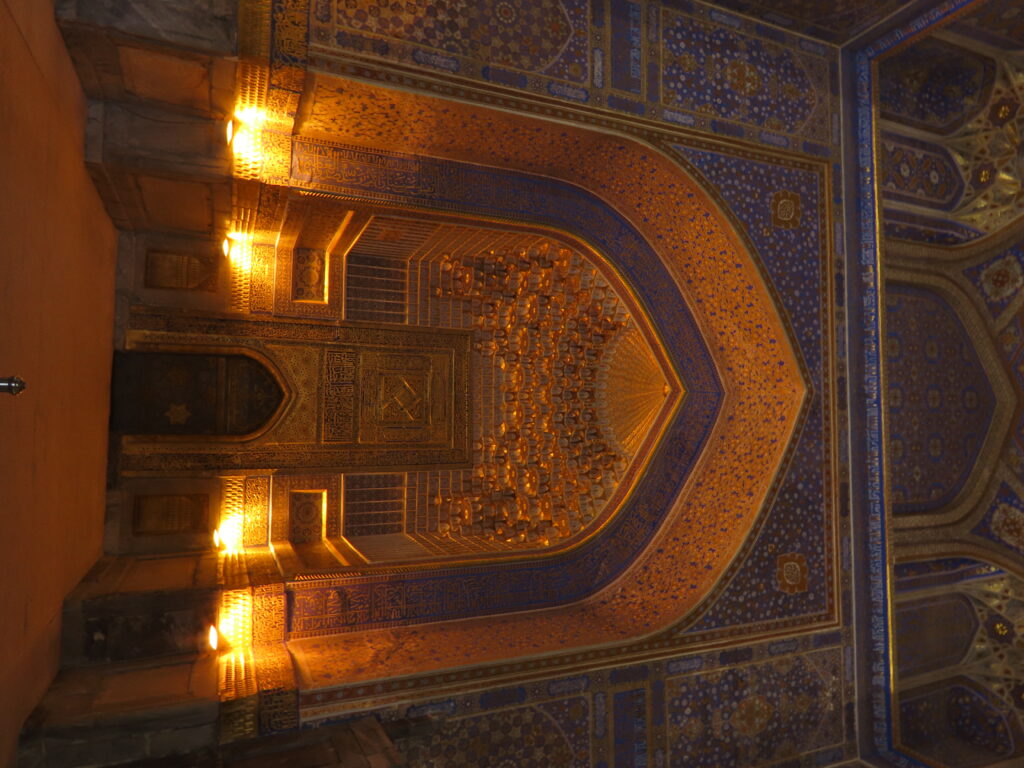
The Tilya Kori Madrassa in the centre has a photoshoot going on in the inner quadrangle with a bride making a pretty picture in white but once inside our jaws drop taking in the rich interiors which seem to be as opulent as Timur’s mausoleum!
Restoration work par excellence (Tilya Kori Madrassa)
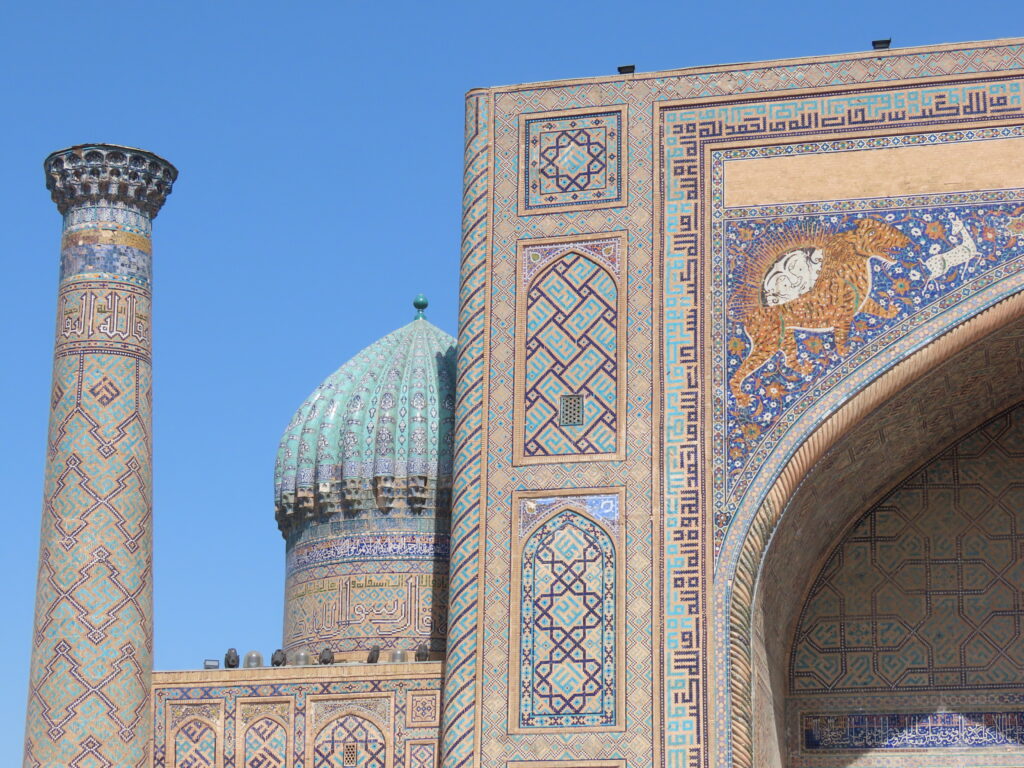
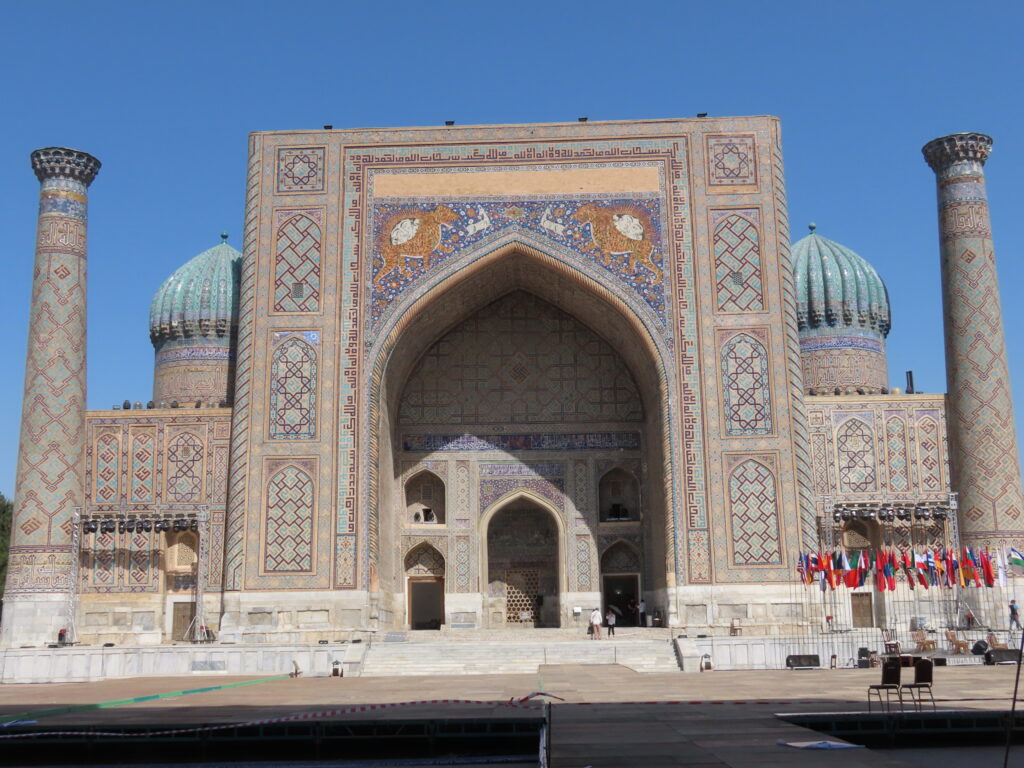
The Sherdor Madrassa is true to its name with unmistakable bright orange shers or tigers on the dwar (door) high up on the arched façade.
Fire in the Belly (Sherdor Madrassa)
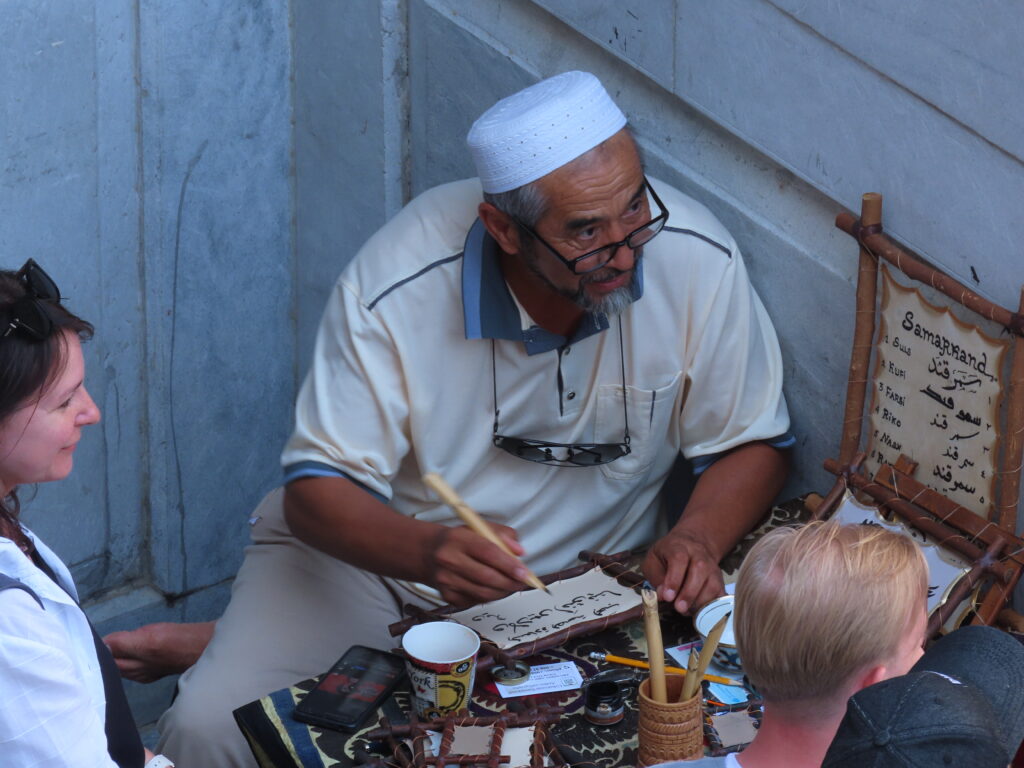
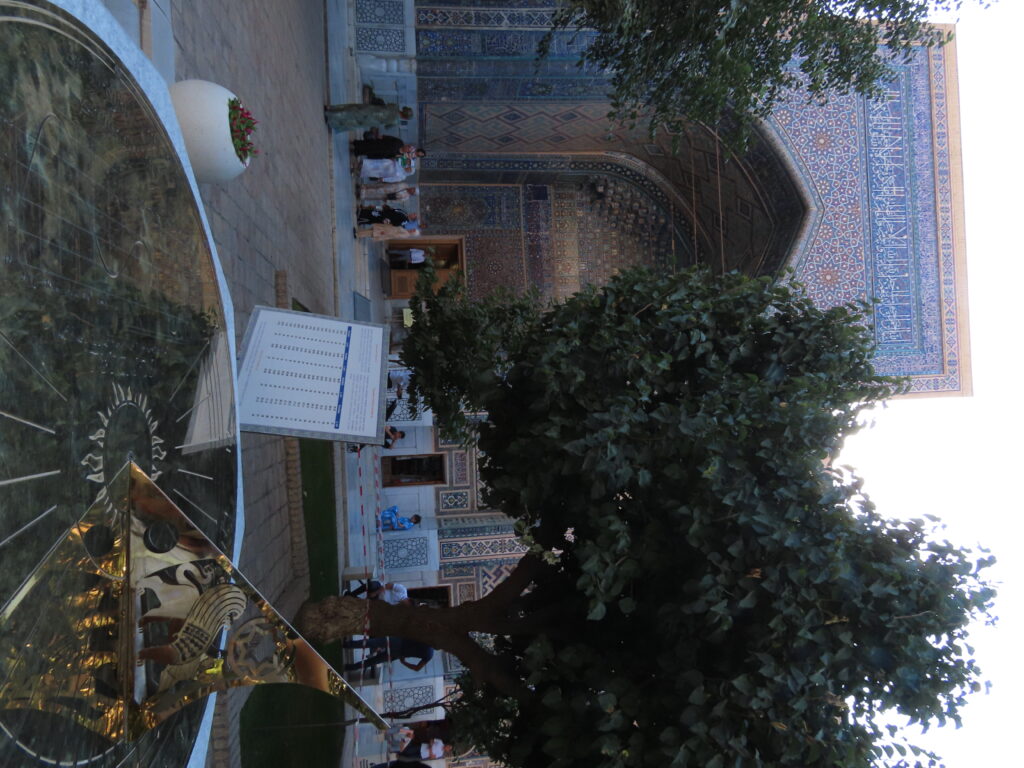
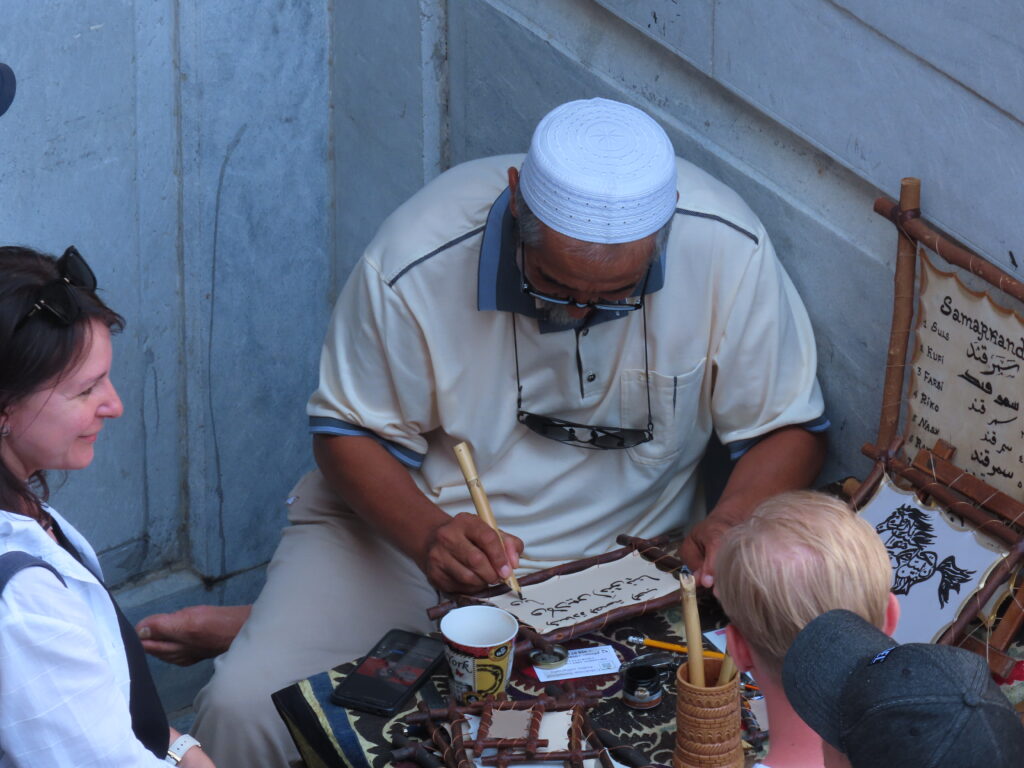
Inside the small quadrangle of Ulug Beg Madrassa with its carpet sellers in an alcove and other trinket shops we find a blink and miss coffee shop on the first floor. A perfect perch to view the calligrapher at work below while sipping an iced coffee.
Portrait of an Artist
The madrassa named after the famous astronomer king has a sundial below. The wheels of time never still and this ancient city, now a bustling metropolis, carries the old along with the new, in perfect step and harmony, much like the performers at Registan.
Time’s Turntable.
Fact File-
Getting there–
There are Sharq(regular) and Afrosiyob (bullet train) trains connecting the two cities to Tashkent.
Use the Yandex app for taxis. Very reasonable and convenient.
Sightseeing–
Bukhara- The Kalon Mosque has an entry ticket.
Samarkand- All the monuments require tickets. The Registan Square ticket is valid for the entire day.
The Silk Route star is supposed to be Samarkand. Famous also for being the seat of Timur’s empire and his final resting place. In my mind’s geography (Thank god it is not a referral map at all!) it was, along with Bukhara, east of the Tian Shan mountains. When we started planning a trip to the cities of the fabled route the geography shifted quite a bit west to Uzbekistan and Khiva, a UNESCO World Heritage site, popped up on the route. (So clueless!) Uzbekistan, the land of Timur, Babur, mosques, madrassas, minarets, markets and as we discovered, oh my goodness sweet melons!!
Land of blue minarets and mosques (Khazrati Imam Complex)
Touchdown at Tashkent
We land at Tashkent on a late night flight and the beginning is tumultuous. After getting the SIM card, soms, and finding a taxi big enough to cart our mounds of luggage at the airport, we reach our hotel only by 2am to discover they have cancelled our booking and not bothered to inform us. Something lost in translation. Fortunately, we are accommodated quickly in a nearby hotel.
Next morning we book a cab for the Khazrati Imam Complex. It is a pleasant surprise to see a young woman behind the wheels with her baby strapped into the co-driver’s seat. The boulevards are wide and leafy with just a few high rises. Most of old Tashkent came crumbling down in an earthquake in 1966 and was rebuilt as a modern Soviet city and remains the most populous city of the Central Asian Republics.
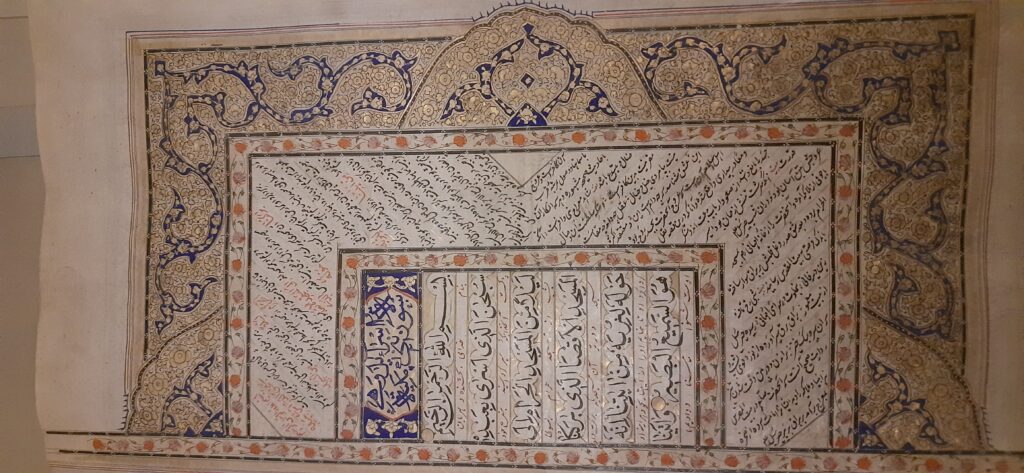
Writing is an Art
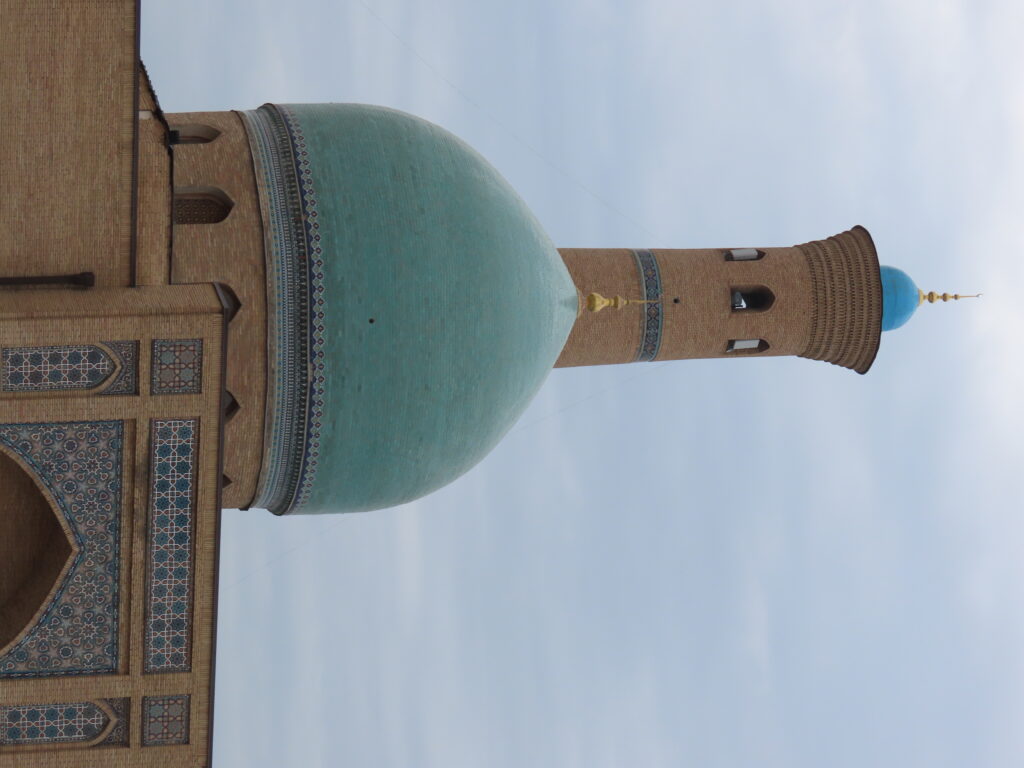
We reach the vast quadrangle of the complex or ensemble as they are called here. The small Muyi Muborak Madrassa, ’school of the sacred hair’ with it’s blue candy-cane dome, is in the middle. Inside, we do not find any sacred hair but the piece de resistance is the Uthman Quran. Written on parchment, this tome, one of the oldest Qurans, is probably the only one left of the six commissioned a few decades after the death of the Prophet. Timur brought it from Damascus. In the small rooms on the sides of this now library are housed a stunning collection of more Qurans. The calligraphy of some is lyrical art but all Arabic to me!
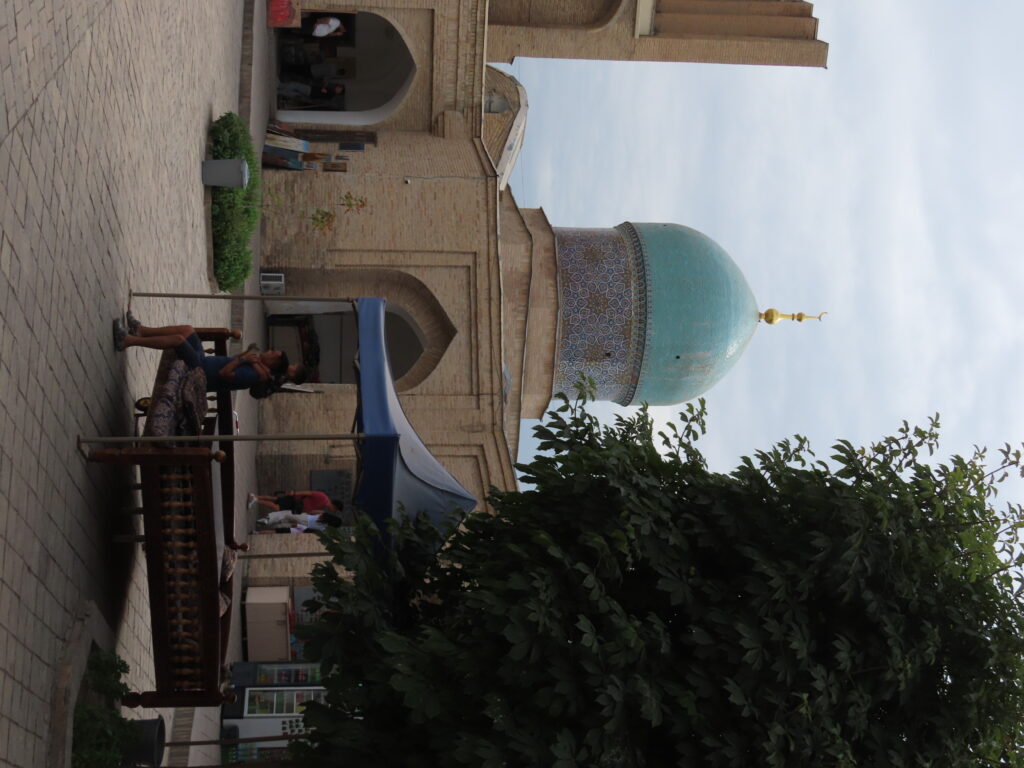
Barak Khan Madrassa at the back has been appropriated with shops selling art and artefacts in the small rooms that must have housed students many centuries back. (The fate of madrassas all over the country). The inner quadrangle makes a pretty picture with a tapchan under a mulberry tree.
The Light Within (Khasti Imam Mosque)
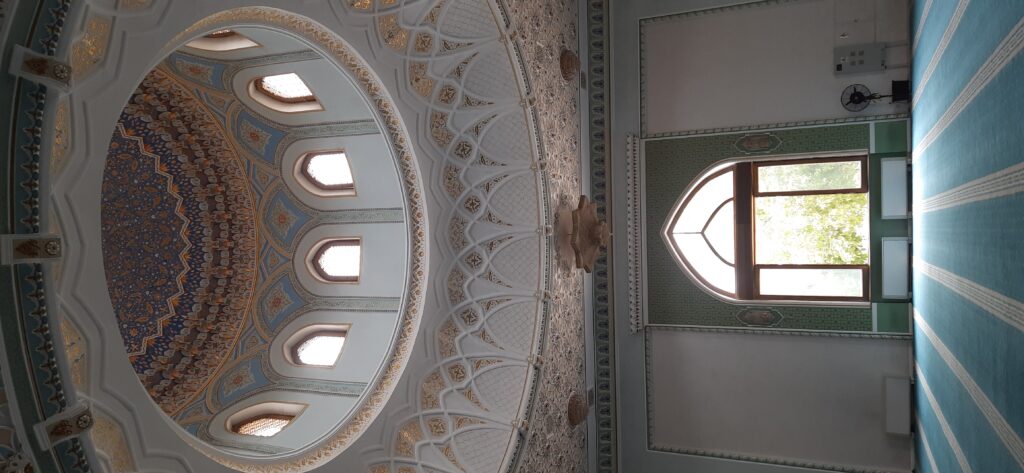
The new Khazrati Imam mosque at the other end is a functional one and women enter from a side but once inside we wander all over the gorgeously carpeted bright expansive hall with vaulted ceilings painted in geometric patterns. The courtyard has carved wooden pillars like those found only in Khiva.
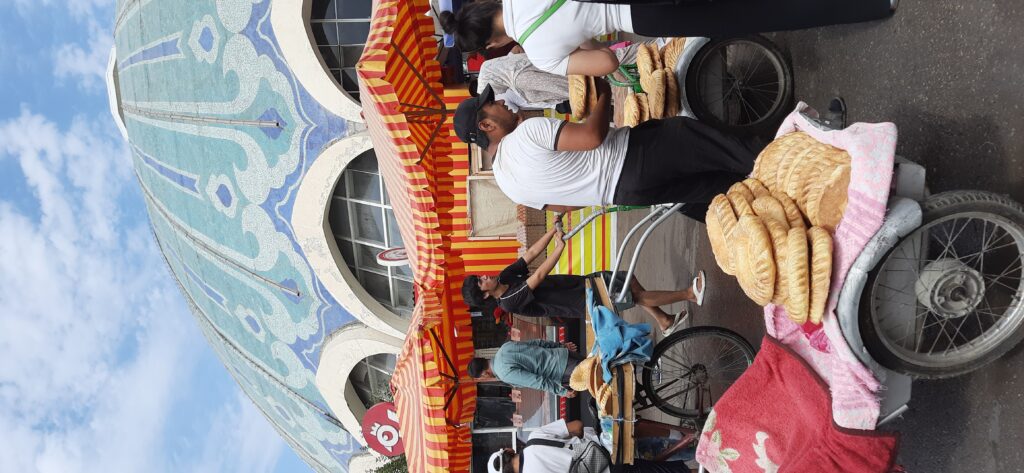
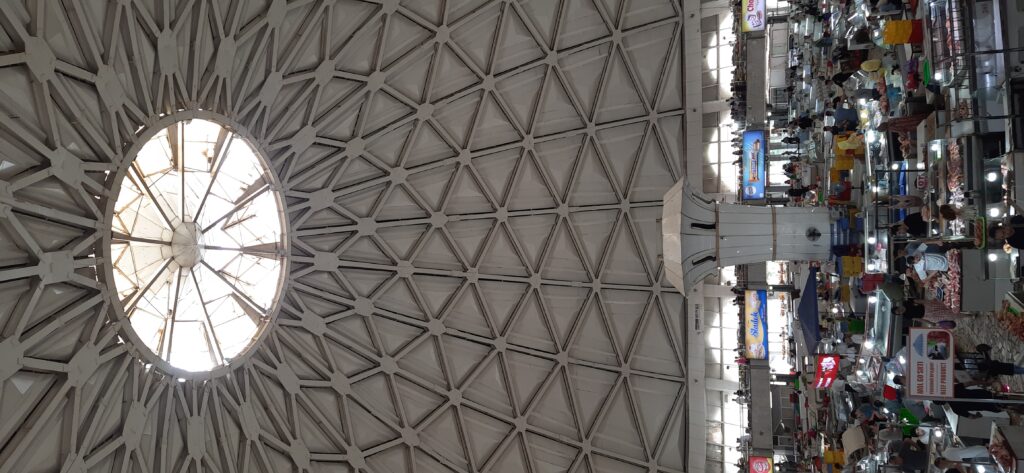
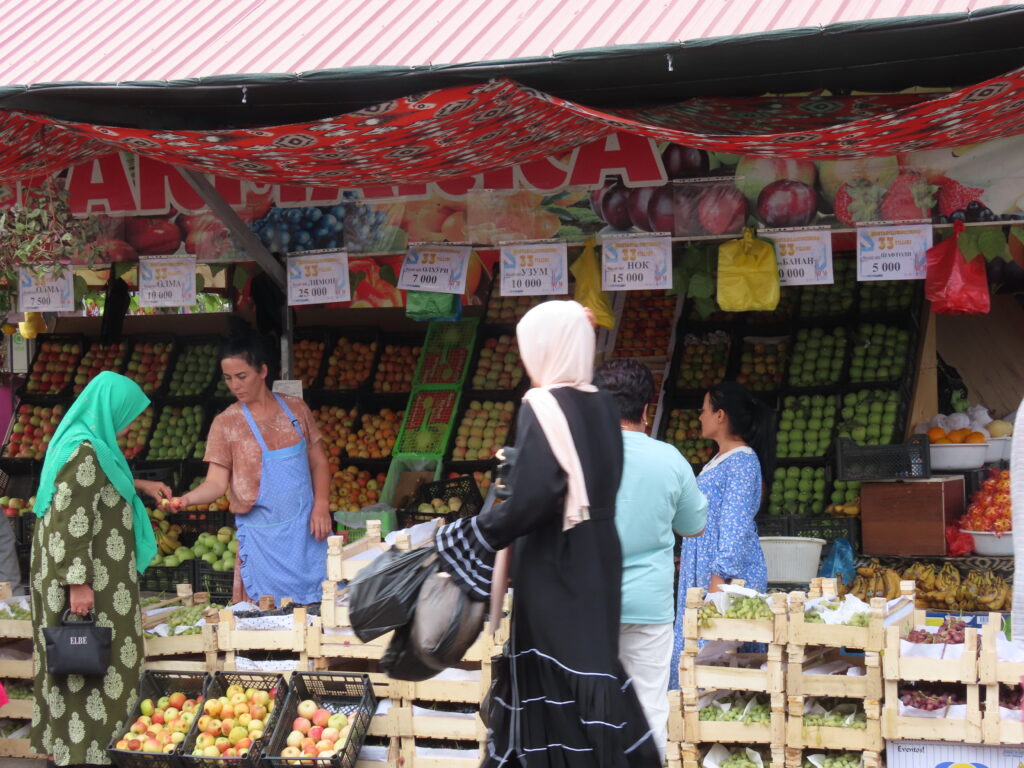
The next stop is Chorsu bazaar with it’s iconic dome. At the entrance nans are being sold from cycle carts. Inside, on the ground floor there are sections dedicated to dairy and fresh meats and on the first floor, mounds of dry fruits. (After bargaining you know you have hit the price when the shopkeeper dramatically says you are killing him!)
Within Chorsu Bazaar.
Around the building are counters of fresh greens and fruits so fabulous and colourful! The apricots are divinely juicy sweet and we drink fresh berry compote, pressed right there. Behind them are stalls of cheap souvenirs and tiny eateries with enticing aromas of live grills. Across the main entrance are lines of shops selling bakery items and small wood work, including bread stamps. After a hearty lunch of piping hot, tandoor fresh somsas and shashliks, we head back since we have an overnight train to Khiva.
In the morning the train chugs past massive scrubby dunes till we cross the legendry Amu Darya. The landscape changes dramatically from one bank to the next with fields and orchard on the other side. Beyond Khiva railway station’s manicured garden are new hotels neatly laid out. We drive into the small oasis town whose history goes back to biblical times. Legend goes that Noah’s son, Shem found water here (Ironic that the father barely survived a flood). Our hotel is a small old madrassa with a courtyard and a covered platform with the signature carved column. The rooms have tall arched niches and a billowing false ceiling of cloth. It gives a very Arabian Nights vibe.
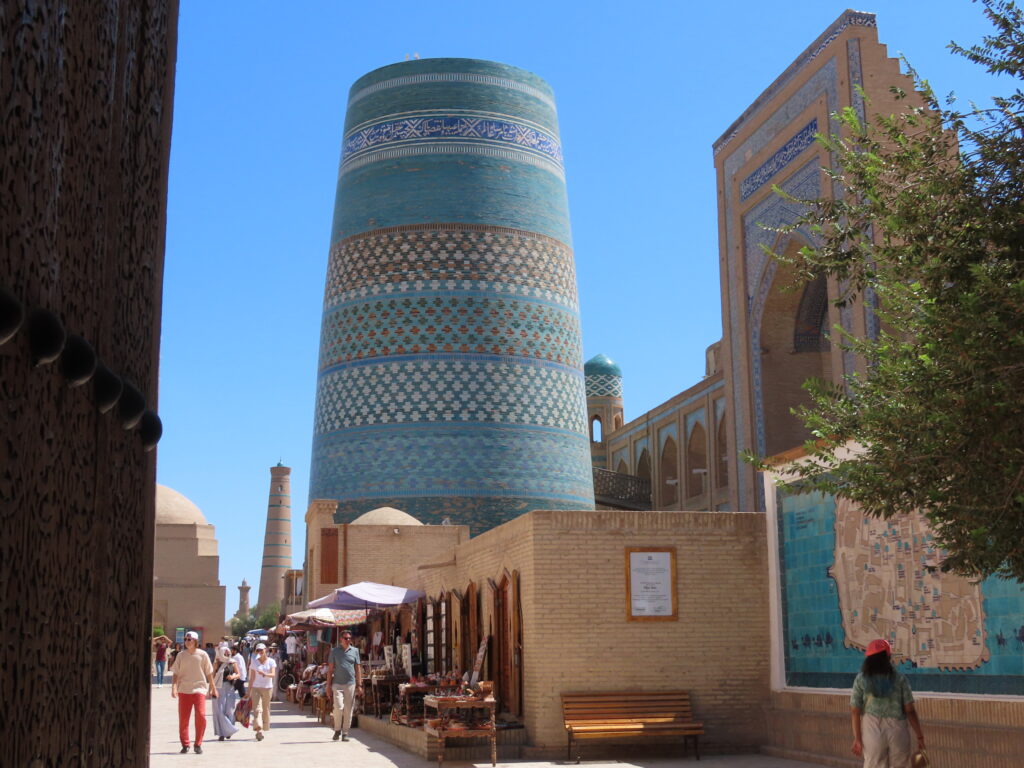
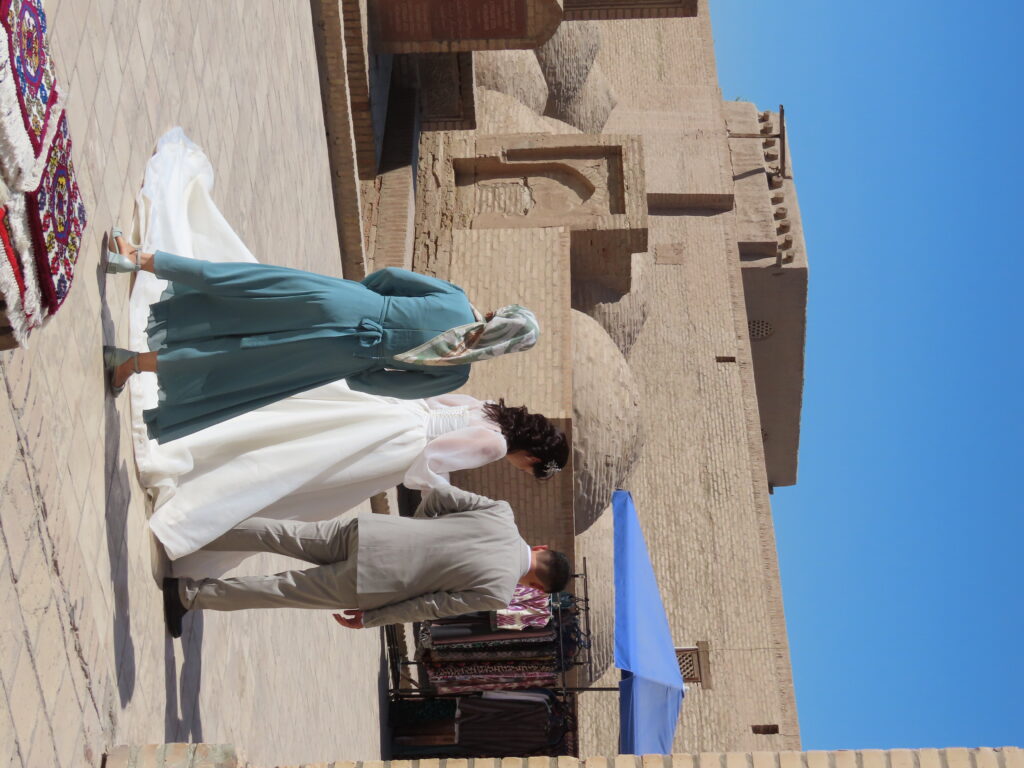
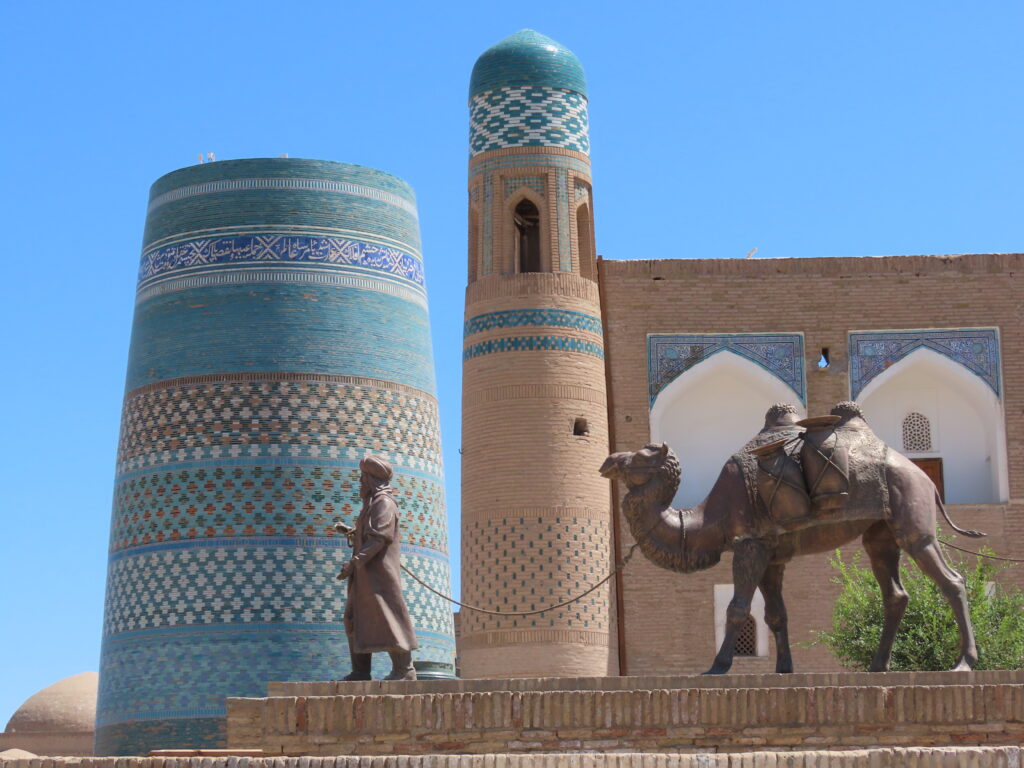
After freshening up we walk to Itchan Kala. The curving cream ramparts look new. Standing inside in the shade of the incomplete yet massive blue Kalta Minor we realise that although the citadel is small, we will not be able make sense of the labyrinthine lanes and see everything, so after lunch we take a guide. As we walk to the West Gate, retracing our steps, a marriage party makes its way for a photoshoot and over the next few days, at many monuments we see it is a done thing in Uzbekistan. (In Delhi’s Sunder Nursery also!)
Happily everafter but first a photoshoot.
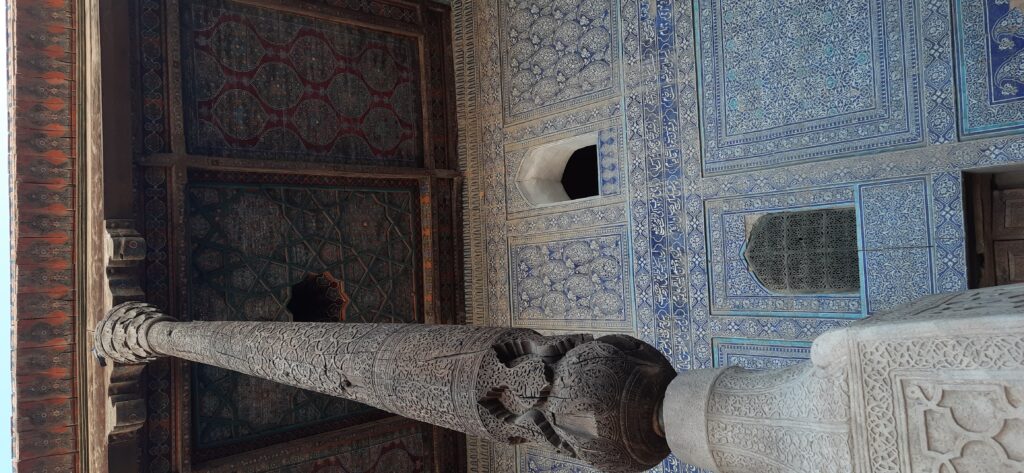
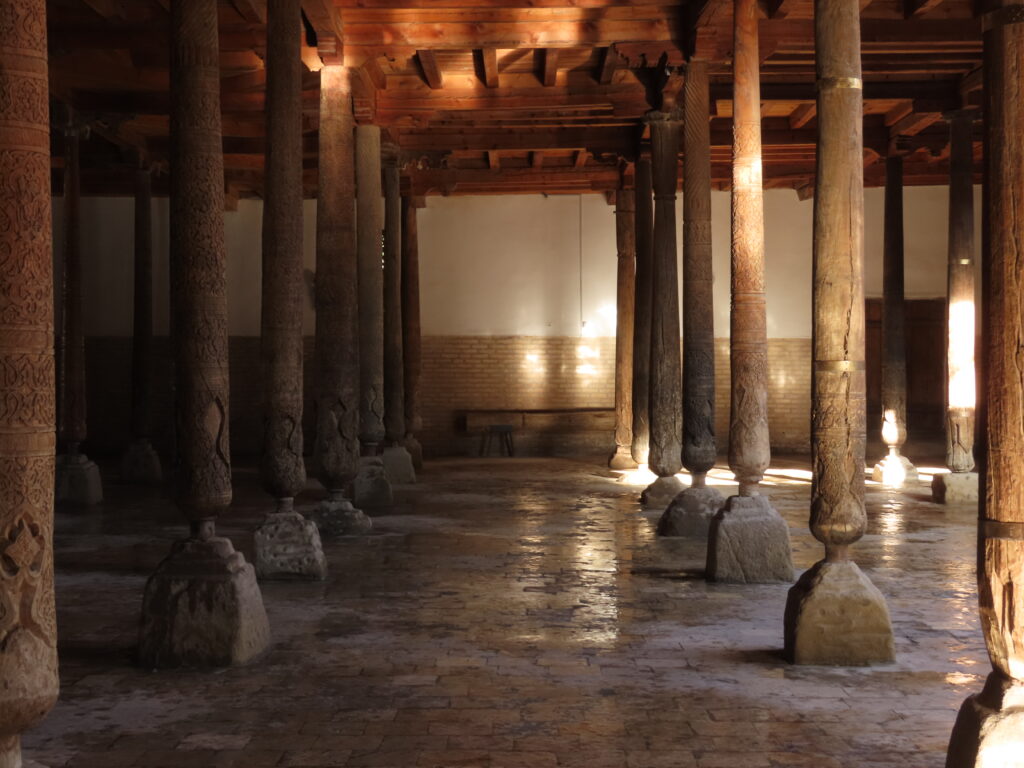
Thanks to Madiyar, our guide, we wander inside the Mohammad Amin Madrassa which is now a hotel. According to him the prison outside Khuna Ark has just one cell since justice was swift… and often brutal. (No point in wasting the exchequers money on feeding the incarcerated.) Small museums in different monuments depict different aspects of life here. The most stunning and distinct architectural feature in Khiva are the ornate wooden pillars made from elm trees in all the inner courtyards.
The Jama Masjid is a visual feast with rows of intricately carved ones, some worn out but no two alike! Toshhovli palace, the king’s residence has an apartment each for his four wives with a distinctly designed pillar in front. One, intriguingly has a prominent swastika. Khiva was part of the Khorezm empire and its Zoroastrian roots are still visible in small distinct iconography. Timur and his ancestor Genghis Khan, who annexed Khiva with all his murderous mayhem, are no heroes in these parts as they are in the rest of Uzbekistan. After all the walking around on a warm afternoon we need a breather and in true Uzbeki style we sit in a tapchan outside a café and drink tea. Black or green, tea is an accompaniment to all Uzbekistan meals. There is something surreal about sitting in such an ancient place which is still so alive.
Colours of Itchan Kala
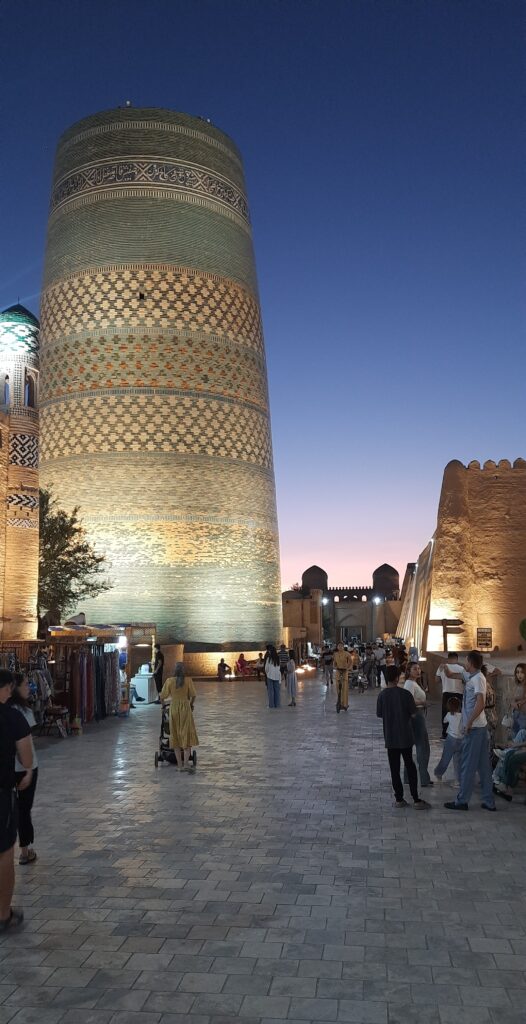
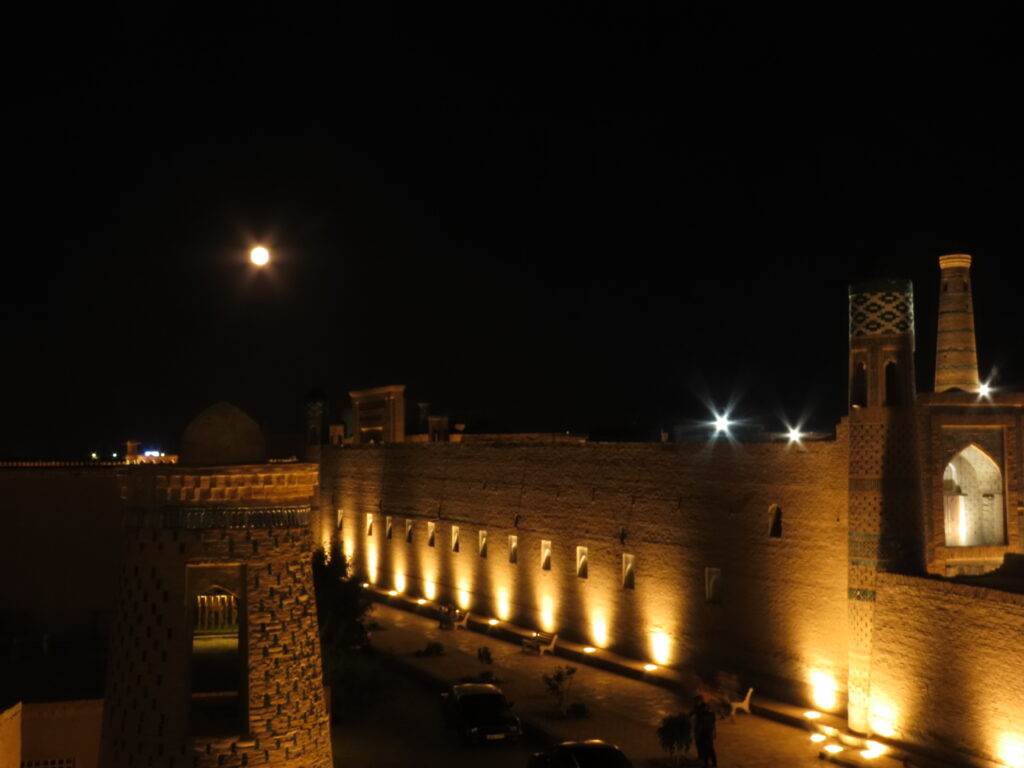
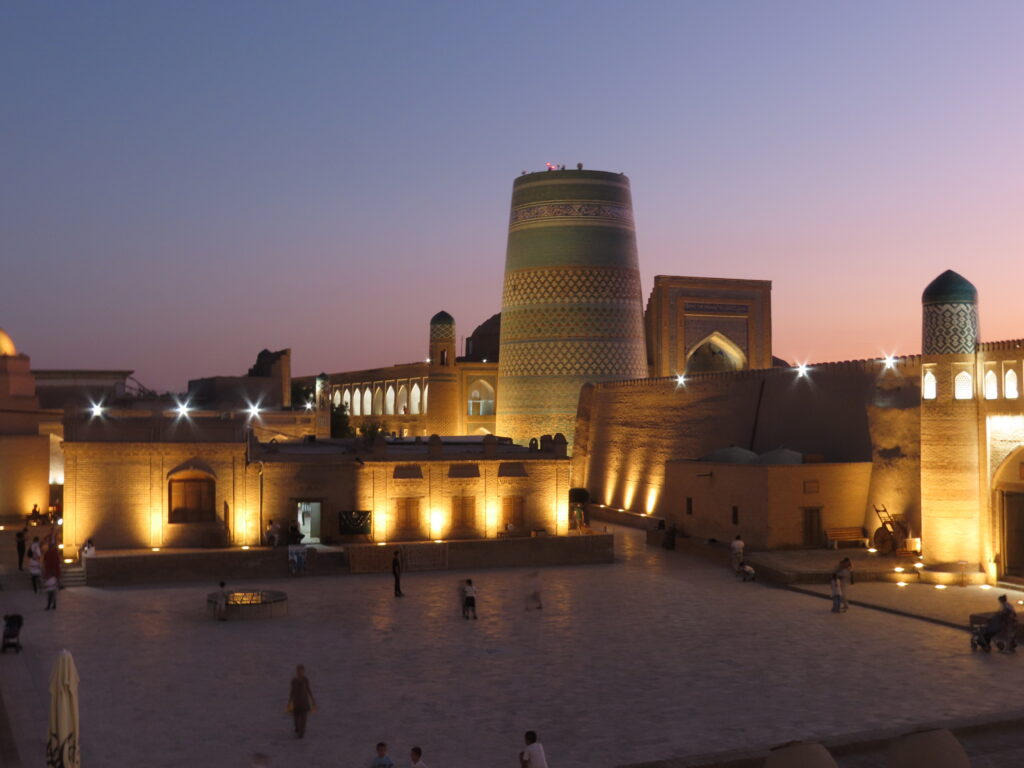
From a rooftop restaurant in the citadel we watch the spotless sky go from a mellow yellow to a dreamy pink and then finally an inky blue. A supermoon makes an appearance from behind the ramparts and it is magical with the monuments all lit up. Music wafts in from somewhere, a tandoor in the square below gets fired up to bake naans for the next day, a boisterous birthday party is on on another roof…
Bluemoon over Itchan Kala
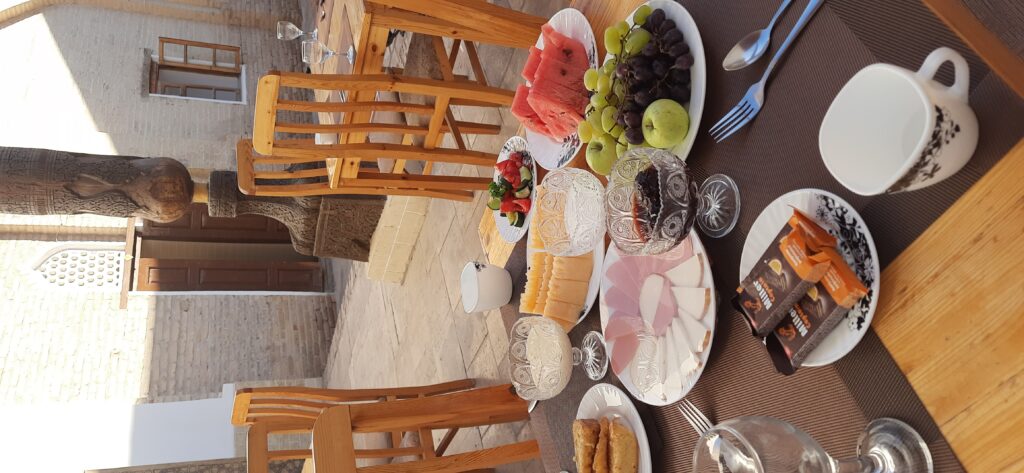
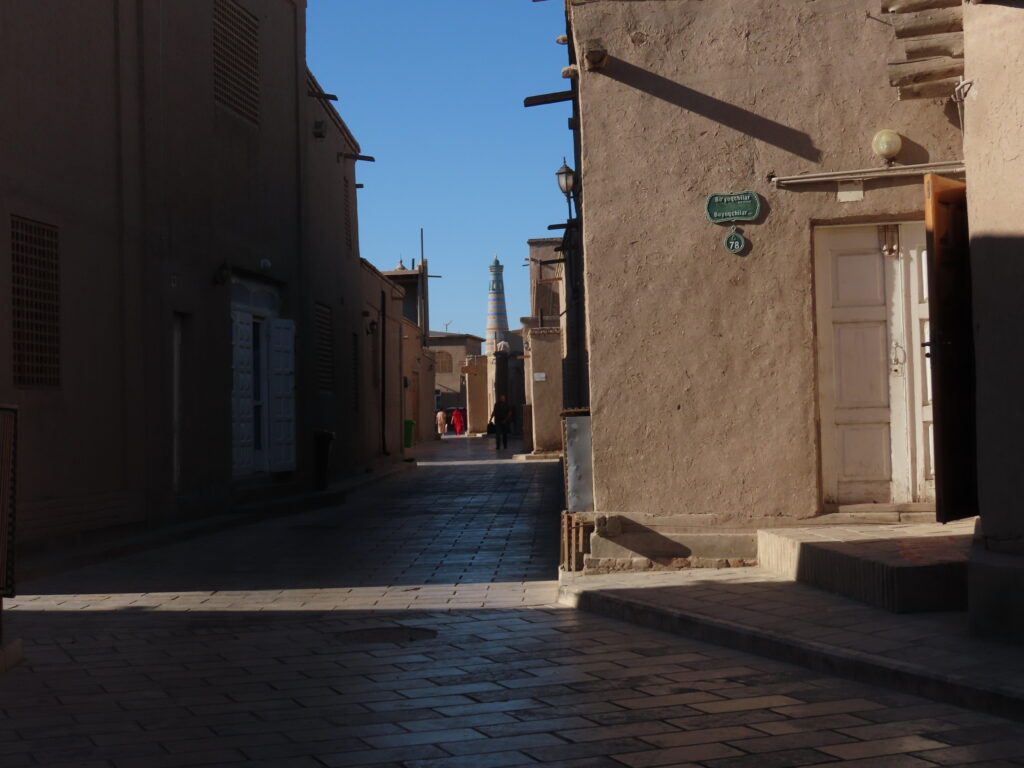
Next morning before a beautifully laid out hearty breakfast we make a dash to Itchan Kala to get a bird’s eye view from the ramparts (whether it is worth the additional payment is debatable) and walk till the slender Islam Khoja minaret with bands of green and blue tilework, through alleys yet to wake up, crossing traditional houses neatly numbered with pretty green tiles.
Breakfast like a King.
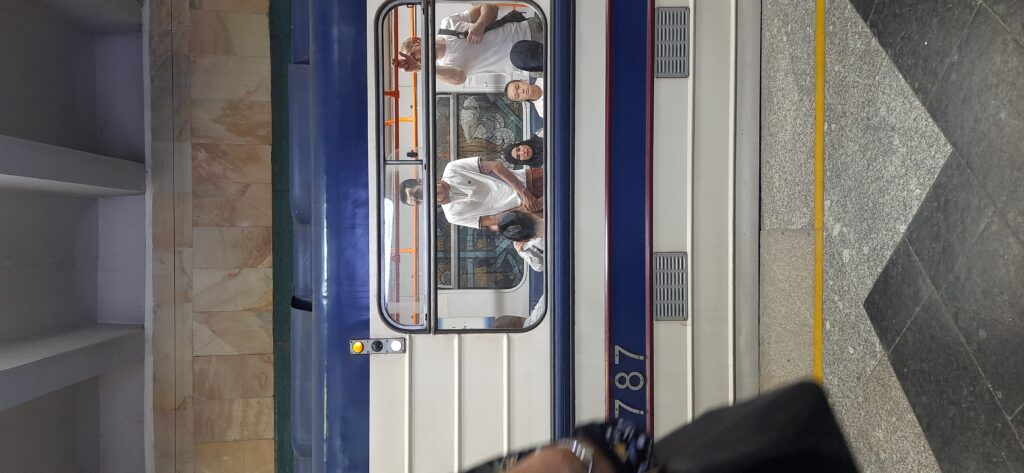
Khiva is an extraordinary example of living heritage where history has not been consigned to museums. Even in Tashkent, on our way out when we take a ride in the metro, getting off at random stations to admire how artfully they have been done up, one line has modern coaches and the other vintage ones. Quintessentially Uzbeki where the past and present run parallel everyday.
Parallel Timelines
Next stop Bukhara and Samarkand.
Fact File
Getting there–
There is an overnight train from Tashkent to Khiva.
The nearest airport for Khiva is Urgrench.
Note-
There is an entry fee for Itchan Kala. A separate ticket has to be bought for the ramparts.
Teressa is a popular restaurant with a great location. It is best to book a table in advance.
‘Thank you Mithun Chakroborty!’, exclaimed the daughter, holding her giant chocolate piece up as trophy outside a clothing store in a mall in Almaty. A manna from heaven after two hours of trying to hunt for a measly jacket in mild desperation in the wrong place. (There were only shops selling very expensive knock offs of obscure, for me, Italian designers!) The owner of this last one where we had walked in was a Mithun fan who could not seem to believe his luck that people from the land of the ‘Disco Dancer’ had come to his store, perhaps for the first time and so had promptly offered a chocolate to the daughter who till this trip had no idea of ‘Jimmy Jimmy’ Chakroborty.
Kazakhstan was added to the holiday itinerary as an appendage I felt, with just two days in Almaty and half a day in Shymkent while crossing over from Uzbekistan. But even though it was no more than ‘dipping the toes’, we got a glimpse of a land that was exactly as one had imagined it to be- wild and vast!
Day Dream
Horsepower
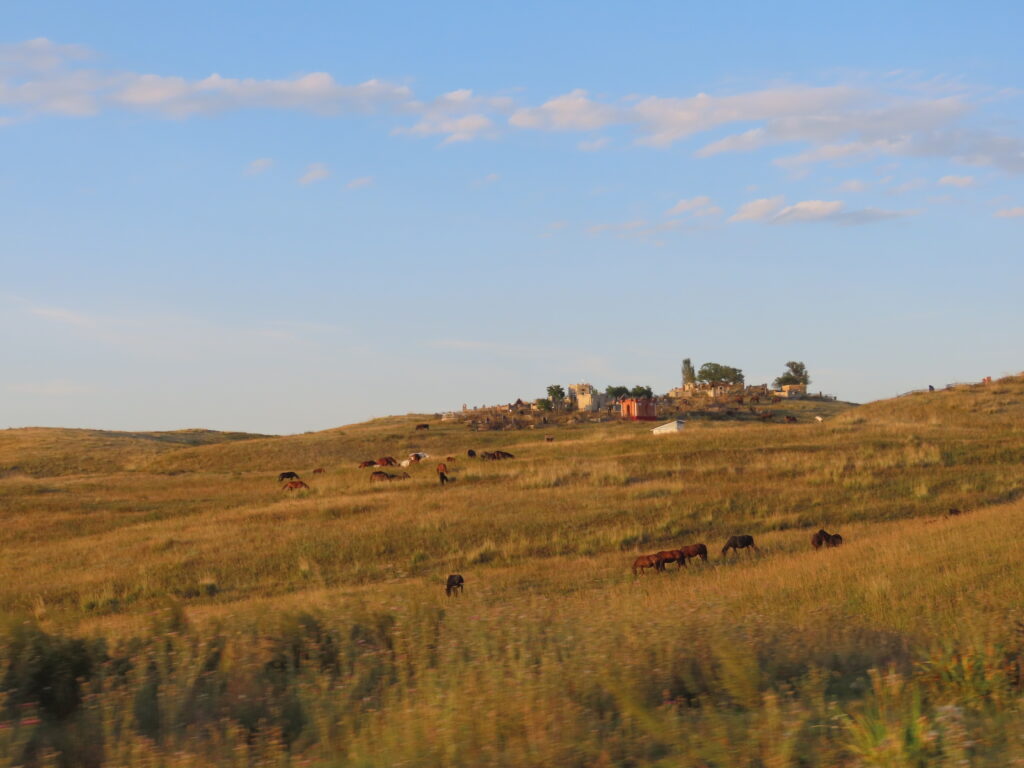
While driving from the border to Shymkent the scenery unfolds a golden, sometimes green, gentle slope at a time. We speed in a vintage Soviet era red Mercedes with the windows down at 140km per hour (It is a wonder my scalp didn’t fly off!) When I ask how do I get the windows up, the driver takes out a rotating handle from the glove compartment with great enthusiasm…
Poised
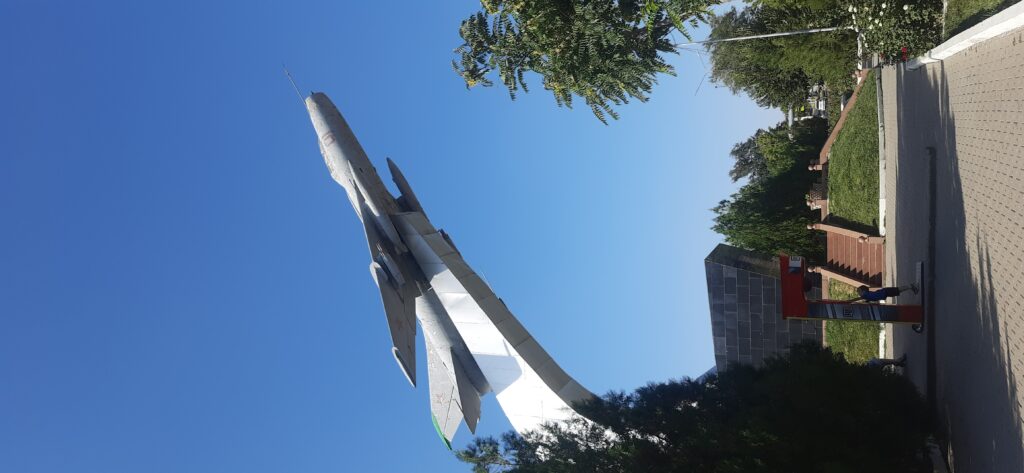
Shymkent is a leafy well laid out city and we have a few hours to spare. The sprawling War Memorial Park is where we head to. Besides a MIG that looks poised to take off and other war machinery, there are endless rows of names of soldiers who died in World War II on a low wall. Later, we catch a very nice train and rock and wind our way through the night to reach Almaty spread on the lower slopes of snow-capped mountains early in the morning.
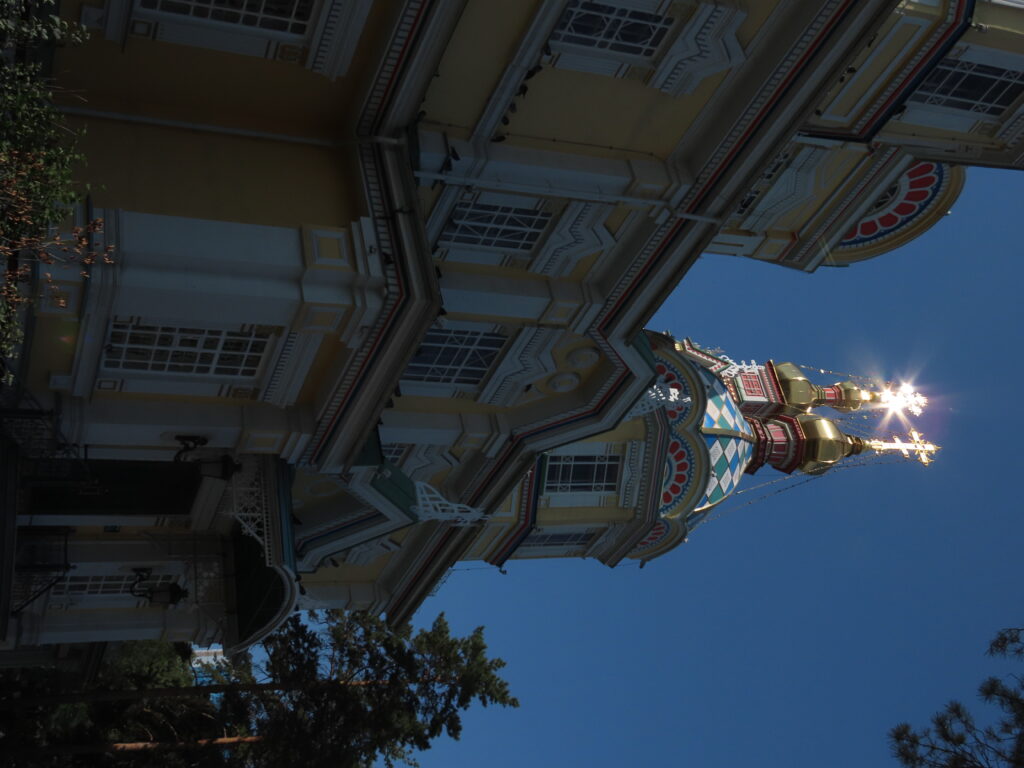
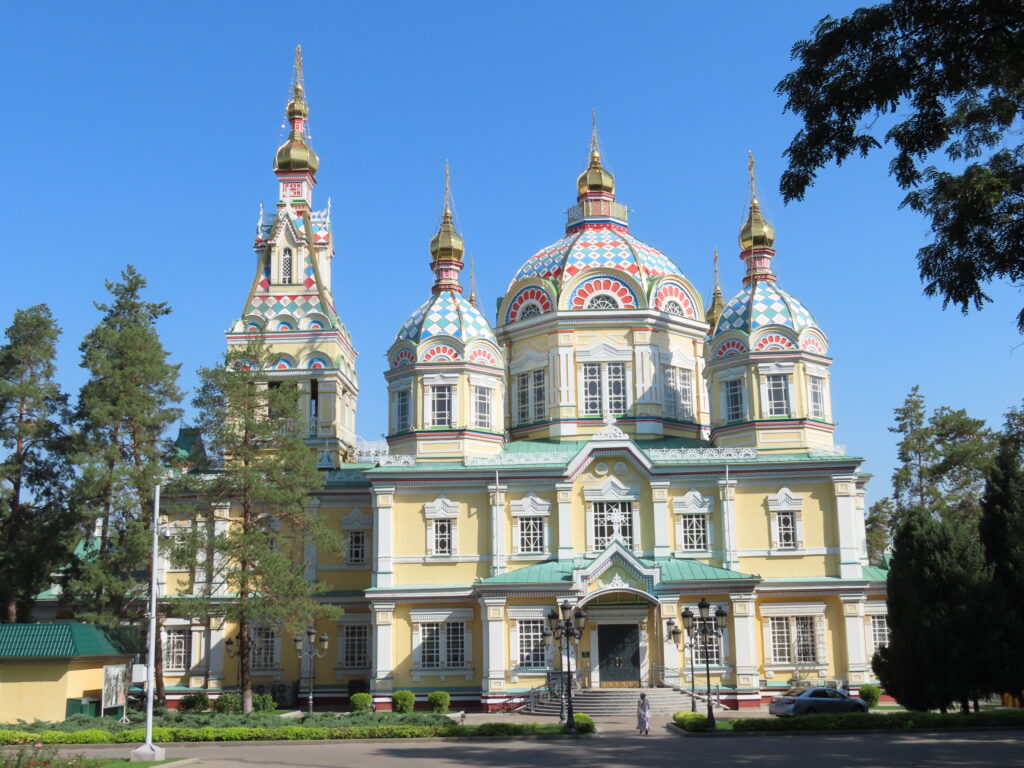
Since our Airbnb is not going to be available till couple of hours later, we leave our luggage at the station. After fortifying ourselves with coffee and snacks from a convenience store nearby, we drive to Panfilov Park. It is like a forest in the middle of the city and we walk down a wide path, crossing well-dressed old women with their tiny pooches, young mothers pushing prams and the odd jogger, in the backdrop we can hear church bells peeling. In a large sunny square stands the buttercup yellow Zenkov cathedral.
The mirrored crucifixes on top of the wooden church catch the morning rays brilliantly. It sounds and looks like something from a fairytale. Inside this Russian orthodox church Sunday Mass is on and we join in for a bit. The singing is haunting and uplifting at the same time. Later we have the most delicious, melt in the mouth cheesecake, probably home baked, from a stall outside.
Candy Cathedral
War and Glory
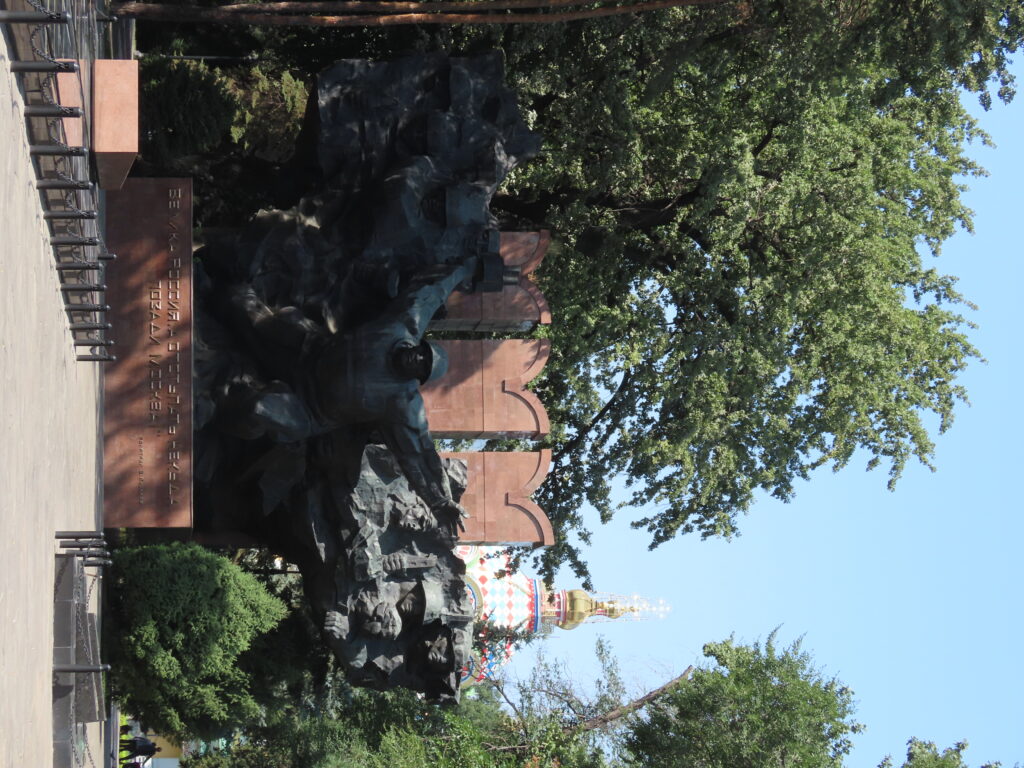
A short path leads to the Memorial of Glory, the war memorial. It is a dramatic brutalist composition of men charging. They seem to burst out of the very stone they are hewn from. An eternal flame burns nearby in memory of World War II heroes. Out next stop is the Central Mosque. It’s dome is shiny new, having being built in 1999 in a post-Soviet era revival of religious roots, but after the opulent ones in Uzbekistan it seems a rather drab affair.
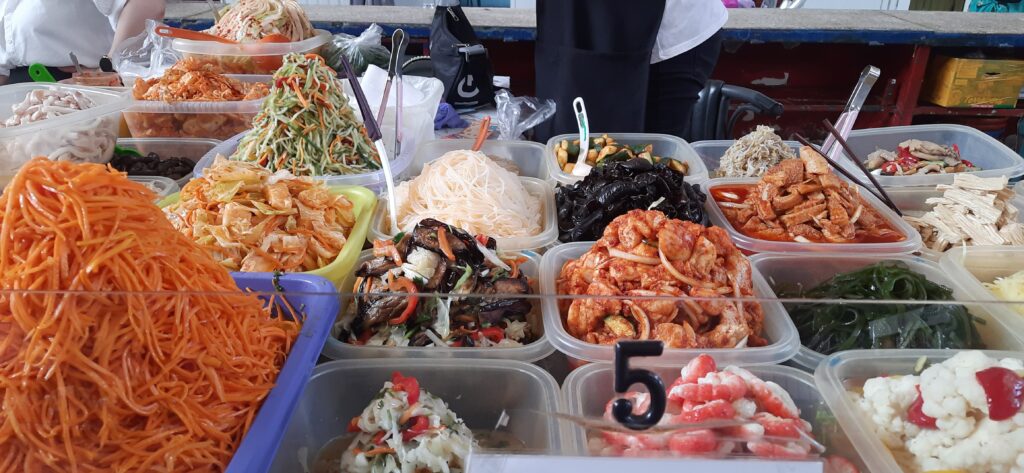
Next up is the Green Market which is the go-to place for all kind of shopping. Apart from colourful fresh fruits, vegetables, meats, there are mounds of dry fruits and a whole section dedicated to dairy products including produce from mare’s milk. The caviar looks tempting and surprisingly, thanks to a large Korean population resettled here by the Russians in the 1930s, there is an entire row of women doling out Korean food. It is a feast!
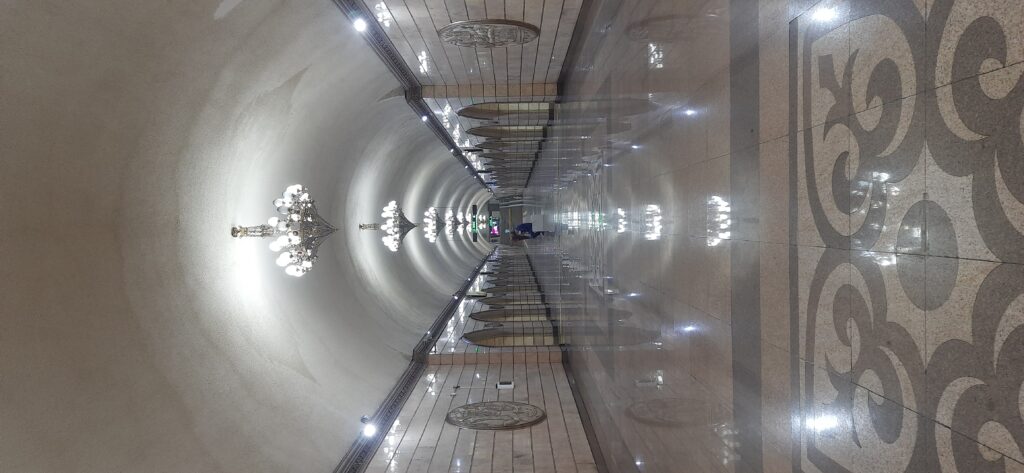
We miss a cable car ride up to Kok Tobe Hill in our wild goose chase for a jacket early in the evening. (Had been told about great and reasonable winterwear available here so in all ‘wiseness’ did not carry one for the daughter!) The rest of the evening is spent at the lively pedestrian Zhebik Zholy Street with its musicians and art stalls on the pavement, and eateries crowded with youngsters and families on the sides. We take the metro to return to our apartment. The chandeliered stations are like nuclear bunkers deep down in the bowls, with vertigo inducing escalators.
Beauty in the Bowls
Of Steppes, Steep Canyons and Sunken Mountains
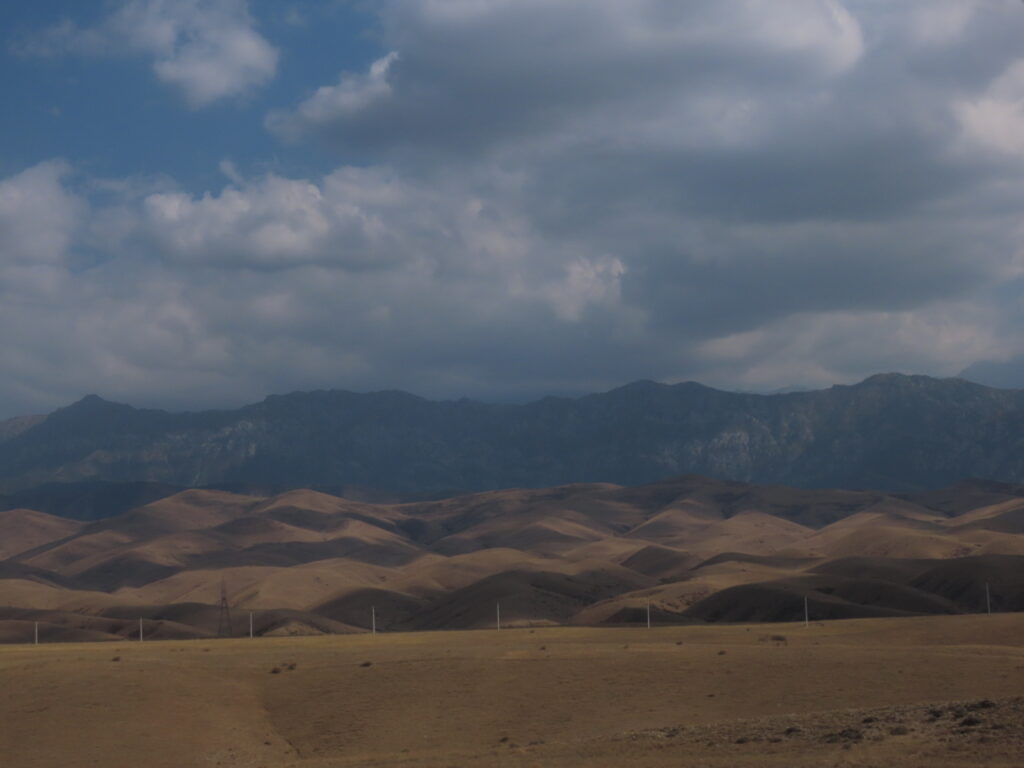
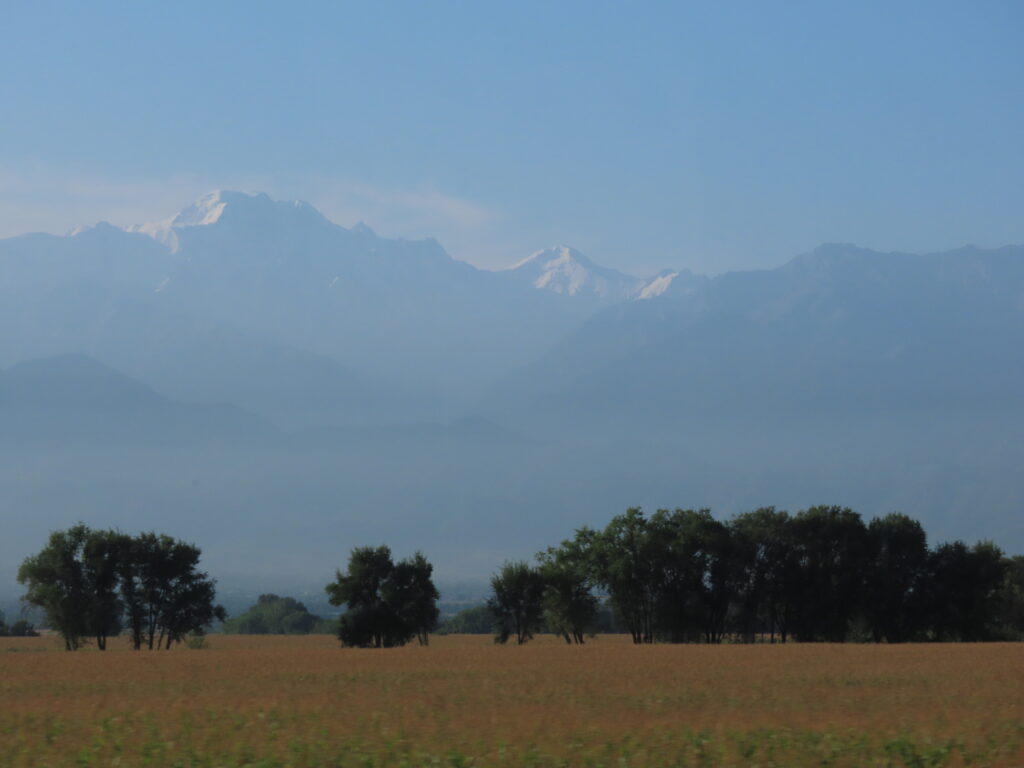
Next morning is an early start to a long day in the countryside in a guided trip. We head down the slopes of Almaty and speed through an expansive countryside. There are fields of maize with snow-capped mountains as backdrop on one hand and on the other, the fields roll till a bare horizon.
In the morning haze
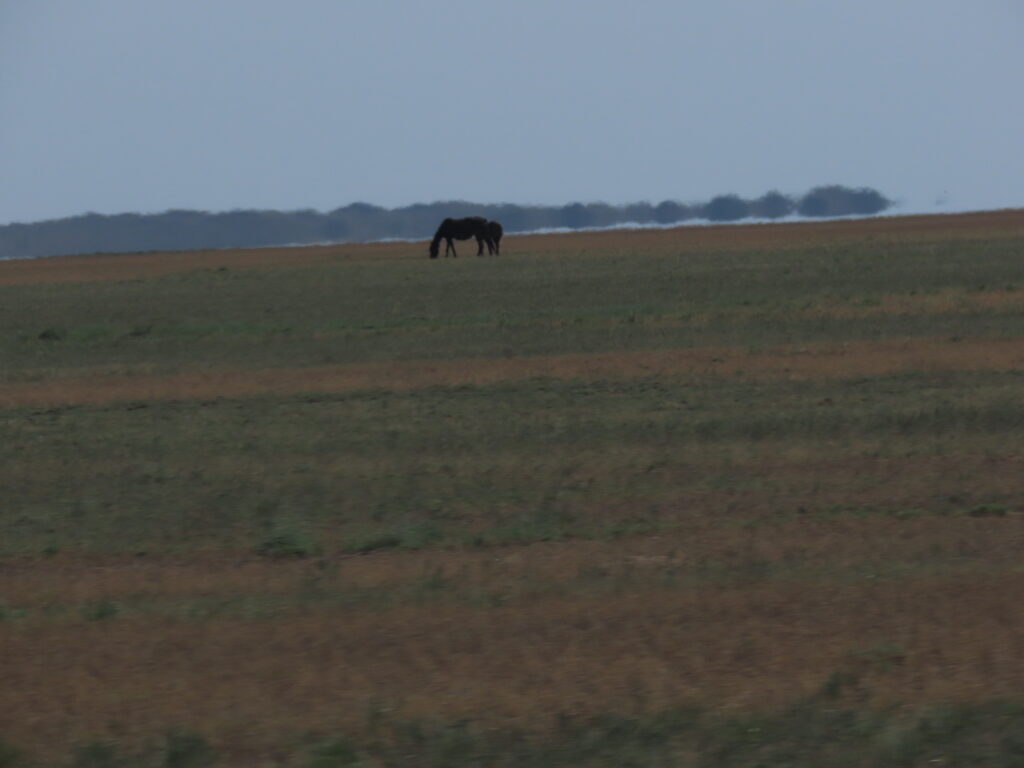
We cross small cemeteries with miniature monuments, villages with mounds of pumpkins till we start winding up a gentle multi-hued slope. Then the road unrolls through flat land that is heating up to create mirages. The hills in the distance look suspended in the air. We cross golden eagles sitting on the ground. One can just imagine horses in full gallop here…
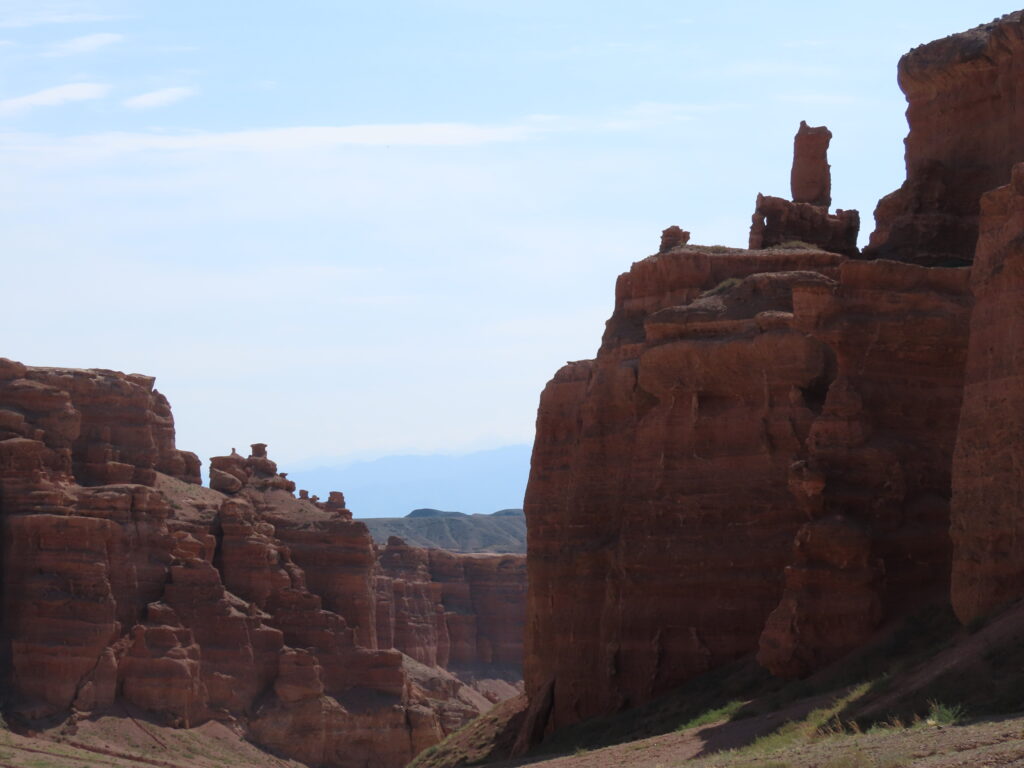
Soon the land start to break up and we reach Charyn Canyon. Drained by a namesake river that originates from the Tian Shan mountains, it has over millions of years eroded the red sandstone earth to create this canyon. We explore only a small portion, descending down a gentle gully and scrambling up a narrow shortcut. A scampering gerbil is the only wildlife we spot. A Korean with us plans to camp the night here and will rejoin the next day’s tour. The narrower Black Canyon cleaved by the same river upstream is our next stop. (No prizes for guessing the colour of the stone there!) We miss seeing the rare Sogdian Ash trees that are only found here.
In the distance mountains rim the flat land and we cross small herds of horses and solitary ones peacefully grazing, and bales of hay being collected around small villages. We reach Saty village in a valley where we leave our comfortable minibus and get into a matador that does not look like it has seen better days but serves the purpose as we canter up a dirt road going into the mountains and rock and roll through streams lined with seabuckthorn. The last couple of kilometres are an option of a horse ride, a hike or a quick jeep ride up to Kaindy lake.
All spruced up.
With white needle-like dead spruce trees piercing the lake’s aqua surface, it makes a pretty picture in a bowl of steep mountains covered with conifer trees. The lake owes its existence to a landslide in 1911. We hike back to the matador van on a path meant for the horses. Back at Saty village lunch is a feast at a local’s house. Its not just the quantity but the layout of the spread that is special as well. Conversation veers to Hindi movies as the guide is a Bollywood fan and vividly remembers Khoon Bhari Maang as one of her favourites. We are asked for the English translation of the title…haha..
Post lunch we head to the bigger and more touristy Kalsai Lake in the mountains surrounded by thick conifer forest, crossing small yurt settlements. The first and only one accessible by road of a trio of lakes at increasing elevation and of decreasing sizes. The cobalt blue lake stretches into the mountains and the jackets finally come handy!
Wild and Vast
Geography lessons from another life had described the endless miles of mildly undulating landscape of the steppes and history had told us about the Mongol hordes sweeping across it to murder and create mayhem. It was exactly all of that and more! Okay no, hordes but loads of horses!
Fact File
Getting there-
There are direct flights from Delhi to Almaty.
Staying –
We stayed at a very smart little airbnb in a neighbourhood of Soviet type blocks to get a local feel.
Getting Around-
Yandex app for taxis works out to be very reasonable.
The overnight train from Shymkent to Almaty has very nice coupes and a dining car.
We booked a day trip to the canyons and lakes with Kazakhstan Guided Tours.
I wish I had the luxury of slow travel! To spend days in a place.. I’m sure most of us yearn for that but till the horses grow wings, I know I am going to be spending just a few days in a place and I need to stretch those days. Not cram them with mindless visits to every place mentioned but, in my own way, savour the essence as much as I can of each place I do visit. Like the two evenings in Bukhara were spent at the Po-i complex, sitting on the steps of the mosque, taking in the lit monuments while the place was overrun with tourists and locals. It was noisy and vibrant and the next evening it was almost deserted and great for photography while being peaceful and contemplative.
Enroute
Uzbekistan is a must visit for history buffs being at the heart of the fabled Silk Route. It has stunning monuments painstakingly restored (probably better than what they might have been originally!) For foodies there is the cuisine so familiar yet so distinct. The cultural links run deep (Babur came from there with his tarbooz!) and they love us there! (so happy to meet Indians) An eight day trip is a minimum. So here is an itinerary to help you organize it.
1. The cheapest flight is at night to Tashkent from Delhi. It puts you there in less than three hours and Tashkent is half an hour behind so you land there at 12:30am Tashkent time.
2. Check into your hotel and catch up on the zzz.
Note- Reconfirm the check-in timings. We got a rude shock because our hotel cancelled our booking without informing us since we were reaching so late. Something lost in translation. Adventurous but not the best beginning to the trip, especially in the middle of the night. They accommodated us at a nearby hotel immediately but still…
Day 2-
1. Tank up on the amazing breakfast spread and it was quite the dastarkhwan, everywhere.
2. Head to the Hazrati Imam complex. Look up in awe at the roof of the Khazrati Imam Mosque. View the oldest Koran and other exquisite ones in the small Muyi Mubarak Madrassa in the middle and browse through a small market in the Barak Khan madrassa at the back. A humungous new Islamic Civilization complex adjoining this is still in the works.
3. Visit Chorsu bazaar. (remember to ask for Bazaar and not market, that is another place!)
4. Lunch at one of the small eateries behind it, if you already have not been offered to sample from the mounds of dry fruits and snacked on the juiciest fruits and drunk fresh compote.
A feast in every sense.
5. Head to Tashkent North Railway Station to catch an overnight train to Khiva. Enjoy being welcomed by liveried staff, sleep in a slightly cramped 1st class compartment and dine on the yummiest but greasy plov in the dining car. (I think it was only for the staff but they generously shared it with us!)
Notes– Though there is a separate entrance for women, once inside you can wander all over in the Khazrati Mosque.
The entry fee at the Muyi Mubarak Madrassa is 50,000som.
Pro Tip– Bargaining at the markets is expected and a 20% reduction is the norm.
The train to Khiva departs at 6:15PM. Reach a little early since all train stations have a security check.
Day 3-
1. Reach Khiva by 11 AM. Head to the hotel, freshen up and head to Itchan Kala. Buy the entry tickets from the West gate and get a guide.
4. To enjoy the sunset and have dinner with a view head to Terrassa Café.
The colours of an evening at Itchan Kala
Pro Tips- The entry ticket to Itchan Kala costs 200,000 som per person.
Carry an umbrella or a hat.
Book a table at Terrassa café well in advance since they sell out fast.
Getting a guide here is a good idea. Although it is a small citadel but with labyrinthine alleys.
Day 4-
1. Head early in the morning to Itchan Kala and buy a ticket to go up the ramparts to get a bird’s eye view (whether it is worth the price is debatable) or just walk through the still inhabited parts of this ancient place and watch the place come to life as people begin to open their businesses and go about their mundane chores.
Lanes to get lost in.
2. Go back to the hotel, grab a good breakfast and check out.
3. Catch a train or drive down to Bukhara.
4. Reach Bukhara late in the evening. and check in.
5. Walk into the lively paved streets of old Bukhara. If you are up to it stroll till the Po-i-Kalyan complex.
Of domes and arches.
6. Have dinner at the Old Bukhara Restaurant or catch a performance (mixed reviews) and dinner at the Nadir Divan Begi Madrassa.
Pro tip- If you drive to Bukhara the Khorezem fortresses fall enroute.
Stay in Old Bukhara.
The train leaves Khiva at 11:10 AM and reaches Bukhara at 6:15 PM.
We stayed at Hotel Fatima.
Day 5-
1. Before breakfast catch a cab or walk to the Ark of Bukhara and Bola Hauz Mosque.
A place to reflect – Bola Hauz Mosque
2. Head back to the hotel, have breakfast and slather on the sunscreen.
3. Wander back towards Ulug’Bek Madrassa and end up at the Po-i-Kalyan Ensemble. Explore Kalan Mosque.
4. Go bargain hunting for carpets and kilims in Toqi Zargaron or Toki Sarrofon, the old domed markets of Bukhara or peep into a functioning foundry where knives are made near Toqi Telpakfurushon.
Bukhara’s famed markets
5. Spend the evening on the steps of Poi-i-Kalyan Ensemble all lit up like a ripe tarbooz with a blue covering, just soaking in the colours and the Kalon Tower all lit up!
Light House
Pro Tip– The Ark of Bukhara Museum opens at 9AM.
All the Madrassas now house shops save Mir-i-Arab Madrassa which is a functional theological school.
The Kalan Mosque’s entry costs 150,000 som.
Day 6-
1. Catch the early morning train to Samarkand.
2. Check-in and head early to Shah-i-Zinda to beat the crazy crowds that fetch up later there.
Shah-i-Zinda, the sacred necropolis
3. After breakfast visit Bibi Khanym Mausoleum and wander into Siyob Bazaar adjoining it.
4. Grab a bite near the market.
5. Head to Amir Timur’s mausoleum and take in the stunning interiors early in the evening.
6. Wander over to Registan Square. Spend the evening on the steps of the Square outside the barricade or catch a performance inside.
Registan Square Side
7. Dine at Labi G’or across the street with live music and drinks.
Pro tip–
A Shah-i-Zinda ticket costs 15,000 som. Take your time here for the colours are truly astounding!
Registan tickets cost 65,000. It is valid for the full day. Plan to see it in the day time and evening on the same day if you want to budget a bit.
Bibi Khanym mausoleum entry costs 40,000 som.
Emir Timur’s mausoleum entry is 40,000 som.
Note– We stayed at Hotel Jasmina. Good place with a fabulous location.
Day 7-
1. Explore Registan Square at leisure. Have coffee in the tiny café on the first floor of Ulug Beg Madrassa and watch a calligrapher at work below. Be awed by the interiors of Tilya-Kori Madrassa.
An artist at work.
2. Visit smaller monuments and places of interest scattered in Samarkand, the heart of Timur’s empire.
3. Finish any left-over shopping at Siyob bazaar.
Pro Tip– Buy the famous Samarkand Paper!
Siyob Bazaar has some very good quality ceramics.
Day 8-
1. Catch the Afrosiyob train to Tashkent.
2. Leave the luggage at the railway station or check into a hotel and then take the metro and explore the beautifully done up metro stations.
3. Get off at Chorsu Bazaar for last minute souvenir and gift shopping and the best dry fruit bargains. My musk melon struck travel companions got the juiciest ones back, with the indulgent aid of the hotel.
4. Catch the night flight back to Delhi.
Pro Tips-
The cloakrooms at the railway stations are well organised and cheap.
Afrosiyob is the bullet train.
A metro ticket has a flat rate.
Points to Ponder
1. English is not widely spoken or understood. So have a translator app handy.
2. Pure vegetarian fare is limited mostly to cheeses, some salads and fruits. Otherwise, it is mostly lamb, beef and sometimes chicken.
3. The mosques require a headscarf but they don’t seem to be fanatical about it and in big mosques they are available outside.
4. The forex card was an utter waste! Uzbeki som was not available. Carry dollars in cash for easy and better rate of conversion.
5. Get a SIM card as soon as you land and use the Yandex app for cabs. It is convenient and very reasonable.