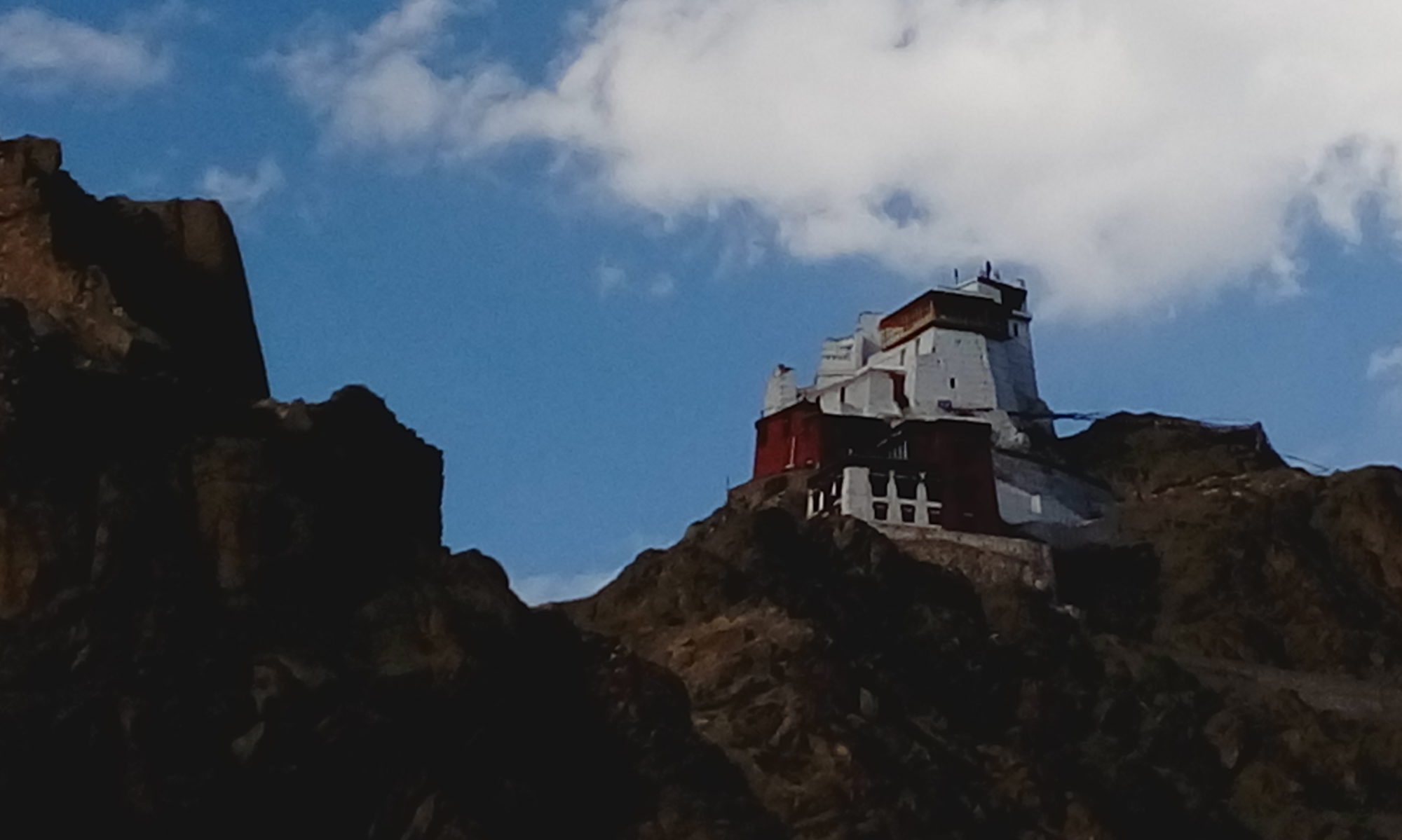
A Handy Guide on How to do the Hornbill Festival

It is 9:30 in the morning on day 2 at the Hornbill Festival as I sip the rice beer being offered. It is followed by flavoured roast gram in a tiny bamboo mug hooked to a finger. I am sitting in a sunny spot just below one of the pavilions. As soon as the Chakhesang tribe started filing out of their Morung humming in unison, beer and snacks in hand I scooted behind and grabbed my spot from the previous day on the stone steps. I got lucky that they decided to sit right there. I offer the goodies further to the elderly man from the Kachari tribe sitting on the other side next to me. I get a disapproving shake of the head and a haughty nose is gently turned up and away. I have a lot to learn….But what I did learn was how to maximize the minimum days I had at the festival at the Heritage Village of Kisama.
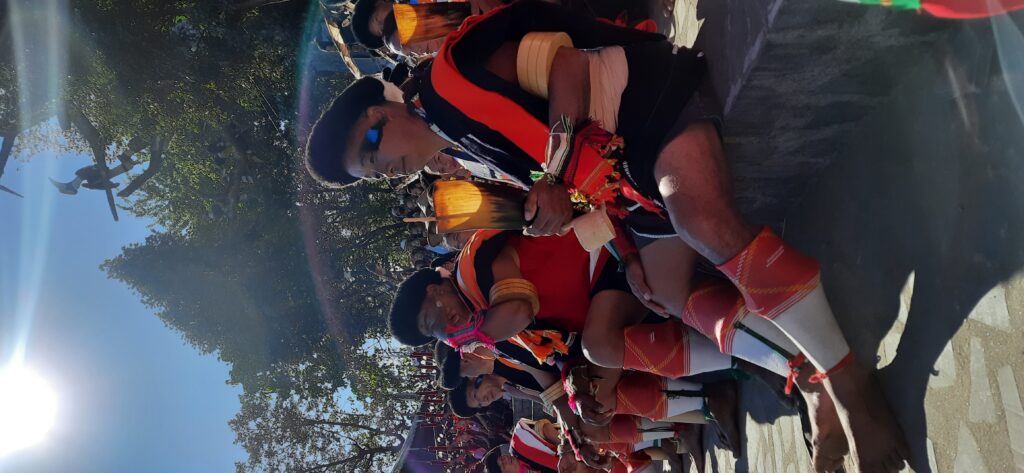
A good start to the day looks like…

1. The cultural performances at the main amphitheatre begin by 9:30 am or later, depending on what time the chief guest of the day deigns to arrive.

2.Reach about an hour early and head for the Morungs right behind the arena. Each tribe has it’s own Morung where the participants congregate, get ready, get a pep talk, have their meals and perhaps an early morning tot to limber up! Perfect place to meet people, chat, get a glimpse of the Naga’s traditional life not to mention some great pics as well.

Get a glimpse of traditional life in- A Tale of Two Veiled Valleys: Part I- Shangarh’s Meadows are meant for Musing
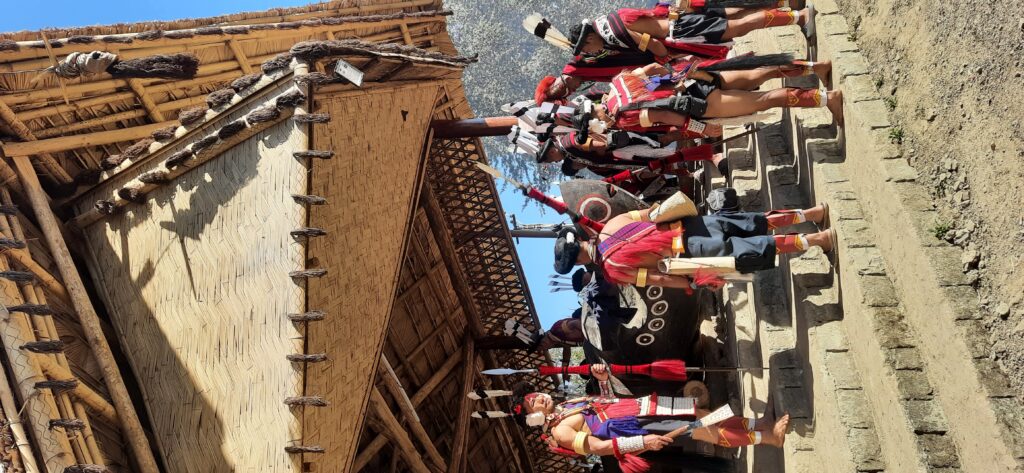
Pep talk at the Morung.

On day one as I stood taking pics of the Ao youngsters seated around their painted log, getting a pep talk and then say a prayer, I suddenly found an arm around my shoulder. One of the older guys wanted to be photographed with me!
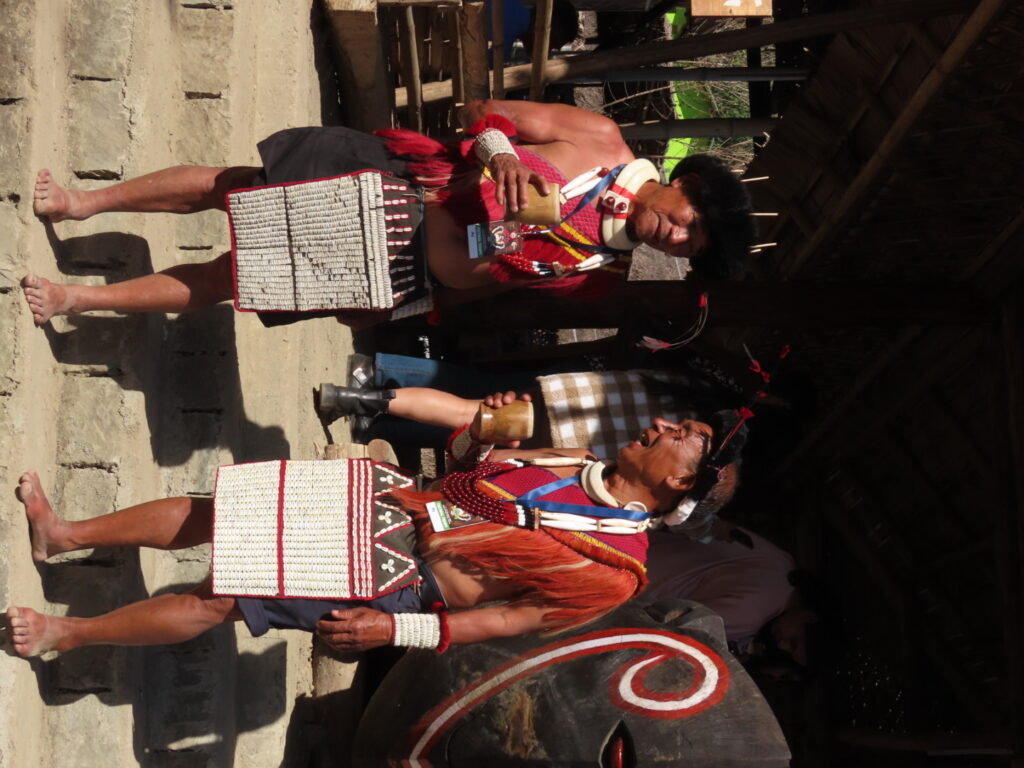
Who says youngsters have all the fun?!

3.Then head to the arena and find a spot, preferably on the right of the centre on the stone steps. Apart from sitting with a participating tribe probably, it offers apt lighting and stays in the shade. The sun is toasty early on but one can get baked soon enough. Focused photographers favour sitting just inside the fence on the matted grass of the arena.
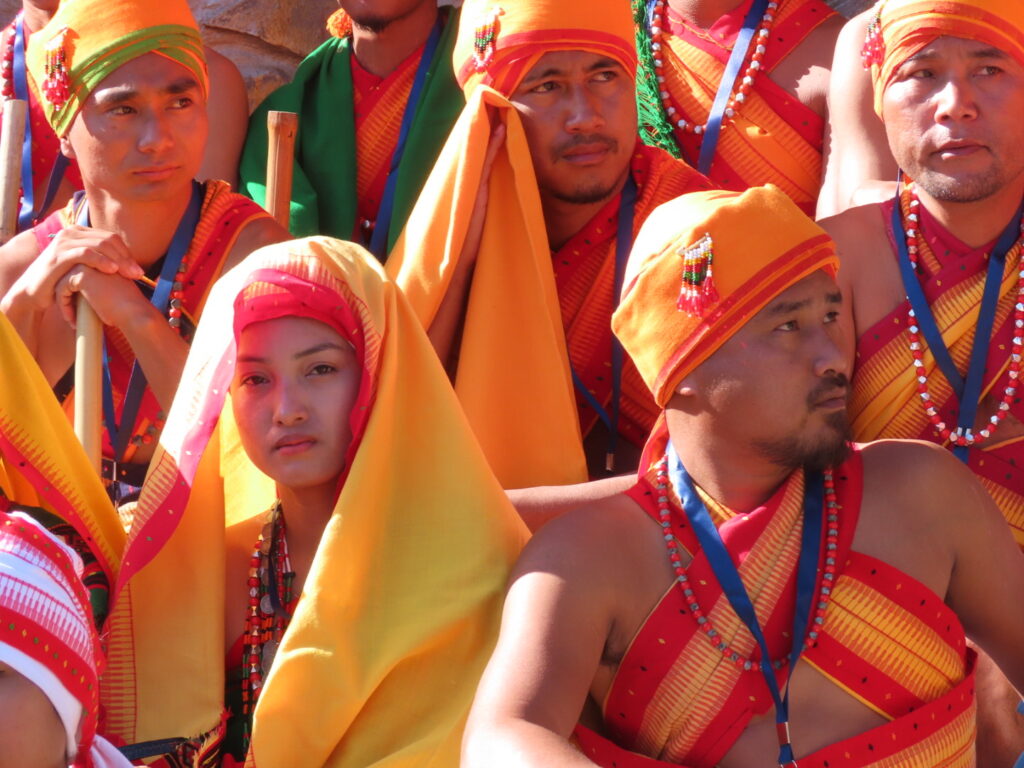
I see you.

4.Each tribe present is introduced at the beginning of the day’s programme. They stand, ululate and generally make their presence felt. Their performances, from courting songs, enactments of games and head-hunting scenes are short affairs and often the same tribe perform different facets on different days.
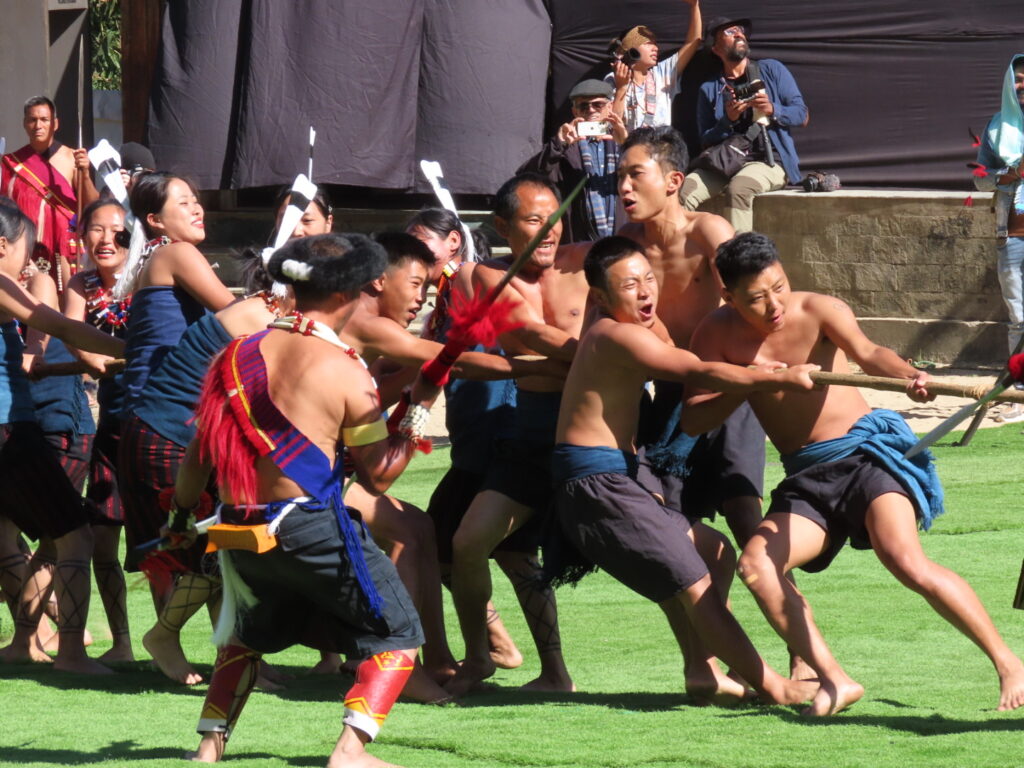
The women always win!

5.Around 11:30 am there is a break and the participants head for the Morungs for lunch and drinks. On the first day I met a youngster at the Chakhesang Morung who happily showed me around, pointing out artefacts like a log used for pounding the grains, baskets used by men and women and offered tobacco being cured by barely there smoke curling up. The next day at the Zeliang Morung it is strips of pork hanging from bamboo rafters being smoked that has us flocking around in fascination.

Read about an obscure town’s claim to fame in-Nasirabad’s Kachora: More than a Savoury Story
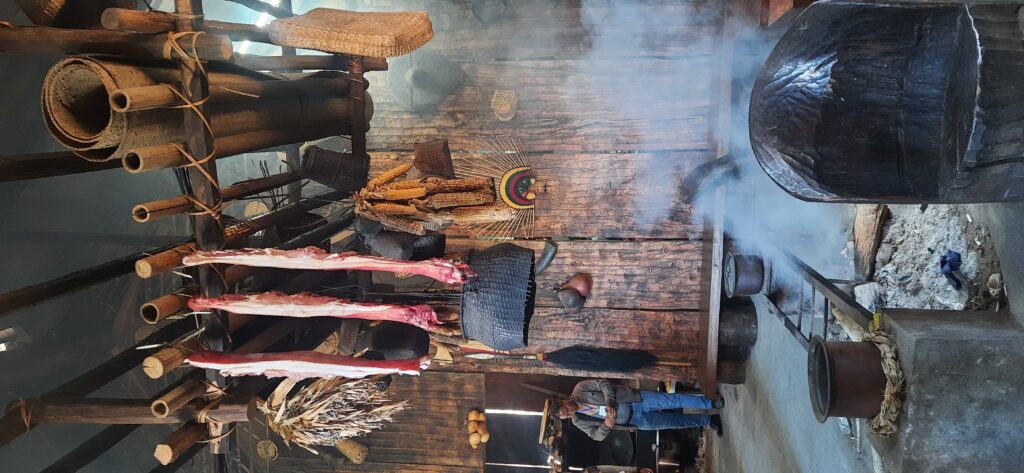
Smokin!

6.Pick a tribe whose food you want to sample. The flavours might differ but the basics remain the same- sticky rice, pork smoked or plain spicy, beef, a flavourful green vegetable, a spicy bamboo shoot chutney and perhaps salad. Its self-help once you buy a coupon and only the meat portion is served fresh from the kitchen in a bowl. On both days I had lunch at different Morungs and the chunky pieces of divinely yum smoked pork from the Sumi tribe were generous enough for greedy me to share with two fellow hungry young visitors who agreed that either you love the fat or you don’t! One did, the other didn’t.
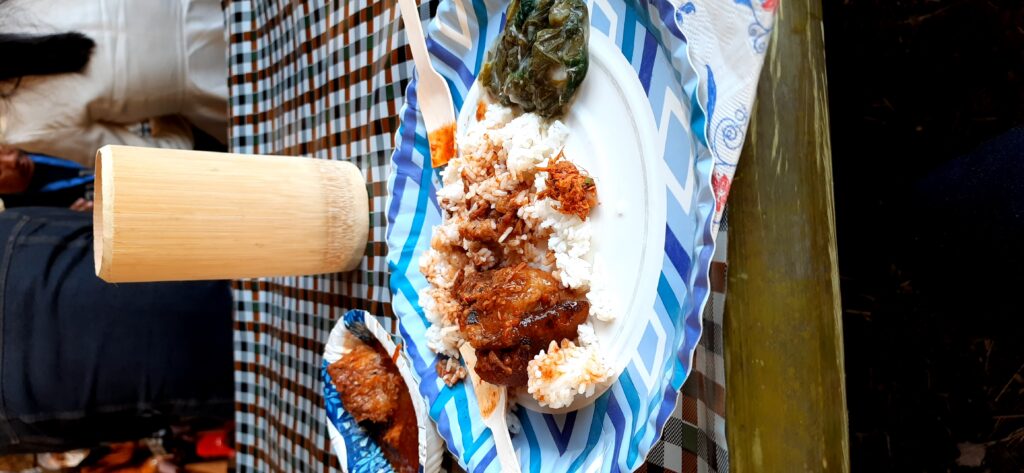
Savour

The cool rice beer(finally!!) in a tall bamboo mug came from the Chakhesang tribe on both days. Not too potent but since I was neither willing to take a chance to discover otherwise nor willing to let go off the mug, I was reluctantly allowed to wander off with the precious mug with a promise to return it. I did.
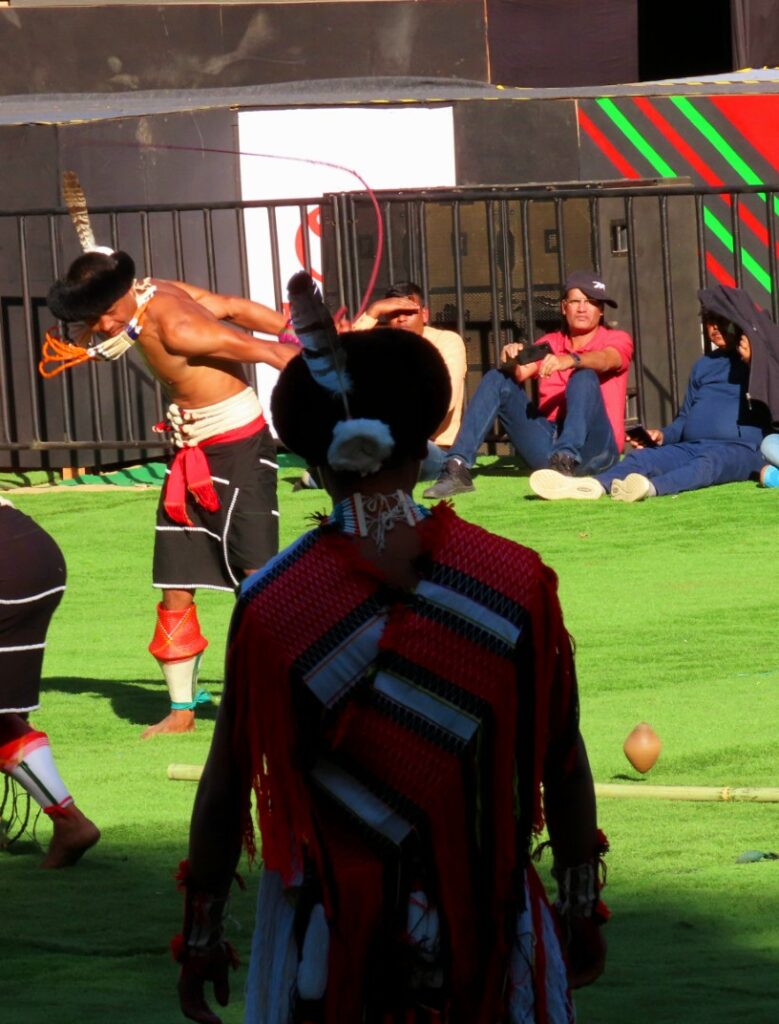
Let it rip.

7.Afternoon shows are more packed and I think after the beer drinking more entertaining offstage! The elated head-hunters after giving a rather artful performance carried on waving the rather shrunk head on a spike on a side, being cheered on by their tribe members.
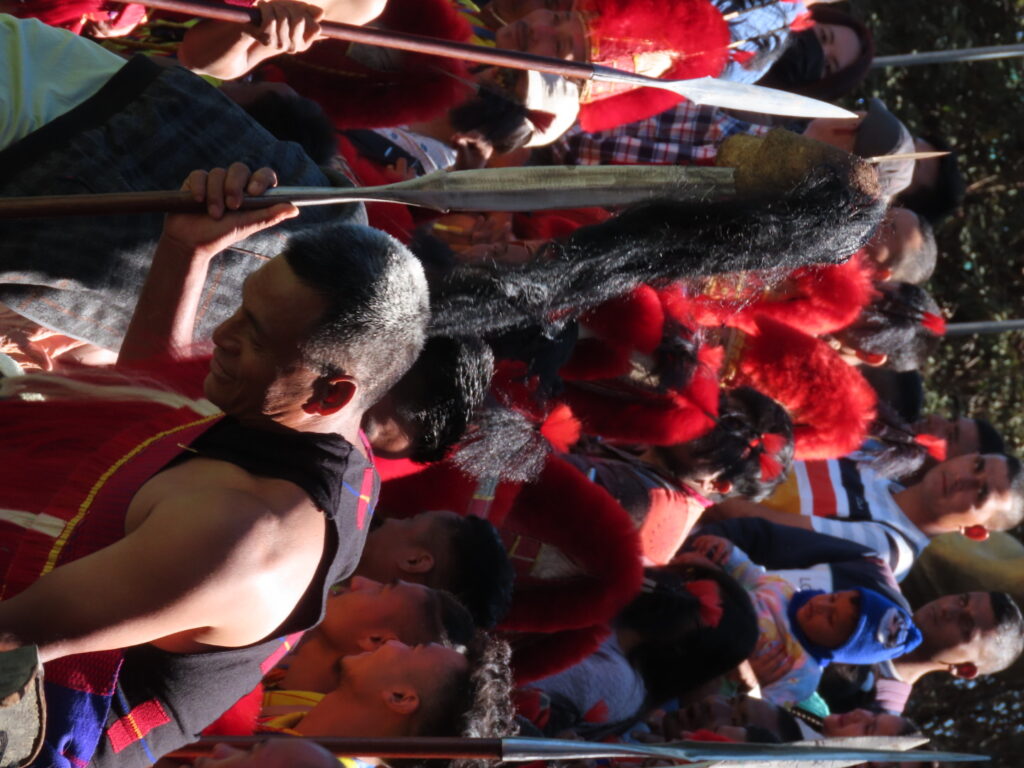
Hunting trophy be like…

8.Apart from the cultural show at the main arena, there is a World War II Museum ground where this year there was a drool worthy collection of vintage Willi jeeps. Another arena had a Naga Masterchef competition on. On a side is an arcade of stalls selling souvenirs, jewellery, shawls, dahs, knives, chopping blocks, pottery etc although many Morung’s have knick-knacks and shawls distinct to their tribe on sale as well.
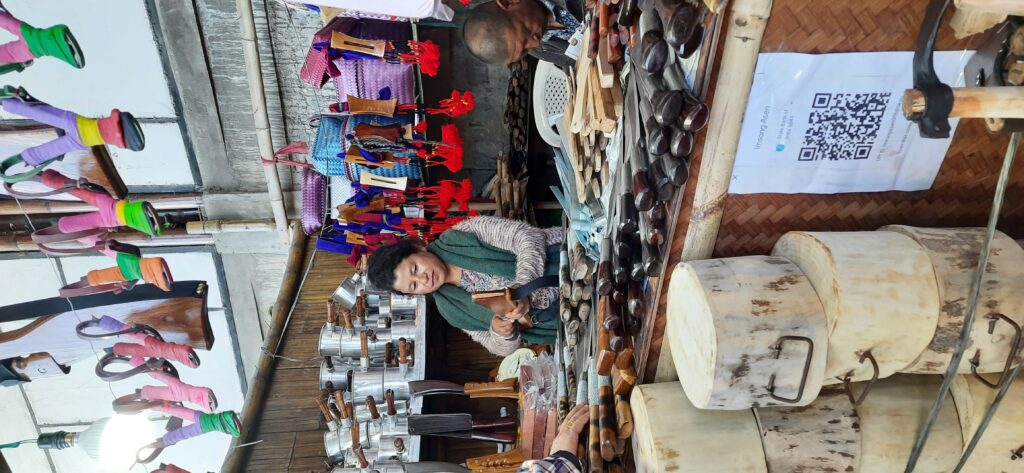
Name your weapon?

9.There is a separate section for organic produce, a competition for local vegetables (super-sized cabbage anyone or an enticingly luscious red raja mircha?) and humungous floral arrangements you can disappear into. Must try the fresh juicy pineapples and kiwis.
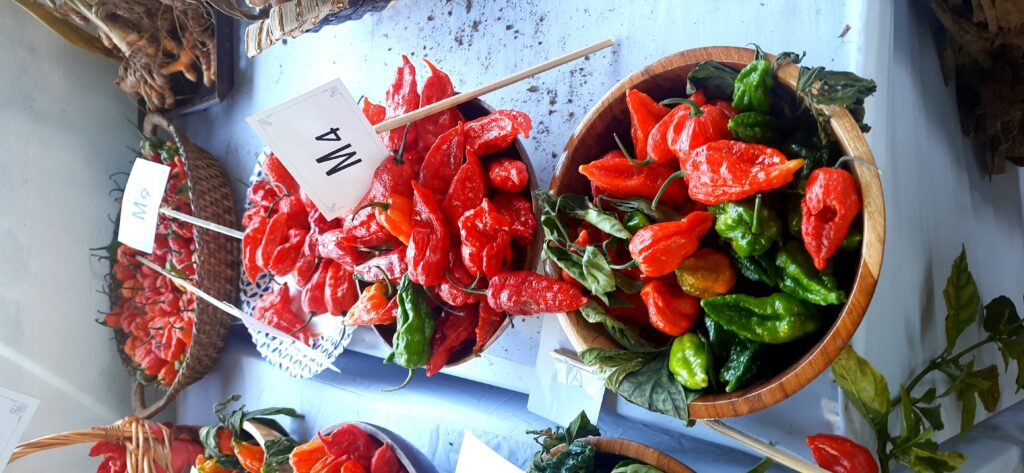
Fiery Red is not just a colour!

10.A coffee joint with a sitting area next to the main amphitheatre is a big magnet in the morning. There are pay and use loos. Thank God!

11.It gets nippy as soon as the sun dips behind the hill so keep the jacket handy. Attend the evening concert which starts after 5pm. Sounds early? Remember its not really IST here and in winter night falls by that time. There are families sitting around wondering what is going on, youngsters high on music, solitary figures brooding over beer lost in the voices only they can hear. The music genre is mostly EDM and rock. The atmosphere eclectic and electric!

Its all about the music.

12.If the pulsating music is not your scene try the Morungs. I discovered bonfires, candlelight and trios belting out classics to chock-a-block full tables.

13.Or you can, if you are staying at Kohima attend the night market in the main street. With Christmas round the corner the air is festive and aromatic with live grills.

Read about singing skills in- 3 Churches in Mhow: Discovering Obscure History and Outstanding Carols 
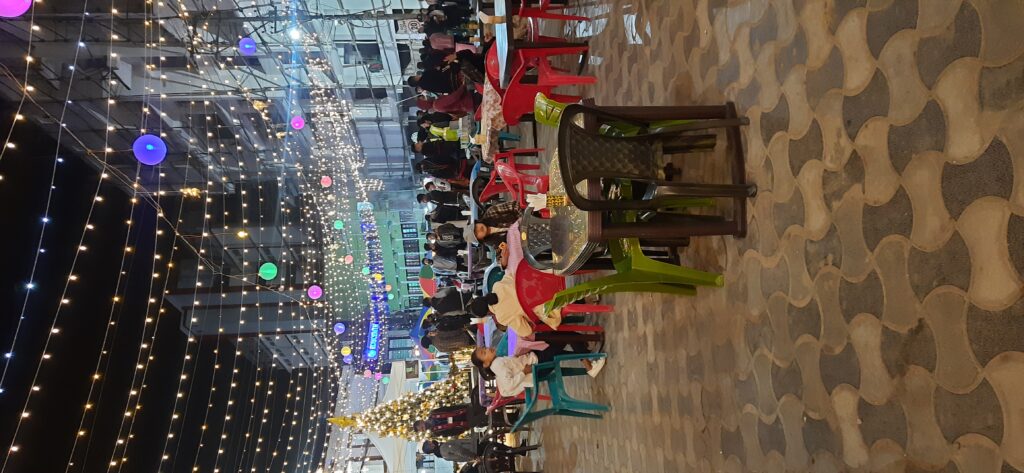
Festive Season’s Festoons.

14.Various events are held simultaneously across venues scattered across different villages and resorts. Check out the schedule before making your itinerary.
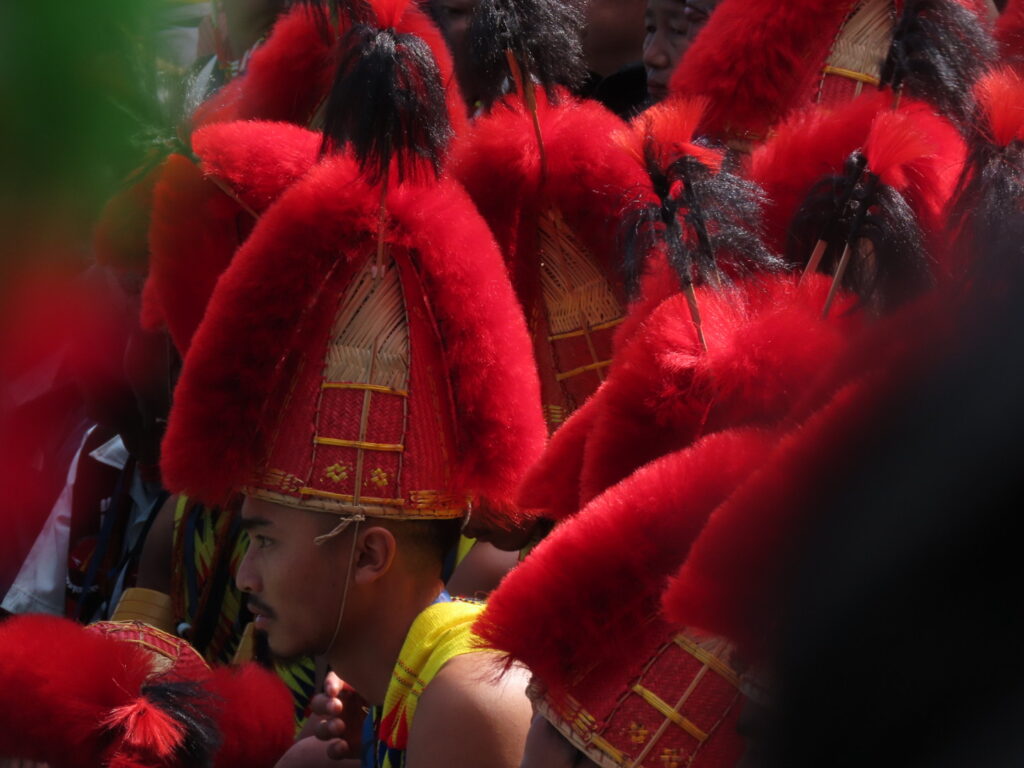
A show worth watching.

15.As a solo female traveller it was a pleasant revelation. The people are friendly but nobody pays attention to a single female. It was so nice to be ignored!

The elderly French photographer sitting beside me deplored the commercialisation as did some of the regular attendees (yet they still turn up). Be that as it may, the festival is a vibrant smorgasbord showcasing the pomp and pageantry of the Naga’s distinctive tribes.


Fact File-

  • Kisama Heritage Village is about 12 km from Kohima.
  • There are many tented camps and a few homestays around Kisama Village.
  • The festival is from the 1st to the 10th of December every year.
  • The entry fee per day is 50 rupees and there are extra charges for DSLRs.
  • A meal generally costs Rs300 and a rice beer Rs100.
  • Remember to be a conscious traveller and always carry your own water bottle!
Into a Bamboo Bowl – A Hike to Dzukou Valley

Thank God the man came along! And thank God for the advice to take a bedsheet. We were like a giant calzone stuffing in the night but at least it was a minty clean wrapping! I had been wanting to do a trek in the north-east but the rains played truant for too long this year and travelling to Walong showed exactly the kind of terrain one might expect- extremely steep slopes and dense jungles mostly. So how was Nagaland’s most popular and doable hike, the Dzukou Valley trek? Steep, yes but also stunning, short, and surprising!

From midway the beginning below.

Facts First-

1. Dzukou valley is part of the ancestral territory of the Angami tribe. It is managed by the South Angami Youth Organization. So, all the trekking companies have to go through them to book the tents, rooms and dormitories in the Rest House complex there. There seems to be no other camping ground.

2.Everything is available on hire to stay there from foam mattresses to blankets. How often they get cleaned (if at all!) is a Big question mark. Its probably on a first come first serve basis. The rooms have basic toilets, no running water and no electricity.

3.Food is available at the Rest House in the valley. You can ask for fresh rice, dal and vegetables or have the ubiquitous Maggie and cup noodles.

4.So, don’t spend money going through a trekking company. Just get a good guide. Its probably mandatory.

5.The distance and hours of walking (approx 3 hours) involved don’t warrant a 2-night stay…. Unless you plan to explore the small valley thoroughly or just want to chill.

6.We took a guide to show us the way and carried small backpacks for an overnight trip but with enough food to last many days!

7.Rainy season is the most popular time to do the trek, especially if you want to see the endemic Dzukou lily blooming. We found post monsoon to be the ideal time. (Climbing or walking those paths in the rain isn’t for me.) The sun is strong but the nights are cold.

Jungle Jamboree

After a night of admiring the twinkling lights of Kohima and Chakabama below us we start from Zakhama a little behind schedule. I spend the time waiting for our vehicle, to chase some Green-backed Tits (Some sense of humour the Englishman naming them had – once said a birdwatcher.) preening and flitting around a bottlebrush. A gorgeous yellow orchid in full bloom adds colour to the barely there bottlebrush flowers. Driving on the road to Viswema and then on the track to the starting point we find there isn’t much difference between the two, both are equally rutted only the latter is rocky enough in places to warrant a 4/4 drive. A parking lot and a massive new house mark the jumping off point. Soon the roughly hewn stone steps begin and the path winds its way up through thick oak forest. Sunlight barely filters through and the soil is as moist as the tree trunks throughout. But the gradient ensures we are soon sweating it out. At places the steps are the roots of the trees and I need to scramble up. We have company throughout and the trail is marked unfortunately by plastic discards. A child is piggy-backing down on a guide and I offer him an energizer bar. Wrong person…should have given it to the guy carrying him. A group of youngsters singing on top of their voices follow…they certainly don’t need those bars! The French couple climbing up rue that they won’t be able to sight any bears or monkeys now. I’ve only encountered two kinds of beings on treks- those who must sing or have music playing or those for whom the wilderness’ silence is the music. As we emerge above the forest the path narrows and there is a giant sloping boulder to be crossed to get to the summit. I ask the man to remind me why I do this to myself. He gleefully says he will next time!
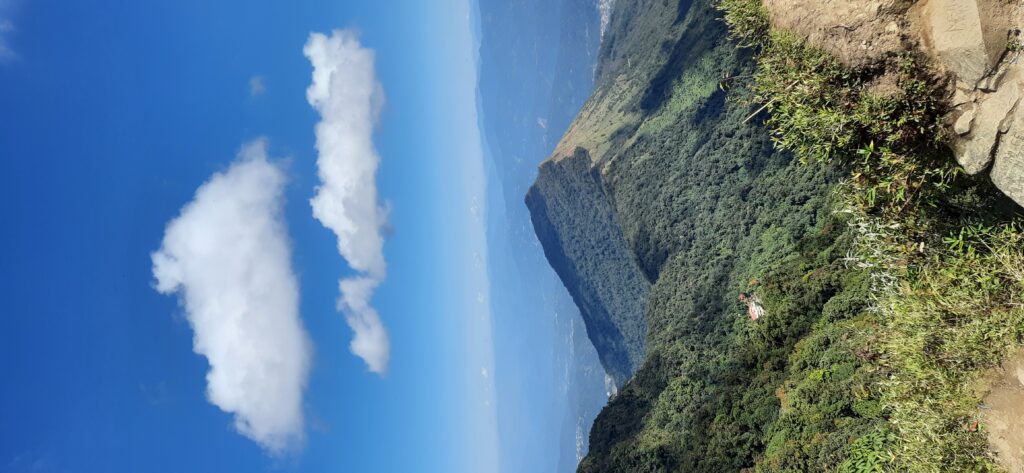
The reason why…

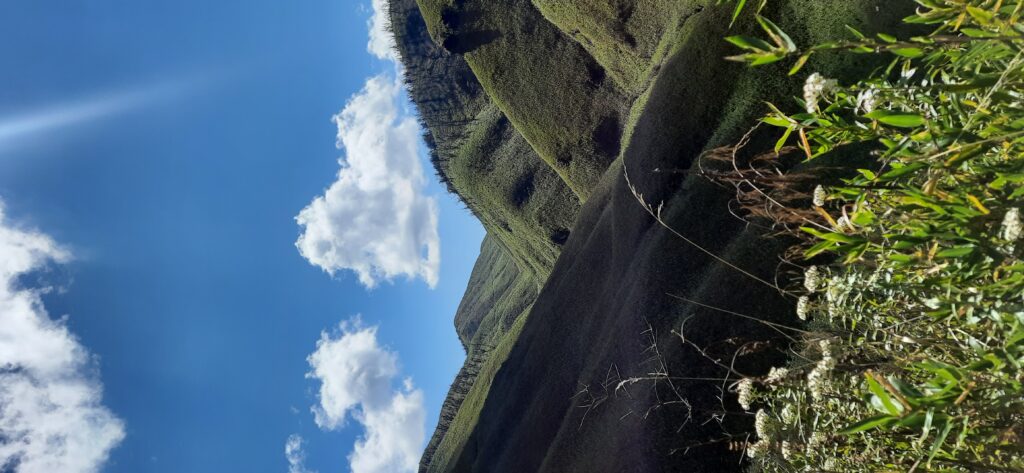
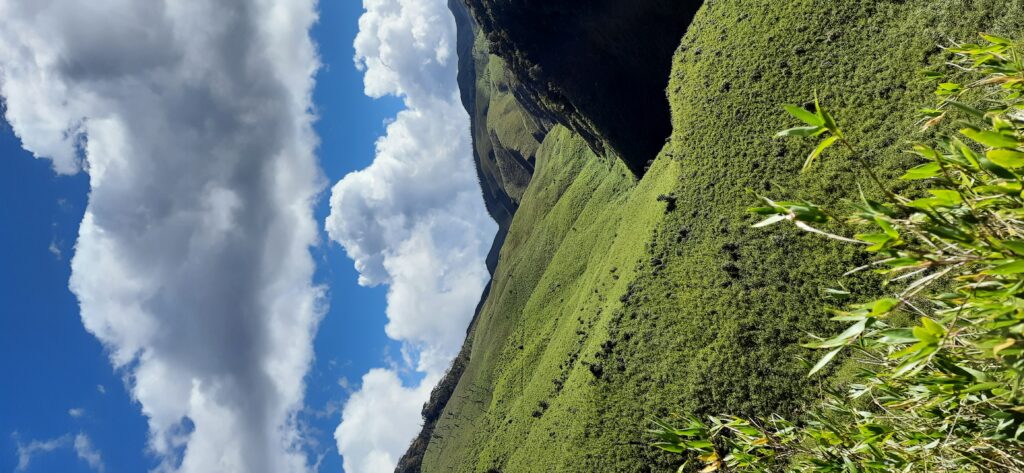
There is a crowded view-point on top. The vistas make a pretty picture- a cerulean sky and rolling hills, their greens made darker by forests and shadow throwing low clouds. A gushing stream hides somewhere in the forest, to be heard but not seen. On a side the path disappears between two grassy slopes…

Discover grassy slopes and more in- A Tale of Two Veiled Valleys: Part I- Shangarh’s Meadows are meant for Musing


Shaded Succour.

Bamboo Bowl Beckons

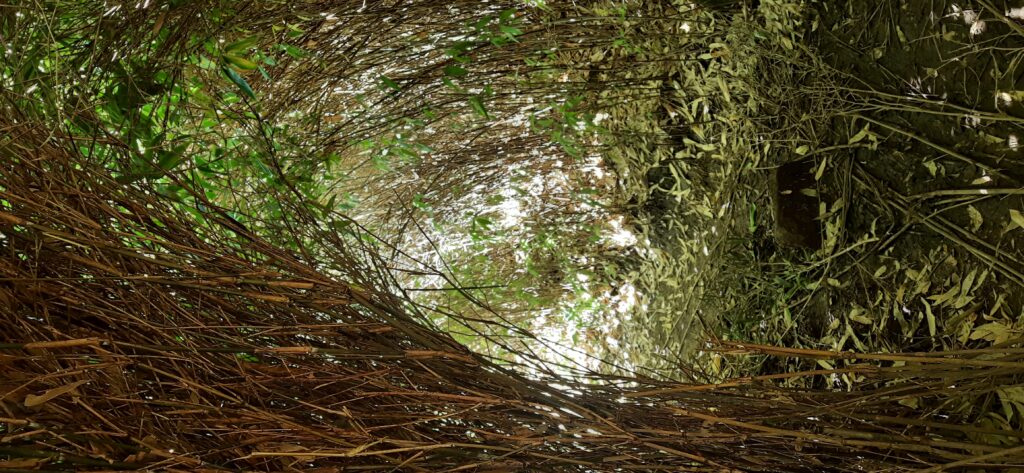
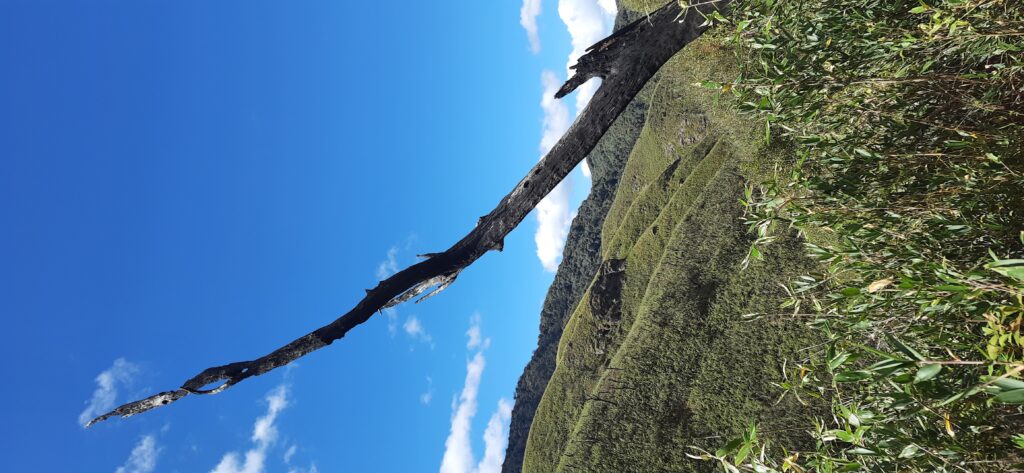
It isn’t grass! Its bamboo that we walk between, on a narrow even path, for the next two hours. Even the larks stick to the path! The light green bamboo covers every inch of the valley. At places it is just waist high but at times it forms a tunnel to walk through. There are crystal clear tiny streams to cross and charred remains of a forest patch. The blackened trunks stand out dramatically. In the strong sun we would be slightly burnt too if it weren’t for the tall bamboo providing some shade.
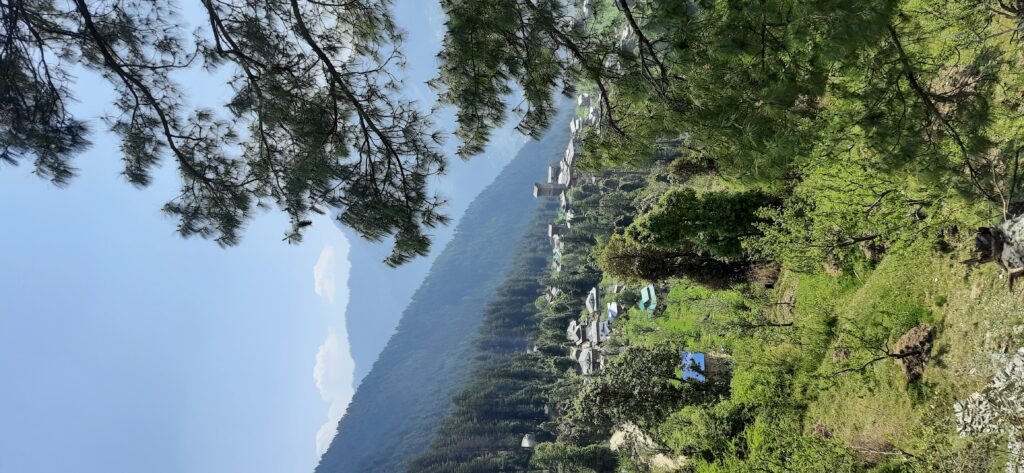
Blackened Beauty

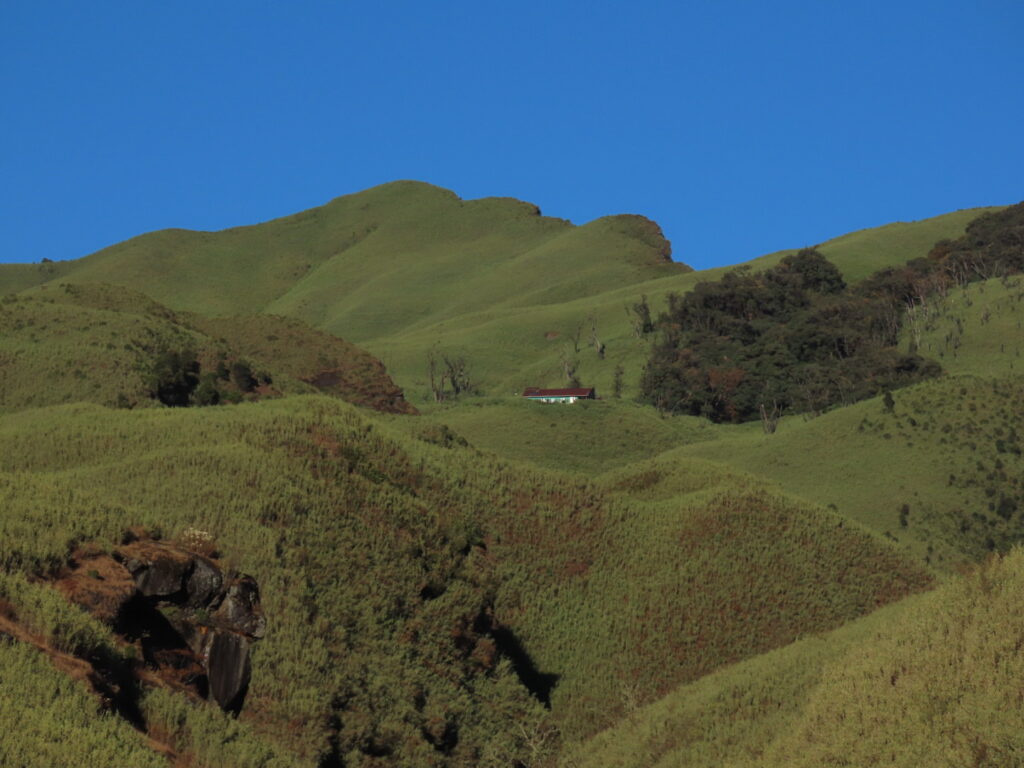
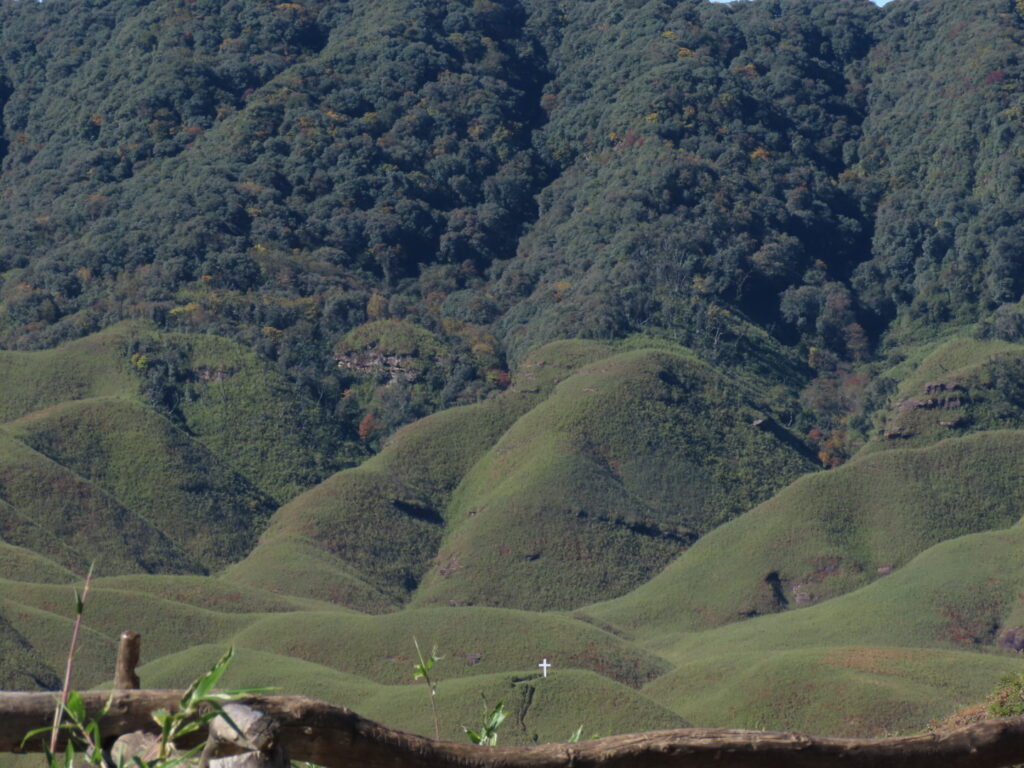
The green and red roofed rest house is like a homing beacon far away on a ridge. We reach the complex of wooden huts spread on the only flat, open ground. We choose a room from the meagre options, dump our stuff, find two chairs and have our packed lunch in a secluded opening with a bird’s eye view of the valley. It’s a shallow bowl of bamboo covered mounds. Right now, post the rains it is still green but come winter it will be covered with frost. Fall colours tinge the tips of a thick grove of trees lining the sides of a stream on a slope nearby. Across the valley there seem to be caves in the rock faces.

Bottom of a Bamboo Bowl.

A trek to remember was- Tarsar Marsar : A Trekker’s Take


A Prayer in the Air.

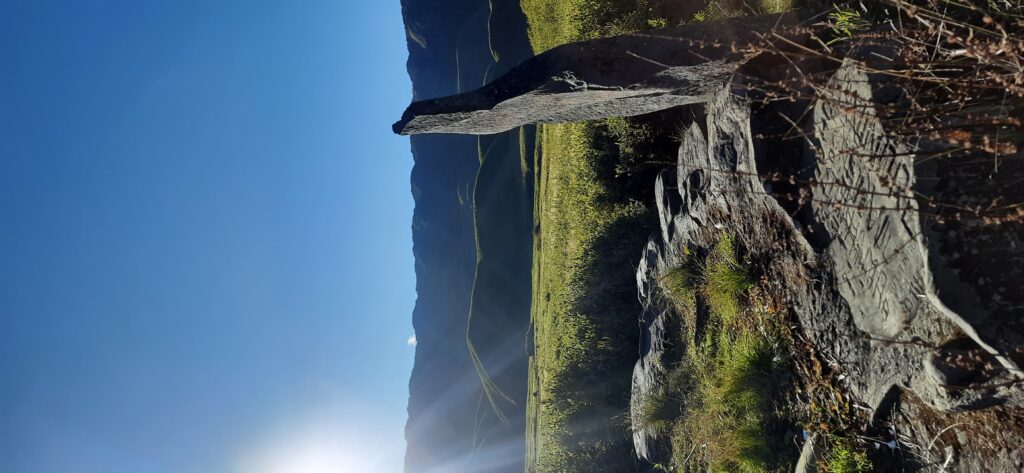
The strong sun and the climb have me wanting to crawl into bed but the man wants to explore this bowl. I reluctantly follow him across the helipad (apparently used only once to douse out a major fire in the valley) and down the slope to the bottom where a cold stream meanders. A circular stone platform with a menhir on the edge doubles as a church we are told. On a mound across the stream a giant white cross makes an incongruous sight.

The faithful will find a way.

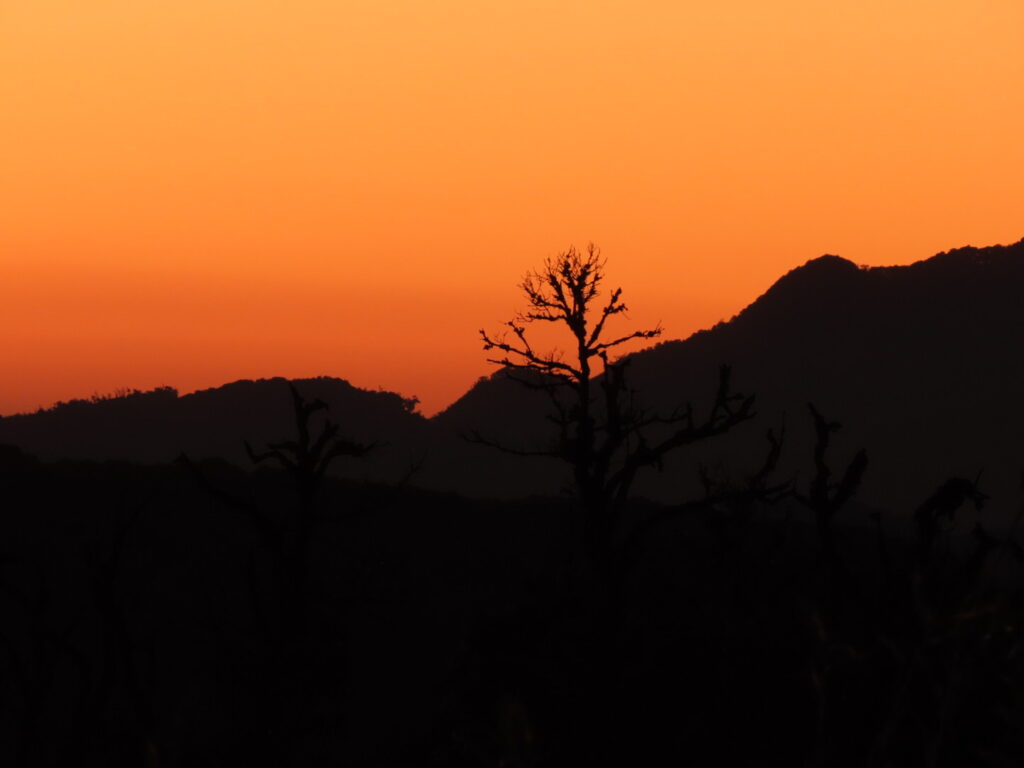
The sun is descending quickly and we will need an hour to climb back to the rest house. We make it back just in time to catch the sun set on the rim of the valley, warming ourselves with a cuppa. The clear sky burns a dying amber orange before darkness descends. The milky way is a pale band in the cold starlight night.

The sun’s last light.

Dzukou’s Denizens

I wake up to the sound of someone rummaging through our open backpacks. We have unwanted company in our room in the night and he is hungry! Although we never see him, the rat wakes us up intermittently even after we hurriedly pack everything and chuck the dinner plates outside the door. In the morning when I tell one of the youngsters running the place, he looks troubled and then thoughtfully says they’ll have to shoot it. Huh?!…okay then…the Nagas are hunters all and the guide did mention getting permits to shoot bears and deer. Still, a bit extreme perhaps and I suggest a trap instead. Visions of the room being shot up as the wily rodent scampers around play in my mind!

Read also- Part One- On the Wild Side of Outstanding Orchha

Alone Together.

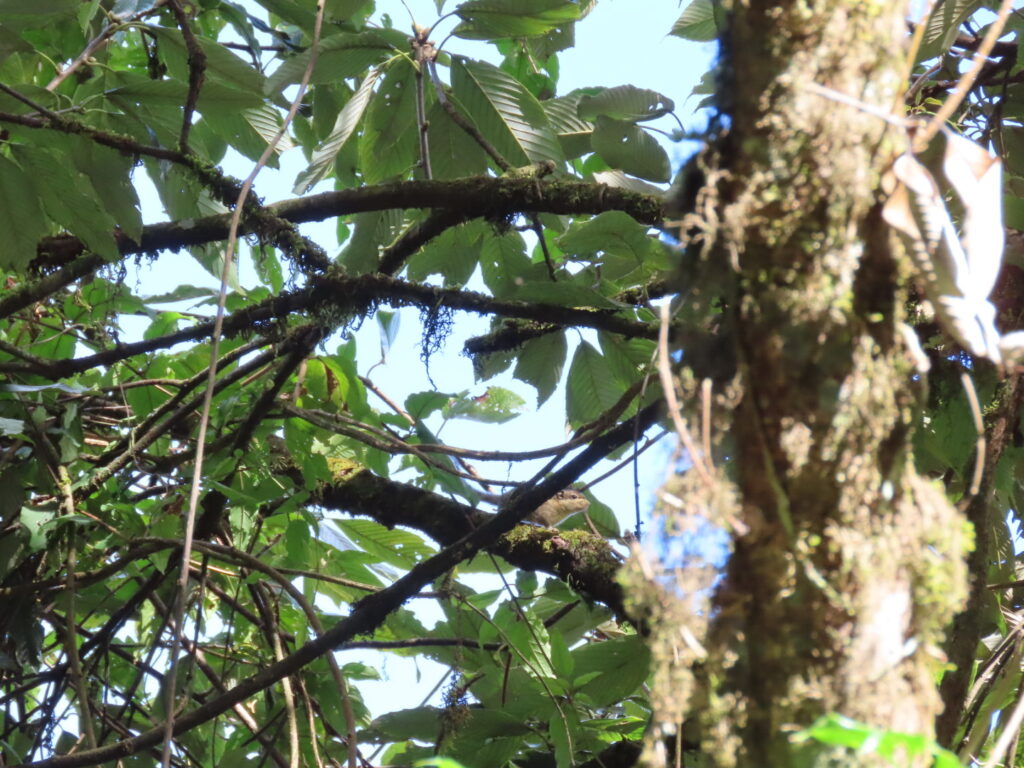
On the way back since we are the last to leave the campsite, we don’t meet a soul till we reach the view point. Its amazing to have a piece of earth to ourselves for couple of hours. The deep dark oak forest’s silence is broken by a flock of Black-eared Shrike Babblers and scampering on a tree ….a giant mouse-like creature! The Nagas need to up their hunting skills…
Captured…only on camera!


Along the Lohit on the Long Road to Walong

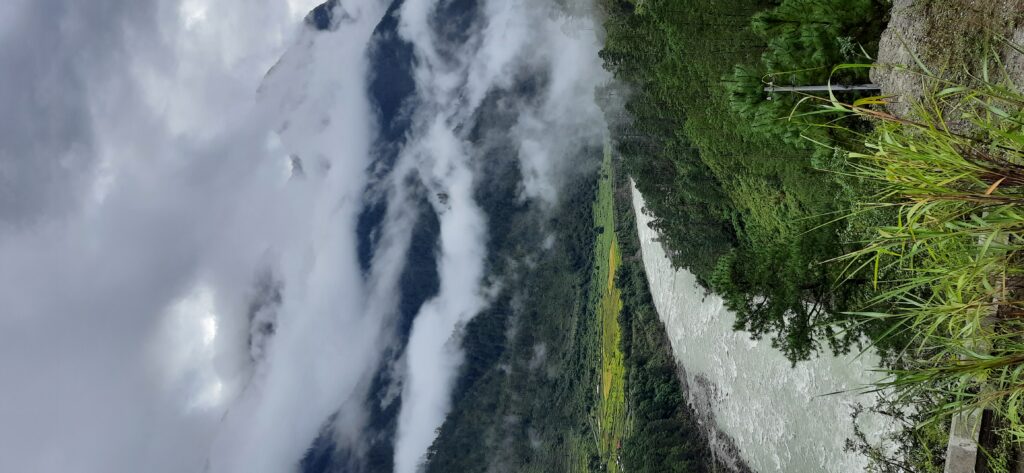
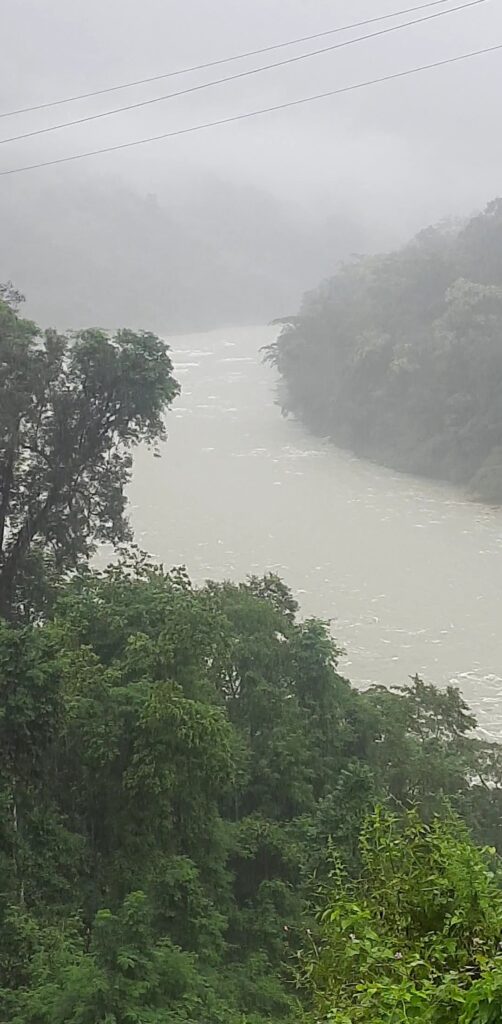
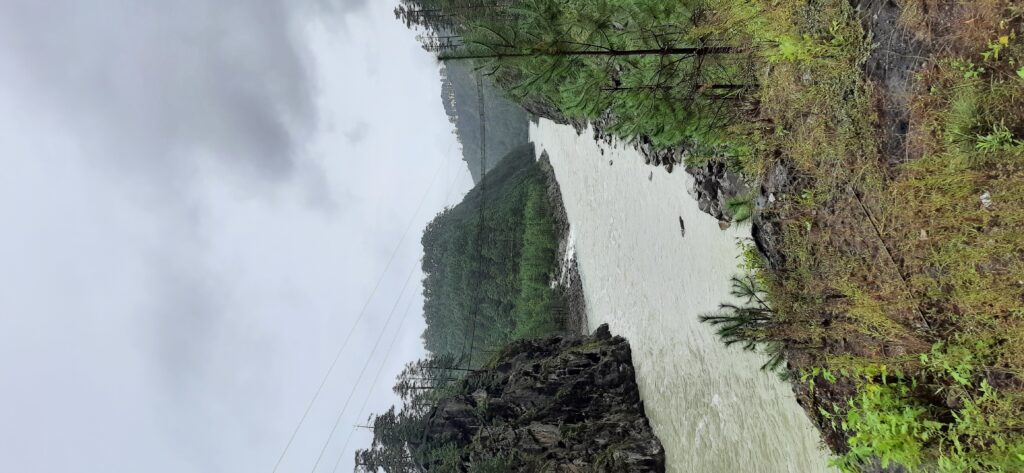
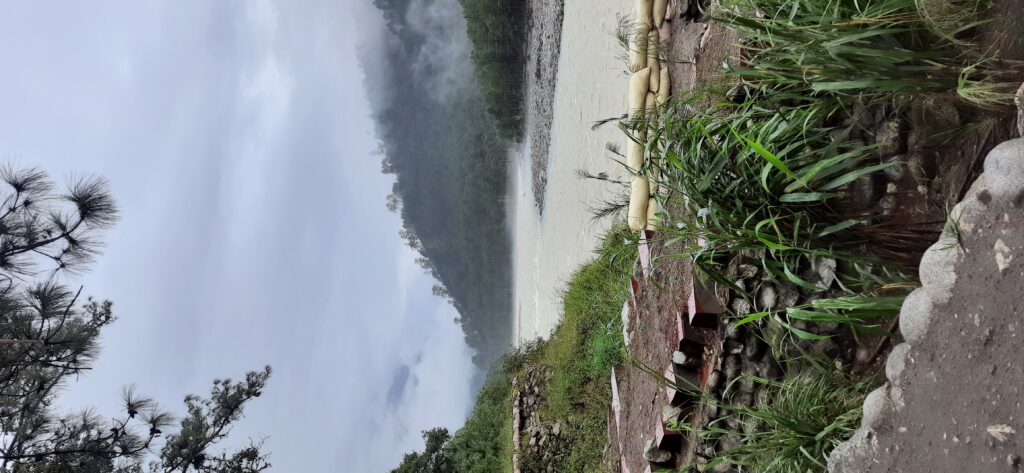
To cross over to Tibet from India one envisages traversing across snow bound passes. Nigh impossible in most seasons. But there is one all-weather pass which the Chinese used in the ’62 war for entering India to reach Walong. It was a maw so fiercely defended they called it the Tiger’s Mouth. Here in the eastern most Indian valley of Namti, the Himalayas part for the gushing, rushing Lohit. To call it a mere tributary of the mighty Brahmaputra is an exercise in semantics. There is nothing mere about the ferocious and unforgiving waters, cradled by steep ranges, covered in a canopy of evergreen forests constantly being fed by the rains and rivulets.  Into this fecund land of excesses we take a driving holiday.

How much is too much..of beauty?

We have waited for the monsoon to retire but well into October and it seems to be on climate change steroids. And now cyclone Sitrang is heading our way so between Mechuka (where no flight will go for the next 2 weeks), Dzukou (trekking in the rain is not my idea of fun) and Walong, the safest(haha…!) bet is to sit dry in a vehicle and drive!

Tezu: A Foot in the Hills
There is a light drizzle when we start and it keeps company through the day. The pot-holed bypass of Tinsukia is familiar till we take a better option through Makum. Crossing into Arunachal sees a dramatic improvement and we breeze past Kongmu Kham or the Golden Pagoda where expansion work is on in earnest. The Lohit before Tezu is a latte coloured meandering mass. We hit the hills in the quickly fading light post lunch at Tezu, a little town wedged between the hills and the river where the silversmiths are masters of upscaling (much before it was even a word) silver coins from all over the country into tribal jewellery for the Mishmi tribe whose land this is.

Prized Possession

Read about intrepid merchants in-Bikaner’s Merchants and Their Mansions

The road narrows as the foliage gives no quarter. Looking at the transmission line climbing up the steep slope past a rock face makes me wonder for the nth time how is it laid! The jungle camouflages the road entirely as we make our way past that rock face in a bit! A newer, more level road is being constructed around the hill but it is pretty much still a dirt track with umpteen slips. So we climb up and down the looping road through Hawa Pass in the dark. Although its just about 5 in the evening, night has fallen with a strange ambient glow. The black hills are silhouetted against a charcoal grey sky as white clouds float in the valley.

In the the land of bridges

We cross Tidding bridge on its namesake river and climbing up on a broken village road masquerading as a highway we hit truck traffic! Very soon it is no more than a slushy track when suddenly a landslide halts us. A boulder has landed in the middle of the road. In the dark the only sound is of running water on the slope bringing more stones clattering down. Heavy duty machinery swings into rescue and a short walk across a mound of sliding silt and a change of vehicle has us in Hayuliang warming up with a brandy in hand as the rain now drums on the roof.

Travel on a better road lesser explored in –At the Darwaza of a Road Less Travelled

So long Hayuliang
As we start for Walong Sitrang swirls around gently the next morning too, making the little overgrown village of Hayuliang a blur. While we wait for another landslide to be cleared, standing in the drizzle, we watch the river froth over gentle rapids at a bend where trees dip their green fingertips into the water. The clouds are constantly on the move. Skimming the water, wafting through the trees.

Green fingers dipping into the river.

The road here onwards is a dream run mostly. Only at Moody nala we come to a screeching halt. The bridge is not yet complete and Moody nala is in snitty spate. A change of vehicles into a higher 4/4 and we plunge into the teapot tempest. My latent ostrichness come to the fore and I shut my eyes and start praying. I had been willing to walk across the very short bridge!

More like walking the plank, this one!

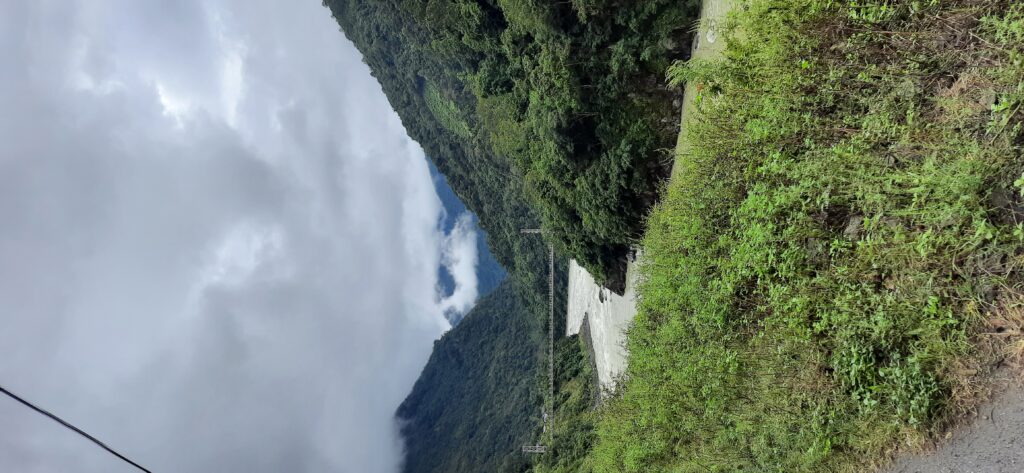
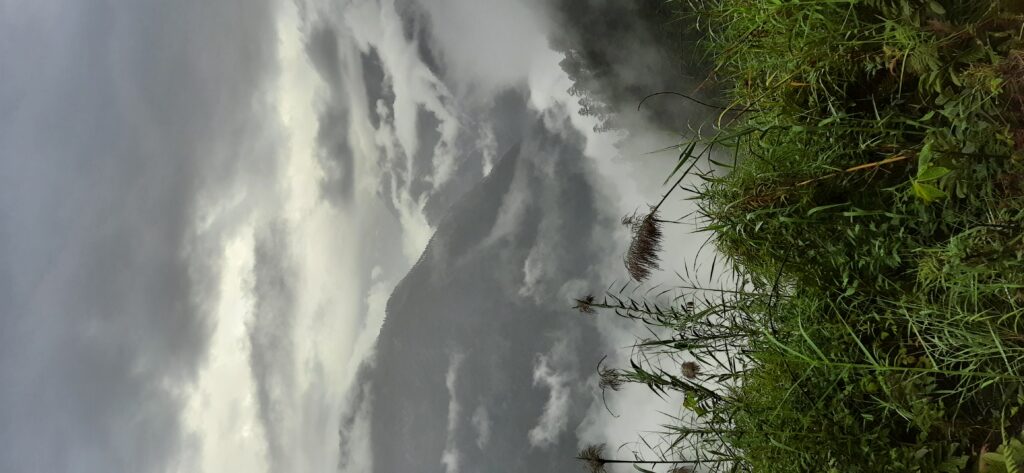
Vehicle and driver prevail but not before I glimpse almost half the vehicle submerged in rushing, swirling water! The rest of the way to Walong is on a gentle road along the river through ranges covered with thick tropical forest and peaks lost in the clouds.

Wonderland

Explore-Mandu and Maheshwar in the Monsoon Mist

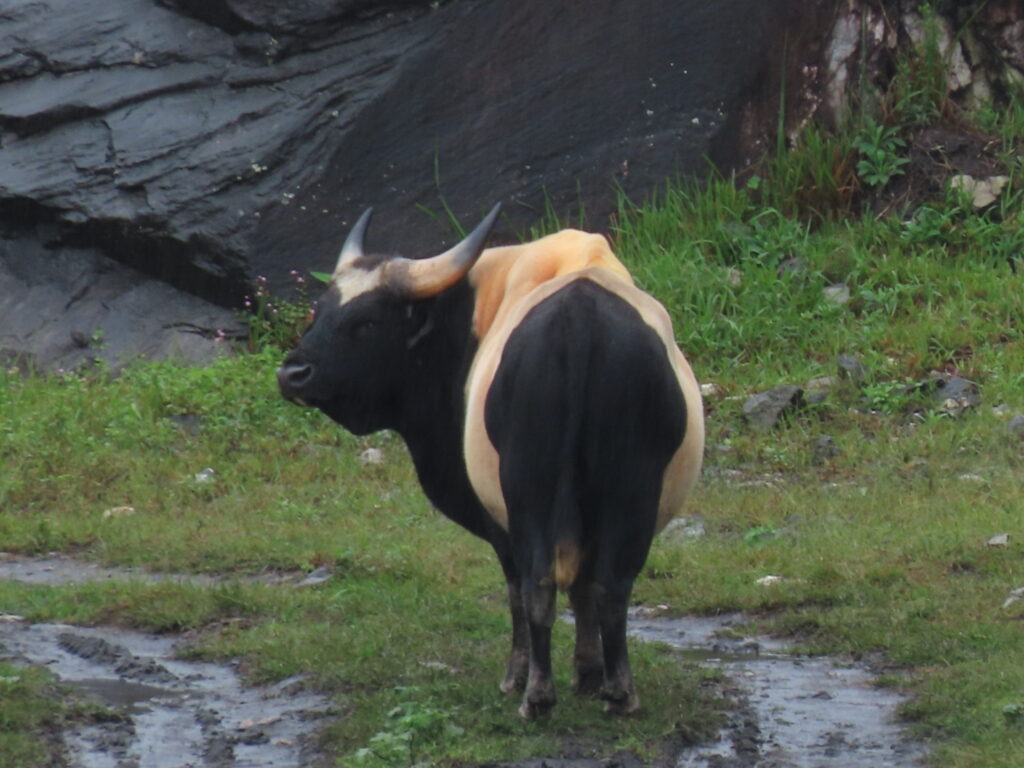
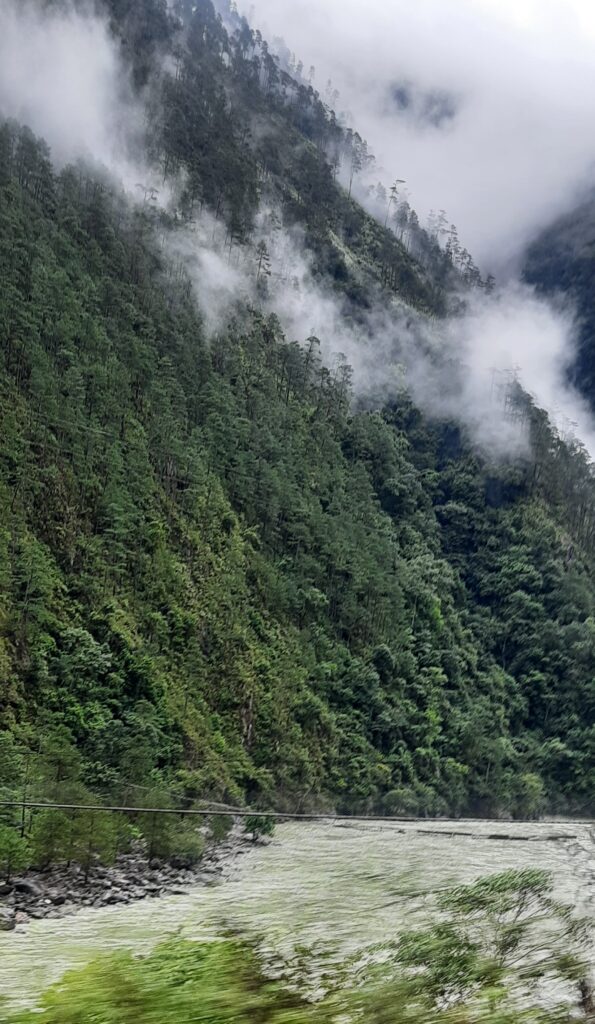
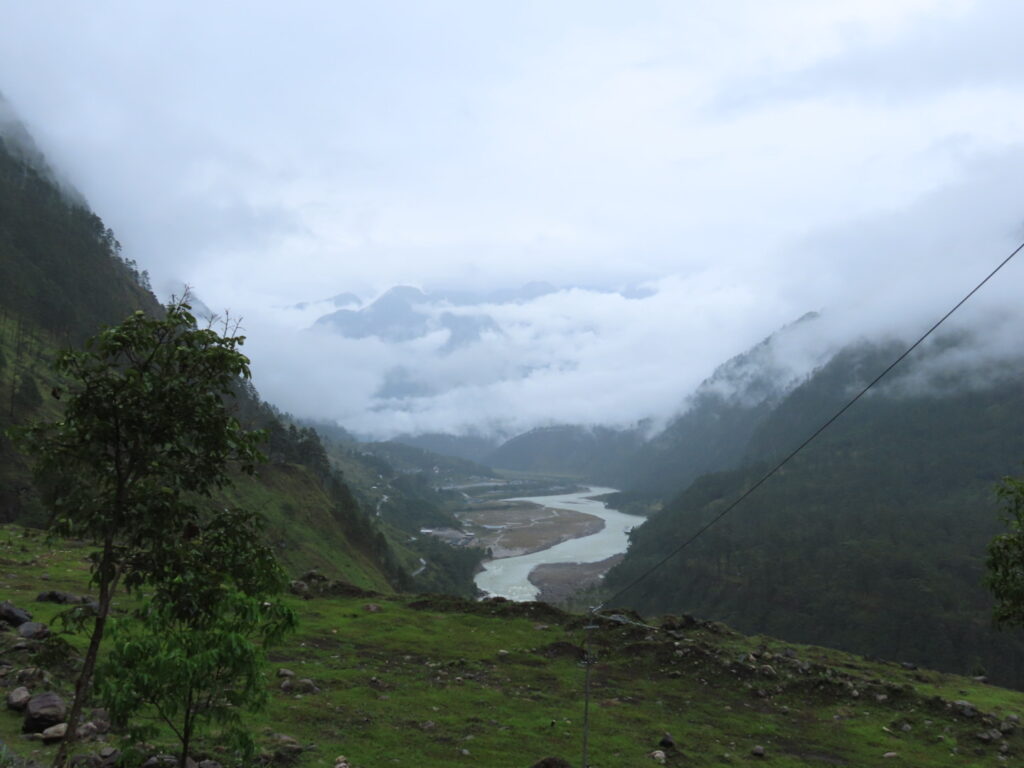
On steep slopes, houses of thatched bamboo pop up now and then, with signs of ‘slash and burn’ cultivation around. Swaying footbridges connect the two banks. We see a magnificent specimen of a Mithun, the prize possession of the Mishmi tribals. Ramshackle wooden shops line the road now and then, their window sills bare of wares and then just as suddenly from one hill to the next, the deep evergreens give way to a reddish brown burnt slope of pine and grass. The range curves and the valley widens into a bowl with Walong on a side.

A Cauldron of Clouds

Walong is a Grove of…
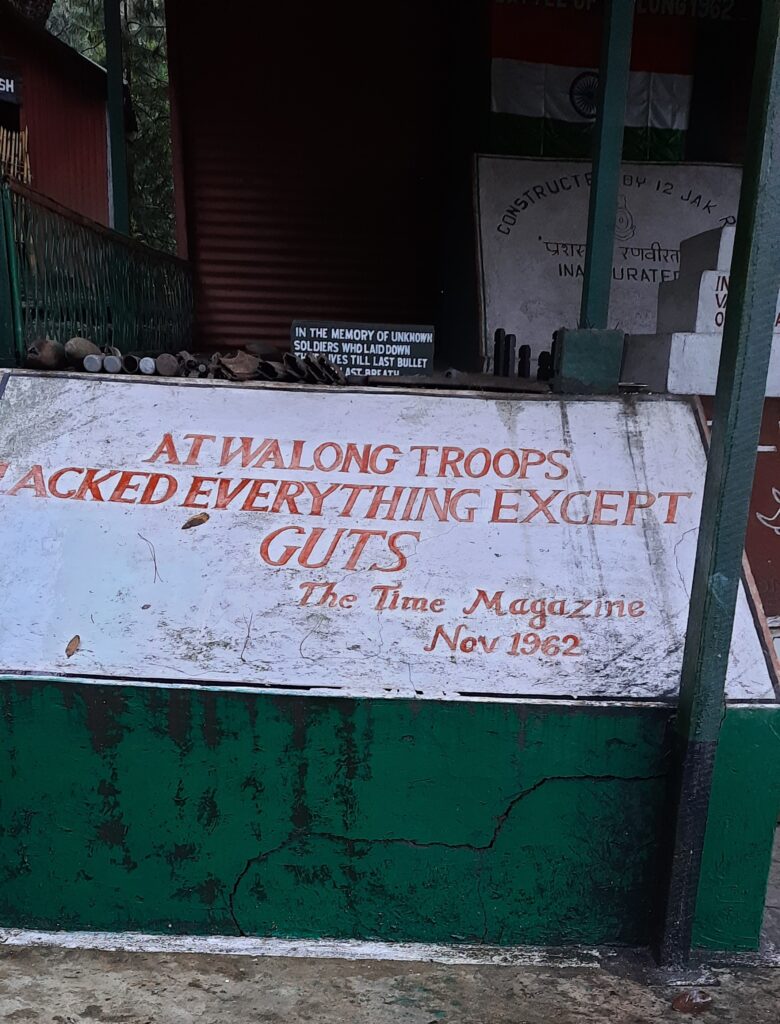
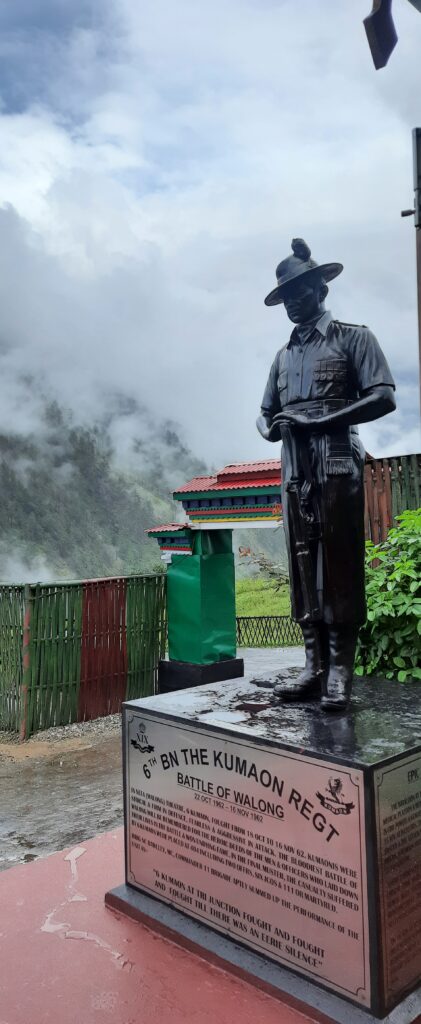
Walong meaning a place of bamboo groves in Mishmi still looks like a big village… with groves of unripe oranges trees and an airstrip! A memorial at one end of town on the road reminds us of the battle for Walong. The Chinese came over the mountains into the valley since they could not make their way along the Lohit.

Truth acknowledged

We drive up 18 km after lunch to Helmet Post, site of a fierce battle where till years later clothing and battle gear still emerge in the thick undergrowth. We startle a family of pheasants out for an early supper into flight. Across the valley the rising clouds thinly thread through tall pines. Nobody has seen much wildlife around. Frankly speaking when every inch of land is covered in foliage, if it didn’t want to meet you, you wouldn’t even know its there…

Layers of Nothing


Kaho in a Corner
In the land of sagging, swaying bridges we walk across the biggest one to Dong village the next morning…aptly called MSB or Mule Suspension Bridge. If it can take a mule it can take me….The FSBs I refuse to put a foot on! Dong village, comprising all of five to seven huts from what I can see, is famous because a small meadow on a nearby hill called Upper Dong is where the sun’s rays first fall in India.

Where do you come from, where do you go?

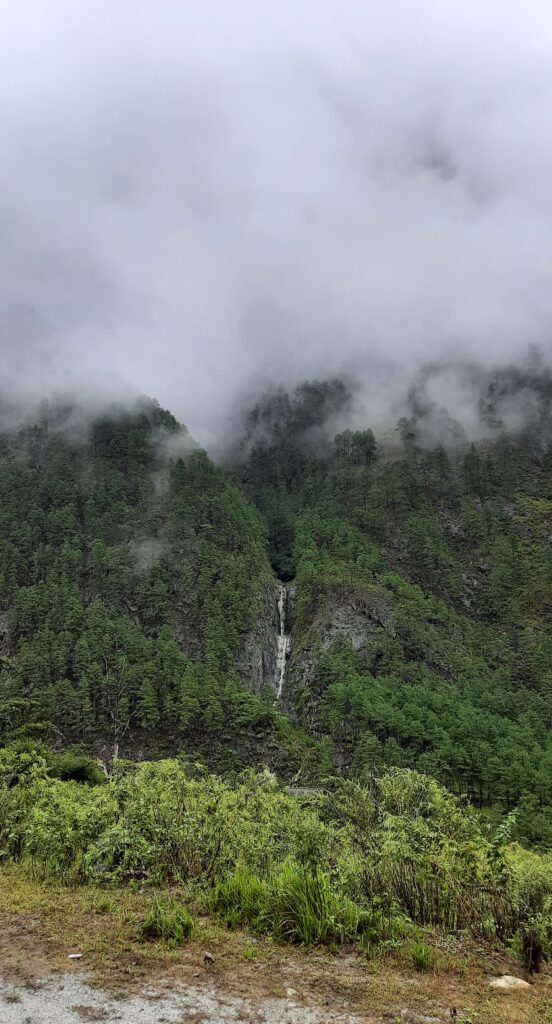
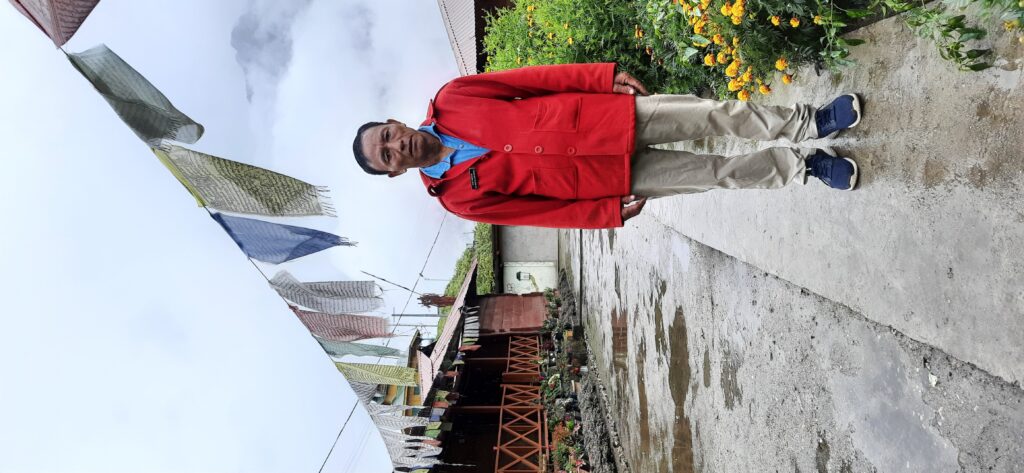
From there it is a drive under hidden waterfalls and across the ripening mellow yellow fields of Meshai village to reach Kaho. India’s easternmost village is inhabited by the Buddhist Meyor tribe, now divided between two countries. We meet the Gaon Burra or village head and a few other villagers at the simple temple on one end of the village. Other than a lack of educational opportunities they seem a contented lot. The GB proudly shows us his homestay. A simple long wooden house with bright geraniums lining the veranda. He will find many takers…we crossed quite a few soaked bikers. At the far end of the village disappearing into the trees are white flags…prayers in the wind for departed souls. Across the Lohit a sheer rock face seems to have a road running across..can’t be…

Leading man

Another border village and unforgettable river-Chushul &Chumathang – Hello Indus & Iridescent Colours!

Watch out at Wacha 
We are crossing that rock face and I have my heart in my mouth again as I look down the sheer fall into the river below. The drivers by now have my vote though. We reach the BPM (Border Post Meeting) ‘hut’ at Wacha. Its like a fancy resort… I go to the loo.. It is a fancy resort! This is where the Chinese and Indians wine, dine and show their cultural prowess during their border meets. Its a complex of AC conference halls and glass huts etal under pine trees beside the Lohit. A lone soldier keeps vigil by the river, oblivious to the never ending drizzle.

A guard’s viewing post/A ridge too far.


Kibithu’s Cookies Melt in the Mouth
After a night at Kibithu, a tiny hamlet of wooden huts perched on a flattish hill with a bird’s eye view of pristine waterfalls and on a clear day of a long TAR valley we make an early start back. Not before we visit the bakery run by local women. They’ve been helped by the army and trained by an NGO from Pune. We find fresh faces offering fresher coconut cookies and chocolate muffins for the journey back.

Battle Hardened

The long drive back is without hiccups. At Namti an Eurasian Krestel chases a pair of tiny birds into the pines ringing the ‘plains’. The window sills of the shops enroute are now stacked with pineapples and the wizened old lady I had glimpsed earlier with a silver pipe has vacated her chair outside a hut for a younger, cigarettes smoking woman. Men on bikes whiz by sporting traditional waistcoats armed with dahs, a common accessory, sometimes even a rifle. A Mithun now and then lumbers across the road. Tiny goats in an inflated sense of self doze in the middle of the now dry road. The clouds are lifting and the sun warms the wings of giant black butterflies with flashes of blue and red. The Lohit bends one last mountain before leaving for the plains, stretching its arms wide….

Freedom or Loss?


Fact File

Distance- Its approx 363 kms from Dibrugarh to Walong.

Hayuliang to Hawai is 56kms.

Staying- Hayuliang has one odd very run down hotel. It is better to stay at Hawai, the district HQ. It has a Circuit House and an old Inspection Bungalow.

Walong- Has a PWD IB and a few basic homestays.

Tilam about 5 kms ahead of Walong has a Government tourist lodge. It has a hot spring nearby too.

Kaho- The Gaon Burra has a simple homestay with a bedroom and dormitory. Its on a first come first serve basis till now.

Coverage-

The mobile coverage is very patchy ahead of Tidding bridge. There is no mobile coverage ahead of Hayuliang. Infact your phone timing will jump about 2 hours!

Discover-Disconnecting with the World on a Mountain Isle at Shaama


Discovering Digboi’s 3 Must-Dos

The pachyderms with their famed elephantine memory won’t be thanking one of their own anytime soon in Digboi, if the local lore is to be believed. It goes that sometime in the 1860s, out of the steaming jungles at the foothills of the Patkai Mountains emerged an elephant, its leg wet with mud mixed with traces of oil. An observant employee of the Assam Railway and Trading Co pounced on the prospect of black gold. Soon the labourers were being exhorted to ‘dig-boy-dig’…and the rest is history…

Green Gold.

Assam is what I call river country. It is also tea country and what a lot of us forget the original oil country. The first mention of oil here was made by army officers and geological surveyors way back in the 1820s. It seemed to seep out and mix in the waters of the Dihing River. Within years of the first oil well being dug in 1859 in the USA and decades before the sheikh’s of the Middle East’s desert discovered their wishing wells, the first oil well was hand dug in Digboi. Making it not only India’s oldest but Asia’s first oil well. Its to this oil town nestled on the fringes and mounds of tropical forests, the traditional elephant corridors now cut off by walls that we headed to.

Read about  Rajasthan’s wells in-  Harlequin Holi at Todaraisingh

Verdant Valley Burns Bright

Cloud Chasing

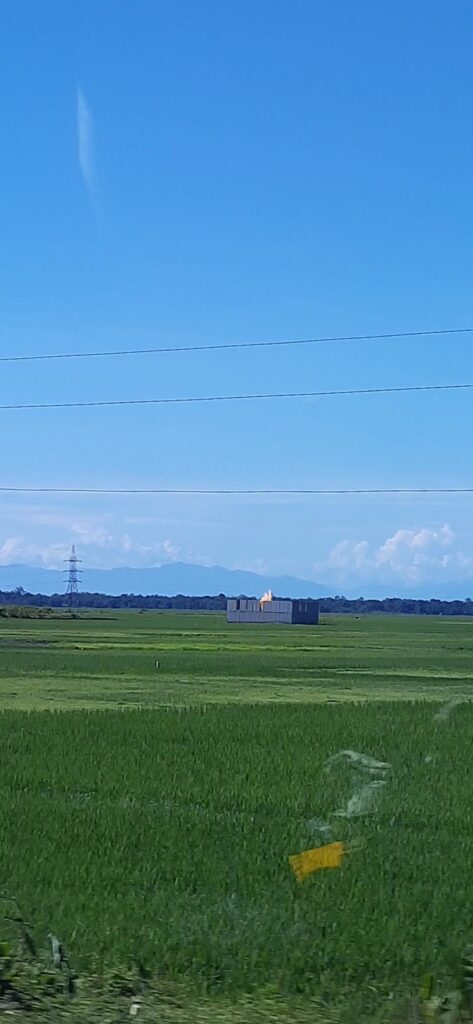
Stormy clouds follow on our heels as we drive to Digboi through a flat valley. The wind blows every shade of green around us. The bamboos creak and bend, the paddy fields flatten out and streams ripple as the water is hurried along. The locals here are accused of being laid back. A passing sight paints a complete picture- In front of a neat little thatched hut is a pond with ducks grooming themselves. A small lush paddy field is lined with slender areca nut trees. What more does a man need?  A little distance ahead a strange vision appears in a vast field…a fire rages in a brick house with no roof. I doubt any roof would survive that blaze! (On the way back we see a drilling rig parked nearby.)The open fields end as we hit the small town of Digboi, it’s center dominated by the curving high walls of India’s oldest continuously running oil refinery since 1901. A road skirts along and on the other side of the road bumpy hillocks rise, covered in thick foliage.

Fire from the Belly.


Digboi’s Date with Destiny

I’m not a museum person but I have encountered the most passionate people in museums. Digboi’s Oil Centenary Museum is no exception. The person incharge walks us through the deserted museum lovingly pointing out each archaic piece of machinery on display. He is clearly an Anglophile. (Only to be beaten by the even more passionate incharge of Margerita’s Coal Museum. As far as he was concerned no progress has been made after the Brits left Margerita…ironically named after an Italian queen!)

Hear another queen story when- A Bard Sings a Story in Jhansi

See the oil seep out dear?

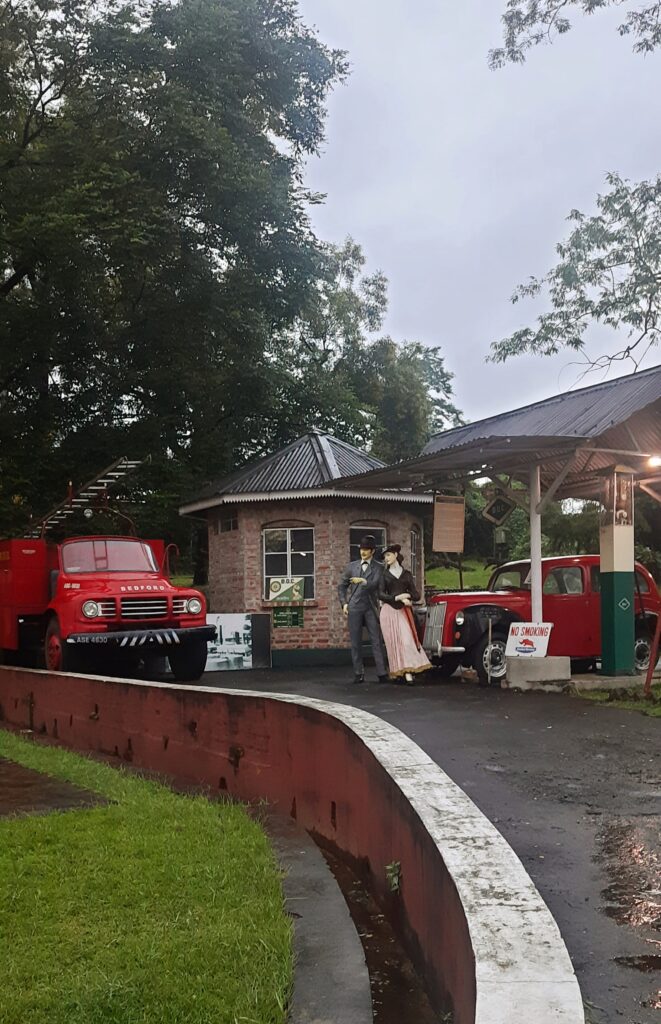
In the museum’s center, life size figures recreate a throwback scene of towering trees, an elephant and a thatched oil well. Bric-a brac of everyday life, pictures of social life, of momentous events and visits, of Joymala- a giant elephant at work, line the walls. Outside apart from machinery and a filling station scene is the 1st oil well. The smell of oil faintly permeates the air as it seeps from the ground to make rainbows in the puddles of water. A tall narrow pipe behind the trees nearby spews fire…an oil well I suppose. The legacy continues.


A Course Par Excellence

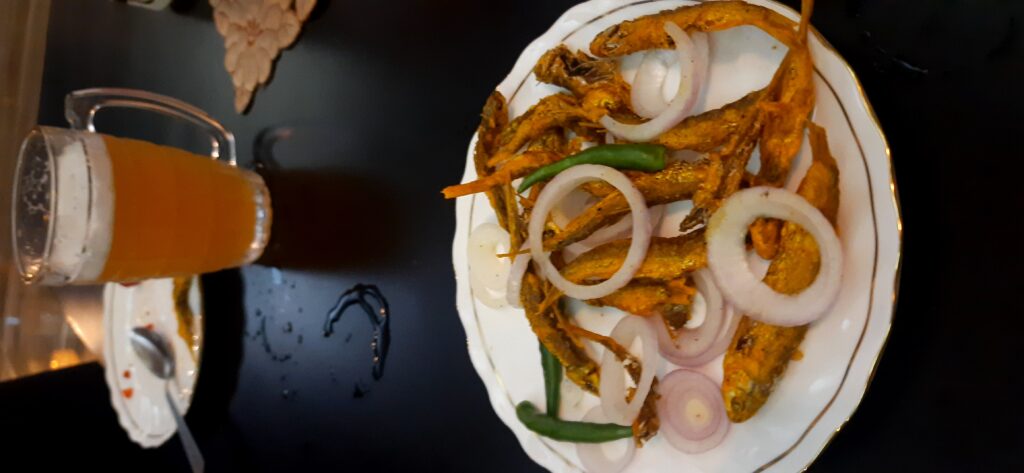
Fish Fingers Fried Crisp

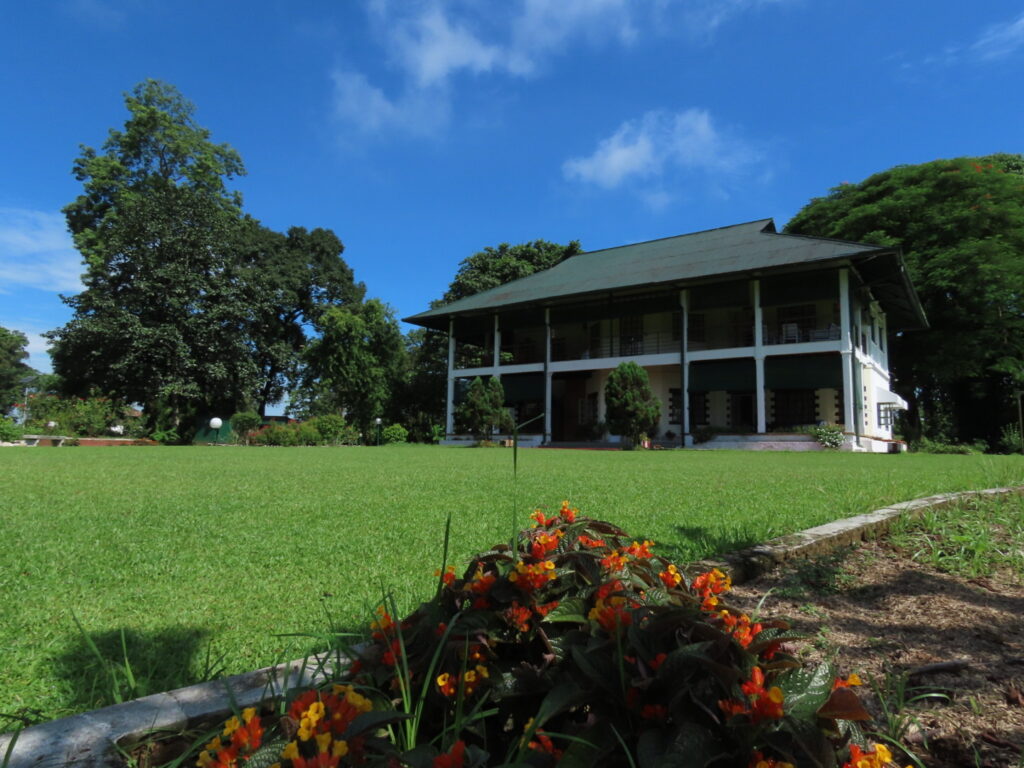
After overeating a dinner which starts with crisp finger sized fish had whole and ends with melt-in-the-mouth caramel custard (The caretaker nodded his head in approval at the choice of pudding. The not-so-secret Anglophile society rules Digboi!) we need an early morning walk. The sun is blazing down even though it is just 7:30 in the morning. (My clock is set at Mirzapur Standard time! Cannot wake up at 5:30..) We stroll down from our guest room at the Patkai Manor crossing similar gorgeous colonial bungalows to the rolling 18-hole green golf course sandwiched between the forested slopes and the rail terminal.

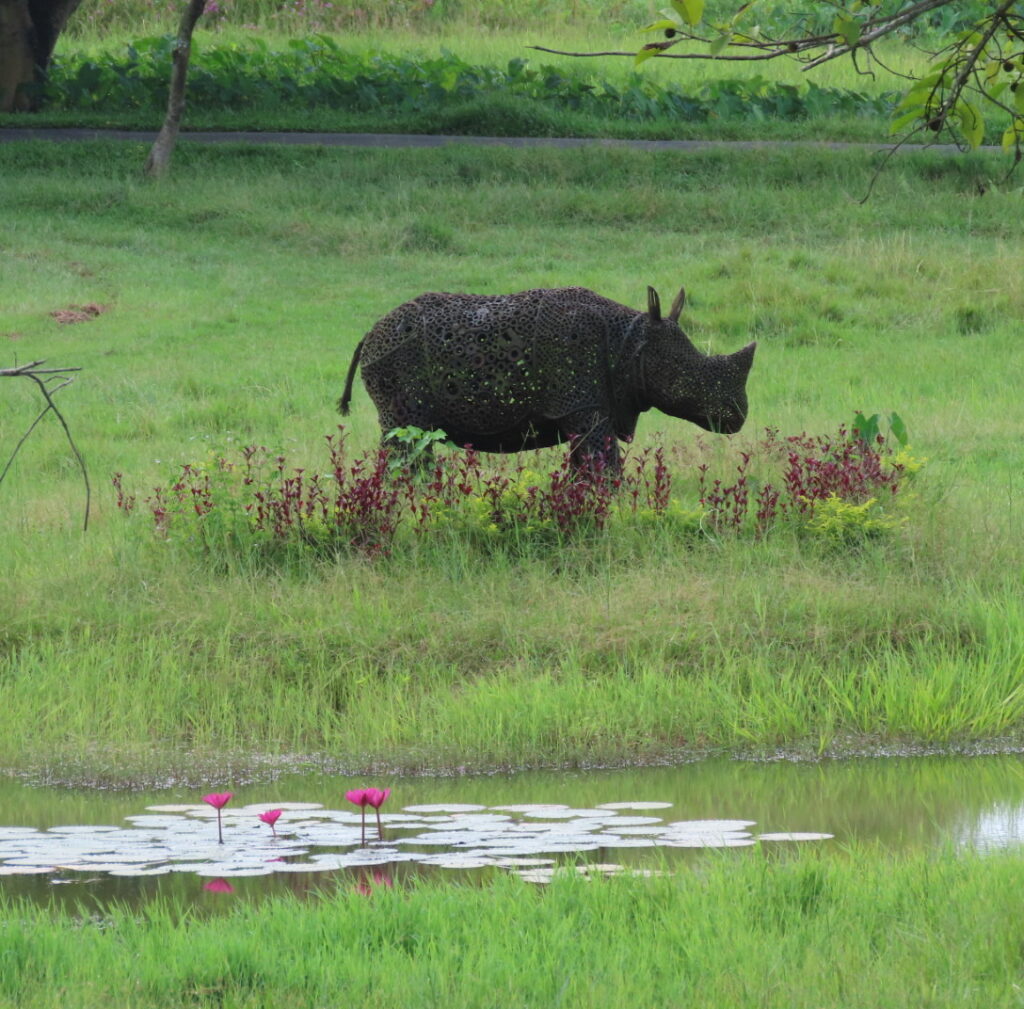
Beauty and the Beast

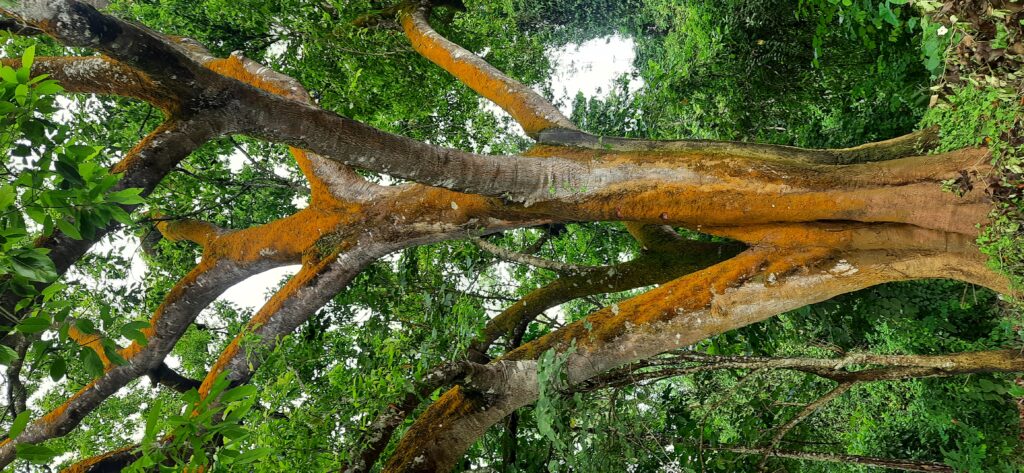
A 3-dimensional emblem of the Assam Oil Co is doing a mock charge at some lovely lilies in a pond near the entrance. After a cart ride through the undulating fairways where flocks of egrets reluctantly take flight to make way (makes me feel like I’m in a Jurassic Park movie!) we have tea in the huge veranda of the Golf Hut. The clouds over the blue Patkai Mountains in front are dissipating in the heat. A traditional elephant corridor to the mountains has literally hit the wall of the rail terminal in front. For the elephants they are mountains too far…. A tree trunk nearby is stained bright orange with lichens thriving in the mugginess of this place. I’m already wilting….

Discover- A Tale of Two Veiled Valleys: Part I- Shangarh’s Meadows are meant for Musing

Some thrive, some wilt.


Vestiges of War

Verandas be like….

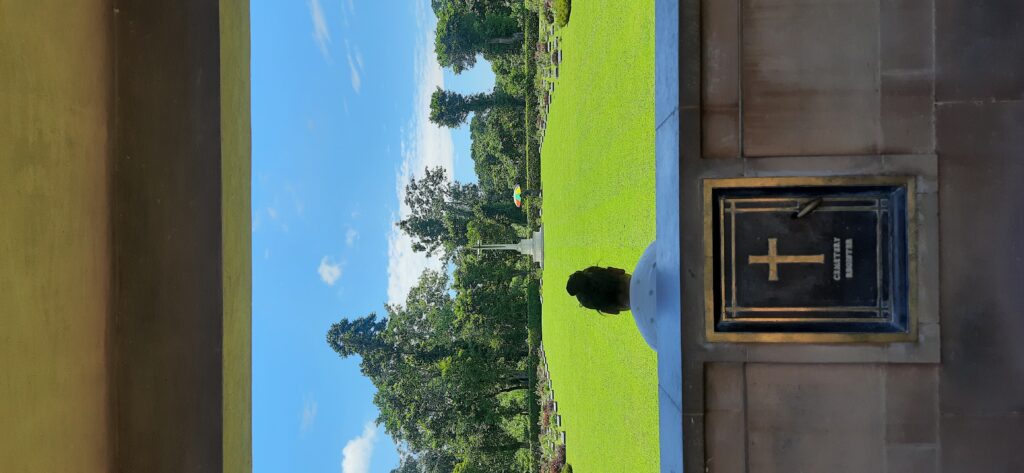
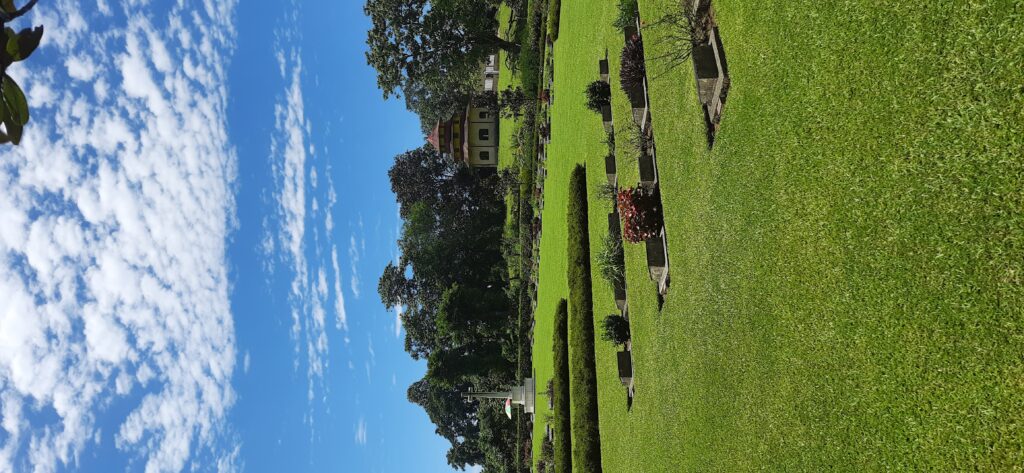
After breakfast and another round of leisurely tea in the deep wooden veranda, which I loathe to leave, we head to the war cemetery just outside town at the edge of the forest. Adjoining it on a mound is a pagoda styled temple. Many graves have been shifted to this place from nearby towns and in the 1950’s the entire graveyard was relocated from its original hillock location.

Somber Solitude.

The cemetery is a small somber affair laid out in perfect symmetry. A square stone arch at the entrance is the only construction. A giant cross stands at the other end and in between, neatly laid down, are rows of gravestones. They tell short stories of soldiers from across continents and religions. Even unknown ones acknowledged in death. Plants grow beside each stone. The Burma campaign during World War II had seen the Allied Forces fighting against the Japanese and sometimes nature, to prevail. The Stilwell Road constructed during World War II to aid the Chinese starts from Ledo near Digboi and it is said to have cost a man a mile to construct.

Read about people- At the Darwaza of a Road Less Travelled

Faith in Life as in Death.

At Digboi, bountiful nature on the surface and from deep within is on show. But it is also where it is starkly obvious that when nature gives it extracts its pound of flesh too, from man and beast alike.

Fact File

Getting there-

Mohanbari airport at Dibrugarh is appox 65kms.

Tinsukia at about 36 kms is the nearest major rail junction, although trains from Guwahati come to Digboi too.

Staying-

We stayed at the IOC’s Patkai Manor. There are a few small hotels and guest rooms in and around town.

Timings-

1. Digboi War Cemetery-

Summer- 8:00 am – 5:00 pm

Winter- 8:00 am – 4:00 pm

2. Digboi Centenary Oil Museum –

9:00 am – 4:00 pm. Monday closed.

A Tale of Two Veiled Valleys: Part II- Tucked Away in Tirthan

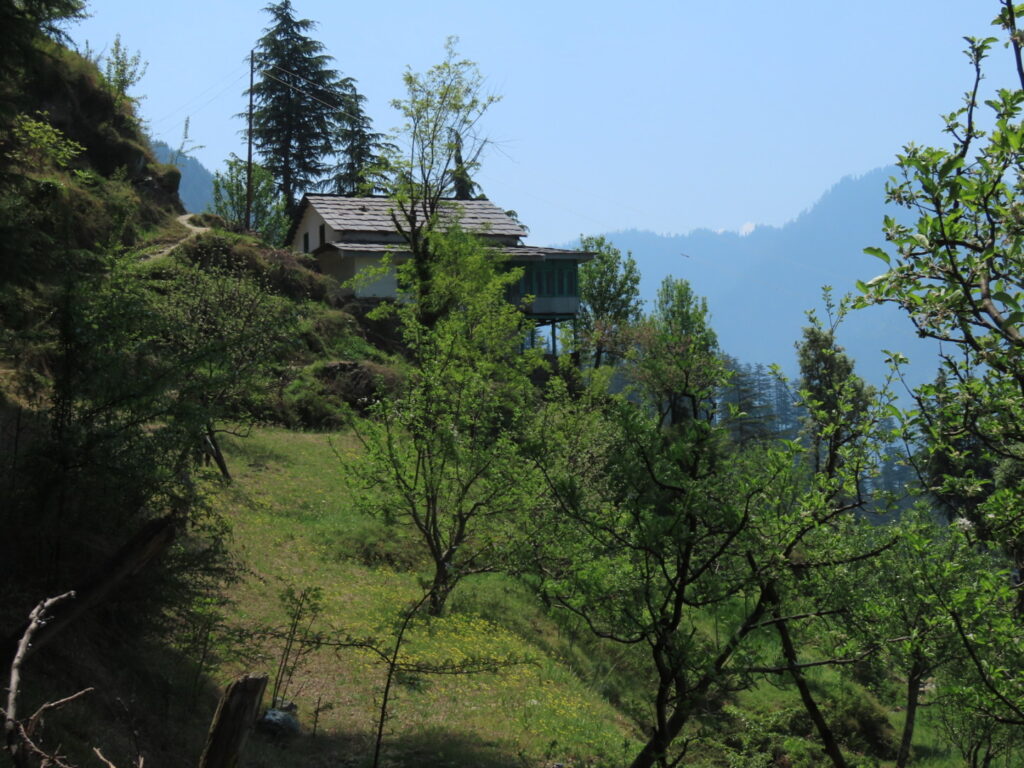
The adjoining valleys of Sainj and Tirthan, named after the rivers that drain them, are part of the Great Himalayan National Park. From Larji a left will take you up the narrow Sainj valley and a right to the bigger, wider Tirthan valley lined with orchards and dotted with scattered hamlets. Our short stay at Shangarh has proved to be worth the horrendous roads. The day hikes, the meditative meandering and just breathing the deodar scented air has us craving for an encore. While the spoon-shaped Sainj valley is still devoid of masses, Tirthan started gaining traction as an ‘off beat’ location about 5 odd years back but now is firmly on the tourist circuit with homestays galore and resorts lining the river ahead of Banjar. Jibhi has trendy cafes and a hippy vibe and the narrow road to Jalori pass has more traffic than it can handle. But tucked up and away in Tirthan Valley, beyond the bustling crowd is the village of Bihar, our second destination.

Perched on a mountainside.

Our departure from the FRH at Shangarh is tinged with a slight sour taste when I see the caretaker dump, along with our conversations and his assurances on waste disposal, segregation etal, the garbage into a neighbouring stream. Lesson learnt. There is, in all hill stations, a burgeoning mountain of a problem of waste disposal. On that sobering note we drive off with plans to reach our homestay post lunch at Jibhi. We are spoilt for choice but our menu is on default setting… trout it has to be! The gentle drive is along the shallow Tirthan River. Hema, our host has an amused tone when she calls to ask about our whereabouts. (we are a couple of hours late) Maybe she has visions of having to organize another rescue!(She has had her share of barmy guests!)

Another road to discover passes- At the Darwaza of a Road Less Travelled

Beyond the Bustle at Bihar

From Jibhi we backtrack towards Banjar and then climb up on a deserted road winding through a forest, cross the entrance to the Shringa Rishi temple till we reach the end of the road. Janisha, a slight girl with an angelic face and solemn eyes has tagged along with Hema, her equally petite mom to help carry our luggage (I think she has heard of the furry guest) up the last 100 meters or so to their home- Tirthan Eagle Nest.

A home for a furry guest.

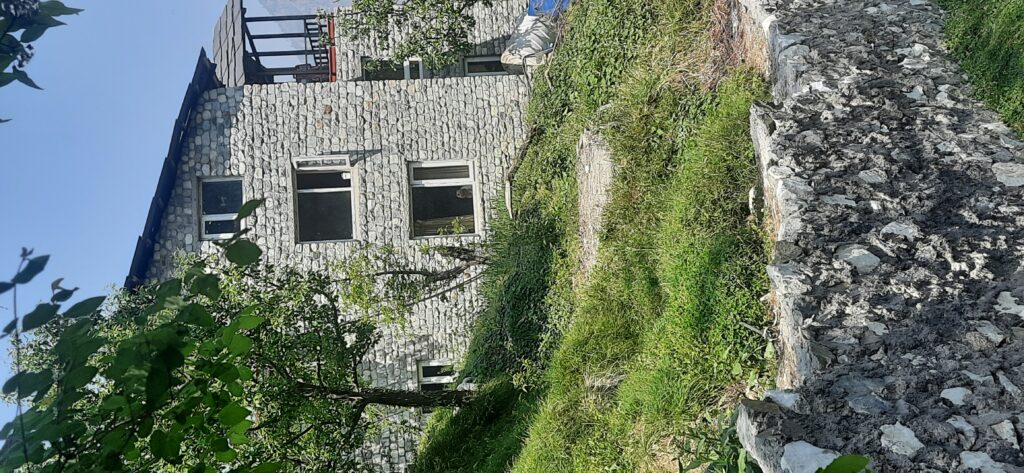
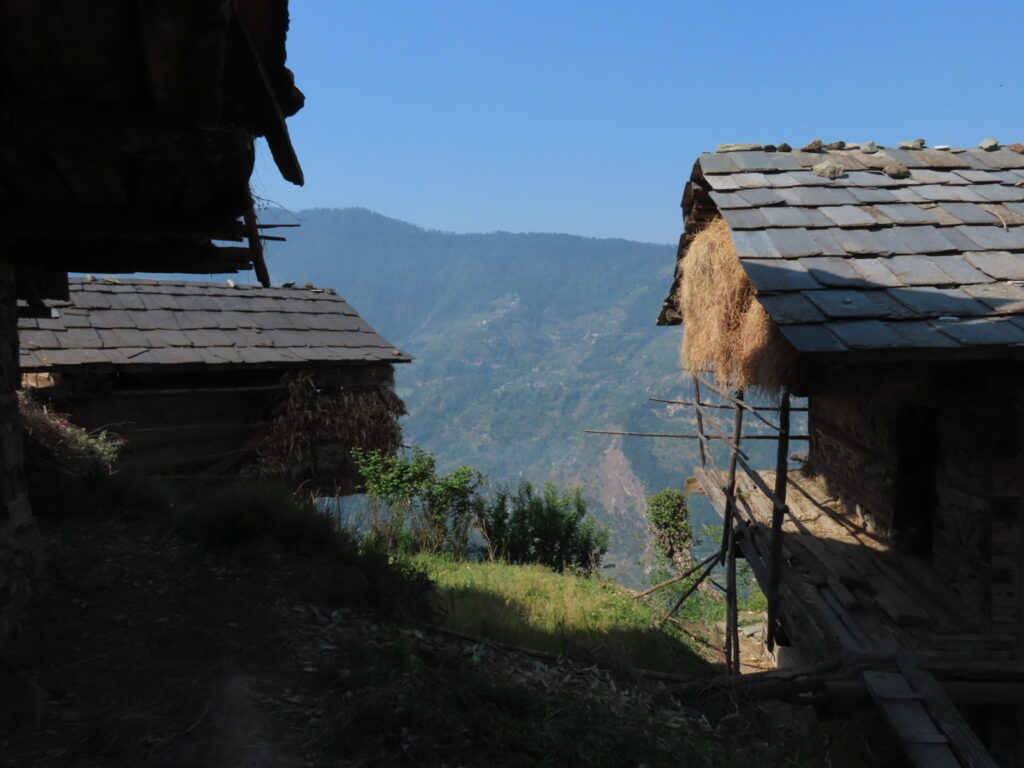
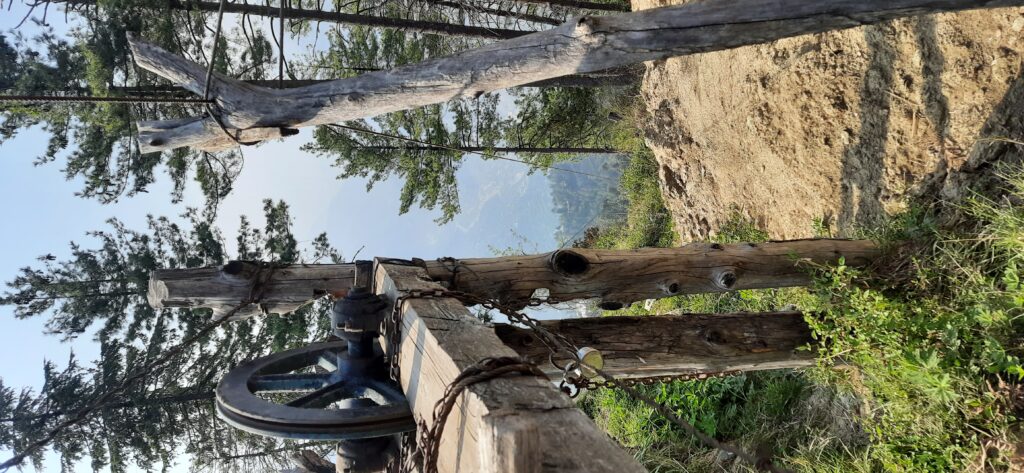
Hema and I have been connecting over the phone and here we are finally, after many false starts. Perched on the edge of the village, close to the wired trolley going right up to Myaji point, the stone and wood house is set into the slope. It is a home made with much thought and from our room window I can reach out and touch the grass! After tea we head up the path to the tiny village, past wooden sheds stacked with hay on top and with a place for the cattle below.

A homestay seeped in culture is- Dera Jaipur: A Homestay for Stellar Style and Exceptional Experiences

Make hay while the sun shines.

The houses are huddled around a clean paved square, their wooden balconies at an arm’s length from each other. Two old women gossiping on one of these stop briefly to give us a cursory look, children run around in the square and up ahead young women go about their chores around a communal tap. Young girls, their bags laden with school books are heading back to their homes somewhere on the mountainside. They point the way to Chehni Kothi. We can see the tower in the fading light. But don’t have enough daylight left to reach and be back and I’m not up to trapezing on narrow paths in the dark. Smart move!

The monuments of Gods and men.


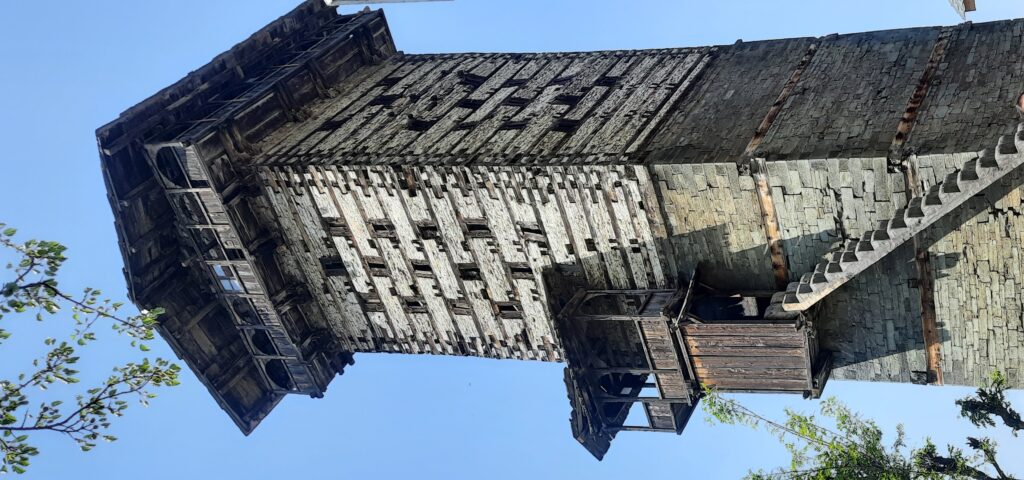
Leaning tower of Chehni Kothi

A sight to behold.

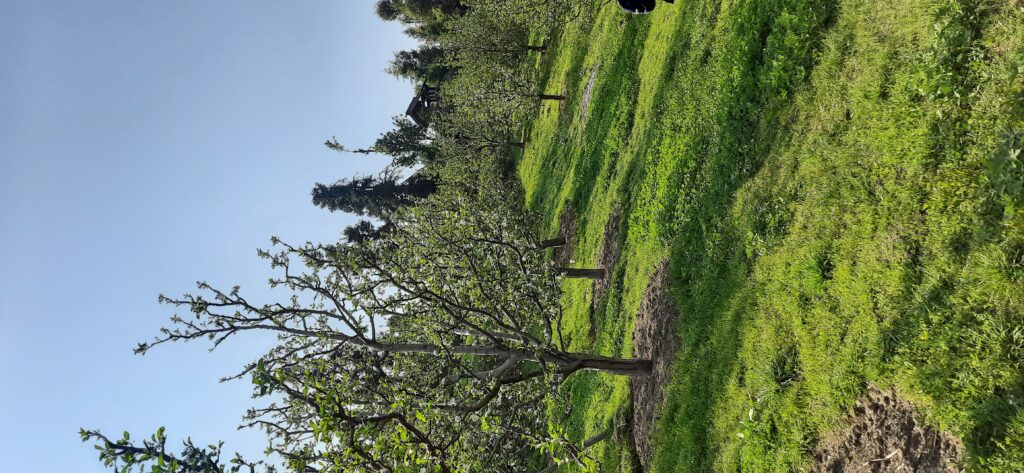
Next morning we discover there is no straight route in the mountains to things in plain sight. We walk through flowering apple orchards and houses with wild rose bushes with paths branching up and down the slopes. We finally hit a dirt track just below Chehni village where an enterprising fellow with a tea stall is now constructing a ‘homestay’ with many rooms. He is going to be ready when the hordes drive up….till then there will be days like today when we have the place to ourselves. Two lost and frightened cows attach themselves, literally, to us, scaring me more. Their pretty owner is chatting with a woman making pattu on a hand loom. The square is deserted save a few boys. A woman with a baby tied to her back, has come to fetch water from the community tap.

A Towering Presence.

The Kath-Kuni styled tower of Chehni Kothi, with its debatable antiquity, lost some of its floors in the 1905 earthquake apparently. Yet it dwarfs everything around including the Krishna temple behind and another smaller tower in front. It leans ever so slightly. The staircase to the balcony way above is carved out of a single log of wood. The makers, like sure-footed mountain goats, gave no thought to lesser mortals needing support or width. But then outsiders are not allowed to climb up. (scraping them off the floor would be messy!) The temple with carved wooden balconies looks like a mansion which has seen better days. It’s entrance is through a wooden platform jutting out of the structure. There is a courtyard inside but we can’t find the inner sanctum.

Must see mansions are to be found in – Part Two- What Not to Miss on a Weekend Vacation in Shekhawati

Is He in there?

Be Game to Get Lost

Garden of Eden

From a makeshift eatery we take packed omelets and walk up to Myaji point. This time we stick to the wide dirt track masquerading as a road. It is lined with apple orchards with wild white and pink lilies growing in the shade. We climb into one to follow two women and their cows across the crest with a small wooden shrine and pond. The white peaks of the inner GHNP form a perfect canvas backdrop.

A landscape artist’s dream.

Lunch is followed by a snooze lolling on the grassy slope of an orchard. Its paradise! We rouse ourselves and reluctantly start back with what we think is enough daytime. From the trolley point we see our homestay below and decide to take a shortcut in the general direction of the village. After a promising start we get royally lost. At one point I have to slide down on my backside a few feet. (As opposed to flying face down) A wrong turn to follow a pipeline (has to go to a tap no?) ends in a thicket. Sense prevails; we backtrack and eventually stumble back on to the track going to Bihar. Sweet relief! Hema has thoughtfully made halwa post dinner knowing I have a fast.

Another adventure was- Tarsar Marsar : Memoirs of an Escapade

Fly me home.

River Run

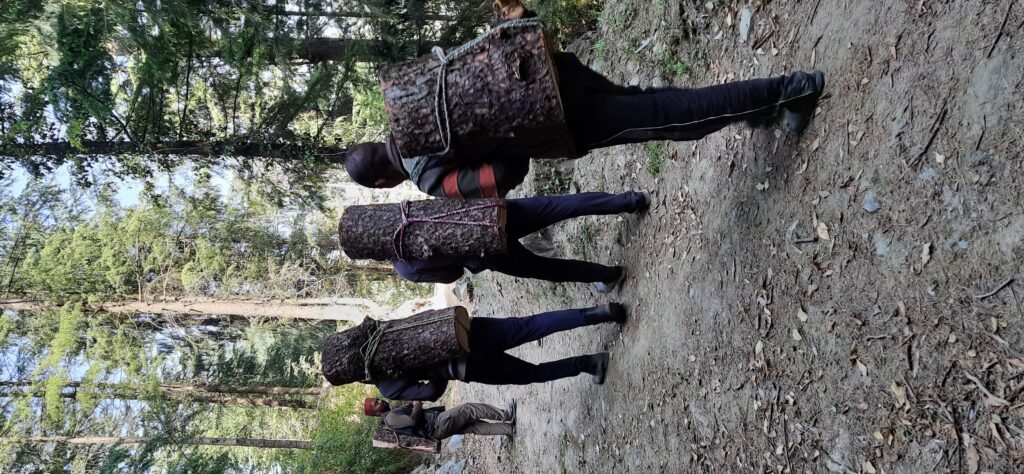
Early next morning we take a walk on an under-construction road through the deodar forest patch near the village. A fallen tree is being chopped up by the village men and they carry the logs on their backs up to the village to stock up for a feast coming up. Cultural rooting is still strong here and family functions and festivals are community affairs.

A load shared.

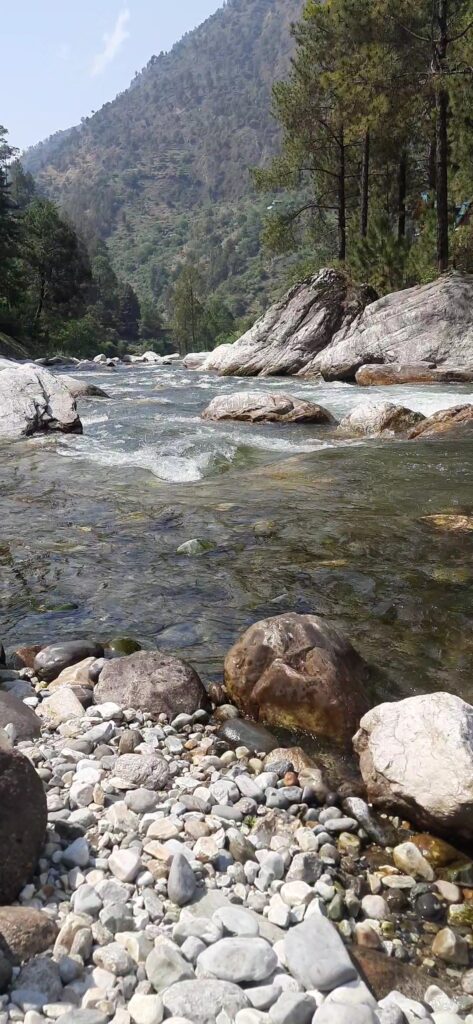
After a hearty breakfast of delicious Siddu drowned in homemade ghee we venture down the mountain to the river. The valley below is overrun with resorts and homestays. We find a deserted stretch where the river cascades over boulders, shimmies into little quiet pools to catch its breath before rushing off again.

Read another river story – Barot and the Serendipitous Catch in the Uhl River

Run River Run

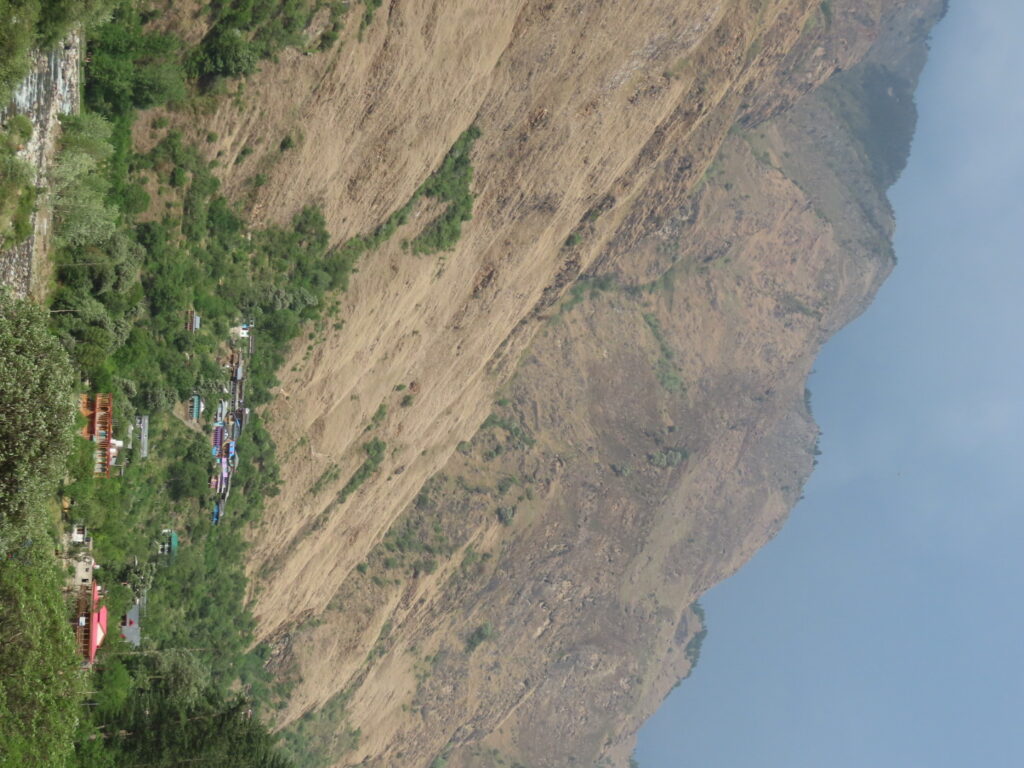
River birds dart around as we chill our feet and drinks in the icy water. Bliss! Later from a hippy café where we lunch we see the sky turn  slate grey behind a rugged golden mountainside. Colourful houses at its base make a striking contrast. A brief shower that follows, brings welcome relief from the unusually high temperatures for spring season but it doesn’t douse out the forest fires on the slopes above. Stephen, our host at the homestay has been telling us of the combustible mix of superstition and greed that leads to these fires.

Colours of a spring storm.

The evenings here have been spent ambling down the road leading to the village. The dusty haze has settled with the afternoon shower and there is a nip in the air. Now that the last bus has thundered back, the road is deserted. A woman walking home offers a cup of tea and I regretfully decline as I try to chase some birds in the dying light. The golden roof of the Shringa Rishi Temple glints in the last rays.

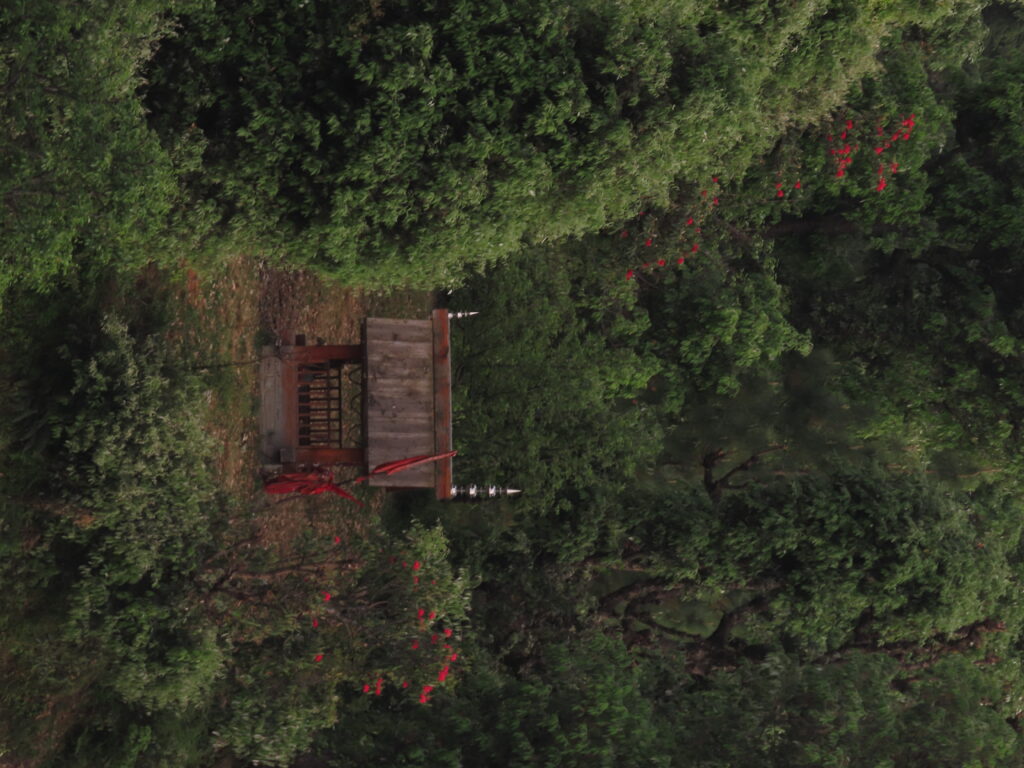
Nature’s shrine.

In a clearing below a wooden shrine sits next to flowering rhododendrons. The mountains are silhouetted against an ombre sky. Then as if a switch has been thrown the lights across the valley come on. The night light show is live! It can be magical when man and nature come together in harmony.

The night light show!


Fact File-

Getting there

By Road-

a)Take a bus for Manali. Get off at Aut. From Aut there are buses and taxis available for Tirthan.

b) Drive from Chandigarh either through the Shimla or Bilaspur route.

Fly in-

Closest airhead is at Buntar, Kullu

Staying

We stayed at Hema and Stephen’s home – Tirthan Eagle Nest.

There are resorts, hotels and homestays to suit all budgets.

Conscious travel tips

Carry your own water bottles.

Eat local produce.

Ask how your hotel/homestay deals with waste.

Carry your plastics back!

A Tale of Two Veiled Valleys: Part I- Shangarh’s Meadows are meant for Musing

‘I hope its worth it’ is more of a prayer than a thought on seeing the man’s tired and slightly irate face. ‘Don’t you bloggers ever write about the roads leading up to those picturesque places?’ He has just asked after being on a patchy mountain road with traffic for more than six hours which included being on dead stop in a traffic jam for an hour. Errr… apparently not! So FYI the road to Manali, and I suspect till Leh, is and will remain for some time a super mess. My morale rises in a bit when we turned off the highway and pass under the entrance gate of the Great Himalayan National Park which is a UNESCO World Heritage Site. The traffic peters off and the narrow road in mint condition stays that way mostly till Shangarh.

Discover a Tourmaline road in- Chushul – Chumathang – Hello Indus & Iridescent Colours!

Shangarh at the end of the road.

We pass a serene lake made by the dam at the confluence of Beas and Sainj, the mountainside disappearing into its depths . Crossing the Sainj River at Larji and hugging the mountainside we make our way up the narrow valley with air scented by pine trees, wild rose bushes and traditional wooden houses clinging to the steep slopes. Reaching the Shangarh Forest Rest House (FRH) perched up and at the end of a kilometer of dirt track with tight turns is the last discordant note in the road medley of the day. Some communication gap and lots of delegation ensures that there is no dinner as spoken about in the morning at the FRH. Fortunately an overstocked food basket with us ensures we are certainly not going to go hungry tonight… or for many nights to come! Nothing like bread, cheese and wine on a bracingly cold evening!

Read about a different palate in- Satiating Nostalgia Under the Winter Rain at Junia

Nature on Show

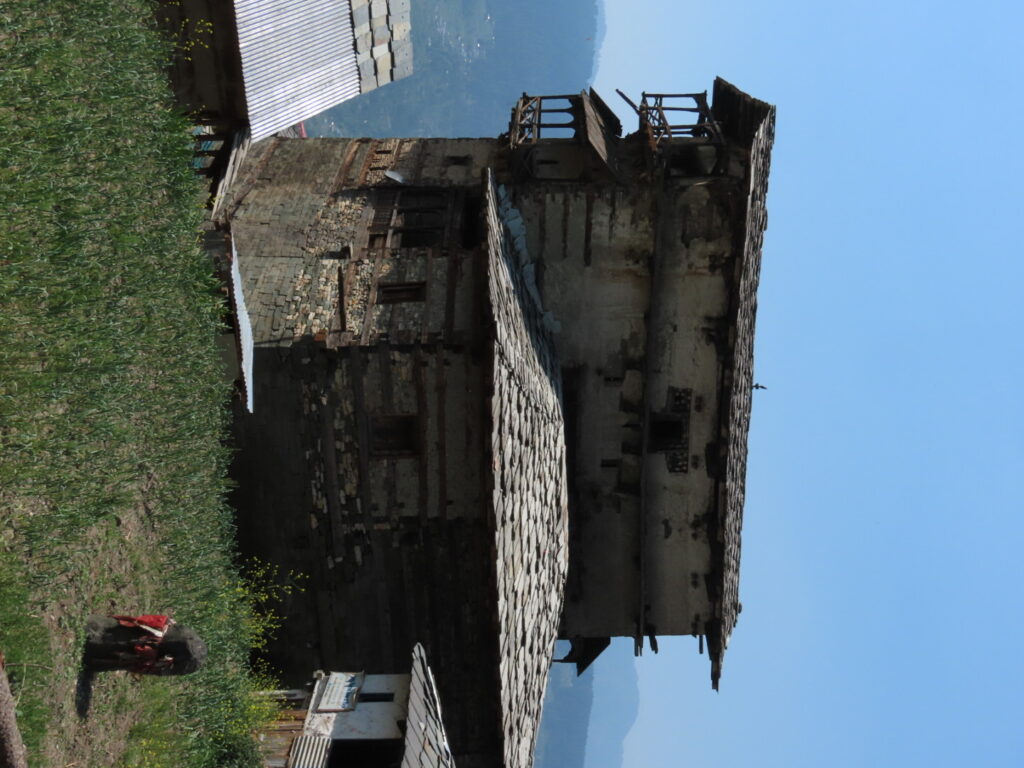
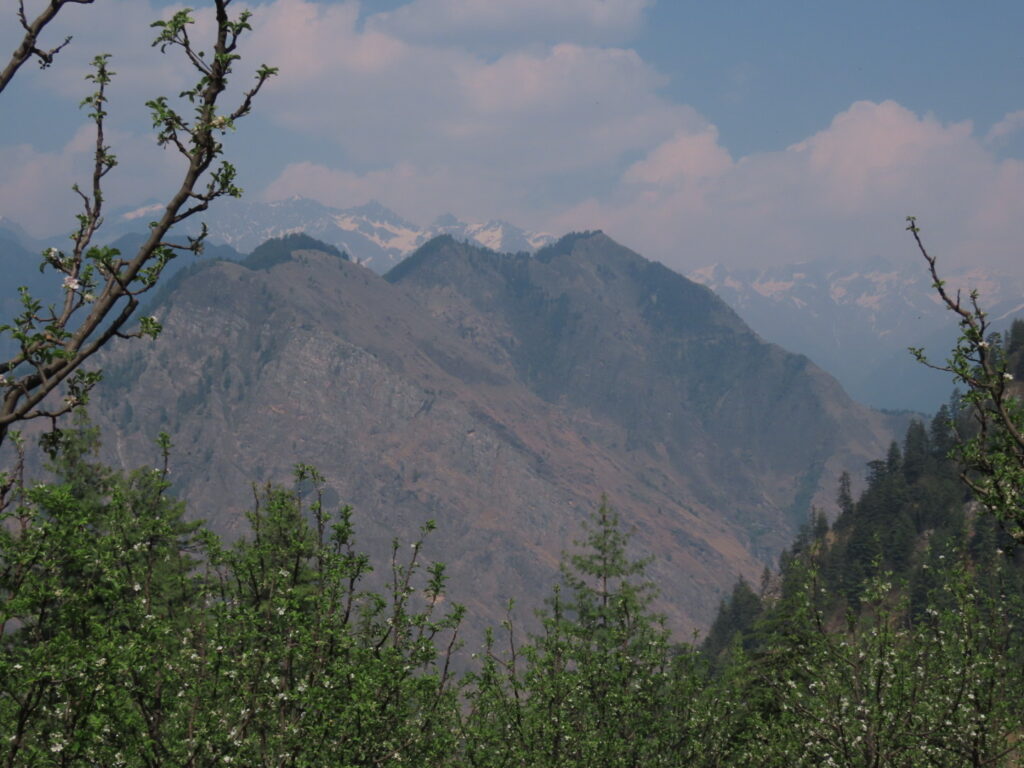
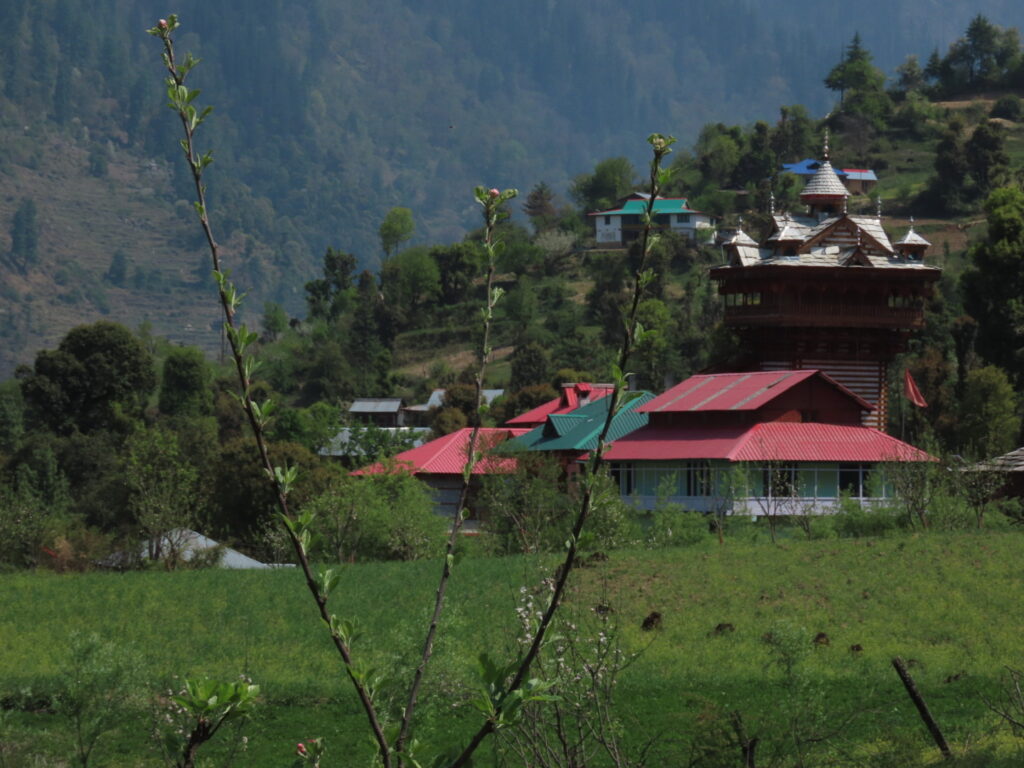
So Shangarh is like an amphitheatre with terraced orchards and fields dotted with houses and the FRH is placed on the highest tier. Morning sees us sipping tea and soaking in the sights from this vantage point. The apple trees are in bloom all around and birds are flitting about. The valley lies blanketed before us in what we think is morning mist but the caretaker tells us that there is a forest fire burning on the slope across. He then points out the ancient Manu Rishi temple on a sliver of an outcrop at the edge of Shanshar village across the valley. It’s 5 tiered roof catches the sun. The temple is dedicated to the fabled progenitor of the human race who gave us the Manu Smriti- the original book of laws. Snow-clad peaks in the distance make a perfect backdrop.

A temple like no other is in- Mystic Maheshwar : At the Center of the Universe

View to be had with morning tea.


God’s Own Meadow

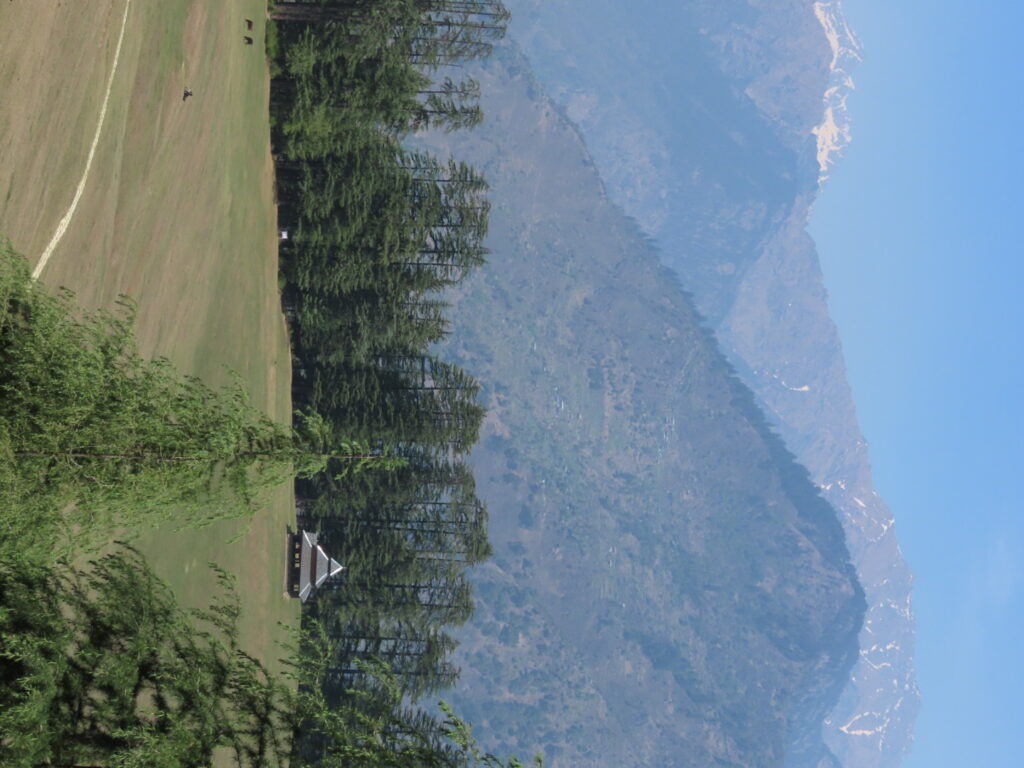
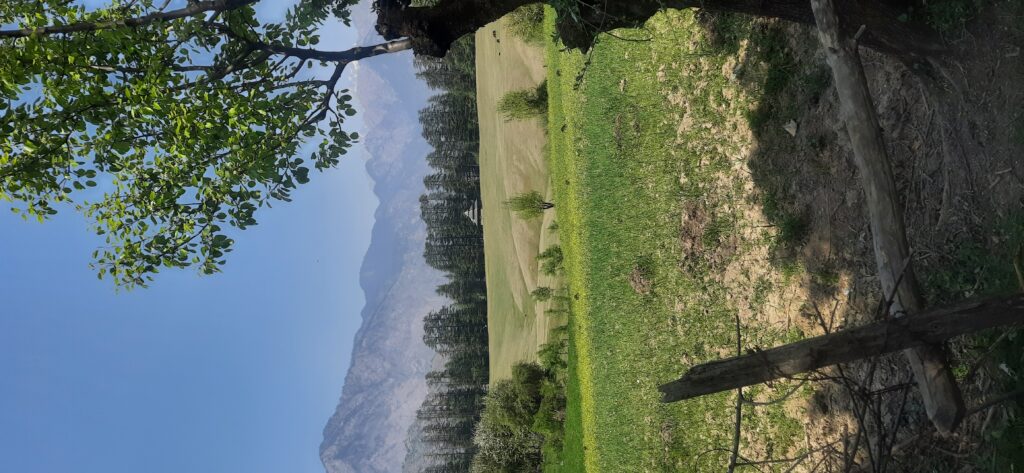
Later we follow him through the old wooden houses so typical of this area and new ones coming up as homestays to cater for the expected surge of tourists. We cross fields of flowering mustard, with cows and sheep grazing on grass made green by small waterfalls. Following an old woman and her herd we walk into the meadow and its unlike anything I have seen. Pristine undulating grassland ringed by mighty deodars… devoid of people almost! The breeze through the trees whispers stories of the Pandavas coming here, clearing this place of all stones save one pillar-like which juts out at an angle demarcating land meant for man and beast. The ownership of the meadow still resides with the Gods.

Discover a dying tribe of nomads in- At the Darwaza of a Road Less Travelled

God’s Own Meadow.

We sit on the slope and behind us is another stone, covered with a metal roof, lined with cylindrical wooden trellis which play out a clickety-clack every time the breeze teases them. We reluctantly rouse ourselves to explore the meadow after basking in the warming sun and just being. The temple in the meadow is all wood and slate and the inner sanctum is surrounded by a pillared veranda. The carvings depict among other gods the 10 avatars of Vishnu. One bears a strong resemblance to Buddha?! Nearby a grove of deodars is fenced off exclusively as the abode of Gods. Trespassers will bear divine consequences. Now who would chance that!

A Resurrected Abode

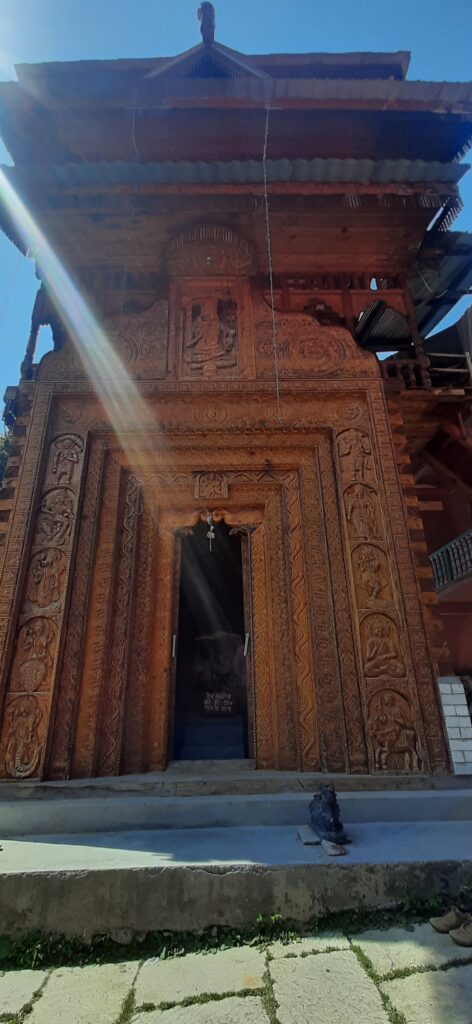
The shiny new roof of the Shungchul Mahadev temple made in typical Kathkuni style beacons. We approach the towering temple from the back as it sits tightly hemmed in by houses and fields ringed with fruiting trees and gape as we turn to the front. Its made of stone and wood, its wooden facade all carved, rising about three storey’s high with two wooden balconies. The original structure burnt down about seven years back but a replica has been resurrected . The only thing that survived from the original temple was the palanquin…and it is much needed!

Discover the temples  of- Part Two -The Old Gold in Outstanding Orchha

Rising Spirituality

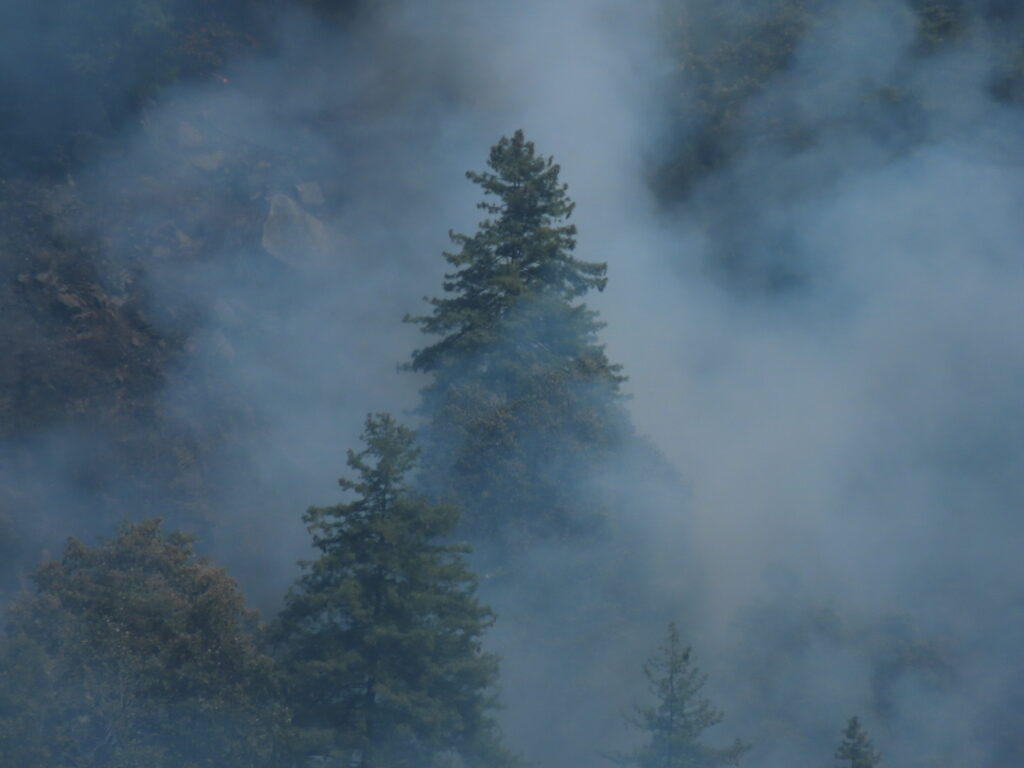
The evening goes in a stroll near the FRH crossing gushing streams, apple orchards surrounded by deodar trees , small cottages and camps catering to the young tourists. The breeze has made the forest fire pick up pace and its a blazing scar zig-zaging its way down the entire face of the mountain in front.

Forsaken Forest


Of Sacred Groves and Meadow Musings

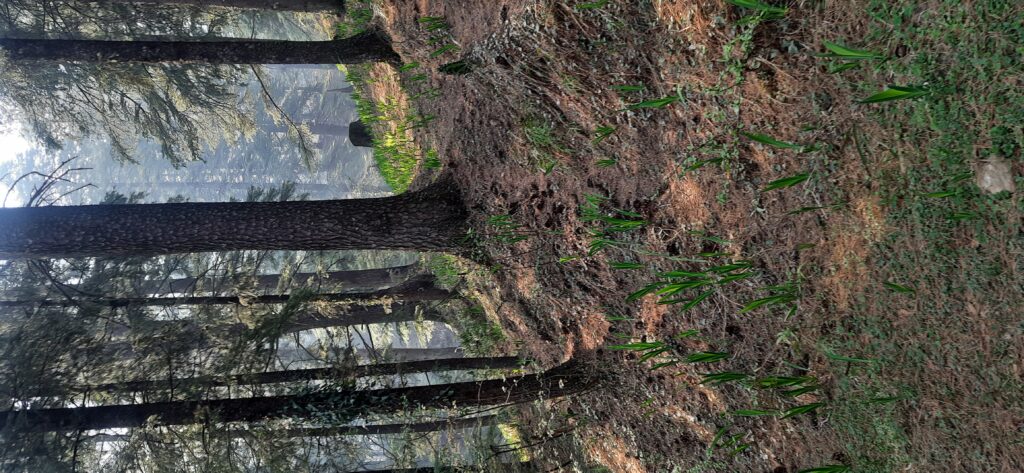
Next morning with packed buns, boiled eggs and a thermos of coffee we follow a young local guide as he leads us up to Jangaon (Ganjau) Thach. It is about half way to the famous Thini Thach which is like a pilgrimage for the locals. Thach is a meadow in local parlance. The initial climb is through a deep deodar forest but the sounds of drums far below rise up clearly. The Gods are making their way back to the temple from a nearby village where they had been invited for some function. Here the deities are extremely social, visiting each other and men alike and a whole procession accompanies their palanquin. The forest is hardly silent too. Birds are chirping everywhere but as any bird watcher will tell you- size and volume is inversely proportional. Its maddening to hear but not be able spot! We make our way through small clearings, cross a rich man’s vast estate and the forest department’s nursery where, enclosed by a low stone wall, a wooden shed gives company to a flowering tree.

Explore the meadows of Kashmir in- Tarsar Marsar : A Trekker’s Take

A colour changing carpet.

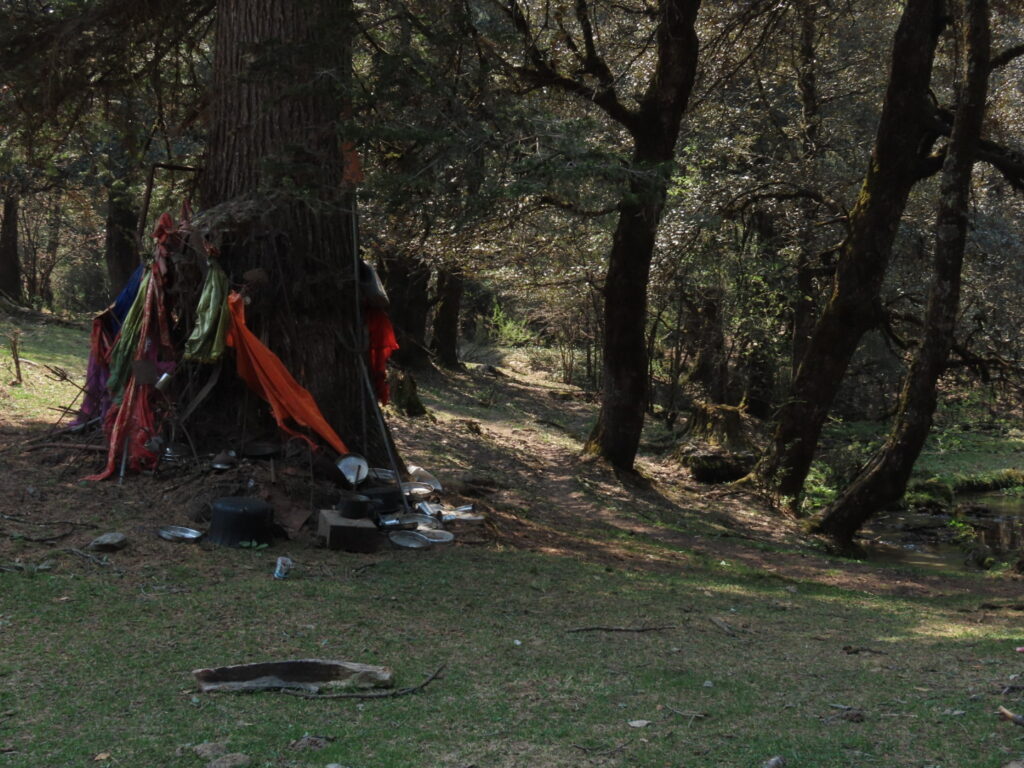
We cross carpets of iris yet to bloom and streams, one with an arched wooden bridge right next to a small yet cascading waterfall. The crystal clear water runs off in a hurry. Just short of the Thach we come to a sacred grove. It’s a flat piece of boggy land with a variety of trees and a loopy stream. A wooden hut stands at the edge and under a tree tied with bright pieces of cloth is a trident and an assortment of metal offerings to the forest goddess including cups, plates and maybe some cutlery too. (Under another tree I spotted a battered extension cord and a wheel hub. What the Goddess needs this for, only she knows!) There is something mysterious yet magical here.

Of Forest Goddesses and Funny Gifts

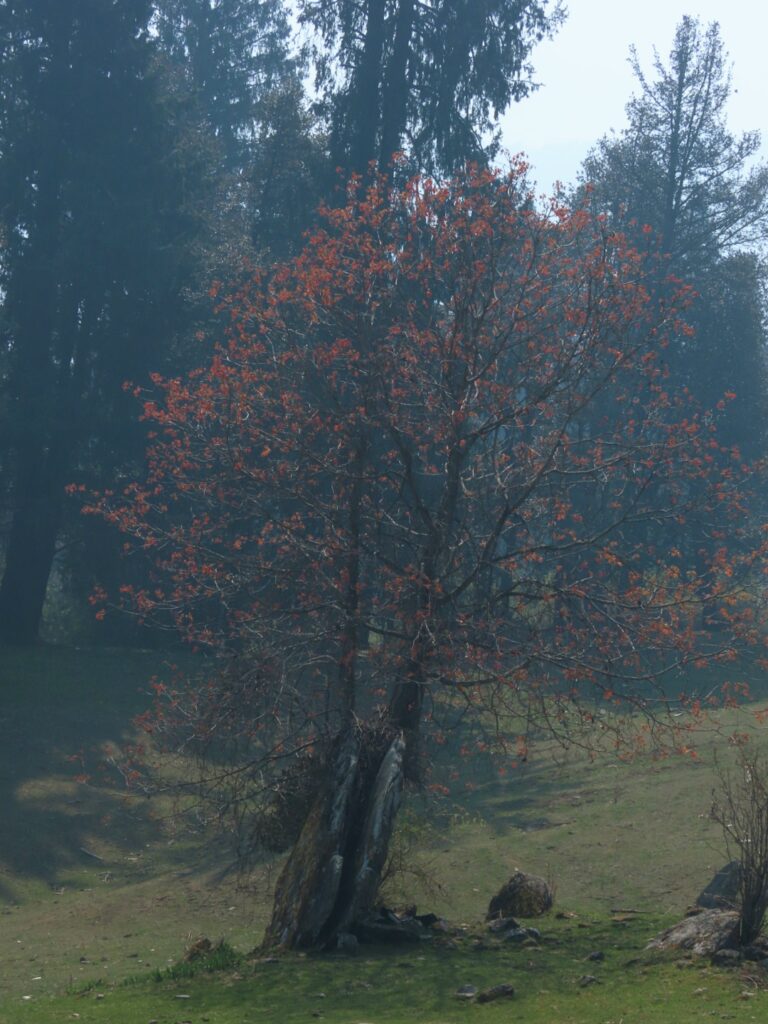
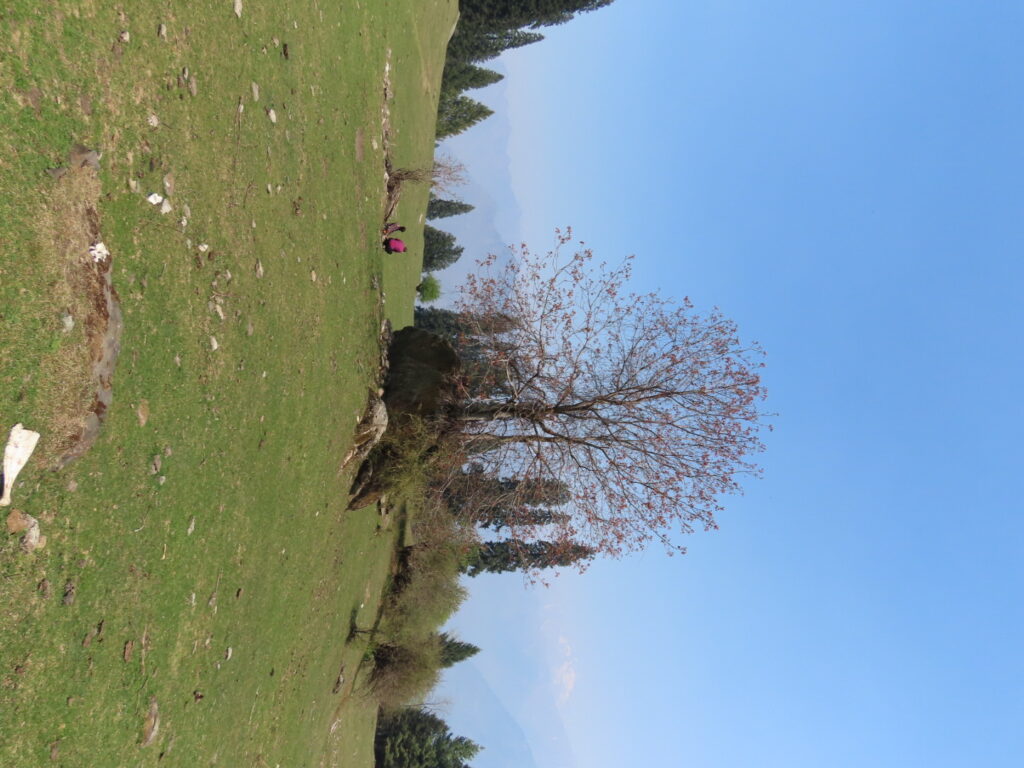
I reluctantly do the short climb to the Thach. The forest fire’s smoke is a shroud over the valley. The hazy sky, a pale version of its usual hue of blue. The snow-clad peaks around are barely visible and the cold air has a faint feeling of despondency. A lone walnut tree in the middle of the undulating grassy meadow has sprung out of and split a massive boulder into two. It tries valiantly to provide some colour with sparse red remnants of winter foliage on its branches. Tiny flowers here and there join the tree in its effort. We munch and muse over the subdued beauty of this meadow.

Memories of Winter

Since my toes are slightly done walking downhill we stick to a level ramble in the evening. Its our last night here and the temptation to use the room’s fireplace is too great to pass on and so canned baked beans and ready-to-eat pasta is our fare by the dying embers of a mellow fire. Richard Parker, the cat, on this road trip with us does not share our enthusiasm for the fire and I think of all the animals on the burning mountainside across.

Aflame here a flame there.

Shangarh is a slice of secluded serenity meant for just being. I truly hope it stays that way.

Fact File

Getting there:

By Road- The road from Mandi onwards is nothing more than a dirt track in patches due to of the widening work so avoid unless a)Its not your car, b) You don’t much care for your car, c)Its meant for off-roading.

By Air- The Buntar airport at Kullu is about 51 kms.

Staying:

The FRH at Shangarh can be booked online on the GHNP website.

We stayed at the FRH at Shangarh. It is clean but basic. The caretaker rustles up tea and simple fare, a bit reluctantly.

There is a Zostel, a few small homestays and tented camps.

Conscious Travelling:

Shangarh and other places in the Sainj valley are little more than overgrown hamlets. They have no system of garbage collection/disposal. Check with your hosts how they manage their waste. It will encourage proper disposal. Till then we visitors need to minimize what disposables we carry and if possible carry our non-biodegradables back!

Coming up next-  A Tale of Veiled Valleys: Part II- Bihar!


Part Two- What Not to Miss on a Weekend Vacation in Shekhawati

Chances are that when you search for places to visit in Rajasthan the 3Js will dominate the itinerary circuit. But Rajasthan’s treasure chest has more gems waiting to be discovered apart from flashy Jaipur, Jodhpur, Jaisalmer and maybe Udaipur. Having sampled the visual treat that Mandawa offered our appetites were totally whetted to try out whatever else the Shekhawati region had to offer. After much debate and ifs and buts we settled on Nawalgarh, Dhundlod, Mehansar and Ramgarh Shekhawati. Perfectly packed itinerary for a weekend vacation of discovering fascinating frescoes and haveli hopping!

We try to make an early start from Delhi and the highway is intermittently lined with mustard fields covered by a thinning mist as we make our way to Mandawa to pick up Om Ji, the guide from our previous trip. Through the drive to Mehansar the discussion veers to the trading practices of the merchants here. Apart from trading in opium, cotton etc, the shrewd businessman seemed to have literally extracted his pound of flesh through exploitative money lending practices from the hardy and poor farmer of this region, where the crops depended solely on the liquid benediction of the moody monsoon.

Read- Batalik – A Tribute to the Human Spirit to discover another lot of tough people living in a cold desert.

Mehansar’s Oh My Moment!

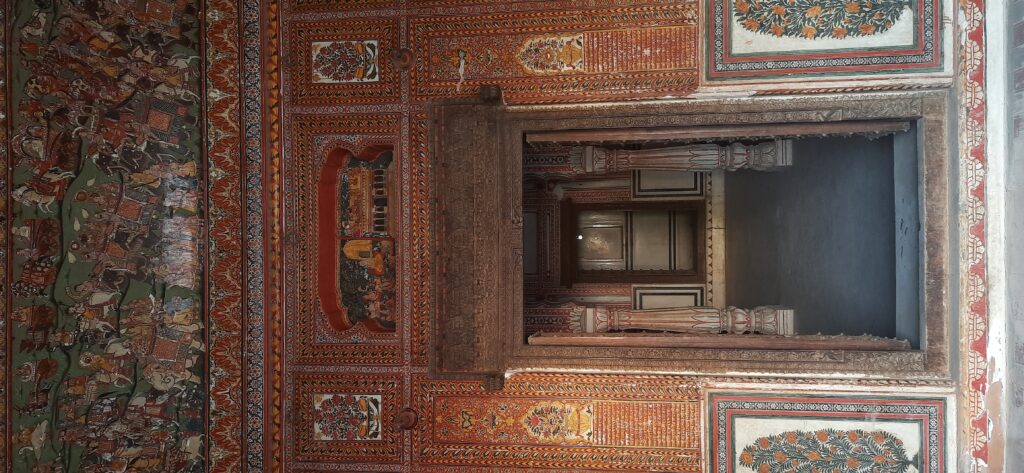
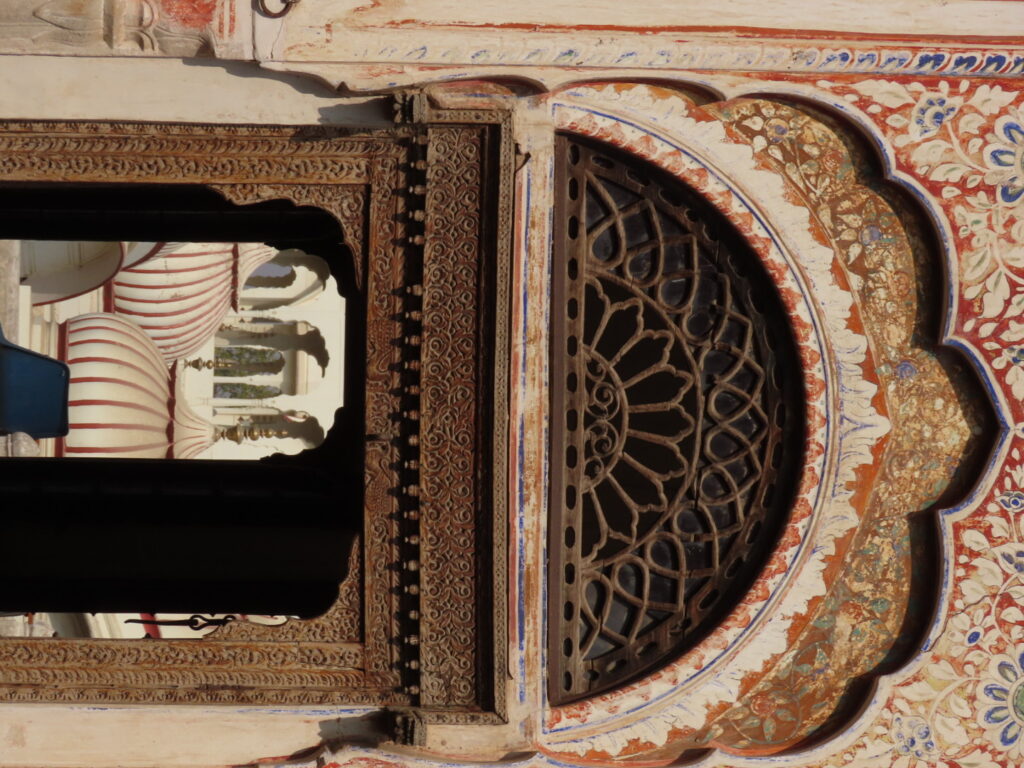
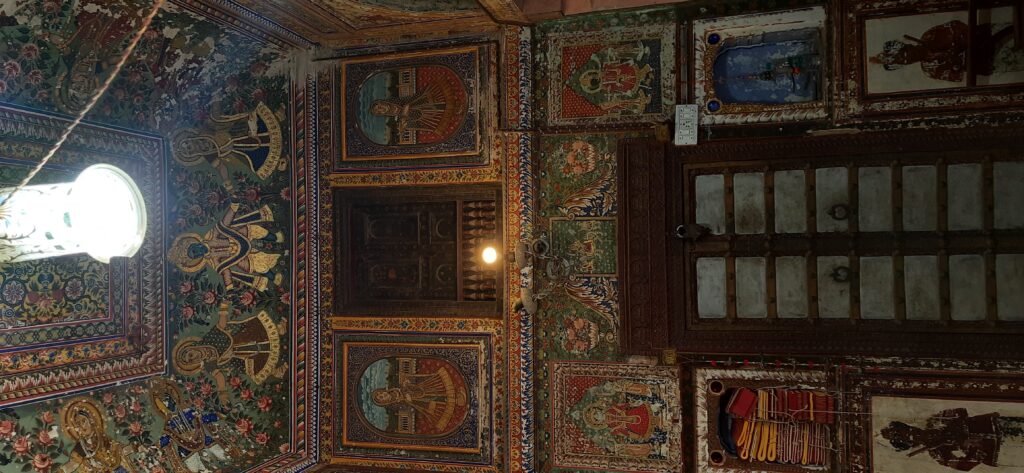
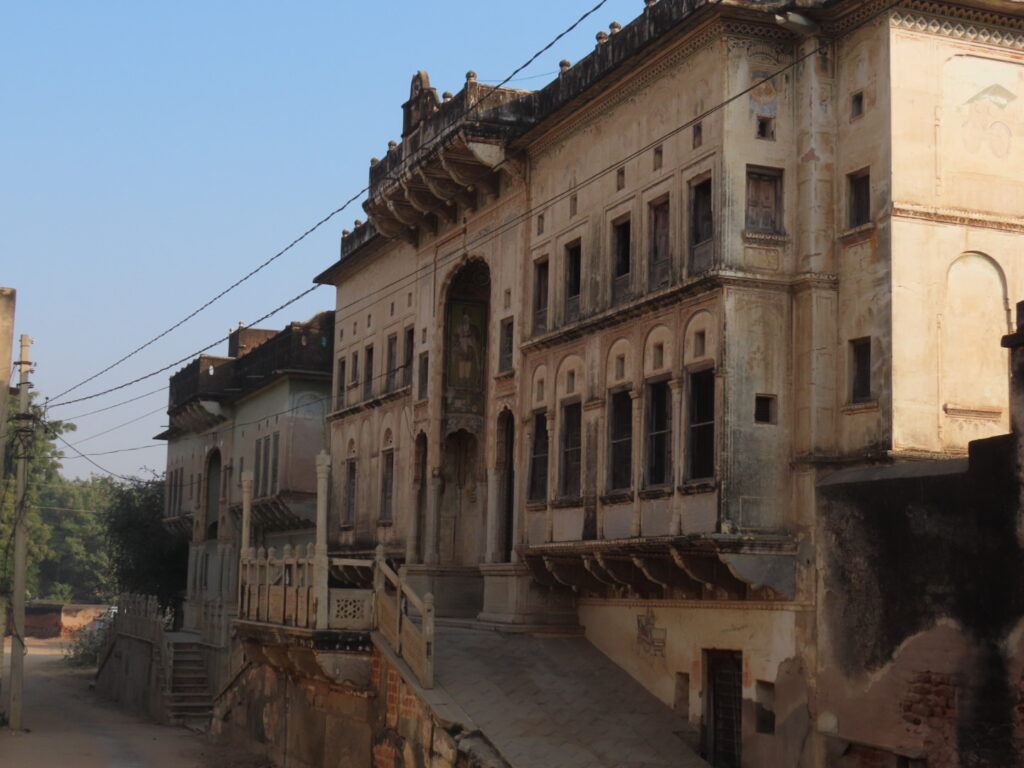
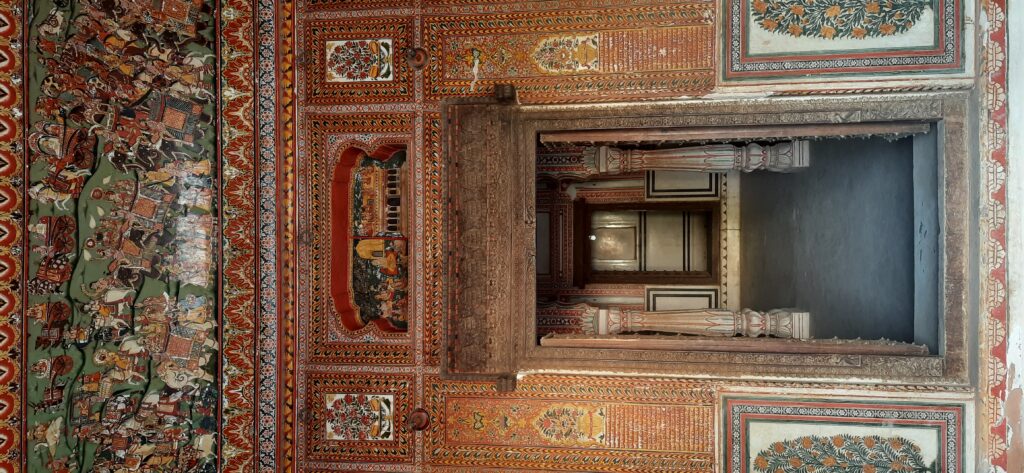
We stop outside a wayside unpretentious haveli at Mehansar. Here the room where business was conducted, in a deviation from the norm, opens into the street instead of a courtyard. An uncovered veranda lined by a drain sits between the room and the dusty street.  Om Ji gets the keys from the caretaker and opens a rather small door typical to this area. As the lights are flicked on we gaze up and around in amazement. It’s a room meant to awe the visitors and marvel at the owner’s refined taste. Every inch is painted in a rich palette.

Oh My indeed!

The motifs on the walls are in crimson red but its the 3 sections of the roof which are the masterpieces. In one section the Yamuna is a broad thread of dull molten gold running through the story of Krishna’s life around the roof. On the other side it’s the Ramayana with a ‘Sone ki Lanka’ in burnished gold. The 180 year old ‘sone ki dukaan’ as this room is called seems like a miniature version of the fabled kingdom. But its not just the use of pure gold in the paintings that is stunning, it’s the finesse with the which the miniature paintings have been done. The world outside looks infinitely drab after that stellar show!

I saw a show like no other at- Tarsar Marsar : A Trekker’s Take

Ramgarh Shekhawati’s Remarkable Chattris

Cenotaphs in Shekhawati be like….

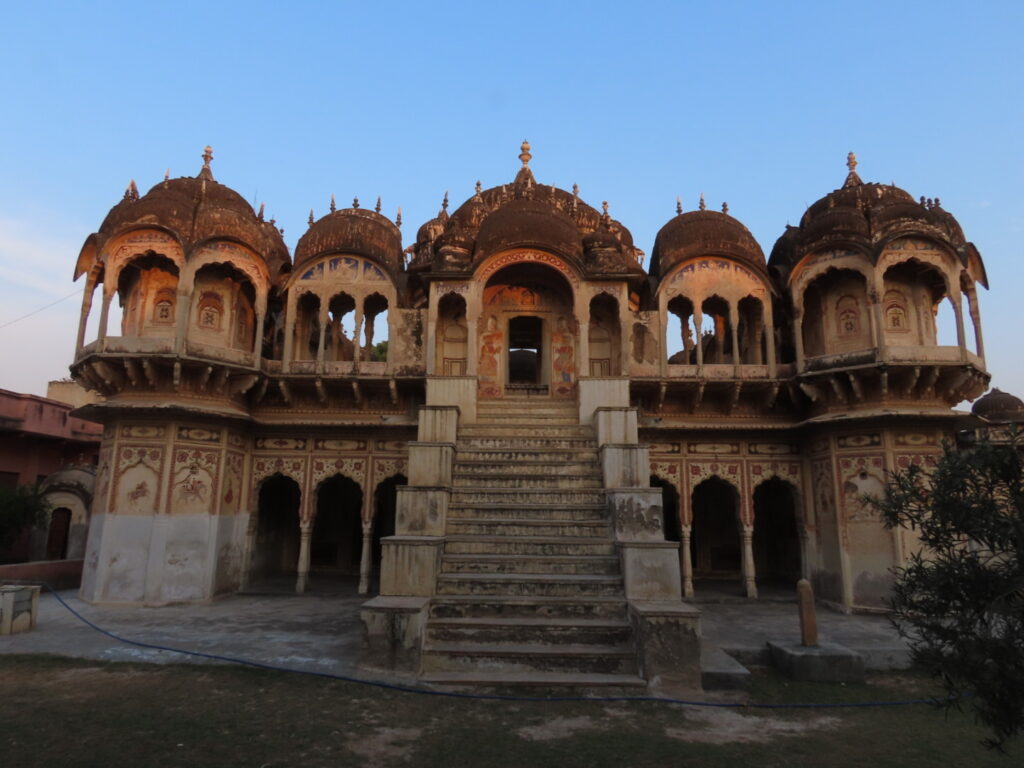
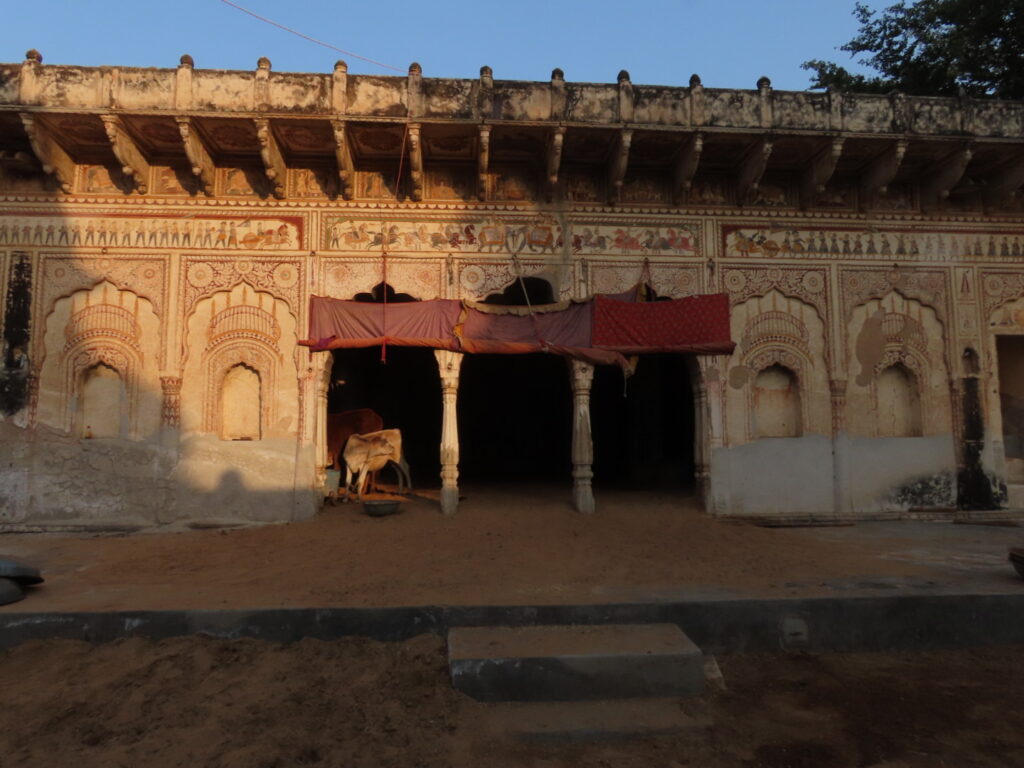
The drive from Mehansar to Ramgarh is a short blur and we wind our way past numerous wells and chattris enclosed behind high walls to come to the Poddar chattris. Built from 1872 onwards these airy pavilions have mandirs tucked inside in the ground floor which often doubled up as serais or inns. Wide staircases lead up to domes surrounded by arched balconies in this cluster of elaborate structures. The setting sun seen through the arches shines on the domes which have frescoes where Krishna multiplies himself endlessly to dance with each gopi around the roof. A Rasamandala. One can imagine these chattris making a dramatic backdrop for a cultural extravaganza. Unfortunately right now they’ve been usurped by someone who is using one of the arched structures as a cowshed. The cow’s kismet!

A cowshed like no other!

History and more dwells in-  3 Churches in Mhow: Discovering Obscure History and Outstanding Carols 

Traditional and Nouveau Art at Nawalgarh

Gods hang out together.

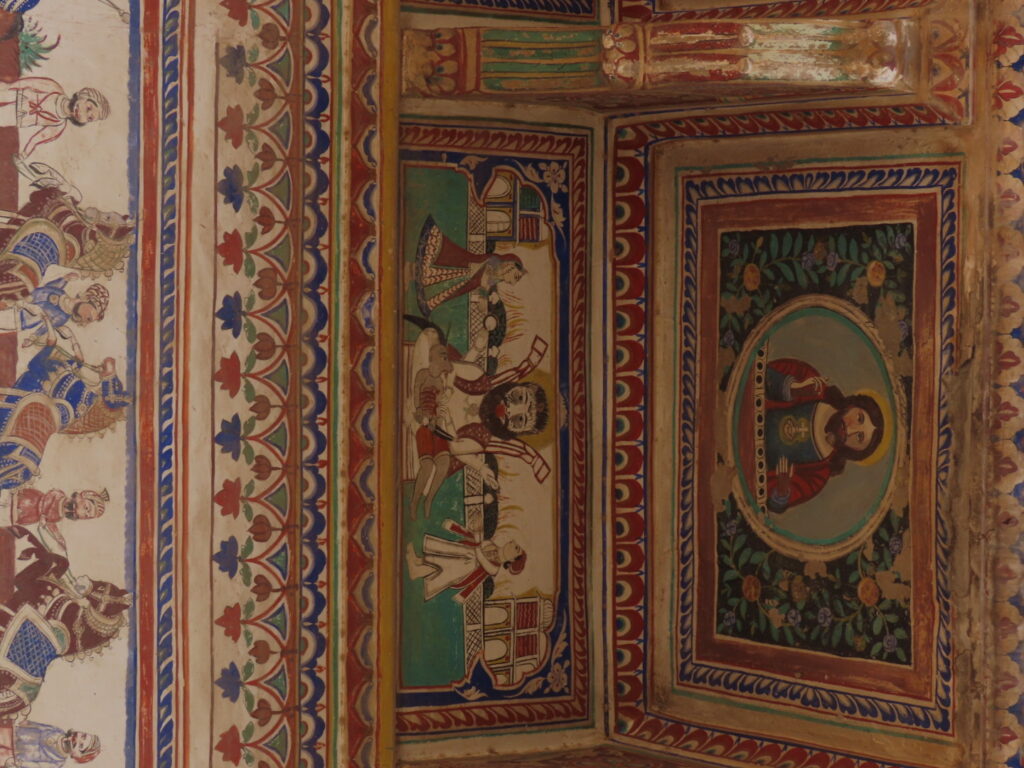
As  testimony to its wealthy past, havelis are scattered dime a dozen in the winding bylanes in Nawalgarh.  We head for the Morarka Haveli. Outside the mansion, under an eave, a portrait of a slightly forlorn looking Jesus is pointed out to us. I suppose his expression is borne out after years of looking at the dismembering happening in the panel below! In the outer courtyard a man plays a one stringed instrument, his voice rising to a melancholic crescendo. The music reverberates in the courtyard.

An artist’s canvas

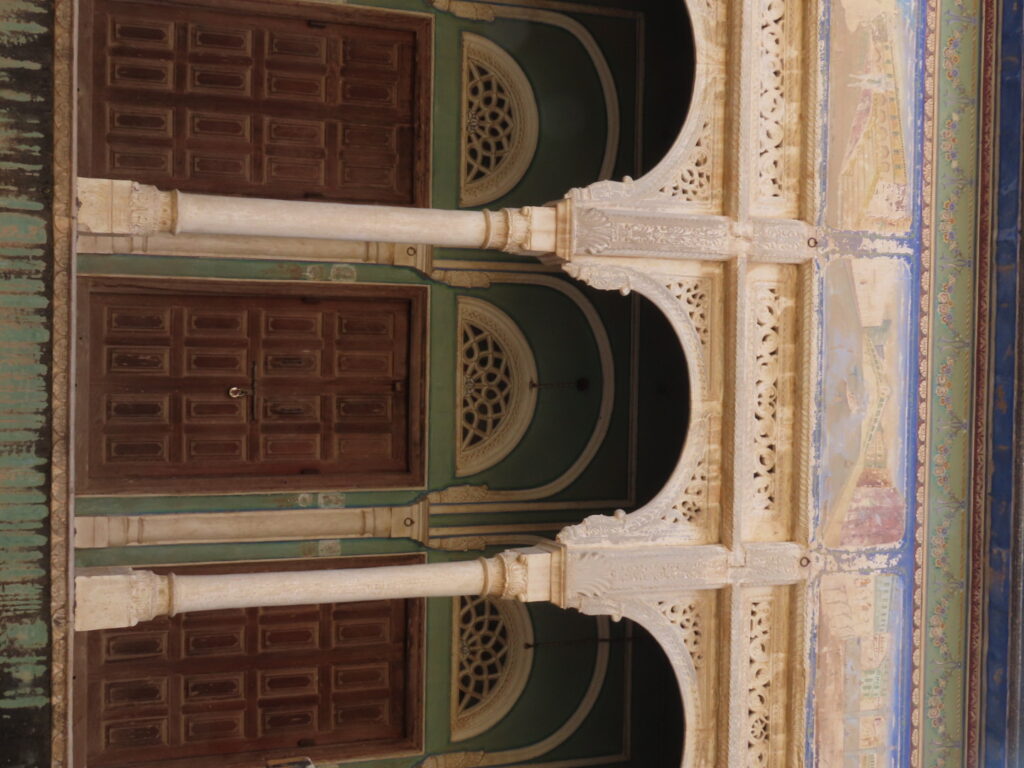
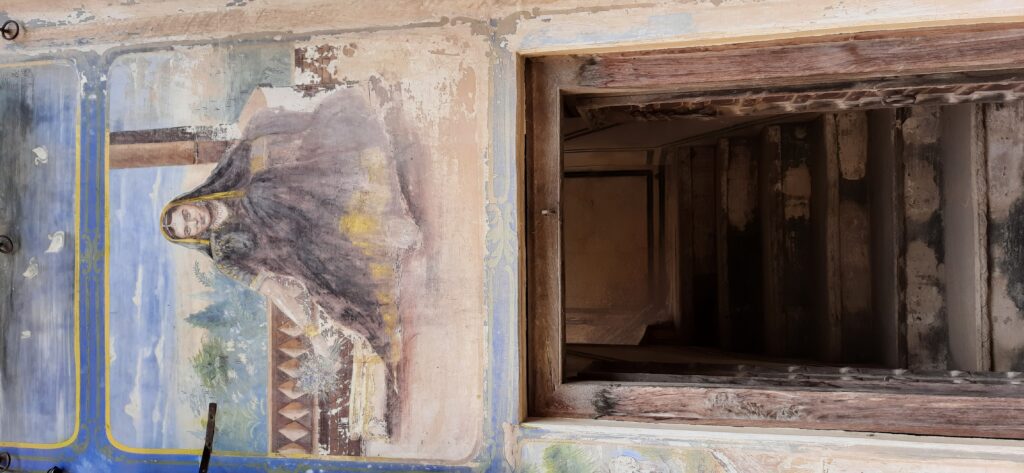
The inner door has bubbles of Belgian glass lining it. Stunning wooden arches hold coloured glass panes. The light filtering though makes them glow. A portrait of a young woman with pencil thin brows and a bindi with wings peers into the distance in a scalloped arch above a carved window frame. From the first floor one glimpses the pristine white and red lined domes of chattris across the lane.

Beauty has no lifespan.

Discover winged visitors of Rajasthan in – The Bird-book of Bikaner

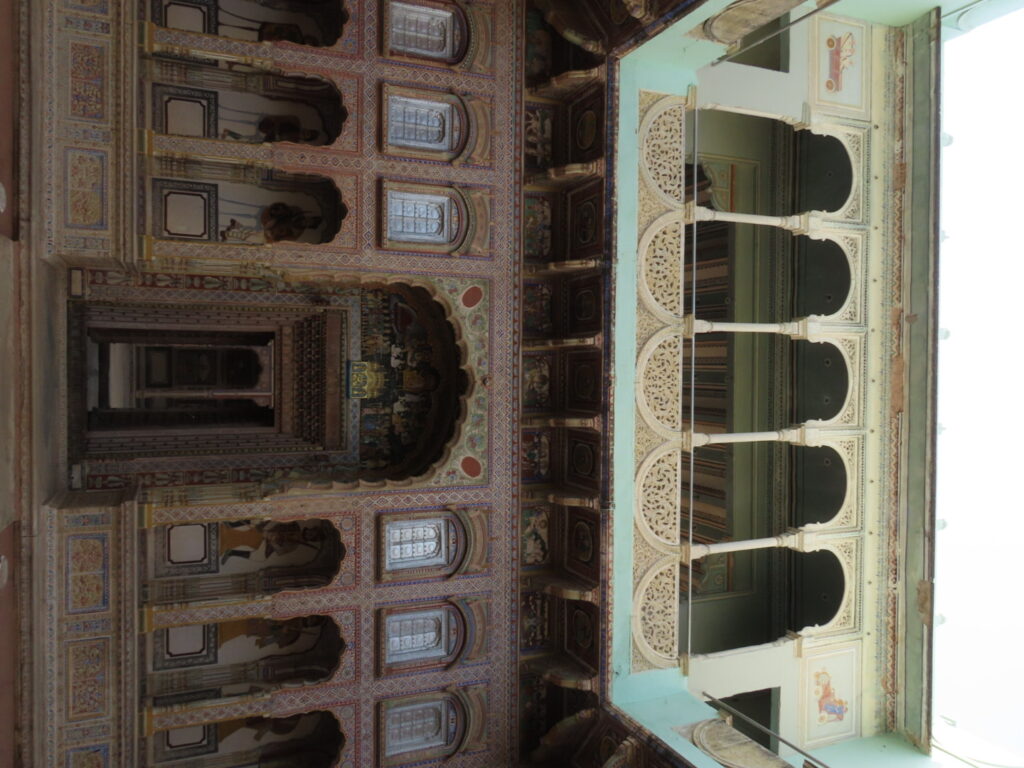
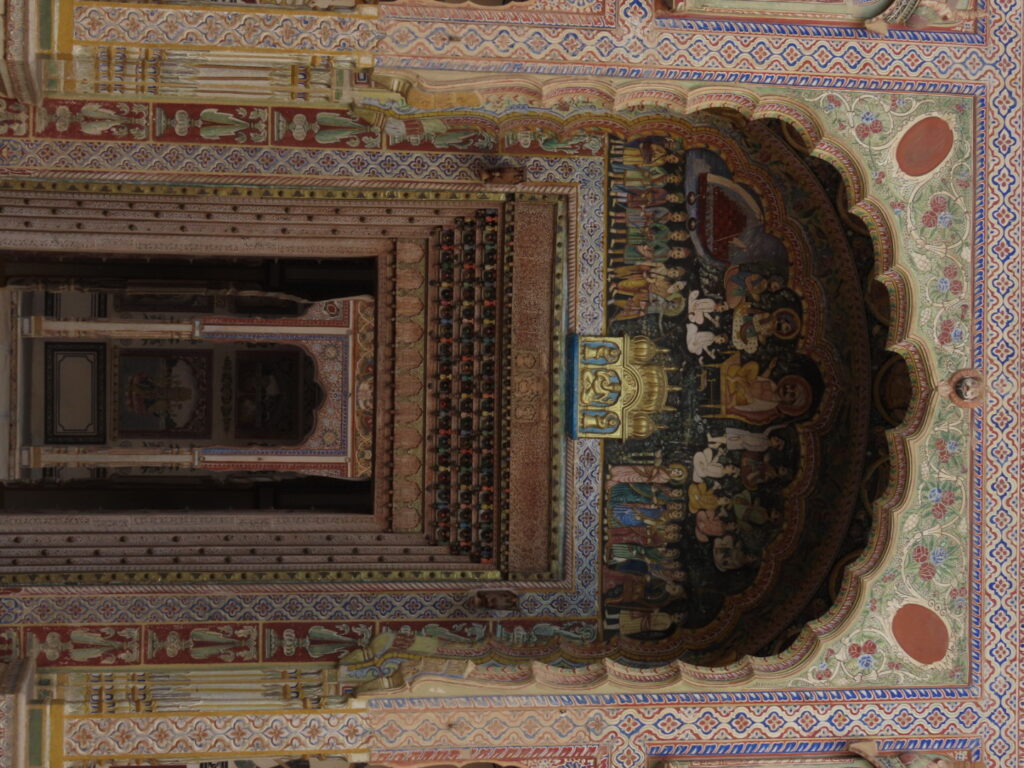
A lane away the Poddar haveli being run as a museum is a beautifully built, lavishly painted not to mention a very well maintained mansion. The first courtyard has more traditional elements and is covered with frescoes. The arch above the inner door is a piece of work where the owner and his business share space with various deities. A panel on a wall catches my eye where on one end a woman in a gown and parasol seems to be having a rendezvous with a young man.

Parallel universe

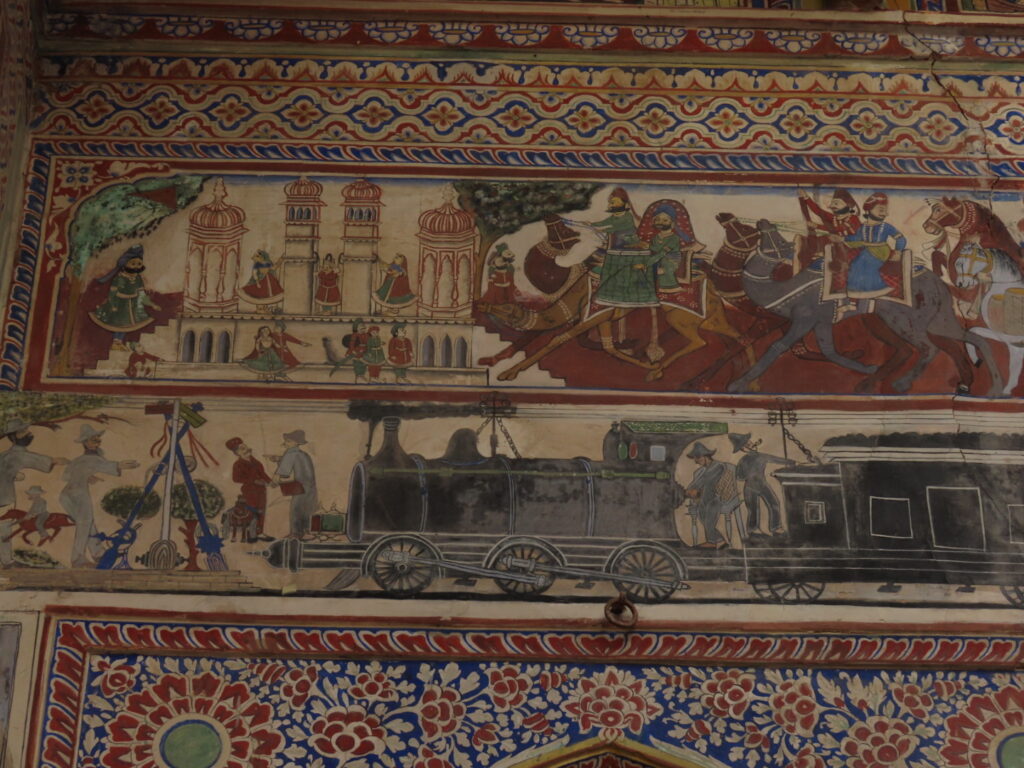
On the other a rather irate looking white man in front of a steam engine is haranguing with a local holding a red flag. Their expressions and details are priceless. A parallel panel above depicts a world apart with scenes of the local revelry and the gangaur festival. The upper floor in pale lime green finish has inverted carved arches holding up slender cream pillars. The rooms inside showcase various aspects of the local culture right from styles of turbans peculiar to each community to various houses of Rajasthani miniatures.

Kitschy elegance

A place like no other is- Chushul -Chumathang -Hello Indus & Iridescent Colours!

The Doors of Dhundlod

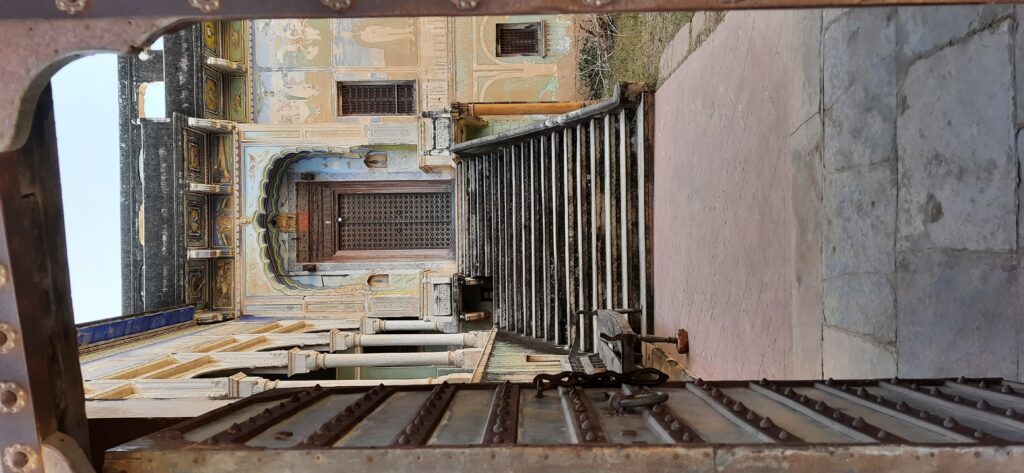
The final stop of the day is another museum depicting everyday life with life sized figurines at the Goenka haveli in Dhundlod. A wide ramp leads to the massive door of the haveli. The inner door is carved and studded with tiny pieces of ivory.

Objects of desire…

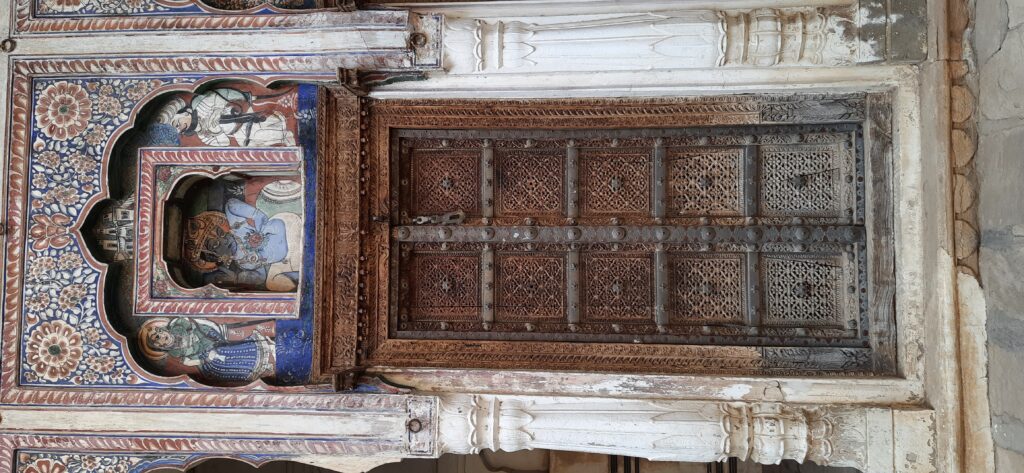
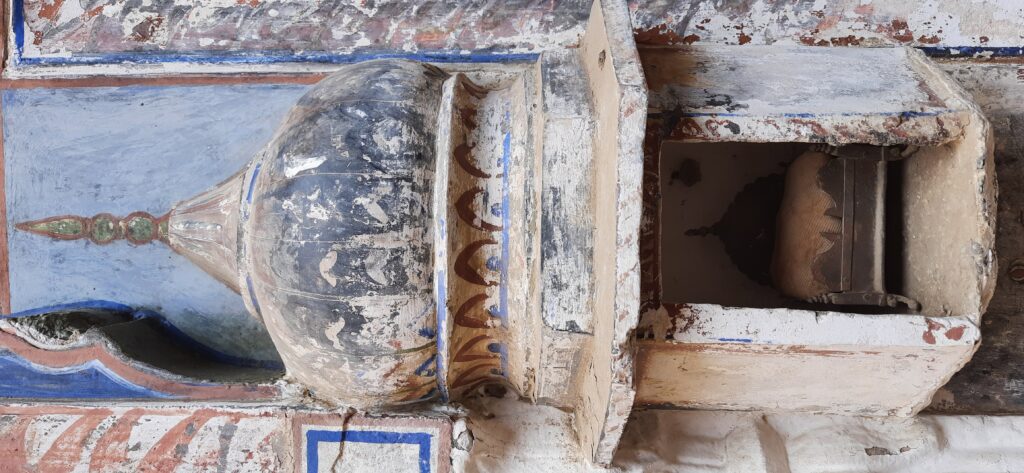
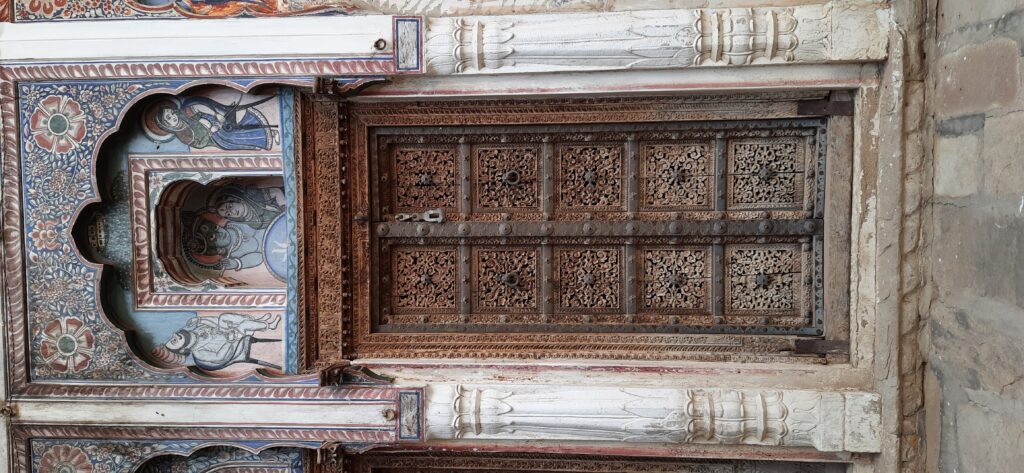
But the truly drool worthy, to have by hook or by crook are the exquisitely carved doors inside. Embellished with beaten brass each one is unique. The arches  above them painted with gods and perhaps members of the household. In a room with a big swing made of wood and inlaid with glass for a tiny bal gopal lie tattered catalogues and brochures with swatches of cloth en vogue in Calcutta in early 20th century. The inner courtyard wall has a small niche to holds a tiny throne to keep a saligram. The primal representation of god deserves one.

A Throne for a Stone

A place like no other is- Pangong Tso -The Gems in the Crown

Satiating all the Senses

Heading back to Churi Ajitgarh where we are putting up we stop to pick up some raj bhog rasgullas. The giant caramel coloured sweetmeats are supposed to be a specialty and to balance out the palate we add the ubiquitous mirchi pakoras and kachoris, served here with an interesting chutney of tamarind and curd. Sights done now its time to indulge in the smells and tastes of the land!

A must on a foodie’s plate is- Nasirabad’s Kachora: More than a Savoury Story

Shekhawati is a visual smorgasbord laid out for slow sampling and one needs to come back to the table again and again to appreciate its artful presentation and idiosyncratic ingredients. This vast region dotted with towns and hamlets is a bit like the rich rasgullas we had… one has to squeeze out some excess syrup to get the full flavor.

Fact File

1.Itinerary-

Day 1- Drive from Delhi to Mandawa and visit Mehansar and Ramgarh Shekhawati.

Day 2- Visit Nawalgarh and Dhundlod.

From Jaipur one will reach Nawalgarh first. So plan accordingly.

1.Staying-

We stayed at Vivaana Culture Hotel at Churi Ajitgarh. It is about 9 kms from Mandawa. It comprises of 2 adjoining havelis.

There are a few options in Mandawa, Nawalgarh and Dhundlod.

2.Entry Fee-

All the places we visited charged anything from 50/- to a 100/- INR.

3.Getting there-

The best way is to drive from either Delhi or Jaipur.

Part One – A Day Meandering in Mandawa

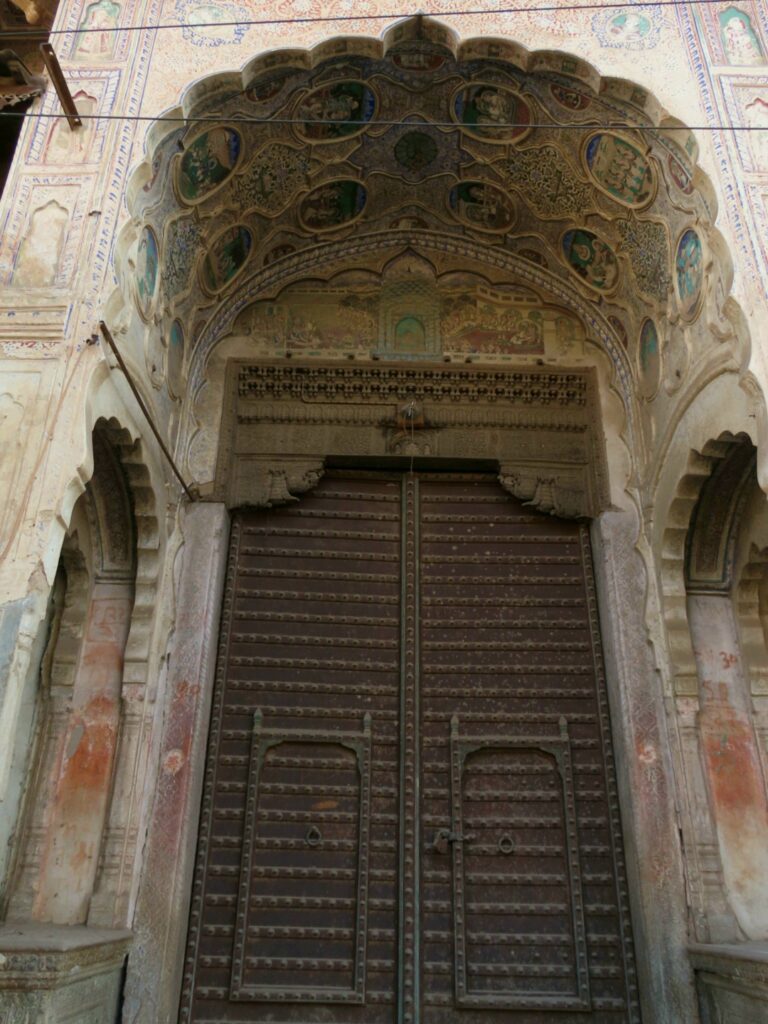
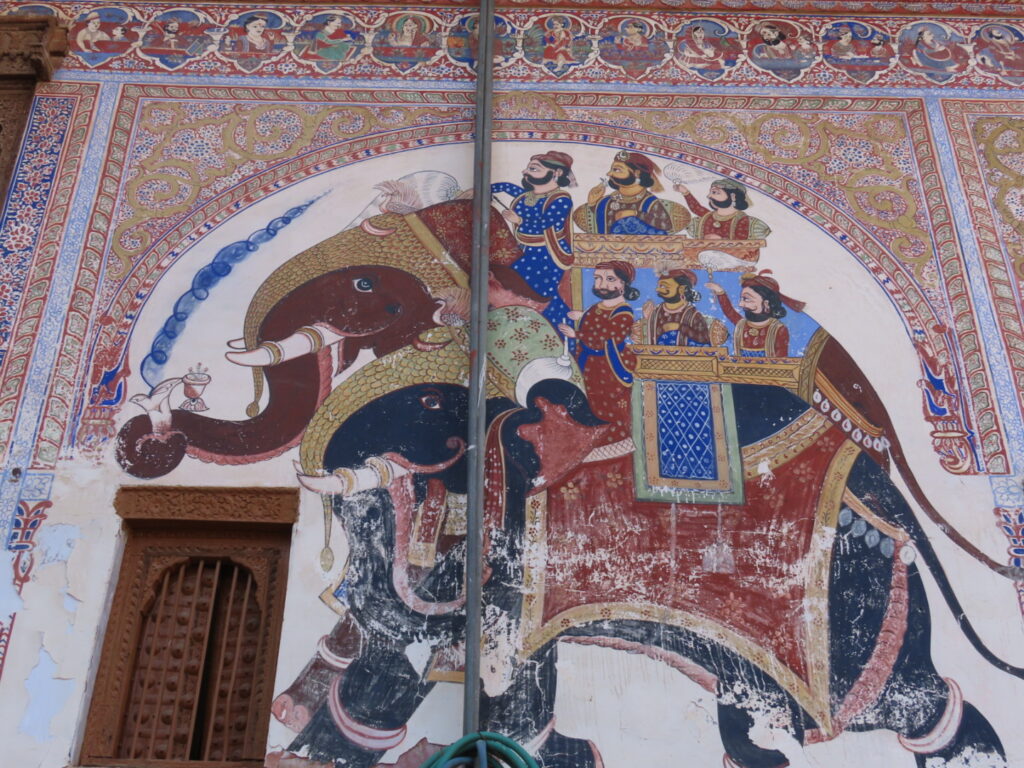
‘Stop, stop! Oh my God!!’We are navigating the winding lanes of Fatehgarh enroute to Mandawa and at a time when I should be looking out for the next turn on the map; I have been waylaid by the facade of a haveli. The resolutely padlocked tall door is crowned with a carved wooden frame but it’s the arch before it which looks like an art aficionado’s wet dream. The stone canopy in pastel colours with portraits in stucco lined oval frames and designs is a masterpiece in itself. On a side, the veranda’s wall has jumbo sized elephants on a march, safe behind a cast iron grill with Queen Victoria’s profile. Welcome to Shekhawati! Where the mansions lining the dusty lanes don’t hold art but are objets d’art themselves.

Gasp and Gape!


Time and Space Warp

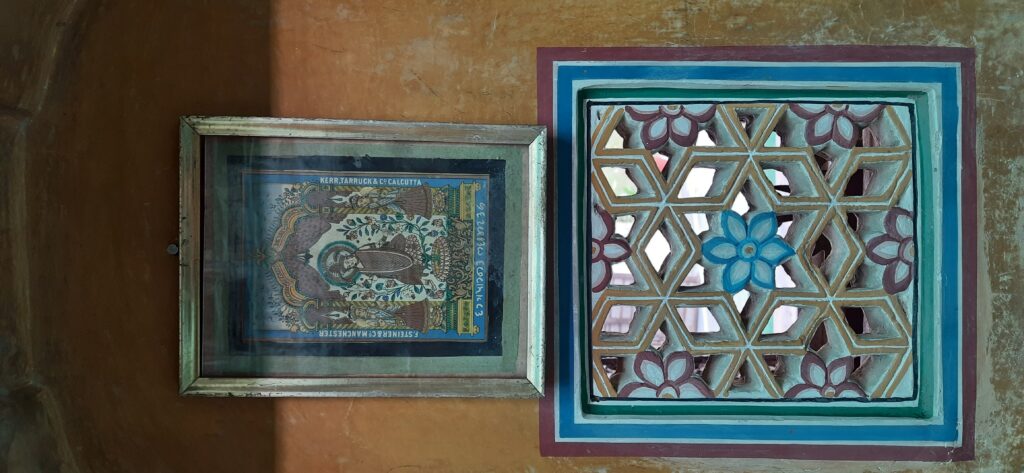
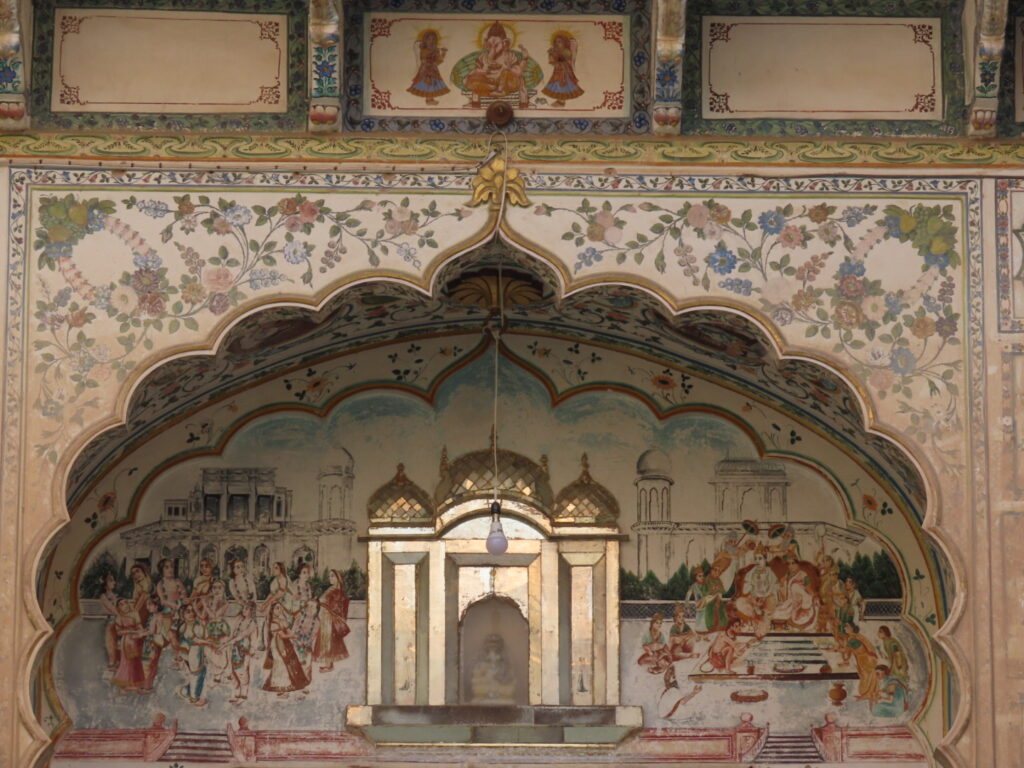
The drive to Mandawa is dotted with lush golden green mustard fields. The colour of eye tonic in a desert! Driving into a charming market street tells us we have reached our destination. Our guide for the day is waiting for us outside the most prominent landmark of the town- the fort. Acquaintance made, we dive behind Mr. Om Shekhawat (Can’t get away from them in this land!) into a narrow path outside the fort wall and emerge beside a tiny well preserved haveli. The frescoes look fresh but the imagery is old and on the arch flanking Ganesha on one side the marriage scene of Shiva-Parvati plays out and on the other Rama is dealing with Shiva’s bow at Sita’s swayamvar. Nearby another haveli has been refurbished into a small hotel. Outside the fading frescoes show a man in riding boots and hat on a chair while a woman plays a gramophone on a veranda with a peacock pecking nearby. Inside I find framed prints of mythological figures with reference to a trading company in Manchester. Time takes a quantum leap in a short space. We discover through the day that time and space has a kitschy co existence on the walls here.

Time stands still at- Mystic Maheshwar : At the Center of the Universe

Mythology travels far.


Timeless Template

A touch-up

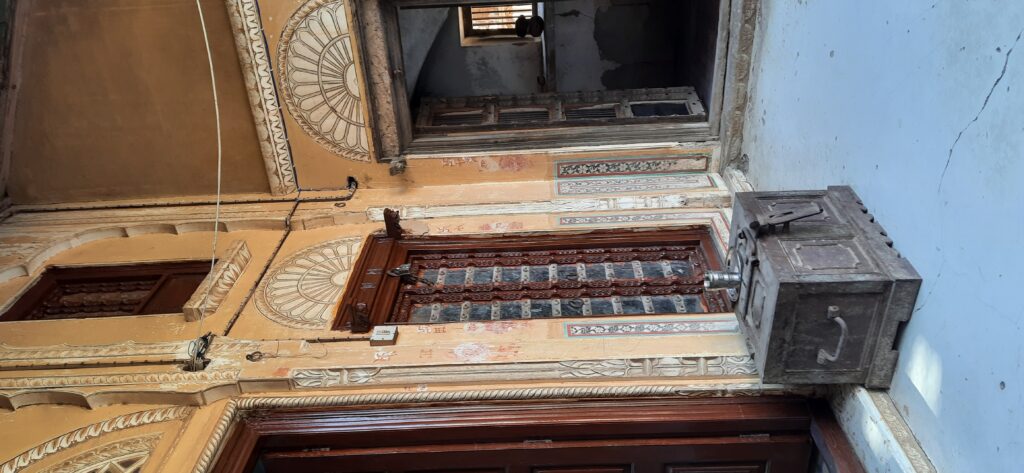
The Chokhany double haveli turns out to be the ancestral property of a classmate and is set inside a joint compound. One is being restored. It is an introduction to the architectural template of havelis. A ramp leads up to the main gate. As one steps through and into the common area, next to the stairs leading up to one haveli there is a room with a veranda. With wide doors this room is where business was conducted and guests received. A solid iron safe sits next to a door like a doorkeeper. There are small balconies within where the women could discreetly join in and eavesdrop. The punkhawala sitting outside whose entire purpose of existence was to keep his master cool had no such insights into the dealings. Preferably he had to be deaf to do this job or at the least the ears would be plugged with cotton.

Keeping the secrets safe.

The carved door to the main haveli has torans hanging on them. Put up during a daughter’s wedding for the groom to touch before being let in, I thought they are taken down subsequently, but not here. Inside is a courtyard surrounded by bedrooms, common dining areas, kitchens and a narrow room to keep the most precious commodity here-water. The walls plastered with crushed shells are still lustrous and cool to touch. In an old system of rainwater harvesting the drains around the courtyard fill up a tank below. The servant’s quarters are on a side in the base and they open into a big courtyard for livestock at the back where the colours of the curving corbel have weathered the vagaries of nature beautifully. The twin haveli is a mirror image.

Endless Art

Experience living the Shekawati life at- Dera Jaipur: A Homestay for Stellar Style and Exceptional Experiences


Shade and Succour.

Well Watered

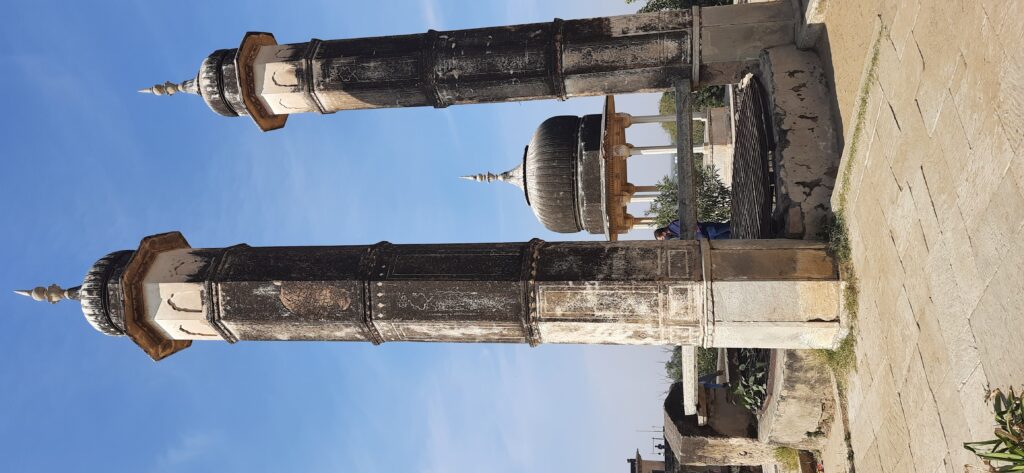
Driving in this region one has often glimpsed wells marked with pillars. At a place near Jhunjhunu the pillars were shaped like slender spires of a temple. Mandawa  is dotted with these tall markers. Four columns denote a public and two a private well. A rambling walk with glimpses of artists restoring a recently bought up haveli brings us to Mandawa Kothi. There is a private well opposite it. Like the houses here it has a high plinth and seems fathomless. There are small chattris on all corners and small tanks with spouts to store the water drawn up by animals. It would be an ideal place to congregate in the evening.  It’s steps look invitingly perfect for a cup of coffee this winter morning too.

Discover the colours of a stepwell and others in-  Harlequin Holi at Todaraisingh


Oh so Opulent

The business of being rich.

An art deco building near the Jhunjhunwala haveli looks like a movie set has been transported straight from Marine Drive. The owner of the Jhunjhunwala haveli, to show he had arrived, lavished not only riches but attention on the interiors of his ‘business room’. Every inch is painted in rich hues with ethnic motifs and designs. Family portraits vie for attention with mythological ones touched up with real gold. Account books still lie stuffed into niches.

A niche experience by itself was  –Disconnecting with the World on a Mountain Isle at Shaama


Italian Hangover

Armchair Travelling

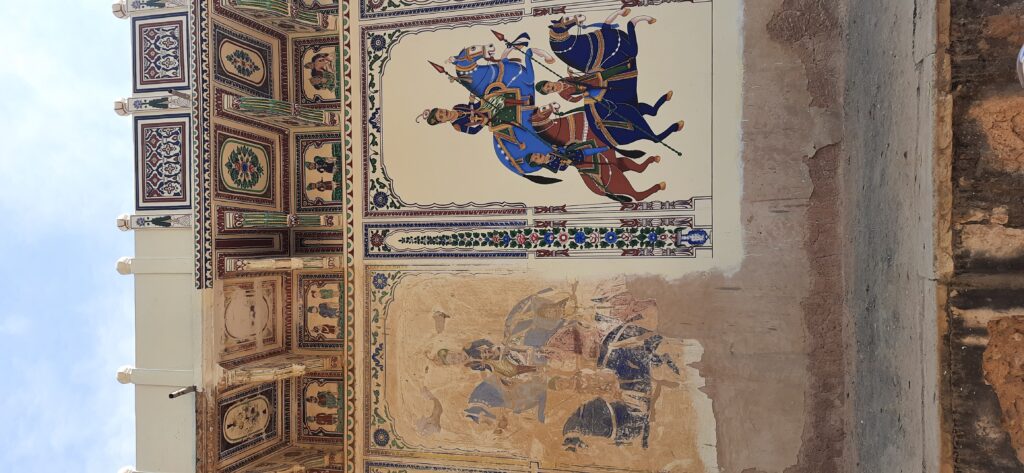
Opposite the Goenka haveli with its contrived chaos full of bric-a-brac inside and interesting frescoes outside stands the Robin eggshell blue Murmuria haveli. The eaves have sceneries from much greener pastures with lakes, conifer trees and sunsets over mountains. It stands apart as a whimsical piece of art with an Italian hangover. A slightly defaced Nehru/Bose astride a horse waving the tricolor in the courtyard would beg to differ. It’s owner visited Venice once and described it to an artist who probably never stepped out of this area. In a testament to the artist’s imagination, as fertile as his paintings, he reproduced an entire brochure of Venice complete with St Mark’s Square etal above the pretty arches in carved stone of the veranda. On another wall a beautiful woman stares the world down, far from the coy and comely images here. I wonder who she was to be immortalized so….

Stairway to Heaven

A Bard Sings a Story in Jhansi – To immortalize another woman…


Fate Nails Some Fails Some

A dark story of neglect

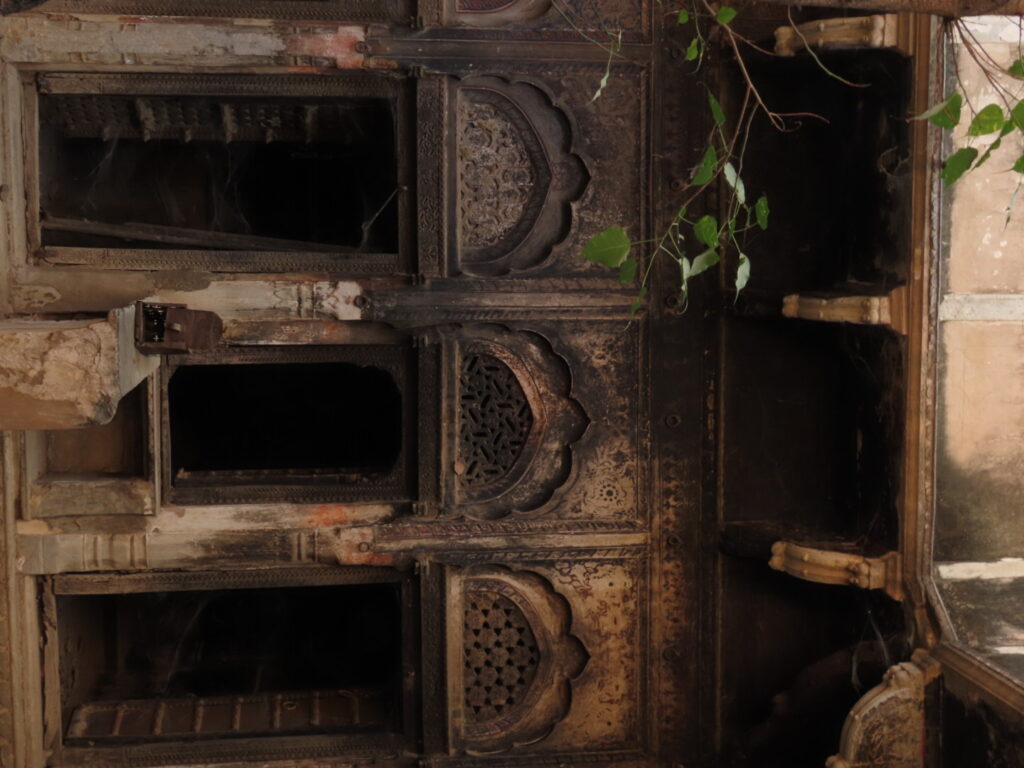
One of the Goenka double havelis adjoining the Murmuria haveli has recently been opened after decades. A long train with all manners of assorted passengers makes for a panel just below an overhang. In the neglected years a peepal tree has thrived in the inner courtyard where the fine woodwork and arches can barely be concealed by the blackened walls. Outside a fresco with a chillum smoking elephant ready to go on the rampage is being touched up. Today, only the bulls are loose in the lanes and the man has had to show off his matador toes occasionally to avoid being flattened like a cow pat!

Revival looks like…

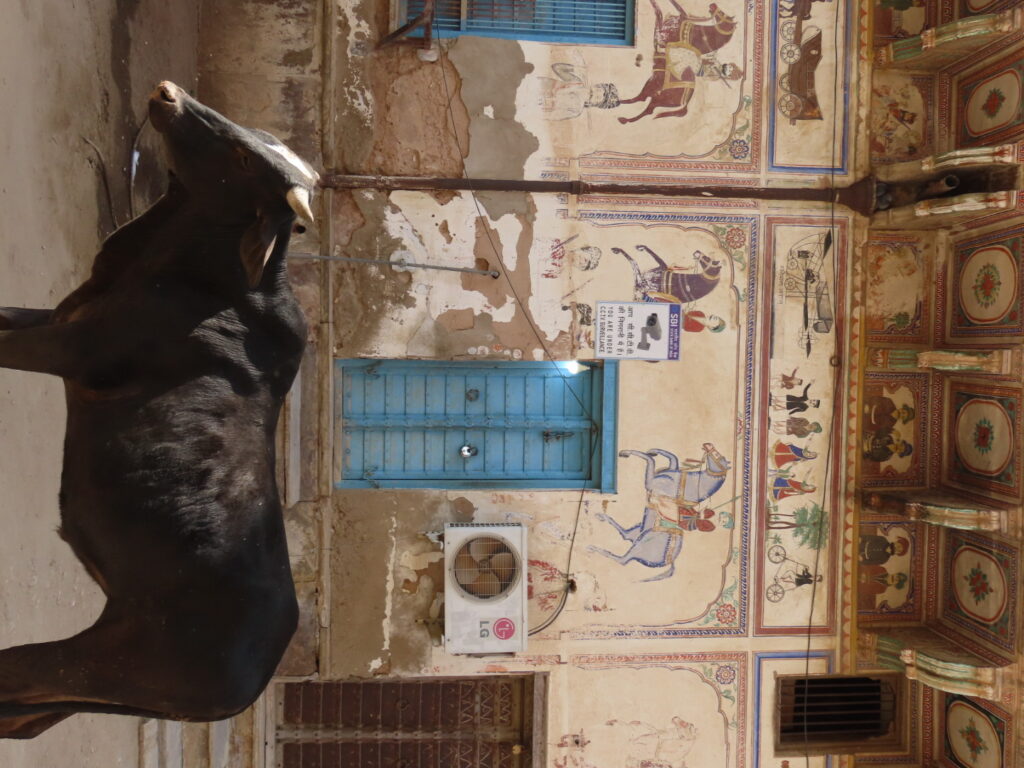
In the main market we cross a cobbler with his orders in Urdu nailed to a tree and come to a haveli now housing a bank. It has a side show of the wonders of modern inventions in faraway lands enthralling the locals. I really doubt the Wright brothers flew over Mandawa! Unfortunately the wall is also defaced by modern contraptions of today.

Beauty and the Beasts.

There are havelis waiting to be explored still in the meandering wide lanes of Mandawa but even on a winter noon the sun is now beating us back into cooler confines. Another time, other places to continue our sojourns to Shekhawati….

Fact File-

1. Distances from Mandawa-

Delhi- 250 km

Jaipur- 170km


2. Places to Stay-

There are some havelis which have been converted to small hotels.

Mandawa Fort has an upscale hotel called Castle Mandawa.


3. Most havelis charge an entry fee now, varying from 50/- to 100/- per person.

4. Best time to visit- Nov to Mar. The nights will be cold and days warm.

5. Keep the walking shoes on even if you feel they will spoil your Insta pics!

Sojourns to Shekhawati

What will we do with a door? The man asked for the nth time. Hang it above our bed like a canopy! I replied somewhat irately. On a flying visit to Jodhpur many moons back I had only one agenda. On the hunt I fell for these doorframes refurbished as bookracks. Stunnnning! (Someday…) This tall Gujarati door with its edges finely carved caught my eye. (Yeah, free guide to the doorways of India thrown in!). In the last warehouse, tiny doors connected these gargantuan halls, much like Aladdin’s cave interconnected in parallel portals. Stepping through to enter the last one something leaning on the wall behind stacked up furniture caught my eye. I made my way to stand in front of my door. A Shekhawati I was told. Since the territory had been the bulwark of the Rajput kingdoms to its south against marauding forces,  diminutive doors  made entry difficult and the metal embellishments reinforced their strength. A bit of a tall story about the small size…The tall gates of the havelis of Shekhawati, never mind the forts, would tell the small door to get back inside where it belonged and let them do the job of defending.

Where it belongs…

Year of the Backyard

Living in Shekhawati’s neighbourhood, through the Year of the Backyard as I call 2021, we had decided to stick to exploring places in our vicinity. One day sifting through some Facebook (it does have some redeeming features) pics I chanced upon stunning visuals of the havelis of Shekhawati. Wow! Art, architecture, history! Throw proximity in the pot and the recipe for an outing was complete. But let’s delve into the story of the region before we embark on a walk though the dusty hamlets and quaint towns that are a living art gallery.

Backyard also includes- Bikaner’s Merchants and Their Mansions

Backyard Blooms

The Territory, Thikanedars and Traders

Shekhawati, the land of Rao Shekha and his descendants, was established as a separate principality when Rao Shekha declared independence from his Kacchawa clansmen at Amber in 1471. Over centuries it expanded to cover much of present Sikar, Jhunjhunu and Churu. His descendants and brethren constructed around 50 forts and palaces in this region and established their own fiefdoms or Thikanas like Nawalgarh, Mandawa, Dundlod. Shekhawati I am told means ‘Garden of Shekha’. I don’t buy that story. Garden is definitely not what this arid, sandy and drab territory can remotely be described as, where the only colour that blooms adorns either the attire of the people or the buildings made by them. It is also the land where the trading routes criss-crossed from Delhi and Kannauj to Sindh and Multan and towards Gujarat. The rulers depended on the merchants traversing through to pay jagat or transit dues to fill their coffers while the latter would get protection to carry on their trade safely. In time many moved and settled in these thikanas.  Well known business families- Poddars, Goenkas, Birlas, Piramals to name some, trace their roots to this region.

Discover-The Gardens of Delhi – A Walk Not Only on the Green Side but Through History Itself

My House, My Life

Being House Proud

Neighbour’s envy…

What a fort or garh is to a king or ruler in Rajasthan, a mansion or haveli is to a merchant. In a land where iconic forts like at Jaipur, Jodhpur and Jaisalmer draw the tourists, in Shekhawati its the havelis which hold their own. Here the merchants upstaged the rulers and their forts. In a ‘have it flaunt it’ attitude the merchants, as they prospered trading in cotton, opium, spices and silks, became patrons of art making their mansions not just more ornate but more opulent inside out. Once they were done with their own dwellings they moved on to making chattris, wells and ponds. But money is a Pied Piper. They followed it here and eventually in time trailed behind it to Calcutta and Bombay where new rulers set up bigger trading posts. Now most of the havelis lie forlornly neglected.

Camels walk- At the Darwaza of a Road Less Travelled

Old makes way for new.

Artful Architecture

Won’t you come on in?

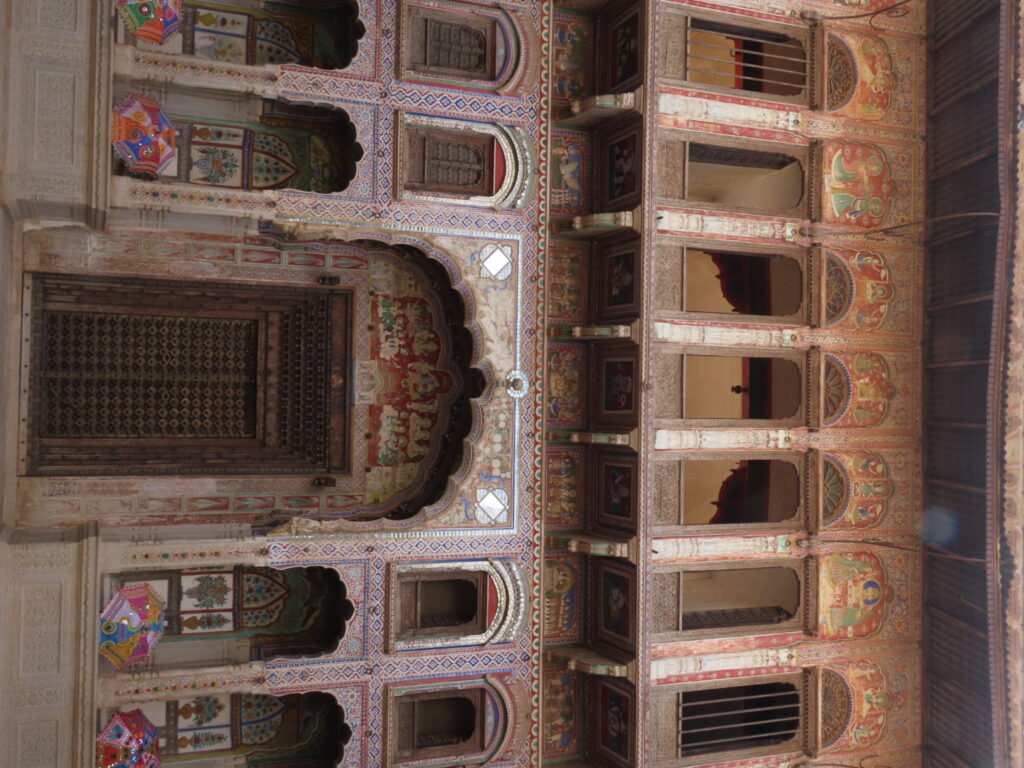
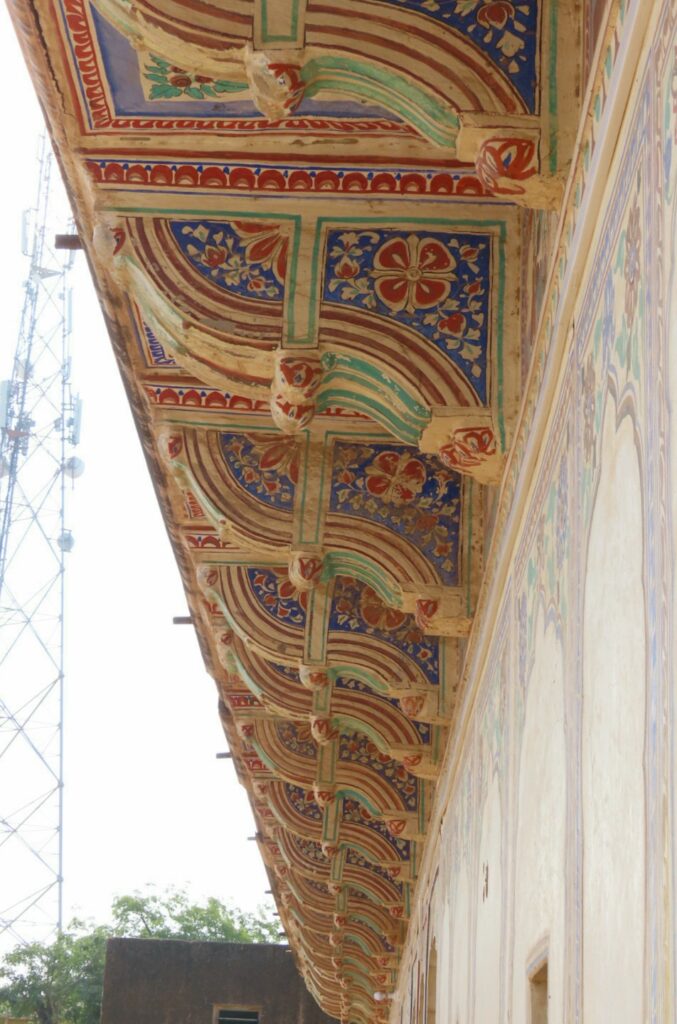
The havelis have a set template when it comes to architectural style with generally two courtyards and two storey’s. Massive arched doors make impressive entrances. The intricate woodwork of the doors and windows makes them a collector’s item. But it’s the frescoes adorning every inch of the building at times which are the piece de résistance. These encapsulate mythological and historical figures and tales, folk tales, flora and fauna, decorative designs, erotica and not the least the Britishers and their devices. Some depict faraway lands, few fanciful scenes, and occasionally plain hilarious ones. Gold leaf and Belgian glass is often a glittering embellishment. The richness of material and descriptive details were meant to shock and awe and they do, still!

Read about nature’s shockers in- Barot  And the Serendipitous Catch in the Uhl River

Awe inspiring art

Once on a visit to the National Gallery of Modern Art in Delhi we were told it is nigh possible to see everything in it in a day. Shekhawati’s treasures too are scattered over numerous little towns and hamlets all vying for unhurried and close attention from discerning travelers to truly reveal their hidden facets. So what not to miss on a visit to a region which is a living art gallery where exceptional architecture provides a canvas for many a masterpiece?

A canvas to compliment an art.

We’ll begin with Mandawa…coming up next.

Bikaner’s Chattris: Royals in Repose

If one wants to meet our dearly departed where do we go? In our culture, no particular place it would seem, but there have never been any absolutes. So we find cenotaphs or chattris in many parts of the country, especially of the royal families, built to honour the memory of the nobles. The first cenotaphs I explored were at Orchha. Like breathing gargoyles endangered vultures sat on the eaves of the humongous monuments made in the typically Bundelkandi architecture, rose bushes faintly scenting the air. There also a few generations give each other company in their walled enclosure.

Read about the Chattris of Orchha in- Part One- On the Wild Side of Outstanding Orchha


The sun sets on everyone.

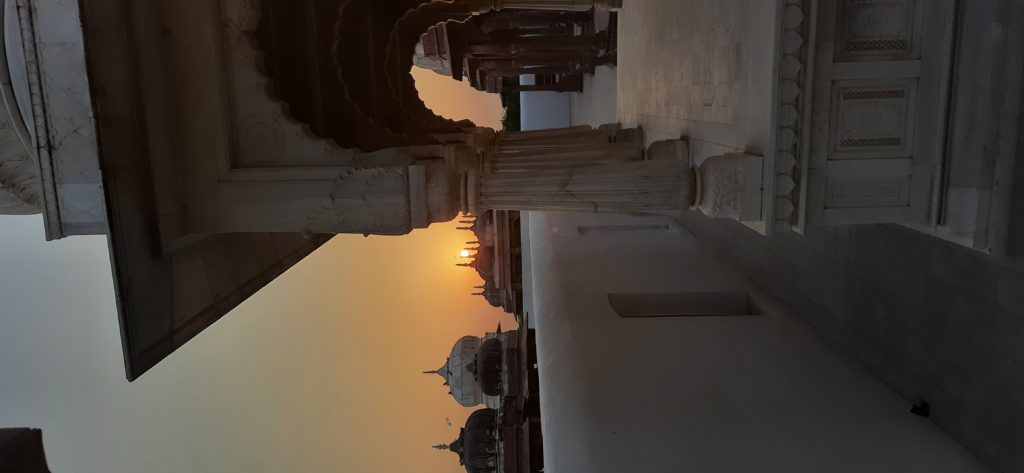
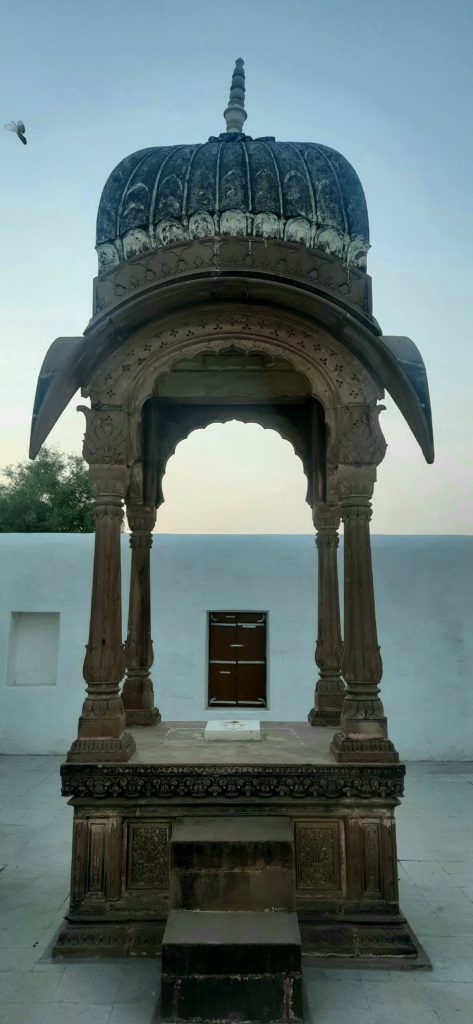
At Bikaner the cenotaphs of the royal family are located at Devi Kund Sagar. Here too on the outskirts of Bikaner the chattris are clustered around in a walled space. But unlike the handful at Orchha, here generations of men, women and children are neatly placed, precisely dated and relations clearly catalogued like a family tree  spread in a garden.  A requiem in stone. We head there one evening with the sun descending, ready to call it a day. The place is clean and paved thankfully since we have to take off our footwear at the entrance.

Discover – The Gardens of Delhi – A walk not only on the green side but through history itself

A place for ever after.

There is some open space as we enter and to a side a small one is being constructed. I wonder how it works …are they made in anticipation according to the wishes of the alive for their ever after resting place or is it left to the whims of the descendants how best to honour the memories? The first one on the right, also the last to be made in 2003 of Maharaja Narendra Singh, is a small chattri in red sandstone, a throwback to the oldest ones at the far end. Two across it are incongruously ‘modern’ and look out of place. They invoke a socialism influenced spartan look somehow in my mind.

There is nothing spartan about- Bikaner’s Merchants and Their Mansions

Astounding art

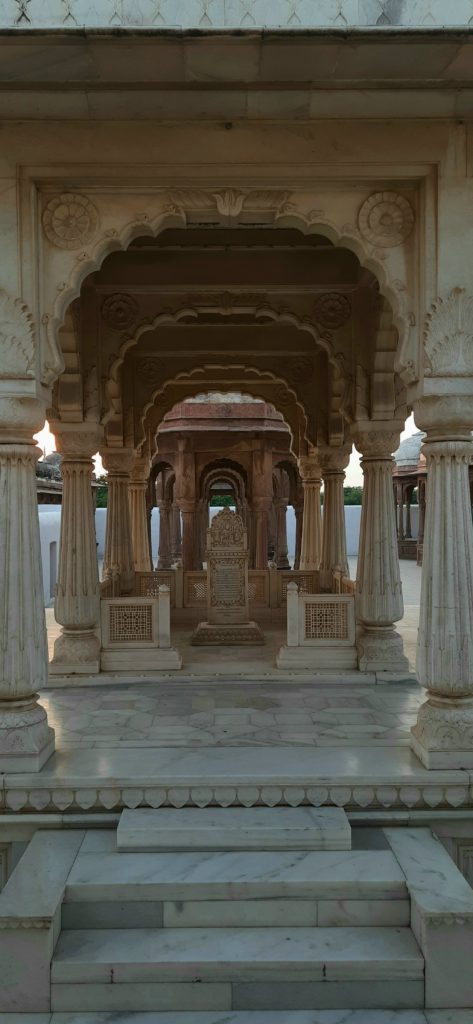
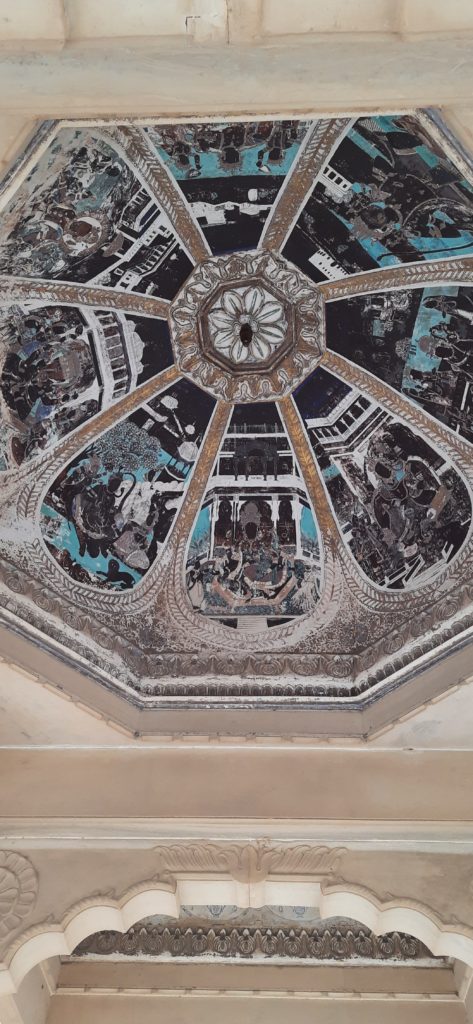
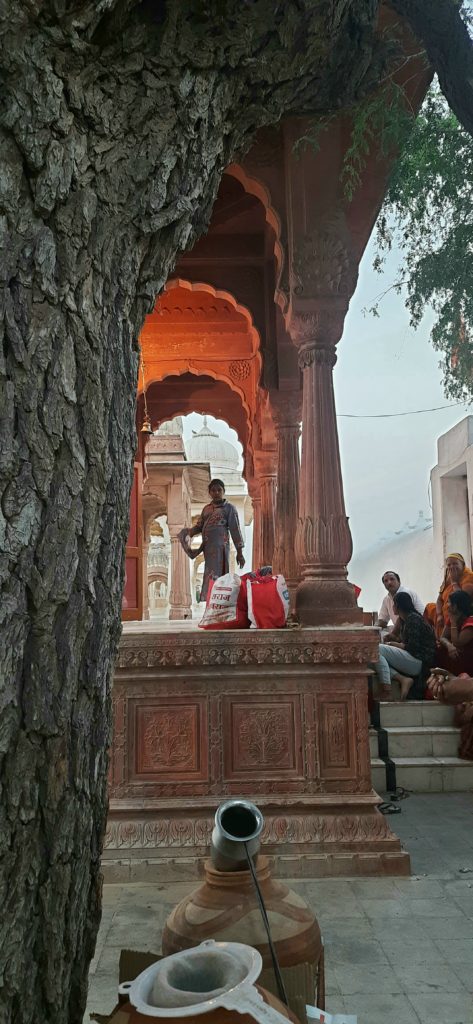
Majority of the big ones in between are of creamy marble with beautifully carved pillars and arches. Some of the domed roofs have stunning artwork on the inside. One follows a limited but eclectic black and blue colour scheme to depict gods and goddess. Another has Radha Krishna in a circular sequence.  At the far end they are mostly made of red and pink sandstone with high and beautifully carved floral plinths. The oldest belongs to Rao Kalyanmal, the 5th ruler of Bikaner who died in 1571.

Explore the hues of Rajasthan in-  Harlequin Holi at Todaraisingh

Small yet striking!

A small one between the big marble and sandstone chattris stands out not only because it belongs to a woman (the board along the wall says Madan Kunwar, 1826) as denoted by the small feet engraved on the marble piece but also because of its distinctive architecture. The eaves curve and sweep down like boughs of a weeping willow.

A man rides into his afterlife with his women.

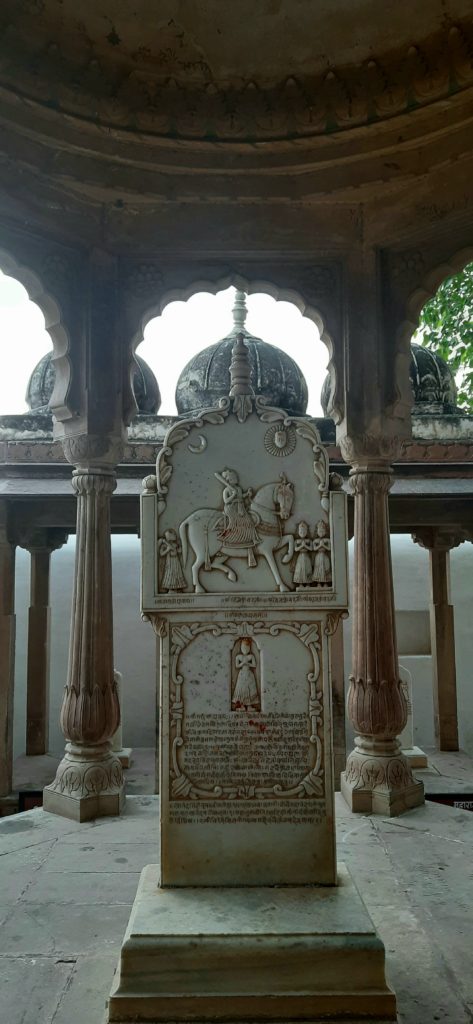
Someone explains the exact iconography in the chattris. The ones belonging to the menfolk have vertical slabs whose edges are beautifully scalloped and carved, engraved with either a man seated with a woman on a throne or alone on a horse, attendants around. Below within a wreath of carved and twisted leaves things are inscribed.  . The ones on horseback we are told denote whose wives committed sati on their death. From the first ruler, Rao Bikaji to the thirteenth king, Maharaja Zorawar not only wives but concubines and at times attendants and slave girls too were expected to commit sati. No wonder women pray for their husband’s long life! There is a temple near the end dedicated to Satimata. It is has a lot of visitors. The barbaric practice might have ended but the idea still is romanticized and worshipped.

Where a woman is literally worshipped – Mystic Maheshwar : At the Center of the Universe

Aglow always.

On one end are the chattris of the women in red sandstone. They are smaller and many are devoid of the ornamentation visible in the men’s. Most have a single pair of tiny feet made on a marble piece, boards alongside clearly mentioning their names and that of their husbands. One near the end has four pairs of feet. The board gives three names of women and one of a man. There are 4 different dates mentioned so I don’t think they are satis or a sato, a rare but recorded occurrence where men commit the act too. The family has had a few instances of them. There are memorials of children too called nada. It’s a simple plinth with no canopy.

Reviving past glories and – Satiating Nostalgia Under the Winter Rain at Junia

Reflecting on a life that was….

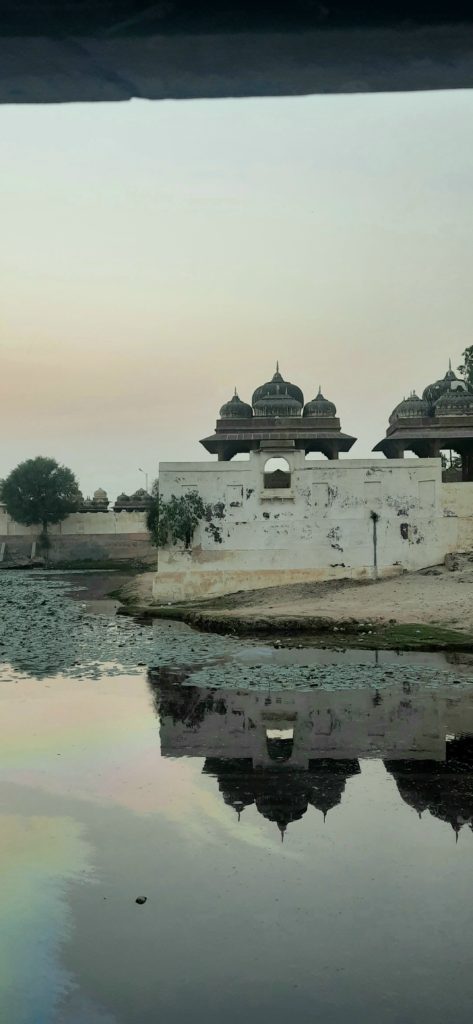
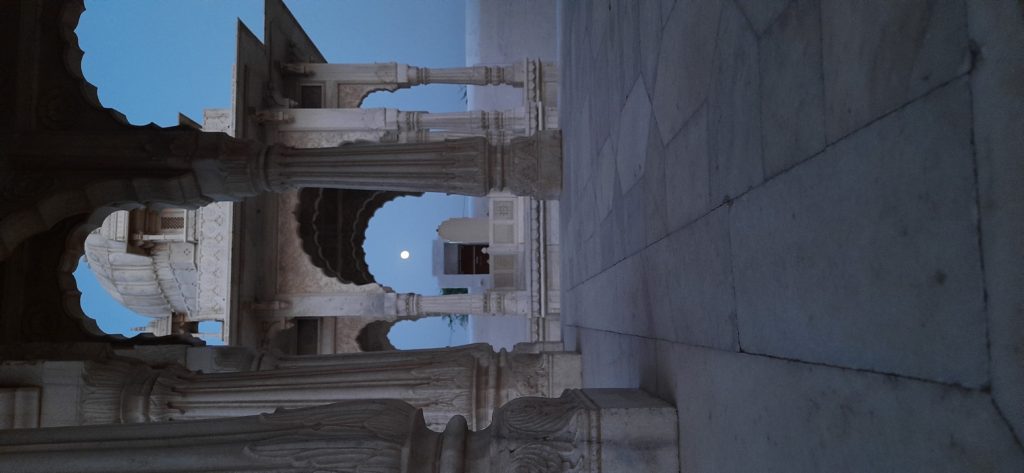
The sun is a ball of blazing orange visible below the arches as curiosity gets the better of me and I unlatch one of the many small wooden doors lined up on the wall, one before each cenotaph. They all open to a sloping ground with broken tombstones, littered with a bit of rubbish ending with an embankment holding back a big pond lined with lotuses. A glossy black cobra slithers amongst the tombstones. As it disappears behind one nearby I hurriedly step back through the door. Latching the door I turn to see the moon has risen and its almost a full moon bathing the monuments in its luminescent light. It is going to be a beautiful night for a family get together.

Moonlit meeting.